
I have a deep appreciation for traditional Japanese-style tattoos. When a master artist is designing a complex piece—like a detailed snake winding its way through a bed of peonies and dark waves—the visual design is only half of the equation.
The true mastery lies in the physical application of the ink.
The artist has to control the exact depth of the needle as it enters the skin. If the needle is too shallow, the ink won’t hold. The beautiful, bold black lines of the snake will look weak, grey, and eventually fade into nothing. But if the artist pushes the needle too deep, it causes unnecessary trauma. The lines will “blow out,” spreading under the skin, and the result will be a harsh, scarred, blurry mess.
You need the exact right amount of penetration to create a masterpiece.
A few years ago, as I was staring at a horribly bitter cup of pour-over coffee in my kitchen, I realized that brewing coffee relies on the exact same physical principle.
But instead of a needle, your tool of penetration is heat.
For years, I had been completely ignoring the temperature of my water. I treated boiling water as a simple, binary utility. It was either hot, or it wasn’t. I didn’t realize that the temperature of the water is the physical force that dictates how deep you penetrate the cellular structure of the coffee bean.
I was essentially scarring my coffee every single morning.
Here is the honest, highly scientific, and deeply transformative story of how water temperature changed my coffee completely, the thermal mistakes I was making, and how learning to control the heat finally allowed me to brew a flawless, perfectly extracted mug.
The Myth of the Screaming Kettle
My original brewing routine was aggressively loud and entirely lacking in nuance.
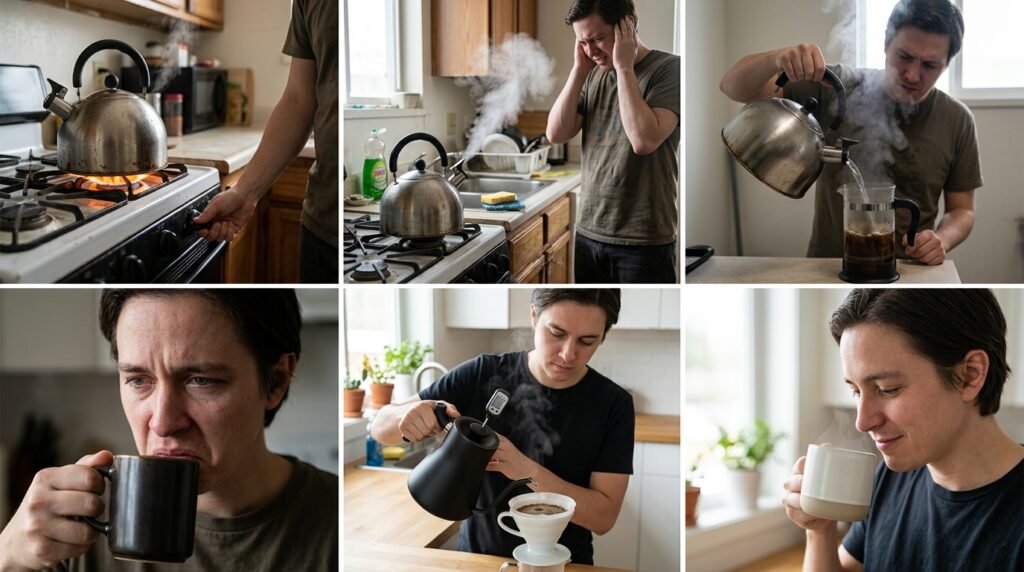
Every morning, I would fill a massive, heavy stainless steel tea kettle with tap water and throw it onto my gas stove. I would turn the burner dial all the way up to maximum heat and walk away to brush my teeth.
Eventually, the kettle would start to whistle. But I wouldn’t take it off the heat immediately. I would let it sit there until the whistle turned into a violent, high-pitched scream.
I wanted that water as dangerously hot as physically possible.
I would grab the kettle, march over to my French Press or my plastic drip cone, and dump the rolling, aggressively boiling water directly onto the dry coffee grounds. The coffee would violently hiss and spit. A thick cloud of dark steam would rise into the air, carrying a smell that I can only describe as burnt toast and sharp ash.
I thought this was just the normal smell of “strong” coffee.
When I finally poured the liquid into my mug and took a sip, it was always a punishing experience. The coffee was relentlessly bitter, leaving a harsh, dry, metallic feeling on the roof of my mouth.
I thought that was just the price you paid for waking up. I assumed coffee was inherently harsh.
The Chemistry of the Solvent
To understand why my screaming kettle was destroying my mornings, I had to stop thinking about water as a mere ingredient and start treating it as a chemical solvent.
When you roast a coffee bean, you are creating hundreds of complex, delicate flavor compounds. There are bright, fruity organic acids. There are heavy, sweet, caramelized sugars. And finally, hiding deep within the cellular walls of the bean, there are harsh, bitter tannins and plant fibers.
When you introduce hot water to these grounds, the water’s job is to dissolve those compounds and pull them into your mug.
But it doesn’t pull them all out at the same time. Extraction happens in a very specific, sequential order.
First, the water dissolves the fast-moving fruit acids and floral notes. Next, it dissolves the heavy, comforting sugars and caramelized fats. Finally, if the water stays in contact with the beans for too long, or if the water is too aggressive, it starts dissolving the bitter tannins and harsh wood fibers.
The kinetic energy of your water—the heat—dictates how violently this extraction happens.
The Danger of Liquid Fire (212°F / 100°C)
When water reaches a rolling boil (212°F or 100°C at sea level), the molecules are moving with maximum kinetic energy. It is chaotic, violent, and highly destructive.
When I was dumping rolling boiling water directly onto my coffee grounds, I was essentially hitting them with a thermal sledgehammer.
The extreme heat was instantly vaporizing the delicate, volatile floral and fruit aromatics, completely sending them up into the air rather than into my cup. Worse, the violent energy of the boiling water was penetrating way too deep into the cellular structure of the bean.
It completely bypassed the sweet sugars and immediately started ripping out the harsh, bitter tannins from the core of the seed.
I wasn’t brewing coffee; I was incinerating it. Understanding this thermal ceiling was a massive part of (Why My Coffee Tasted Bitter (And How I Fixed It)), because I finally realized that my heat source was literally scarring the delicate oils of my expensive specialty beans.
The Overcorrection and the Sour Ghost
When I finally learned that boiling water was burning my coffee, I did what any frustrated beginner does: I panicked and completely overcorrected.
I read on an old coffee forum that “gentle” heat was the secret to a smooth cup. So, the next morning, I boiled my kettle, turned off the stove, and let the water sit there for a full ten minutes before I poured it over my coffee.
The water had likely dropped to around 175°F (80°C). It was barely steaming.
When I poured this lukewarm water over my V60 pour-over cone, the coffee didn’t bubble. It didn’t bloom. The water just lazily pooled on top of the grounds, looking like a sad, brown puddle.
When I took a sip of that coffee, my jaw physically clenched.
It was unbelievably sour. It tasted like biting into a raw, unripe green apple mixed with weak, watery tea. It completely lacked the heavy, comforting chocolate notes I was craving.
Because the water was too cold, it lacked the kinetic energy required to penetrate the bean. Like a tattoo needle that barely scratches the surface of the skin, the cool water only managed to wash away the fast-dissolving surface acids. It was too weak to reach the deep, heavy sugars that balance out the cup.
Finding the absolute balance between these two extreme failures is exactly (How I Learned to Control Coffee Strength). I realized that strength and flavor aren’t just about how much coffee you use; they are entirely dependent on giving the water the precise amount of energy it needs to do its job.
The Golden Window (195°F to 205°F)
I was exhausted by the extremes. I didn’t want burnt ash, and I didn’t want sour lemon water. I needed to find the golden window.
In the specialty coffee industry, the universally accepted ideal temperature range for brewing coffee is between 195°F and 205°F (90°C to 96°C).
This ten-degree window provides the exact perfect amount of kinetic energy. It is hot enough to penetrate the cellular walls of the bean and dissolve the heavy, sweet sugars, but it is just cool enough to leave the harsh, bitter tannins locked safely inside the plant fibers.
I didn’t want to buy an expensive, digital temperature-controlled kettle right away. I wanted a practical, everyday solution.
I discovered the “Off-Boil” method.
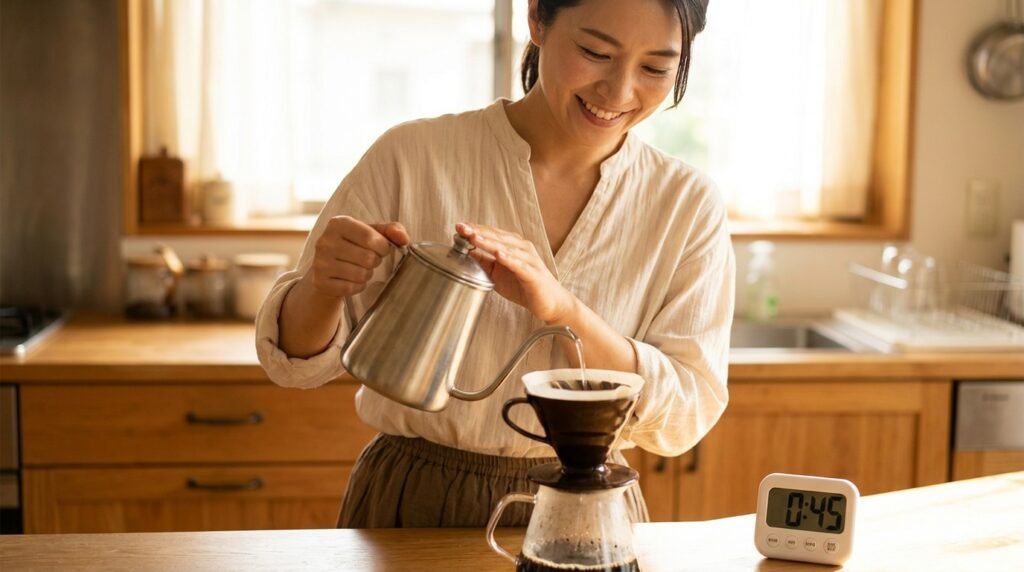
It is incredibly simple. I take my kettle and let it reach a full, rolling boil on the stove. But instead of pouring it immediately, I take it off the heat, set it on a cold burner, and start a timer for exactly forty-five seconds.
During those forty-five seconds, the violent, chaotic bubbling stops. The water settles. The extreme heat naturally dissipates into the air, dropping the temperature right down into the perfect 200°F sweet spot.
Advanced Thermal Dynamics: Adjusting for the Roast
Using the forty-five-second “Off-Boil” trick completely fixed my morning coffee. The bitterness vanished, the sourness disappeared, and I was left with a beautifully sweet, balanced mug.
But as my palate evolved, and I started buying different types of single-origin coffees, I realized that the golden window is not a rigid law. It is a sliding scale.
I had to learn how to adjust my water temperature based on the specific roast level of the beans I was buying.
When a coffee roaster creates a Dark Roast (like a traditional French or Italian roast), they leave the beans in the roasting machine for a very long time. The extreme heat of the roaster physically breaks down the cellular structure of the bean. The bean becomes highly porous, puffy, and brittle.
Because a dark roast is so fragile and porous, it is incredibly easy for water to extract flavor from it. If you hit a dark roast with 205°F water, it will instantly over-extract and taste like burnt rubber.
For dark roasts, you actually want to drop your temperature significantly. You want to aim for the lower end of the window—around 190°F to 195°F. I achieve this by waiting a full two minutes off-boil before pouring.
On the other hand, when a roaster creates a Light Roast (like a high-altitude Ethiopian or Kenyan specialty coffee), the bean is pulled out of the roaster very early. The cellular structure remains tightly packed, incredibly dense, and rock-hard.
Because a light roast is so stubborn and dense, you need maximum kinetic energy to force the sugars out. If you use cool water on a light roast, it will taste incredibly sour.
For light roasts, you want to aim for the absolute top of the golden window—around 205°F to 208°F. I achieve this by pouring the water almost immediately, waiting only ten seconds after the kettle stops screaming.
Mastering this sliding scale of thermal dynamics based entirely on the visual color of the bean is precisely (What I Wish I Knew About Coffee Brewing Earlier). It took me from being a blind recipe follower to an intuitive, reactive home brewer.
The Proof in the Cup
I will never forget the morning I successfully applied all of this thermal knowledge to a brand new bag of coffee.
I had purchased a beautiful, lightly roasted washed Colombian coffee from the Huila region. Because I knew it was a dense light roast, I boiled my kettle, waited just fifteen seconds, and poured the steaming (but not aggressively boiling) water over the grounds in my V60 cone.
The aroma that rose from the wet coffee bed was not the smell of burnt toast. It smelled like warm caramel and sweet red cherries.
When I finished the pour and poured the ruby-red liquid into my mug, I let it cool to a comfortable drinking temperature.
I took a sip.
It was a completely flawless extraction. There was no harsh bite at the back of my throat. There was no sour, mouth-puckering acidity.
Instead, the coffee coated my palate with a rich, heavy, velvety sweetness. I could vividly taste notes of milk chocolate, toasted almonds, and a brilliant, crisp finish that tasted exactly like biting into a sweet, ripe apple.
It was the first time I had ever tasted a coffee that felt completely and utterly smooth.
Respect the Thermometer
We spend so much time obsessing over the brand of our coffee machine, the origin of our beans, and the size of our coffee grounds.
But if you ignore the temperature of your water, you are driving a luxury sports car with flat tires. The engine doesn’t matter if the physical connection to the road is broken.
Water temperature is the ultimate invisible variable. It is the physical force that dictates exactly what flavors will end up in your mug and what flavors will remain locked inside the filter.
If your coffee constantly tastes like bitter ash, stop attacking your beans with liquid fire. Let your kettle rest. Let the chaos subside.
If your coffee constantly tastes like sour lemon water, stop babying your beans. Turn up the heat and give the water the energy it needs to penetrate the dense cellular walls.
When you finally stop treating heat as a binary switch and start treating it as a precision instrument, you will unlock a level of sweetness and clarity in your coffee that you never thought was possible. You will stop scarring the canvas, and you will finally start brewing a masterpiece.

My name is Daniel Carter, I am 35 years old, and I live in the United States. I have been passionate about aquariums for many years, and what started as a simple hobby quickly became a lifelong interest in aquatic life, fish behavior, and responsible tank care.
Through TheBrightLance, I share real experiences, practical knowledge, and honest lessons learned from maintaining different types of aquariums. I enjoy testing equipment, studying fish behavior, improving maintenance routines, and helping beginners avoid common mistakes.
My goal is to make aquarism easier, more ethical, and more enjoyable for everyone — whether you are setting up your very first tank or looking to refine your techniques.