
I spend a considerable amount of my time working in digital photo editing. A while ago, I was tackling a particularly tricky, detailed project where I had to completely replace a specific soccer jersey on a person in a photograph.
If you have ever tried to do advanced image composition, you know that you cannot just copy and paste a new piece of clothing onto a subject and call it a day. If you fail to meticulously adjust the shadows, match the ambient lighting, and soften the edges, the new jersey looks violently artificial. It creates a harsh, jagged contrast that completely destroys the harmony of the entire image. Your eyes are instantly drawn to the ugly, clashing mistake, ruining the illusion entirely.
For the first decade of my coffee-drinking life, my morning mug suffered from that exact same harsh, clashing imbalance.
It wasn’t smooth. It didn’t have harmony. It was aggressively, unapologetically bitter.
Every time I took a sip, it felt like my tongue was being scrubbed with dry sandpaper. The dark liquid left a harsh, ashy, metallic taste in the back of my throat that lingered for hours. I used to drown my coffee in heavy cream and massive spoonfuls of sugar just to mask the aggressive, punishing bite.
I honestly thought that was just the way coffee was supposed to taste. I thought “bitter” was just a culinary synonym for “strong.”
It wasn’t until I started diving deep into the actual science of manual extraction that I realized I was completely wrong. High-quality coffee is not inherently bitter. I was just making a series of violent, clumsy mistakes in my kitchen that were actively ruining the natural harmony of the beans.
Here is the honest, step-by-step story of why my coffee always tasted bitter, the underlying chemistry of over-extraction, and the precise mechanical changes I made to finally fix it and brew a flawlessly balanced cup.
The Vocabulary of Failure
Before I could fix the bitterness in my mug, I had to understand what bitterness actually was.
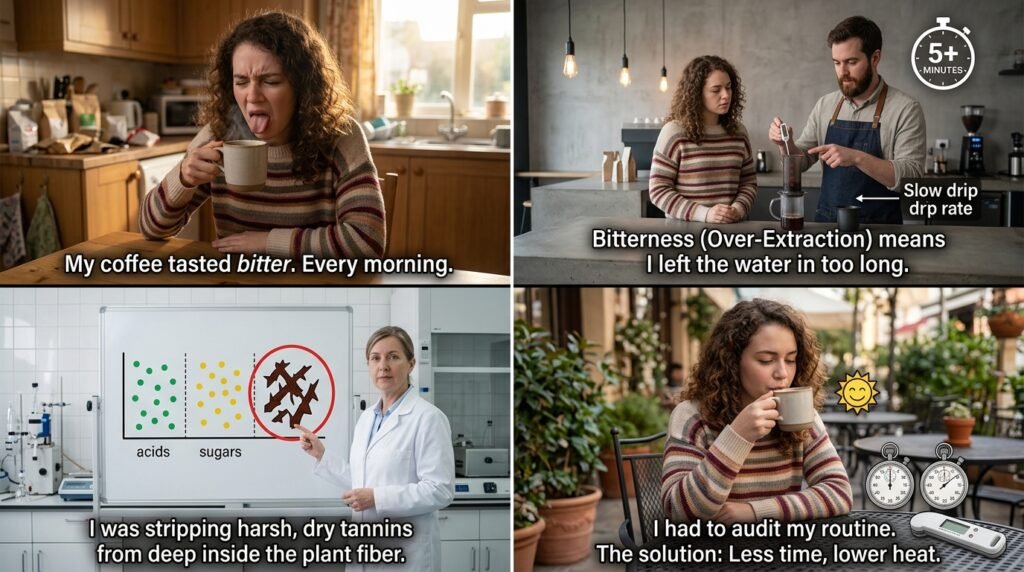
In the specialty coffee world, there are two primary ways to ruin a cup of coffee: you can make it sour, or you can make it bitter. Beginners often confuse the two, but chemically and physically, they are exact opposites.
If your coffee tastes sour, like biting into a raw, green lemon, you have “under-extracted” the beans. The water didn’t pull enough flavor out of the coffee grounds.
If your coffee tastes bitter, like chewing on a dry aspirin or sucking on a piece of burnt wood, you have “over-extracted” the beans.
Coffee extraction happens in a very specific sequence. When hot water hits coffee grounds, the very first things to dissolve are the bright, fruity acids. The next things to dissolve are the heavy, sweet, caramelized sugars.
But if you leave the water in contact with the coffee for too long, or if you apply too much kinetic energy, the water eventually runs out of good things to extract. It starts violently pulling out the harsh, dry, astringent plant fibers and tannins hidden deep inside the cellular walls of the seed.
My coffee tasted bitter because I was constantly over-extracting my beans. I was pulling out the harsh tannins every single morning. I had to audit my routine to figure out exactly why my extraction was going too far.
Culprit 1: The Microscopic Mud
The very first place I looked was my coffee grinder.
For a long time, I assumed that a finer grind was always better. I thought that grinding the coffee into a fine, powdery dust would automatically give me a stronger, richer cup of coffee.
I would crank my hand grinder all the way down and produce grounds that looked exactly like baking flour.
This was an absolute disaster for my extraction.
When you grind coffee too fine, you exponentially increase the surface area of the beans. Because there is so much surface area exposed, the hot water dissolves the flavors incredibly fast.
But more importantly, fine coffee powder acts like wet cement.
If you are using a pour-over method like a V60, the microscopic coffee dust completely clogs the pores of the paper filter. The water gets trapped. Instead of flowing through the coffee bed in a standard three minutes, the water stalls. It sits there, soaking the coffee grounds for five or six agonizing minutes.
Because the water is trapped, it just keeps extracting, extracting, and extracting until it pulls every last drop of bitter tannin out of the pulverized beans.
Realizing that water flow dictates flavor was the core lesson of (How Grind Size Affected My Coffee More Than I Expected).
The Fix: I immediately adjusted my grinder to a coarser setting. I aimed for a texture that felt like standard table sand, rather than fine flour. By making the coffee grounds slightly larger, the water could flow freely through the bed without choking the filter. The extraction finished in a healthy three minutes, completely leaving the bitter tannins behind in the grounds.
Culprit 2: The Sledgehammer of Heat
My second massive mistake was happening right on my stove.
I was using a heavy stainless steel kettle, and I firmly believed that coffee required aggressively boiling water. I would wait until the kettle was screaming, pull it off the burner, and immediately dump the rolling, violently bubbling water directly onto my coffee grounds.
I didn’t realize I was physically scorching the delicate oils inside the beans.
Water at a rolling boil (212°F or 100°C) contains maximum kinetic energy. It is an incredibly aggressive solvent. When you hit coffee grounds with water that hot, the heat instantly vaporizes the delicate, volatile floral and fruit aromatics, sending them into the air instead of your cup.
Simultaneously, that extreme energy aggressively punches deep into the cellular walls of the bean, rapidly dissolving the harsh, bitter plant fibers before the sweet sugars even have a chance to balance the cup out.
Understanding the destructive power of this thermal sledgehammer was precisely (How Water Temperature Changed My Coffee Completely). I was using liquid fire to brew my morning beverage.
The Fix: I learned to respect the golden window of brewing temperature, which sits between 195°F and 205°F (90°C to 96°C). I still bring my kettle to a boil, but now, I pull it off the heat and let it sit with the lid off for exactly forty-five seconds. This simple pause allows the aggressive heat to dissipate. When I finally pour the water, it has the perfect amount of energy to melt the sweet sugars without burning the oils.

Culprit 3: The Dark Roast Illusion
As I fixed my grind size and my water temperature, the coffee improved significantly, but a lingering, ashy bitterness still haunted the back of my palate.
I realized I had to look past my equipment and examine the raw ingredient itself.
For years, I bought the darkest roasts I could find at the supermarket. The beans were pitch black, incredibly oily on the surface, and smelled like burnt toast. I thought “French Roast” or “Espresso Roast” meant the coffee was premium and strong.
I was completely wrong.
During the commercial roasting process, coffee beans undergo massive chemical changes. If a roaster leaves the beans in the massive steel drum for too long, the natural sugars inside the bean physically ignite and burn away into pure carbon.
When you buy a shiny, black, oily coffee bean, you are not tasting the origin of the coffee. You are not tasting the soil, the altitude, or the fruit. You are only tasting the roasting machine. You are tasting burnt carbon.
And carbon will always, undeniably, taste bitter. No amount of perfect grinding or temperature control can save a bean that has been burned to a crisp before it even reached your kitchen.
Accepting that my supermarket beans were inherently flawed was the exact reason (Why I Stopped Buying Cheap Coffee and Never Looked Back).
The Fix: I completely stopped buying dark, oily beans. I started buying light and medium roasts from reputable specialty coffee roasters. The beans are a beautiful, matte, pale brown color. Because they haven’t been burned to a crisp, they still retain their natural fruit acids and complex, caramel sweetness. The harsh, ashy bitterness was instantly eliminated from my life.
Culprit 4: The Agitation Error
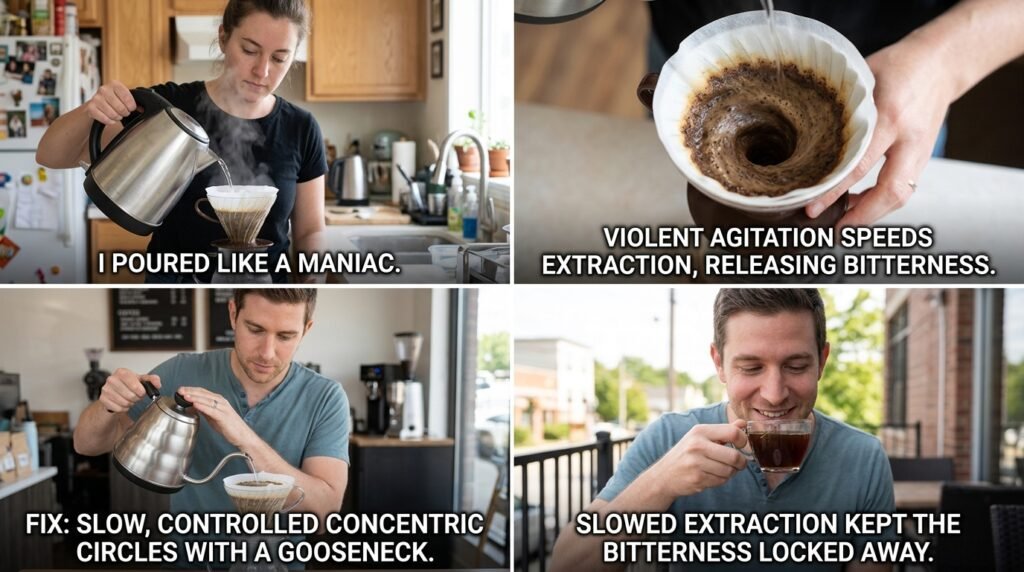
There was one more subtle technique error that was pushing my coffee into the bitter zone: I was pouring my water like a maniac.
I used to grab my kettle and aggressively dump the water directly into the center of my pour-over cone. I would swirl the brewer violently, trying to make sure all the grounds were spinning.
I didn’t know that physical agitation increases extraction speed.
When you aggressively swirl, stir, or pour heavy streams of water into your coffee bed, you are dramatically increasing the rate at which the water dissolves the coffee compounds. If you agitate the coffee too much, you force the water to extract those bitter tannins prematurely.
The Fix: I bought a gooseneck kettle. The thin, precise spout naturally restricts the flow of water. I learned to pour incredibly slowly, drawing gentle, controlled concentric circles over the coffee bed. I stopped swirling the brewer aggressively. By treating the coffee bed gently, I slowed down the extraction rate, keeping the bitter compounds locked safely away.
Culprit 5: The Invisible Residue
The final source of bitterness in my coffee had absolutely nothing to do with my technique or my beans. It was an embarrassing hygiene issue.
Coffee beans are packed with natural, aromatic oils. Whenever you grind coffee or brew a cup, those heavy oils coat the inside of your grinder, the inside of your French Press, and the inside of your thermal carafe.
If you just rinse your equipment with hot water, those oils do not wash away. They stick to the metal and the glass like glue. Over the course of a few weeks, those leftover oils physically go rancid.
When you brew fresh coffee in dirty equipment, the hot water immediately melts those rancid, stale oils from last week and mixes them directly into your fresh beverage.
Rancid coffee oil tastes incredibly sharp, metallic, and aggressively bitter.
The Fix: I started treating my coffee equipment like actual cookware. Once a week, I disassemble my grinder and brush out the old grounds. I soak my French Press mesh filters in a specialized coffee detergent designed to break down heavy oils. I scrub my thermal carafe with soap and hot water. Brewing fresh coffee in pristinely clean equipment made an immediate, shocking difference in the sweetness of my cup.
Editing the Final Image
When I finally managed to combine all of these fixes—when I ground the coffee slightly coarser, used cooler water, bought a lighter roast, poured gently, and cleaned my equipment—the result was breathtaking.
The harsh, clashing, jagged edges of my morning beverage were completely gone.
Just like successfully blending the shadows and highlights to make that digitally edited soccer jersey look perfectly natural and real, adjusting my brewing variables finally brought harmony to my mug.
The coffee was incredibly sweet, rich, and vibrant. It tasted like caramel, toasted nuts, and fresh berries. I didn’t need to add a single drop of milk or a single grain of sugar to mask the flavor, because there was nothing left to mask.
If you are currently struggling with bitter, harsh, unpalatable coffee every morning, I promise you that you do not have to accept it. Coffee is not supposed to taste like burnt ash.
Your coffee is bitter because you are extracting too much. You are pushing the image too far.
Back off the heat. Loosen up your grinder. Stop buying burnt, oily beans. When you learn to pull back on the variables and respect the delicate chemistry of the extraction, the bitterness will vanish, and you will finally discover the smooth, sweet masterpiece hiding right inside your kitchen.

My name is Daniel Carter, I am 35 years old, and I live in the United States. I have been passionate about aquariums for many years, and what started as a simple hobby quickly became a lifelong interest in aquatic life, fish behavior, and responsible tank care.
Through TheBrightLance, I share real experiences, practical knowledge, and honest lessons learned from maintaining different types of aquariums. I enjoy testing equipment, studying fish behavior, improving maintenance routines, and helping beginners avoid common mistakes.
My goal is to make aquarism easier, more ethical, and more enjoyable for everyone — whether you are setting up your very first tank or looking to refine your techniques.