
If you have ever used a professional DSLR camera with a high-end manual lens, you know the absolute anxiety and thrill of the focus ring.
When you look through the viewfinder, you might have the perfect subject. The lighting might be breathtaking, hitting the scene at the exact right angle during the golden hour. The framing might be a compositional masterpiece.
But if your manual focus ring is twisted just one millimeter in the wrong direction, the entire image is useless. The subject becomes a soft, blurry, unrecognizable smudge. All of that perfect lighting and brilliant composition is completely wasted because the lens couldn’t resolve the details.
For a very long time, I was treating my morning coffee like a photographer shooting with a blurry lens.
I was doing almost everything else right. I was buying expensive, highly-rated specialty coffee beans. I had finally invested in a digital scale to measure my water-to-coffee ratio. I had a precise gooseneck kettle, and I was making sure my water temperature wasn’t aggressively burning the beans.
But despite all of this perfect “lighting and framing,” my coffee still tasted like a blurry smudge. It was either aggressively sour, harshly bitter, or just completely hollow.
I was missing the focus ring. I didn’t realize that the physical size of the coffee grounds was the ultimate gatekeeper of flavor. Here is the honest, highly technical story of how grind size affected my coffee more than I ever expected, the invisible physics of surface area, and how one tiny “click” completely brought my morning routine into absolute, high-definition clarity.
The Myth of “Ground Coffee”
My ignorance started with a very common, fundamental misunderstanding of what coffee actually is.
Before I got deep into the specialty coffee world, I thought “ground coffee” was a universal constant. I assumed that once a bean was pulverized into smaller pieces, the job was done. It didn’t matter if those pieces were the size of coarse sea salt or the size of powdered sugar. I thought hot water would magically extract the flavor regardless.
This assumption is a culinary disaster.
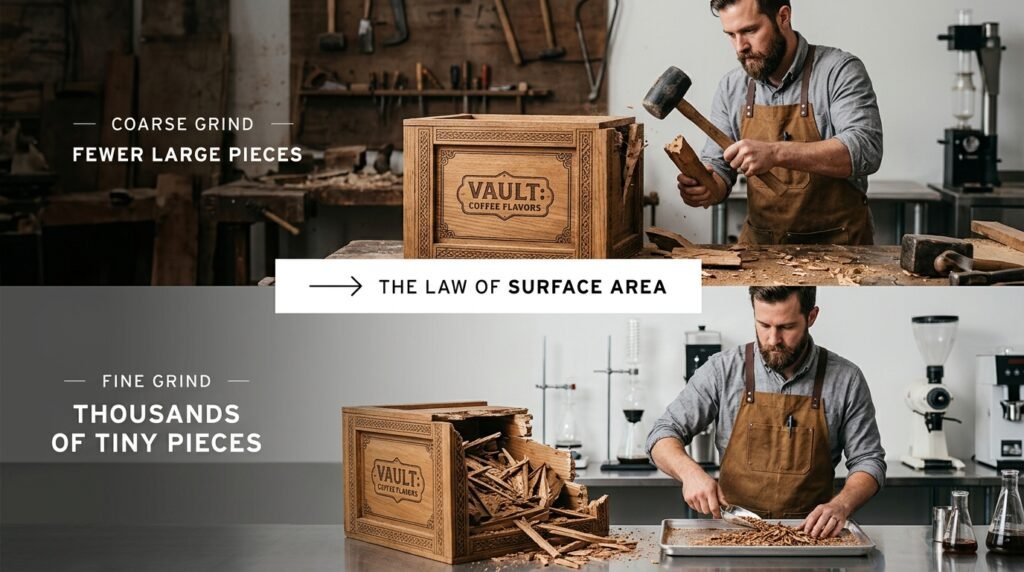
The roasted coffee bean is basically a tiny, wooden vault locked full of beautiful, water-soluble flavor compounds. You have delicate fruit acids, heavy caramelized sugars, and harsh, bitter plant tannins all trapped inside that dense cellular structure.
The hot water is the bank robber trying to get inside the vault.
If you just drop a whole, unground coffee bean into a mug of hot water, absolutely nothing happens. The water cannot penetrate the hard exterior shell. To help the water get inside, we use a grinder to smash the vault into pieces.
But how many pieces you smash it into changes the entire dynamic of the robbery. This is the law of surface area.
The Law of Surface Area
If you take a coffee bean and chop it in half, the hot water now has access to the inside of the bean. But it still takes a long time for the water to dissolve the sugars.
If you take that same coffee bean and crush it into one thousand microscopic pieces, you have exponentially increased the surface area. The hot water now has immediate, rapid access to every single cellular wall of the bean simultaneously.
The smaller the particle, the faster the extraction. The larger the particle, the slower the extraction.
This invisible law of physics is the exact reason why (The Simple Brewing Mistakes I Used to Make Every Day) were completely destroying my expensive beans. I was using a cheap blade grinder that violently chopped the coffee into massive boulders and microscopic dust at the exact same time.
The water was rapidly over-extracting the dust, making it bitter, while simultaneously under-extracting the massive boulders, making them sour. I was drinking a chaotic, contradictory mess.
The “Sour” Experience (Grinding Too Coarse)
When I finally bought a high-quality manual burr grinder that produced perfectly uniform particles, I thought my problems were instantly solved.
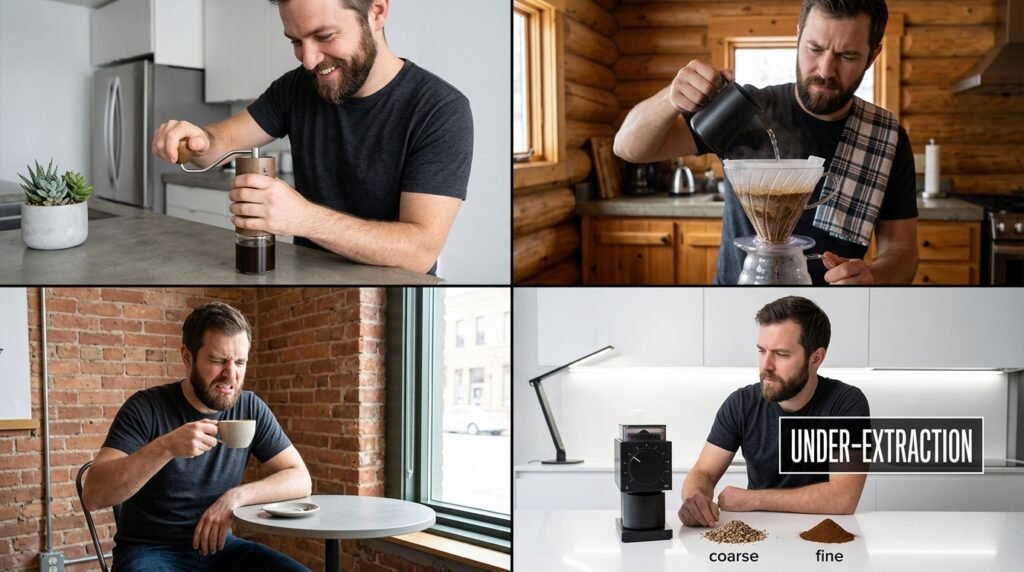
I set the dial to a nice, coarse setting. The grounds came out looking like beautiful, chunky gravel. I put them in my V60 pour-over cone and started pouring my hot water.
The water rushed through the plastic cone like it was falling through a drain. The entire brew, which was supposed to take three minutes, finished in under ninety seconds.
When I took a sip of the resulting liquid, my face physically contorted.
It was aggressively, punishingly sour. It tasted like I was drinking hot lemon juice mixed with weak, watery tea. It was so acidic that it made the sides of my jaw physically ache.
This is the classic hallmark of “Under-Extraction.”
Because the coffee grounds were too large (too coarse), the water flowed past them too quickly. The water only had time to dissolve the fastest-moving compounds on the very surface of the bean, which are the bright, fruity organic acids.
It did not have the time—or the surface area—to penetrate deeper into the coarse chunks to dissolve the heavy, sweet, caramelized sugars that balance out the acidity. The resulting cup was a massive, unbalanced punch of sour acid.
The “Bitter” Experience (Grinding Too Fine)
Determined to fix the sourness, I went back to my grinder. If coarse was bad, then fine must be good.
I twisted the dial all the way down. I cranked the handle, and the coffee came out looking like soft, powdery flour. It looked exactly like the pre-ground espresso you buy in a vacuum-sealed brick at the supermarket.
I dumped the powder into my V60 and poured the hot water.
This time, the water didn’t rush through. In fact, it didn’t move at all. The microscopic coffee dust immediately compacted into a dense, cement-like mud at the bottom of the paper filter. The water pooled on top, trapped.
It took almost six agonizing minutes for the water to slowly choke its way through the mud.
When I tasted the dark, murky liquid, my palate was assaulted by a completely different nightmare.
The sourness was gone, but it was replaced by a harsh, aggressive, astringent bitterness. It tasted like burnt wood, dry ash, and crushed aspirin. It physically dried out my mouth, leaving a terrible, lingering metallic finish on my tongue.
This is the absolute definition of “Over-Extraction.”
Because the particles were so microscopically tiny, the massive surface area allowed the water to extract everything almost instantly. The water dissolved the acids, it dissolved the sweet sugars, and then, because it was trapped in the filter for six minutes, it kept aggressively dissolving the harsh, bitter plant fibers and tannins hidden deep inside the bean’s structure.
Identifying this specific, dry, ashy taste was exactly (Why My Coffee Tasted Bitter (And How I Fixed It)), because it forced me to realize that “strong” coffee isn’t supposed to make you wince in pain.
The Sweet Spot: Dialing It In
I now understood the two extremes of the spectrum. Too coarse equals sour and weak. Too fine equals bitter and harsh.
My job as the brewer was to find the exact middle ground. I had to turn the focus ring until the image became perfectly sharp. In the specialty coffee world, this process is called “Dialing In.”
The next morning, I set the grinder right in the middle. I aimed for a texture that felt like standard table sand.
I poured the water over my V60. The flow rate was beautiful. It wasn’t rushing like a waterfall, and it wasn’t choking like wet cement. It drained at a steady, rhythmic pace, finishing right around the three-minute mark.
I took a sip, and my eyes widened.
It was an absolute masterpiece. The aggressive, jaw-aching sourness was completely gone, replaced by a vibrant, sparkling fruit acidity. The harsh, burnt bitterness was nowhere to be found, leaving behind a massive wave of heavy, sweet caramel and milk chocolate.
The coffee was perfectly balanced. The focus was razor-sharp.
Discovering the profound power of this simple mechanical adjustment is precisely (What I Changed to Improve My Coffee Instantly), because I finally stopped blaming the roaster and started taking responsibility for the extraction.
The “One Click” Revelation
But the real shock—the moment that truly proved how much grind size affected my coffee more than I expected—happened a few days later.
I was brewing that exact same bag of perfectly dialed-in coffee. I wanted to see what would happen if I made a micro-adjustment. My manual burr grinder has a numbered dial with tiny, satisfying clicks.
I moved the dial exactly one click finer. It was a microscopic physical change. To the naked eye, the coffee grounds looked exactly the same as the day before.
I brewed the coffee using the exact same water temperature and the exact same pouring technique.
When I tasted it, the flavor profile had completely shifted.
The subtle peach note that was hiding in the background the day before had suddenly exploded to the forefront of my palate. The body of the coffee felt noticeably heavier, thicker, and more syrupy on my tongue. The finish lingered for two full minutes longer.
That one, single, microscopic click of the grinder had physically changed the flow rate of the water by roughly ten seconds. Those ten extra seconds of contact time were enough to extract an entirely new layer of complex sugars from the bean.
I was absolutely mind-blown. One click was the difference between a “good” cup of coffee and an “unforgettable” cup of coffee. It proved that precision is everything.
The Moving Target (Aging Beans)
Once I mastered the focus ring, I realized that coffee is not a static object. It is a dynamic, aging agricultural product.
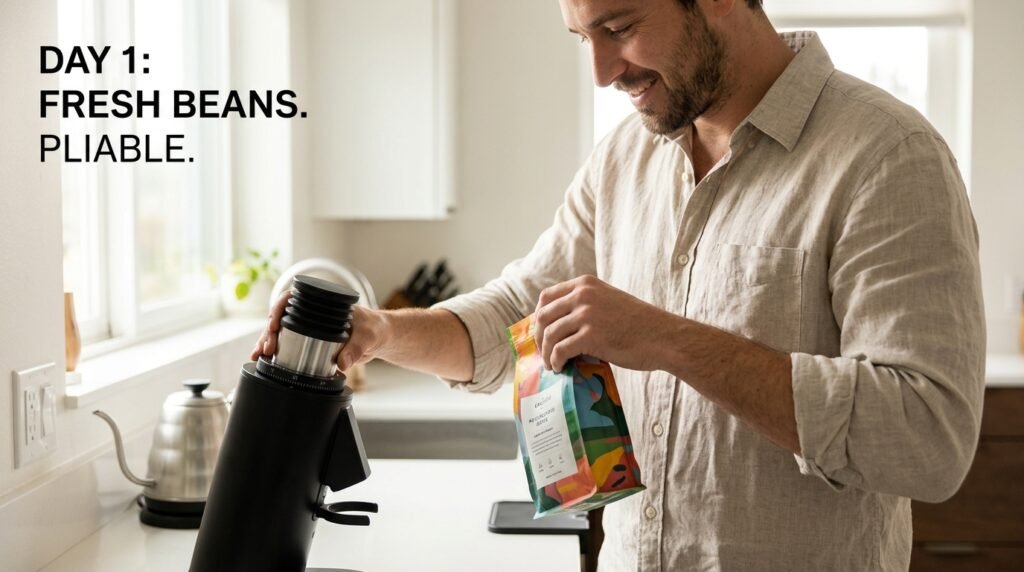
When you buy a bag of freshly roasted coffee, the beans are full of moisture and trapped carbon dioxide gas. They are relatively pliable.
But as the days turn into weeks, the coffee beans slowly dry out. They lose their moisture and they lose their gas. They become brittle.
If you use the exact same grind setting on Day 1 that you use on Day 14, your coffee will suddenly start tasting sour and draining too fast. Because the bean is older and more brittle, it shatters differently inside the grinder, creating less resistance for the water.
You have to actively chase the sweet spot.
As my bag of coffee ages, I slowly adjust my grinder one click finer every three or four days. I am constantly tightening the focus ring to compensate for the aging bean, ensuring that the water resistance stays perfectly consistent from the first cup of the bag to the very last.
Matching the Tool to the Grind
The final piece of the puzzle was understanding that every single coffee brewer in the world demands a completely different grind size.
You cannot use the same grind setting for a French Press that you use for an AeroPress.
Because a French Press immerses the coffee in water for four full minutes, it demands a massive, coarse grind to prevent over-extraction. If you use a fine grind in a French Press, you will create a bitter, muddy disaster.
Because an espresso machine forces water through the coffee in just twenty-five seconds using nine bars of atmospheric pressure, it demands an incredibly fine, powdery grind to create a massive physical wall of resistance. If you use a coarse grind in an espresso machine, the pressurized water will violently blast through it in three seconds, creating a sour, watery mess.
The brewer dictates the time. The time dictates the grind size.
Master Your Focus Ring
We spend so much time stressing about finding the perfect, magical bag of coffee beans. We think that if we just buy a more expensive bag from a fancier roaster, our mornings will suddenly become luxurious.
But the truth is, if your manual focus ring is broken, it doesn’t matter how beautiful the subject is.
If your coffee constantly tastes weak, hollow, or aggressively sour, do not throw the beans away. Stop pouring the water so fast, and adjust your grinder one or two clicks finer.
If your coffee constantly tastes dry, ashy, and leaves a harsh metallic bitterness on your tongue, the beans are probably fine. Your water is just trapped. Adjust your grinder one or two clicks coarser.
Stop treating coffee grounds as a generic, unchangeable powder. Treat them as the ultimate control valve for your extraction. When you finally invest in a high-quality burr grinder and learn how to make those microscopic, deliberate adjustments, your coffee will snap into absolute, breathtaking clarity.

My name is Daniel Carter, I am 35 years old, and I live in the United States. I have been passionate about aquariums for many years, and what started as a simple hobby quickly became a lifelong interest in aquatic life, fish behavior, and responsible tank care.
Through TheBrightLance, I share real experiences, practical knowledge, and honest lessons learned from maintaining different types of aquariums. I enjoy testing equipment, studying fish behavior, improving maintenance routines, and helping beginners avoid common mistakes.
My goal is to make aquarism easier, more ethical, and more enjoyable for everyone — whether you are setting up your very first tank or looking to refine your techniques.