
If you have ever watched a grandparent cook an old, beloved family recipe, you probably noticed something incredibly frustrating: they never use measuring cups.
They don’t use digital kitchen scales, and they certainly don’t set alarms on their phones. They just grab handfuls of flour, throw in a pinch of salt, and stir the pot until it “smells right.” If you ask them for the exact measurements so you can write the recipe down, they usually just laugh and tell you to measure with your heart.
They are not following a strict, calculated set of instructions. They are operating entirely on muscle memory, instinct, and decades of accumulated history.
Observing that kind of cooking teaches you a very profound lesson about human behavior: there is a massive, fundamental difference between a routine and a tradition.
A routine is something you do purely for the sake of efficiency. Brushing your teeth is a routine. Taking out the trash is a routine. You do it on autopilot, trying to get it over with as quickly as possible so you can move on to the next task.
A tradition, on the other hand, is an act of connection. It is a deliberate pause. You do not rush a tradition, because the entire point of the activity is to experience it, honor it, and remember who you are.
For the first decade of my adult life, I treated my morning coffee strictly as a routine. I treated it exactly like taking out the garbage.
I bought cheap, pre-ground powder. I threw it into a plastic machine, pressed a button, and aggressively drank the bitter liquid in my car on the way to work. It was a chore. It was a caffeine delivery system devoid of any soul or history.
But when I finally started looking beyond the generic supermarket shelves, my entire worldview was shattered.
Here is the honest, eye-opening story of what I discovered about coffee traditions, how different cultures around the world elevate this simple seed into a sacred daily act, and how adopting their ancient wisdom completely transformed the way I wake up every morning.
The Baseline of the Western Rush
To truly appreciate the beauty of global coffee traditions, I first had to look in the mirror and acknowledge the absurdity of my own culture.
In the modern Western world, our primary coffee tradition is pure, unadulterated speed. We have built massive, multi-billion-dollar industries entirely around the concept of not having to step out of our cars to get a cup of coffee. We speak our orders into plastic microphones at drive-thru windows. We carry massive paper cups with plastic lids so we can drink while we walk, type, and drive.
We view coffee as a fuel for economic productivity. It is a tool designed to make us work harder and faster.
I lived inside this fast-paced, isolated bubble for years. But as my palate matured and I started seeking out higher quality beans, my curiosity pushed me to look past the drive-thru window.
Realizing that this beverage had a vast, vibrant cultural history hiding behind the corporate logos was exactly (How Exploring Coffee Origins Made Me Enjoy Coffee More). I realized that treating coffee like a fast-food transaction was actually a modern anomaly. For most of human history, coffee was an event.

The Ethiopian Ceremony: The Origin of Hospitality
My journey of discovery naturally started at the very beginning, in the high-altitude forests of the Ethiopian plateau, the undisputed biological birthplace of the Coffea arabica plant.
In Ethiopia, coffee is not something you grab in a paper cup because you are running late for a meeting. It is the absolute centerpiece of community life, respect, and hospitality.
They do not have a coffee “habit.” They have a coffee ceremony.
When a guest arrives at an Ethiopian home, the ritual starts from absolute scratch. The host does not open a bag of pre-roasted beans. They take raw, green coffee seeds and wash them. They place the green seeds in a flat, iron pan and roast them over an open charcoal fire right in the middle of the living room.
The heavy, intoxicating smoke of roasting coffee, often mixed with burning frankincense, fills the entire space. The host walks around the room, gently wafting the smoke toward the guests so they can appreciate the rich aroma.
Once the beans are dark and oily, they are crushed by hand using a wooden mortar and pestle.
The fresh grounds are boiled in a traditional, elegant clay pot called a jebena. The coffee is then poured from a height into tiny, handleless cups.
The ceremony consists of three distinct rounds of coffee. The first round, called Abol, is the strongest. The second, Tona, is milder. The third round, Baraka, translates to “to be blessed.”
You cannot rush this process. It can easily take two or three hours. To leave the home before the third cup is poured is considered a deep insult to the host. In this tradition, time is not money; time is the ultimate currency of respect.
The Turkish Sand: Coffee and Destiny
As the coffee bean historically traveled from the African continent into the Middle East, the cultural tradition morphed into something deeply mystical, intimate, and magical.
In countries like Turkey, coffee preparation feels less like a culinary task and more like ancient alchemy.
They do not use paper filters, and they certainly don’t use espresso machines. They grind the roasted coffee beans into an incredibly fine, microscopic powder, almost like flour.
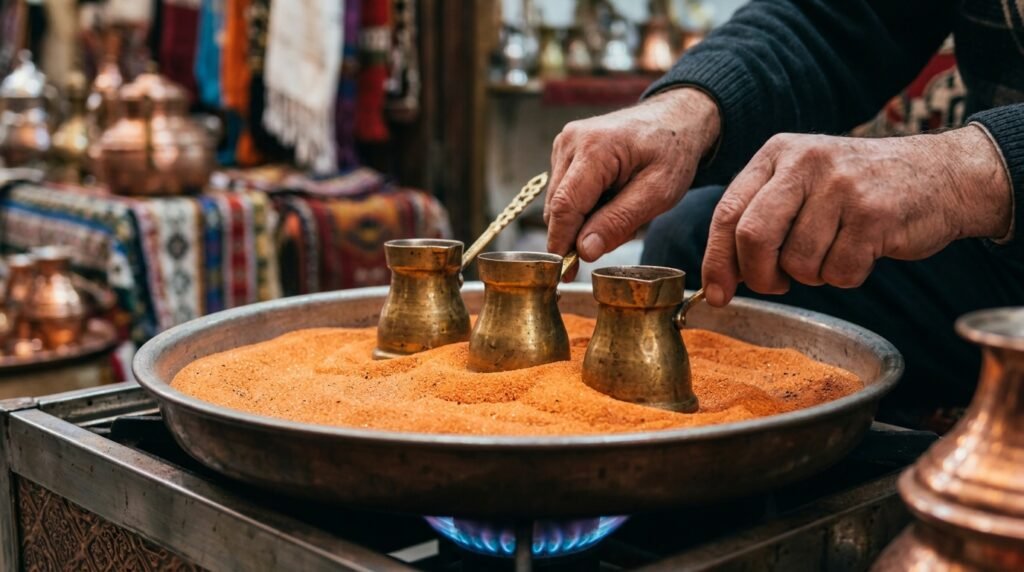
This powder is placed into a small brass or copper pot with a long handle, known as a cezve or an ibrik, along with cold water and sugar.
Instead of placing the pot on a modern electric stove, the traditional method involves burying the brass pot deep into a pan of scorching hot, burning sand.
The intense, even heat from the sand causes the dark liquid inside the pot to foam up violently. It rises to the very brim of the pot before the brewer quickly pulls it away from the heat. This delicate dance is repeated several times to build a thick, luxurious, heavy layer of foam on top of the coffee.
Because the coffee is entirely unfiltered, it is poured directly into a tiny, ornate cup with the muddy grounds included.
You must wait patiently for the mud to settle to the bottom of the cup before taking a careful sip of the thick, heavily spiced liquid. But the tradition goes far beyond the drink itself.
Once the cup is empty, the drinker flips it upside down onto the saucer. After it cools, a designated reader will lift the cup and interpret the chaotic, abstract shapes left behind by the muddy coffee grounds on the porcelain walls.
They use the coffee to divine the drinker’s future. It is a tradition where the beverage literally dictates human destiny.
The Japanese Kissaten: The Art of Absolute Mastery
If the Middle Eastern tradition is rooted in mysticism, the Japanese tradition is rooted in an unwavering, obsessive pursuit of absolute perfection.
When coffee culture took root in Japan, specifically in the traditional, old-school cafes known as Kissaten, it was treated with the exact same level of reverence as a traditional tea ceremony.
A Kissaten is the antithesis of a loud, bright American chain store. They are dark, moody, quiet sanctuaries, often playing soft jazz on vintage vinyl records.
The master of the Kissaten does not use automated machines with flashing lights and buttons. They rely entirely on slow, meticulous manual brewing methods. They treat their tools like precision instruments.
They use intricate glass vacuum siphons that look like 19th-century chemistry equipment, or they use the Nel Drip, a method that utilizes a thick, reusable cotton flannel cloth suspended on a wire hoop.
The master will pour a thread-thin, impossibly precise stream of hot water over heavily roasted, sometimes aged coffee beans. They stand perfectly still, executing a flawless flow rate for five or six agonizingly slow minutes.
The resulting liquid is thick, intense, and profoundly complex.
In Japan, serving coffee is an artisan discipline. This profound realization is exactly (Why I Now Pay Attention to Coffee Origin and Type). When you see someone treat the brewing process with a lifetime of dedicated mastery, you realize that the raw ingredient must be treated with the exact same level of respect.
The Swedish Fika: The Psychological Shield
Perhaps the most universally applicable tradition I discovered belongs to the freezing, dark winters of Scandinavia.
In Sweden, they practice a cultural institution called Fika.
If you ask an outsider, they might tell you that Fika just means having coffee and a sweet pastry. But that definition completely misses the immense psychological gravity of the tradition.
Fika is a socially mandated pause button.
In Swedish workplaces, productivity completely stops twice a day—usually around mid-morning and mid-afternoon. Employees are actively encouraged, and often expected, to step away from their computer monitors. They leave their stressful spreadsheets behind and gather in a communal break room.
They pour a cup of hot black coffee, eat a cinnamon bun, and sit down to talk to their colleagues.
But the golden rule of Fika is that you are not allowed to talk about work.
It is a tradition built entirely around mental health and psychological survival. It is a cultural acknowledgment that human beings are not machines, and that we desperately need analog warmth, sugar, and social connection to survive the demands of the modern corporate world.
Building My Own Tradition
Before I learned about these incredible global traditions, my kitchen was a sterile, boring place. I was operating on a generic, automated routine that brought absolutely no joy to my life.
But as I absorbed the stories of the Ethiopian jebena, the Turkish hot sand, the Japanese Kissaten, and the Swedish Fika, I realized that I didn’t have to be a victim of the modern drive-thru culture.
I had the power to write my own tradition.
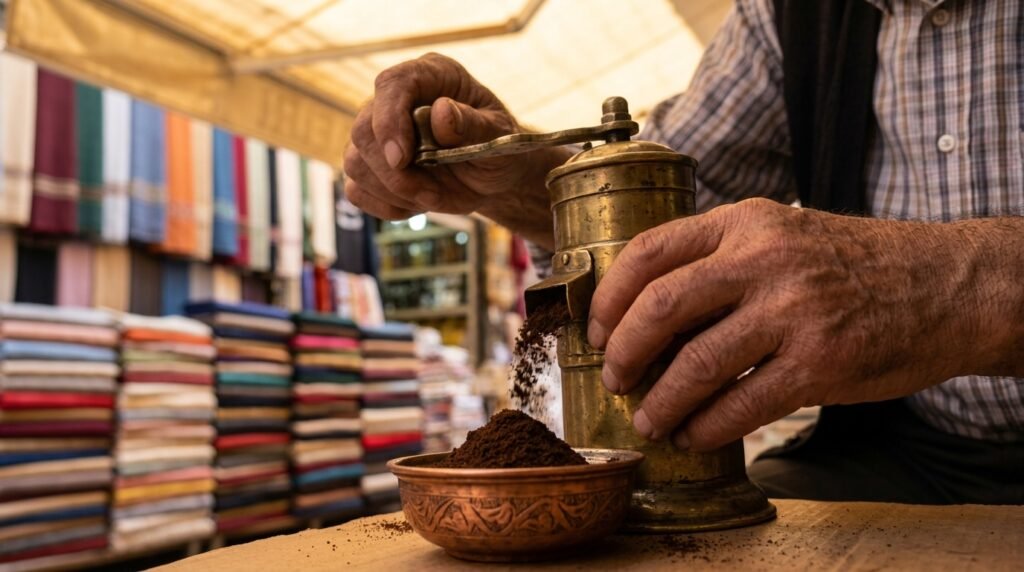
I threw away my automatic plastic machine. I bought a manual steel burr grinder, a digital kitchen scale, and a glass V60 pour-over cone. I decided that my mornings would no longer be a frantic race against the clock.
I adopted the deliberate intentionality of the Ethiopian ceremony. I started waking up thirty minutes earlier, just so I could stand in my kitchen in the dark and manually weigh, grind, and pour my coffee without rushing.
The Anchor in the Chaos
This new, customized tradition completely rewired my brain.
For fifteen minutes every single morning, I am completely disconnected from the chaotic universe outside my apartment window. I listen to the mechanical crunch of the grinder. I smell the explosive, sweet aromatics filling the room. I watch the physical laws of gravity pull the hot water through the coffee bed.
Implementing this daily, analog anchor was undeniably (The Coffee That Changed My Morning Routine Completely). It created an impenetrable psychological shield around my morning.
By the time I finally sit down with my warm ceramic mug and open my inbox to face the stressful demands of the day, I have already secured a victory. I have already experienced a moment of quiet, analog peace.
From Chore to Ceremony
If you are currently treating your morning coffee like a thoughtless, automated chore, you are drinking a soulless cup of brown liquid. You are executing a routine, not a tradition.
I challenge you to look at the global rituals that have kept this beverage alive for centuries.
You do not need to bury a brass pot in hot sand, and you do not need to roast green beans over an open fire in your living room to respect the bean. But you do need to introduce intentionality into your kitchen.
Stop checking your emails while your coffee brews. Stop drinking it out of disposable paper cups. Buy a heavy, beautiful ceramic mug. Buy a manual grinder and actively engage your physical senses. Treat the preparation not as a frustrating delay to your day, but as the very first accomplishment of it.
When you finally anchor your morning coffee to a specific, deliberate, physical tradition, it stops being a drug. It transforms into an experience. You will stop rushing through the motions, and you will never look at that simple, dark liquid the same way ever again.

My name is Daniel Carter, I am 35 years old, and I live in the United States. I have been passionate about aquariums for many years, and what started as a simple hobby quickly became a lifelong interest in aquatic life, fish behavior, and responsible tank care.
Through TheBrightLance, I share real experiences, practical knowledge, and honest lessons learned from maintaining different types of aquariums. I enjoy testing equipment, studying fish behavior, improving maintenance routines, and helping beginners avoid common mistakes.
My goal is to make aquarism easier, more ethical, and more enjoyable for everyone — whether you are setting up your very first tank or looking to refine your techniques.