
If you travel frequently, you are probably very familiar with the subtle, lingering anxiety of renting a car at the airport.
You walk out to the parking garage, find your assigned vehicle, throw your luggage in the trunk, and sit down in the driver’s seat. But the moment you sit down, everything feels completely wrong.
The previous driver was six inches taller than you, so your feet can barely reach the pedals. The steering wheel is tilted too high, cutting off your view of the speedometer. The rearview mirror is angled directly at the ceiling.
If you just put the car in drive and try to merge onto a busy highway in this condition, you are going to be miserable. You will feel unsafe, uncomfortable, and entirely out of control. Your shoulders will tense up, and you will hate the entire drive.
But you do not have to suffer. You can spend exactly forty-five seconds adjusting the seat track, tilting the steering wheel, and fixing the mirrors. With those tiny, instant adjustments, a chaotic, uncomfortable experience suddenly transforms into a smooth, confident, and enjoyable ride.
For the first decade of my adult life, my morning coffee routine was the exact equivalent of driving a rental car without adjusting the seat.
I was stumbling into my kitchen, operating entirely on autopilot, and simply accepting a bitter, uncomfortable, and chaotic result. I thought making good coffee required expensive machinery or years of culinary training.
I was completely wrong.
Here is the honest, practical story of what I changed to improve my coffee instantly, the tiny, low-cost adjustments that completely fixed my morning routine, and how spending just a few extra seconds in the kitchen transformed my daily cup into a masterpiece.
The First Adjustment: Throwing Away the Plastic Scoop
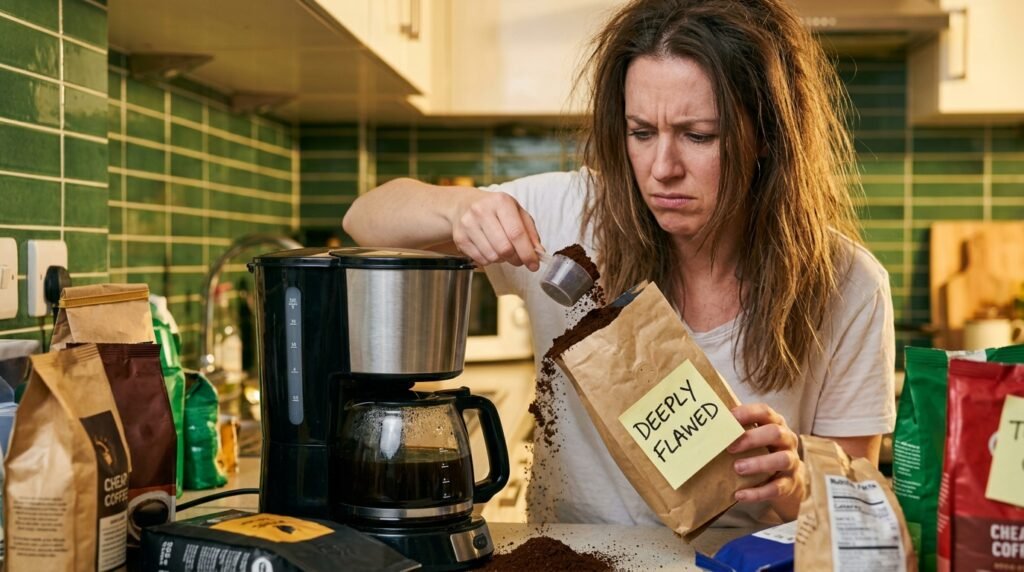
When I first decided I wanted to make better coffee at home, I was still relying on a deeply flawed, outdated piece of equipment: the tiny plastic measuring scoop that came inside the coffee bag.
I used to think that making coffee was like following a simple laundry instruction. The bag said “use two scoops per cup,” so I blindly dumped two heaping mounds of ground coffee into my machine.
But my coffee never tasted the same two days in a row.
On Monday, it would be weak, watery, and sour. On Tuesday, it would be aggressively strong, bitter, and muddy. I was incredibly frustrated. I thought the coffee beans were defective, but the reality was that my measuring system was fundamentally broken.
I didn’t realize that coffee beans are an agricultural product with wildly varying densities.
A dark roast coffee bean has been cooked so long that it expands and becomes very light. A light roast coffee bean is dense, heavy, and small. If you use a plastic scoop to measure both, you will end up with vastly different amounts of actual coffee mass.
The absolute most important, instant change I ever made was throwing that plastic scoop into the trash. I bought a cheap, fifteen-dollar digital kitchen scale.
Instead of guessing volumes, I started measuring my coffee in exact grams. Fifteen grams of coffee is exactly fifteen grams, no matter what the beans look like. Discovering this mathematical truth was the defining moment of (The Day I Finally Got My Coffee Ratio Right).
The very first morning I used a scale, the unpredictable chaos completely vanished. My coffee was instantly, perfectly consistent. I finally adjusted the driver’s seat.
The Second Adjustment: Fixing the Blade Grinder
Once I started weighing my coffee, I noticed an improvement, but the flavor still wasn’t where I wanted it to be. It still had a harsh, dry finish that hurt the back of my throat.
The culprit was the machine I was using to crush the beans.
I was using a cheap electric spice grinder with a small metal blade that spun around like a helicopter propeller. Every morning, I would press the button and listen to the machine violently chop the beans into pieces.
I thought I was saving time. But a spinning blade does not grind coffee; it massacres it.
When you chop coffee with a blade, the resulting pieces are entirely chaotic. Half of the grounds are massive, jagged boulders. The other half is pulverized into microscopic, powdery dust.
When you pour hot water over this mixture, the tiny dust particles extract instantly, releasing harsh, bitter flavors. The massive boulders barely extract at all, releasing weak, sour water. The resulting cup is a confused, muddy mess.
Understanding the physics behind this disaster was exactly (How Grind Size Affected My Coffee More Than I Expected).
I stopped using the electric blade and bought a manual, hand-cranked burr grinder. A burr grinder uses two grooved steel plates to crush the beans into perfectly uniform, symmetrical pieces.
The change in flavor was not gradual. It was immediate.
The very first time I brewed a cup using uniformly ground coffee, the harsh bitterness disappeared. The hot water was finally able to extract the exact same amount of flavor from every single particle. The coffee became incredibly smooth, sweet, and balanced.
The Third Adjustment: The Invisible Ingredient
There is a massive blind spot in the modern coffee world. We spend so much time obsessing over the origin of the beans, the roast level, and the brewing equipment, that we completely ignore the most abundant ingredient in the cup.
A cup of coffee is 98.5% water.
For years, I was using raw tap water straight from my kitchen sink. I lived in a city with notoriously hard water that was heavily treated with chlorine and industrial minerals.
If you took a glass of my tap water and smelled it, it faintly smelled like a public swimming pool.
But because I was boiling it and pouring it over dark brown coffee grounds, I assumed the coffee flavor would just magically overpower the bad water. I was completely wrong. The heavy minerals in the tap water were physically preventing the delicate fruit and chocolate notes of the coffee from extracting. The chlorine was interacting with the roasted oils, creating a harsh, metallic aftertaste.
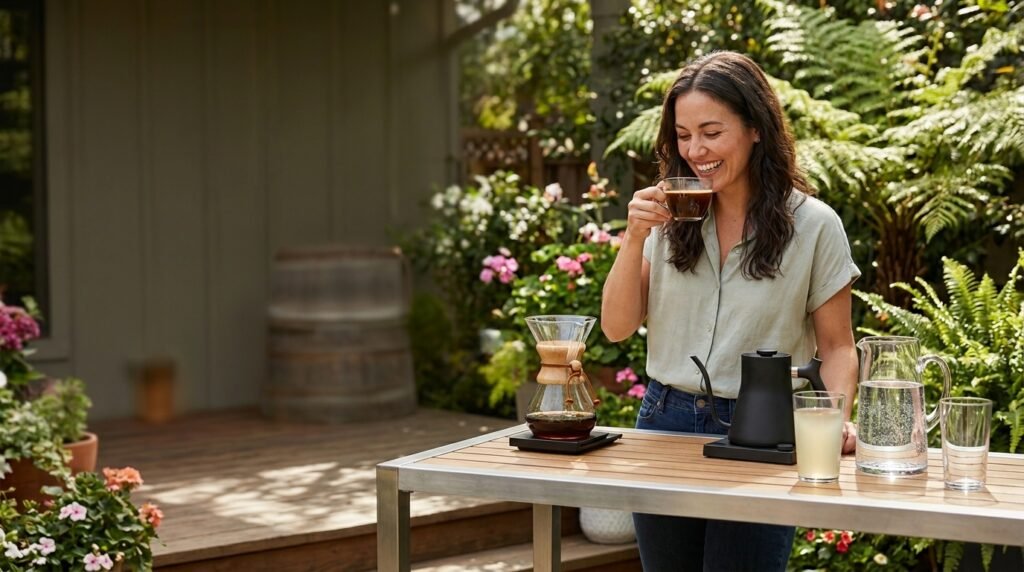
One morning, on a complete whim, I decided to use filtered, purified drinking water from my refrigerator instead of the tap.
The result was staggering. I didn’t change the beans. I didn’t change my brewing method. But the coffee suddenly tasted like an entirely different, incredibly expensive beverage.
Realizing that the liquid base was holding me back perfectly illustrates (How I Improved My Coffee Without Buying New Equipment).
The metallic aftertaste vanished completely. The coffee was soft, vibrant, and clean. If your tap water does not taste delicious on its own, it will absolutely ruin your coffee. Switching to filtered water is the ultimate instant upgrade.
The Fourth Adjustment: The Sixty-Second Pause
Even with filtered water, a scale, and a burr grinder, I still had one terrible habit that I needed to break.
I was deeply impatient.
When my traditional stovetop kettle would start whistling, signaling that the water had reached a rolling, aggressive boil, I would pull it off the heat and immediately dump it straight over my coffee grounds.
I did not realize that I was physically burning my breakfast.
Coffee beans contain highly sensitive, volatile aromatic oils. These oils are the source of all the incredible flavors you read about on the bag—the jasmine, the blueberry, the brown sugar.
If you hit those delicate oils with water that is 212 degrees Fahrenheit (100 degrees Celsius), you scorch them. You destroy the sweetness and violently extract the harsh, carbonized ash hidden deep within the cellulose of the bean.
I learned to introduce a tiny, sixty-second pause into my routine.
Now, when my kettle reaches a boil, I take it off the stove and I just let it sit there for one minute. This allows the water temperature to drop to a gentle, perfect 200 degrees Fahrenheit.
This tiny change requires absolutely zero money and zero new equipment. It just requires a single minute of patience. But the moment I stopped scorching my coffee, the natural sweetness of the beans finally survived the brewing process and made it into my mug.
The Fifth Adjustment: Allowing the Coffee to Breathe
The final instant change I made was completely psychological. I had to learn how to respect the physical reaction happening inside my brewing cone.
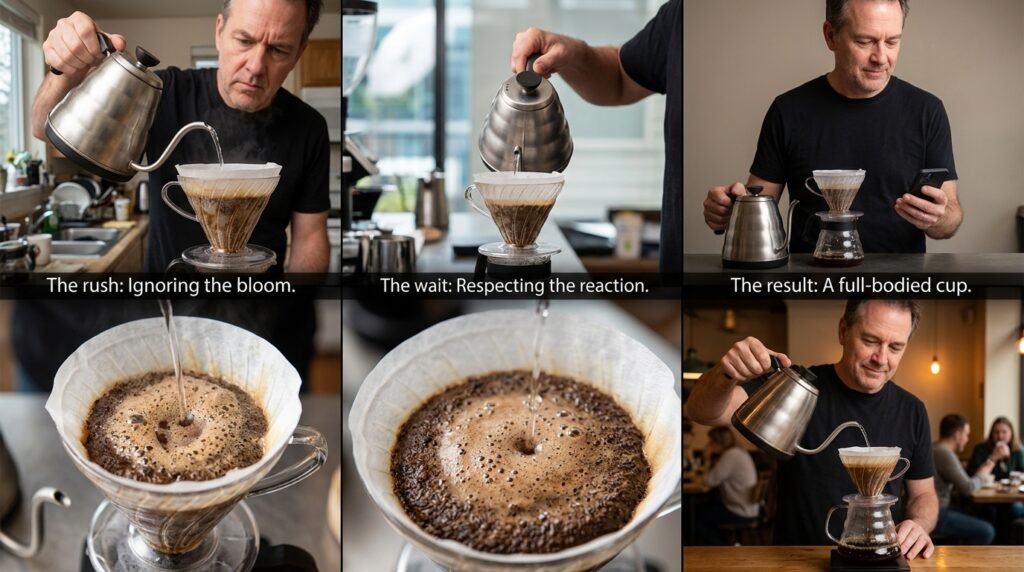
When coffee is freshly roasted, carbon dioxide gas gets trapped inside the bean. When you introduce hot water to fresh coffee grounds, this gas rapidly escapes, causing the coffee bed to bubble and swell. This is called the “bloom.”
In the past, I would just dump all my water into the brewer as fast as possible, ignoring the bubbles.
But when the gas is escaping, the water cannot get in. If you pour all your water at once, it just slides around the expanding gas, slipping down the sides of the paper filter without actually extracting any flavor.
I changed my pouring technique instantly.
Now, I pour just a tiny splash of water—enough to simply wet the grounds. Then, I put the kettle down and I wait for forty-five seconds. I watch the coffee expand. I let it breathe.
Only after the gas has completely escaped do I resume my slow, steady pour. This simple technique change guarantees that the water can fully penetrate the coffee bed, resulting in a rich, full-bodied cup every single time.
You Are in the Driver’s Seat
We often assume that to enjoy a luxury culinary experience at home, we have to spend hundreds of dollars on fancy espresso machines or take expensive barista courses.
We think the barrier to entry is massive.
But the truth is, the gap between a terrible, bitter cup of coffee and a beautiful, sweet, cafe-quality cup of coffee is incredibly small. It is not about buying magic beans. It is simply about removing the thoughtless errors from your routine.
If you are currently frustrated with your morning coffee, I urge you to look at the adjustments you are ignoring.
Are you driving the rental car with the seat pushed all the way back, wondering why you can’t reach the pedals?
Throw away your plastic scoop and buy a cheap digital scale. Stop chopping your coffee with a blade grinder. Use filtered water that actually tastes good on its own. Let your boiling water cool down for sixty seconds before you pour, and give your coffee grounds time to bloom.
If you make these tiny, inexpensive changes tomorrow morning, your coffee will not just improve gradually over time. It will improve instantly. And you will finally understand the profound joy of driving a perfectly adjusted morning routine.

My name is Daniel Carter, I am 35 years old, and I live in the United States. I have been passionate about aquariums for many years, and what started as a simple hobby quickly became a lifelong interest in aquatic life, fish behavior, and responsible tank care.
Through TheBrightLance, I share real experiences, practical knowledge, and honest lessons learned from maintaining different types of aquariums. I enjoy testing equipment, studying fish behavior, improving maintenance routines, and helping beginners avoid common mistakes.
My goal is to make aquarism easier, more ethical, and more enjoyable for everyone — whether you are setting up your very first tank or looking to refine your techniques.