
If you have ever spent time editing photographs or designing graphics on a computer, you are intimately familiar with the golden rule of resizing an image.
When you want to make a photograph larger or smaller, you must lock the “aspect ratio.” You have to hold down the shift key while you drag the corner of the image. This ensures that the width and the height scale together perfectly, preserving the integrity of the original picture.
If you forget to lock that ratio, and you just drag the side of the image, the result is an absolute disaster. The subject becomes violently stretched, squashed, and distorted. The raw data of the pixels is still technically there, but the relationship between them is completely broken. The image becomes unreadable.
For the first few years of my specialty coffee journey, I was constantly stretching and squashing my morning beverage.
I was buying incredibly expensive, beautiful coffee beans. I was using filtered water. I even had a decent grinder. But every single morning, my coffee tasted like a distorted, blurry mess. Some days it was overwhelmingly heavy and sour; other days it tasted like mildly flavored brown water.
I was missing the fundamental lock. I was completely ignoring the aspect ratio of my brewing process.
Here is the honest, highly mathematical, and deeply liberating story of the day I finally got my coffee ratio right, why trusting your eyes is a culinary trap, and how a cheap piece of plastic completely transformed my kitchen into a professional laboratory.
The Soup Spoon Sabotage
My failure started with a tool that belongs in every kitchen, but should never be used for coffee: the standard soup spoon.
Before I understood the chemistry of extraction, I treated coffee like a casual baking recipe. I thought making coffee was just a rough estimation. Every morning, I would open my bag of premium beans, grab a metal spoon from the drawer, and blindly scoop “three healthy spoonfuls” into my grinder.
Then, I would take my kettle and pour hot water into my French Press or pour-over cone until it simply “looked full.”
I thought I was being efficient. I didn’t want to do math at seven o’clock in the morning. I just wanted caffeine.
But this blind reliance on volume is a massive, structural flaw. Relying on visual measurements was the absolute root cause of (Why My Coffee Always Tasted Weak (And How I Fixed It)), because I was constantly starving my water of the necessary coffee mass.
I didn’t realize that the coffee beans were actively deceiving my eyes.
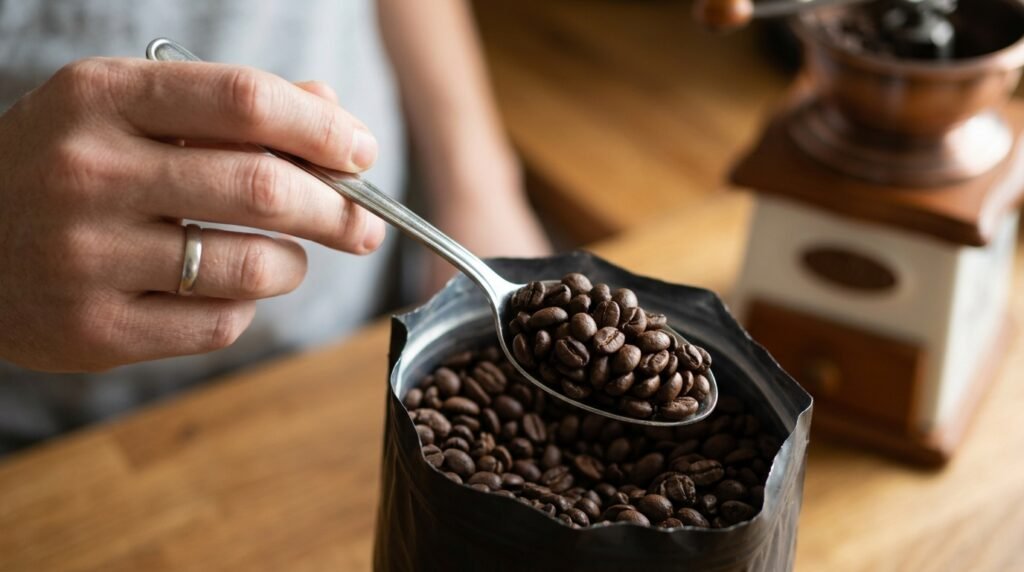
The Density Deception
The fundamental problem with measuring coffee by volume (using scoops) is that coffee beans are an agricultural product, and their physical density varies wildly depending on their origin and their roast level.
Let me explain the physics.
If you buy a bag of Dark Roast coffee from Brazil or Indonesia, those beans have been inside the roasting machine for a very long time. The extreme, prolonged heat causes the cellular structure of the bean to expand and pop, much like popcorn. It loses a massive amount of its internal moisture. The resulting dark roast bean is puffy, brittle, and incredibly light.
On the other hand, if you buy a bag of Light Roast coffee from the high-altitude mountains of Ethiopia, those beans were pulled out of the roaster very early. They have retained their moisture. They remain tightly packed, tiny, rock-hard, and incredibly dense.
This means that one single soup spoon of puffy Dark Roast might only weigh 8 grams.
But that exact same soup spoon, filled with the dense Light Roast, might weigh 15 grams.
If you use three scoops of dark roast, you are brewing with 24 grams of coffee. If you use three scoops of light roast, you are brewing with 45 grams of coffee.
By trusting my eyes, I was wildly fluctuating my coffee mass by nearly fifty percent every single time I changed bags. The aspect ratio of my brew was completely shattered. No wonder my coffee tasted like a chaotic, unpredictable gamble.
The Resistance to the Scale
I knew that the professionals in the specialty cafés used digital scales. I had watched them do it. But I stubbornly resisted buying one for a very long time.
I thought using a digital scale to make coffee was pretentious. I thought it was unnecessary snobbery. I just wanted a comforting morning routine, not a high-school chemistry exam.
But after pouring my hundredth mug of sour, diluted, unpredictable coffee down the kitchen sink, my frustration finally overpowered my stubbornness.
I went online and purchased a cheap, twenty-dollar digital kitchen scale. I specifically made sure it could measure in precise, single-gram increments, and that it had a “Tare” button (a button that zeroes out the weight of whatever container you place on it).
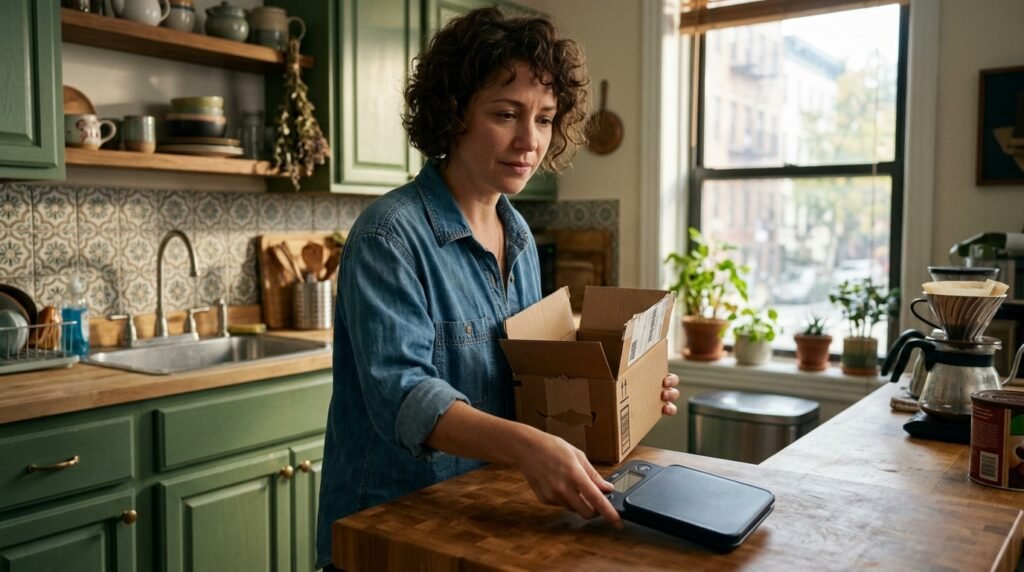
When the cardboard box arrived at my apartment, I felt a strange mix of defeat and anticipation. I unboxed the tiny plastic square, put the batteries in, and placed it on my kitchen counter.
Little did I know, this inexpensive tool was going to be the foundation of (The Simple Change That Improved My Coffee Instantly). It was the key that finally locked my aspect ratio.
The Golden Ratio (1:16)
Before I could use the scale, I had to understand the math I was trying to achieve.
In the specialty coffee world, there is a universally accepted baseline formula known as the “Golden Ratio.” This ratio is 1:16.
This means that for every 1 gram of dry coffee grounds you use, you need exactly 16 grams of hot water.
This ratio is not arbitrary. It is based on decades of chemical extraction science. At a 1:16 ratio, the water has the exact perfect amount of solvent power to dissolve the sweet sugars and complex fruit acids inside the bean, without becoming so saturated that it chokes, and without being so abundant that it dilutes the beverage.
It is the perfect balance of strength and extraction.
To put this into practical, morning-routine numbers: If I want to brew a standard, satisfying mug of coffee (roughly 8 ounces), I need to use 15 grams of coffee beans.
If I multiply 15 grams of coffee by 16, I get 240.
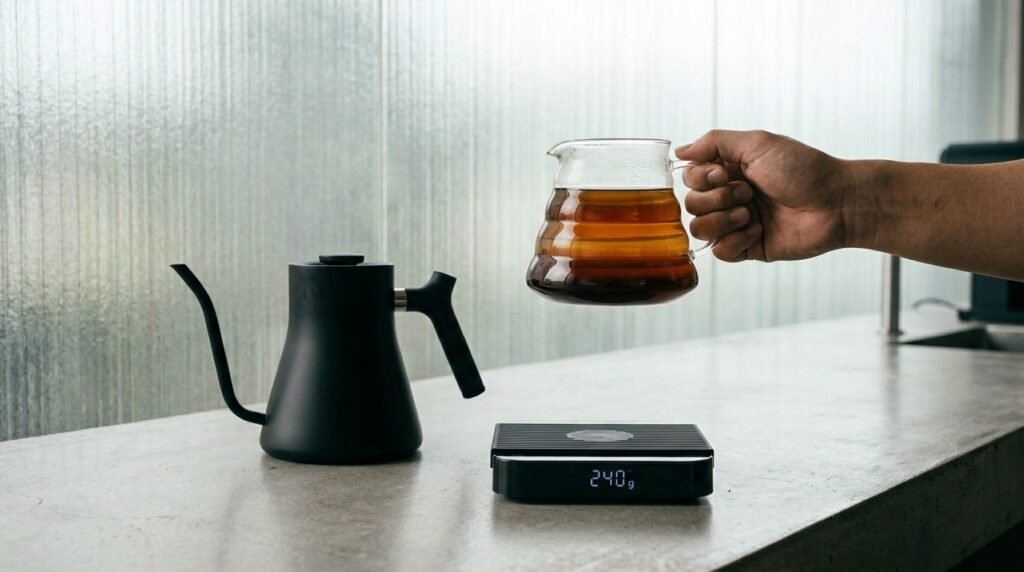
Therefore, my target is exactly 15 grams of coffee and exactly 240 grams of water.
The Execution of the Math
The very next morning, I stepped up to my kitchen counter. I pushed my useless soup spoon to the back of the drawer.
I placed a small ceramic bowl on the digital scale and pressed the “Tare” button to zero it out. I opened a fresh bag of washed Colombian coffee. I carefully poured the beans into the bowl, watching the red digital numbers tick up.
10 grams. 13 grams. 14 grams. I added exactly four more beans. 15 grams.
It was a tiny, seemingly insignificant amount of coffee, but I trusted the math. I poured the 15 grams into my manual burr grinder and ground them to a medium-fine, sand-like texture.
I placed my glass V60 carafe and the plastic brewing cone directly onto the scale. I put the paper filter in, rinsed it with hot water, and dumped the rinse water out. I placed the brewer back on the scale and added my 15 grams of ground coffee.
I pressed “Tare” one more time. The scale read 0 grams. I was ready.
The Hypnotic Pour
I grabbed my gooseneck kettle, filled with 202°F water.
I gently poured 45 grams of water over the dry grounds to let them “bloom.” I watched the digital display hit 45g, and I stopped pouring. I waited exactly forty-five seconds while the coffee bubbled and released its trapped carbon dioxide.
Then, I resumed the pour. I watched the numbers climb steadily.
100 grams. 150 grams. 200 grams.
I kept my pouring hand perfectly steady, tracing slow concentric circles over the coffee bed. As the scale approached my target, I slowed the flow of water down to a delicate trickle.
238 grams. 239 grams. 240 grams.
I instantly stopped pouring. I lifted the kettle away.
I stood there in the quiet kitchen, watching the last few drops of water filter through the coffee bed and fall into the glass carafe below. For the first time in my entire life, I knew exactly what was inside that glass. There was no guessing. There was no soup spoon variance.
It was a perfectly locked, mathematically flawless 1:16 ratio.
The Sip of Absolute Clarity
I removed the V60 cone, picked up the glass carafe, and swirled the dark, ruby-red liquid. The aroma was intensely sweet, smelling of caramelized brown sugar and crisp red apples.
I poured the coffee into my favorite mug and let it cool for two minutes.
I took a sip.
My brain completely stalled. It was a revelation.
There was absolutely zero harsh, biting bitterness. There was no thin, watery, hollow weakness. The liquid coated my palate perfectly. It was incredibly smooth, possessing a rich, velvety body that completely balanced the vibrant, fruity acidity of the Colombian beans.
It tasted like a masterpiece. It tasted like I had paid an expert barista five dollars to make it for me. Finally achieving this level of self-sufficiency was the exact moment I realized (How I Made Café-Quality Coffee in My Kitchen), because the secret wasn’t magic; it was just discipline.
The image wasn’t stretched. The image wasn’t squashed. The resolution was crystal clear, and the aspect ratio was perfectly locked.
Adjusting the Slider (The 1:15 and 1:17 Ratios)
Once I mastered the baseline 1:16 ratio, my digital scale became my favorite tool in the kitchen. It didn’t restrict me; it completely liberated me.
Because I finally had a measurable baseline, I could start intentionally manipulating the math to suit my specific daily cravings. I learned how to adjust the slider.
If I wake up on a cold, rainy Monday morning and I want a coffee that feels heavier, thicker, and more comforting, I tighten the ratio. I switch to a 1:15 ratio (15 grams of coffee to 225 grams of water). Because there is slightly less water, the resulting beverage is more concentrated. It boosts the heavy chocolate notes and gives the coffee a massive, syrupy body.
If I wake up on a sunny Saturday and I am brewing a highly expensive, delicate, floral coffee from Ethiopia, I widen the ratio. I switch to a 1:17 ratio (15 grams of coffee to 255 grams of water). The extra water slightly dilutes the heavy body, which allows the delicate, tea-like floral notes and bright peach acidity to shine through with absolute clarity.
I am no longer guessing. I am engineering my morning.
Throw Away the Spoon
If you are currently frustrated with your coffee routine—if your mug tastes amazing on Tuesday but tastes like bitter swamp water on Wednesday—you are suffering from a broken aspect ratio.
Your eyes are lying to you. Your soup spoon is actively sabotaging your expensive coffee beans.
I urge you to let go of the “eyeball method.” Go online and spend twenty dollars on a digital kitchen scale.
It might feel slightly strange or overly clinical the first few times you use it. You might feel a bit silly weighing a ceramic bowl of brown beans at seven in the morning. But I promise you, the moment you take that first sip of a perfectly calculated, mathematically flawless extraction, all of that hesitation will vanish.
You will finally taste the coffee exactly as the farmer and the roaster intended it to be tasted. You will lock the aspect ratio of your morning routine, and you will never let a plastic scoop ruin your masterpiece ever again.

My name is Daniel Carter, I am 35 years old, and I live in the United States. I have been passionate about aquariums for many years, and what started as a simple hobby quickly became a lifelong interest in aquatic life, fish behavior, and responsible tank care.
Through TheBrightLance, I share real experiences, practical knowledge, and honest lessons learned from maintaining different types of aquariums. I enjoy testing equipment, studying fish behavior, improving maintenance routines, and helping beginners avoid common mistakes.
My goal is to make aquarism easier, more ethical, and more enjoyable for everyone — whether you are setting up your very first tank or looking to refine your techniques.