
When you spend hours doing complex digital image editing, one of the most tedious and demanding tasks you can face is removing bold, intrusive text from a highly detailed background.
If you are an amateur, you might just try to blur the text out or paint over it with a solid color. But that always leaves a blurry, ugly smudge that instantly ruins the photograph.
To do it right, you have to meticulously clone the surrounding textures. You have to match the grain, balance the ambient lighting, and painstakingly reconstruct the pixels that were hiding behind those letters. When you finally finish the edit, the text is completely gone, and the background looks flawlessly natural.
To an untrained eye, the final image looks like absolute magic. But the person who did the work knows it isn’t magic at all. It is simply the result of layering small, precise, foundational techniques on top of each other.
For a very long time, I looked at specialty coffee shops with that exact same untrained eye.
I would walk into a beautiful, minimalist café, pay six dollars for a hand-poured coffee, and take a sip. The liquid was impossibly clear, vibrantly sweet, and bursting with complex fruit flavors.
I was convinced the baristas were wizards. I assumed they had access to secret, magical beans that normal people couldn’t buy. I thought their massive, expensive commercial grinders and filtered water systems were the only way to achieve that level of culinary perfection.
Then, I would go home, turn on my cheap plastic drip machine, and brew a cup of coffee that tasted like muddy, bitter ash.
The gap between the café and my kitchen felt insurmountable. But eventually, my frustration overpowered my intimidation. I decided I was going to figure out exactly how the magic trick worked.
Here is the honest, highly practical story of how I made café-quality coffee in my kitchen, the invisible variables I had to master, and how rebuilding my routine from the ground up completely changed my mornings forever.
Erasing the Supermarket Illusion
If you want to reconstruct a flawless image, you need high-resolution raw data. You cannot build a masterpiece out of blurry, corrupted files.
My first step to achieving café-quality coffee was confronting the terrible quality of the raw materials I was bringing into my kitchen.
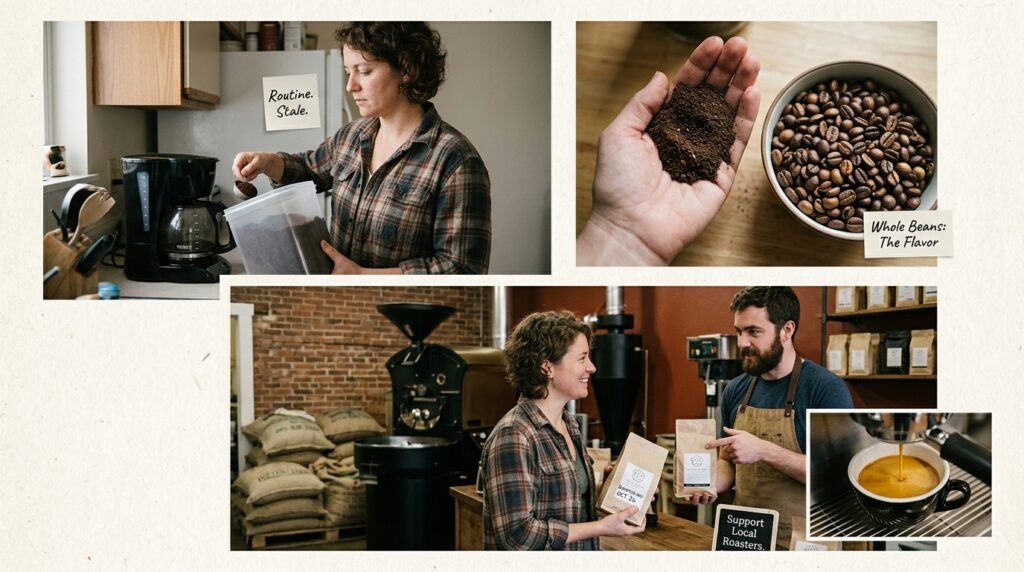
For years, I bought pre-ground coffee from the supermarket. The bags were massive, cheap, and convenient. I didn’t realize that I was buying a completely dead ingredient.
Coffee beans are full of delicate, highly volatile aromatic oils. These oils are what give the coffee its incredible flavors of blueberry, jasmine, or caramel. But the absolute second you grind a coffee bean, you expose all of those internal oils to the oxygen in the room.
Within minutes of being ground, the coffee starts to rapidly oxidize and lose its flavor. By the time a massive factory grinds the coffee, puts it in a plastic tub, ships it to a grocery store, and you let it sit in your pantry for a month, the coffee is completely devoid of life.
It is stale dust.
Realizing that the raw ingredient was fundamentally broken was the driving force behind (Why I Stopped Buying Cheap Coffee and Never Looked Back). I knew that if I wanted café results, I needed café ingredients.
I stopped buying coffee from the grocery store. I found a local specialty roaster and started buying whole beans that had a specific “Roasted On” date printed on the back of the bag. I made sure to buy beans that had been roasted within the last two weeks.
Investing in the Texture (The Grinder)
Once I had high-quality, freshly roasted whole beans, I faced my next massive hurdle. I had to figure out how to grind them.
Initially, I bought a cheap, twenty-dollar electric blade grinder. It worked like a tiny blender, spinning a metal blade to chop the beans.
The result was a chaotic, uneven disaster. Half of the coffee was chopped into massive, coarse boulders, while the other half was pulverized into microscopic, powdery dust.
When you pour hot water over an uneven mixture like that, the extraction completely breaks down. The water rapidly over-extracts the fine dust, releasing harsh, bitter tannins. At the same time, the water under-extracts the massive boulders, releasing aggressively sour acids.
My coffee tasted bitter and sour at the exact same time. It was a sensory nightmare.
I learned that professional cafés spend thousands of dollars on massive commercial burr grinders for one simple reason: uniformity. A burr grinder crushes the beans between two steel plates, ensuring every single particle is the exact same size.
I couldn’t afford a commercial machine, but I could afford a high-quality manual hand grinder with steel burrs.
It takes me about forty seconds of physical labor to grind my beans every morning, but the resulting texture is beautifully uniform. It looks exactly like perfect table sand. That uniformity finally allowed the water to extract the sweet sugars evenly, completely eliminating the harsh, muddy flavors from my cup.
The Chemistry of the Canvas (Water Quality)
If you are a painter, you do not use dirty, muddy water to clean your brushes and mix your bright colors. The mud will taint the canvas.
A cup of black coffee is approximately 98 percent water. It is a mathematical certainty that if your water tastes bad, your coffee will taste bad.
For years, I was filling my kettle straight from the kitchen sink. My local tap water is heavily treated with chlorine and packed with hard minerals like calcium.
When you heat up highly chlorinated water and pour it over delicate specialty coffee, the harsh chemicals completely mask the fragile floral and fruit notes. The heavy minerals bind to the flavor compounds, resulting in a flat, dull, metallic beverage.
I wasn’t tasting the beautiful Ethiopian beans; I was tasting the plumbing of my apartment building.
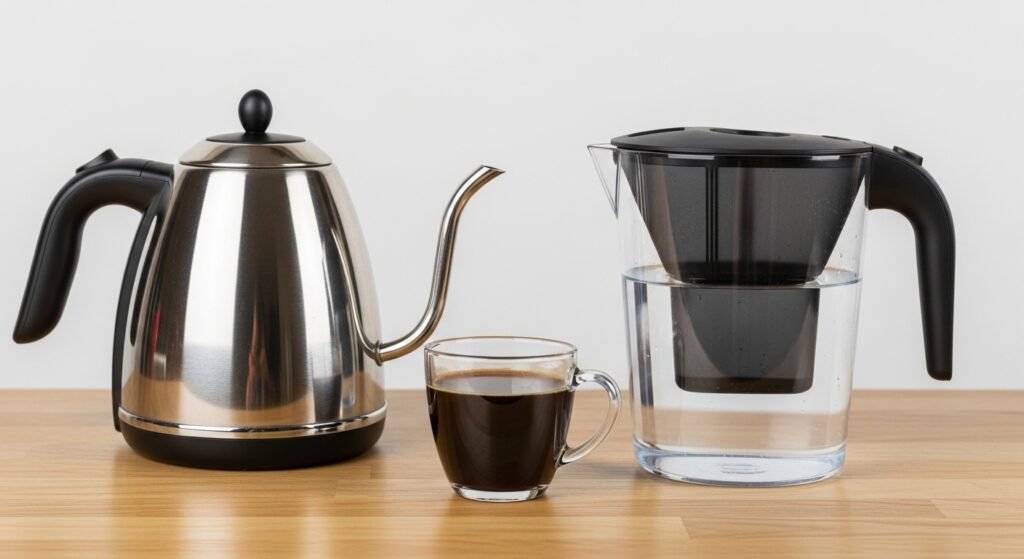
I stopped using tap water immediately. I bought a simple, inexpensive charcoal water filter pitcher and kept it in my fridge.
Using clean, filtered, neutralized water was an absolute revelation. Without the heavy noise of the chlorine and minerals, the bright, vibrant acidity of the coffee was finally allowed to shine. The canvas was clean, and the colors popped.
The Mathematics of the Café
The next secret I had to steal from the professional baristas was their absolute devotion to mathematics.
If you stand and watch a specialty barista make a pour-over, you will notice that they never guess. They never use a “scoop.” Everything is meticulously weighed on a digital scale.
I used to just eyeball my measurements. I would throw a few spoons of coffee into my filter and pour water until my mug looked full. Because I was guessing, my coffee-to-water ratio was fluctuating wildly every single day.
If you want café-quality consistency, you have to lock your variables.
I bought a cheap digital kitchen scale. Discovering the power of precision was exactly (The Simple Trick That Made My Coffee Taste Better).
I started using the golden ratio of 1:16. For every 1 gram of coffee, I poured exactly 16 grams of water. By weighing 15 grams of coffee and 240 grams of water, I completely removed the guesswork. My coffee was never too weak, and it was never too overwhelmingly strong. It was mathematically engineered to be perfect.
Taming the Heat
As I was locking in all these new variables, I was still making a massive thermal error that was keeping me from reaching that elusive café flavor.
I believed that coffee required aggressively boiling water. I would let my kettle scream on the stove, pull it off the burner, and dump the rolling, violently bubbling water directly onto my grounds.
I didn’t realize I was physically scorching the beans.
Boiling water (212°F or 100°C) is highly destructive. It vaporizes the delicate aromatic oils and rapidly extracts the harsh, bitter plant tannins from the coffee.
Professional baristas do not use boiling water. Their expensive kettles are digitally set to specific temperatures.
I didn’t have a digital kettle, but I learned a simple hack. I let my kettle boil, then I take it off the heat, take the lid off, and wait for exactly forty-five seconds.
This simple pause allows the violent bubbling to stop, bringing the water down to a gentle, perfect 200°F (93°C). This cooler water melted the heavy, sweet sugars without burning the delicate oils, instantly fixing the lingering bitterness in my cup.
The Ritual of the Pour
The final piece of the puzzle was the physical act of brewing itself.
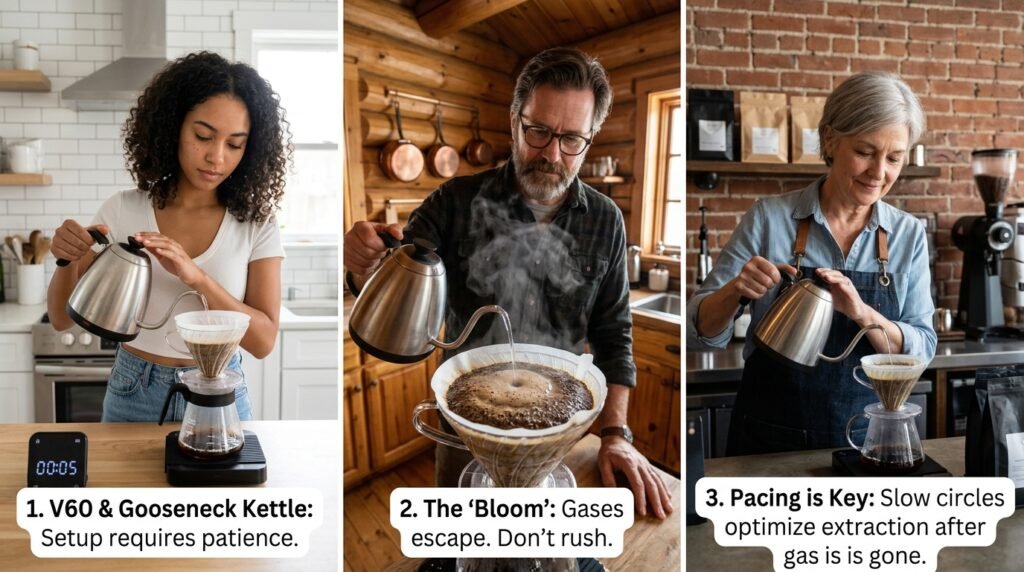
I bought a glass V60 pour-over cone and a stainless steel gooseneck kettle. The thin, curved spout of the kettle allowed me to pour a slow, incredibly precise stream of water, exactly like the baristas did.
But I had to learn patience.
When you pour hot water over fresh, high-quality coffee, the grounds rapidly release trapped carbon dioxide gas. The coffee bed bubbles, expands, and swells. This is called the “Bloom.”
If you dump all your water in at once, that escaping gas acts as a shield, repelling the water and preventing extraction.
I learned to pour just 45 grams of water to gently wet the grounds, and then I put the kettle down. I wait for forty-five seconds. I let the coffee exhale.
Only after the gas has escaped do I resume my pour in slow, hypnotic, concentric circles. Modifying my physical technique was the cornerstone of (What I Do Differently Now When Making Coffee), because I finally realized that agitation and pacing are just as important as the ingredients.
The First Flawless Cup
I will never forget the morning I finally successfully executed all of these foundational steps at the exact same time.
I ground fresh, light-roast Colombian beans with my manual burr grinder. I used filtered water, heated to exactly 200°F. I placed my V60 on my digital scale, locked in my 1:16 ratio, let the coffee bloom, and poured in slow, gentle circles.
When the dripping stopped, I poured the translucent, ruby-red liquid into my favorite mug.
The aroma was breathtaking. It smelled exactly like a professional café.
I let it cool for a moment, and I took a sip.
My brain completely stalled. The coffee was flawlessly clean. There was absolutely zero bitterness, and no harsh, biting acidity. Instead, it coated my palate with a velvety, heavy sweetness. I could vividly taste notes of milk chocolate, toasted almonds, and a bright, crisp finish of sweet red apple.
It was a masterpiece. And the best part was that I didn’t pay six dollars for it, and I didn’t have to leave my house.
You Have the Power
The illusion of the café is incredibly powerful. The beautiful aesthetics, the expensive machinery, and the aproned baristas are designed to make you feel like they possess a magic you could never replicate.
But it is just an illusion.
Great coffee is not magic. It is just the result of respecting the raw ingredients and controlling a few basic scientific variables.
You do not need a massive commercial espresso machine. You just need to stop buying stale supermarket dust. You need to filter your water, buy a twenty-dollar digital scale, invest in a burr grinder, and learn to respect the temperature of your kettle.
When you meticulously rebuild the pixels of your morning routine and strip away all the chaotic, bitter distractions, you will be absolutely shocked by what is hiding underneath. You have the power to make café-quality coffee in your own kitchen; you just have to be willing to do the work.

My name is Daniel Carter, I am 35 years old, and I live in the United States. I have been passionate about aquariums for many years, and what started as a simple hobby quickly became a lifelong interest in aquatic life, fish behavior, and responsible tank care.
Through TheBrightLance, I share real experiences, practical knowledge, and honest lessons learned from maintaining different types of aquariums. I enjoy testing equipment, studying fish behavior, improving maintenance routines, and helping beginners avoid common mistakes.
My goal is to make aquarism easier, more ethical, and more enjoyable for everyone — whether you are setting up your very first tank or looking to refine your techniques.