
For what seemed like forever, my relationship with coffee was purely transactional. I didn’t drink it for pleasure. I drank it because I had an early commute, a long to-do list, and a brain that refused to function before 8:00 AM.
Because of this mindset, my coffee buying strategy was embarrassingly simple: walk into the supermarket, find the largest container of pre-ground coffee available, and make sure it was on sale. If it came in a massive plastic tub that looked like it could survive a nuclear winter, even better.
I genuinely believed I was hacking the system. I would look at the small, beautiful bags of specialty whole beans selling for three times the price and think, Who on earth is wasting their money on that? Coffee is just coffee.
I was so incredibly wrong.
Today, if you look in my kitchen pantry, you won’t find a single plastic tub. You won’t find anything pre-ground. Instead, you will find carefully sealed bags of whole beans, complete with roast dates, origin details, and tasting notes.
Making the switch wasn’t just a slight upgrade in my morning routine; it completely shifted how I view food, agriculture, and my own daily rituals. Here is the honest story of why I finally stopped buying cheap coffee, what I learned along the way, and why I could never, ever go back to the bitter dark dust of my past.
The Illusion of “Strong” Coffee
To understand my transformation, you have to understand what I used to drink.
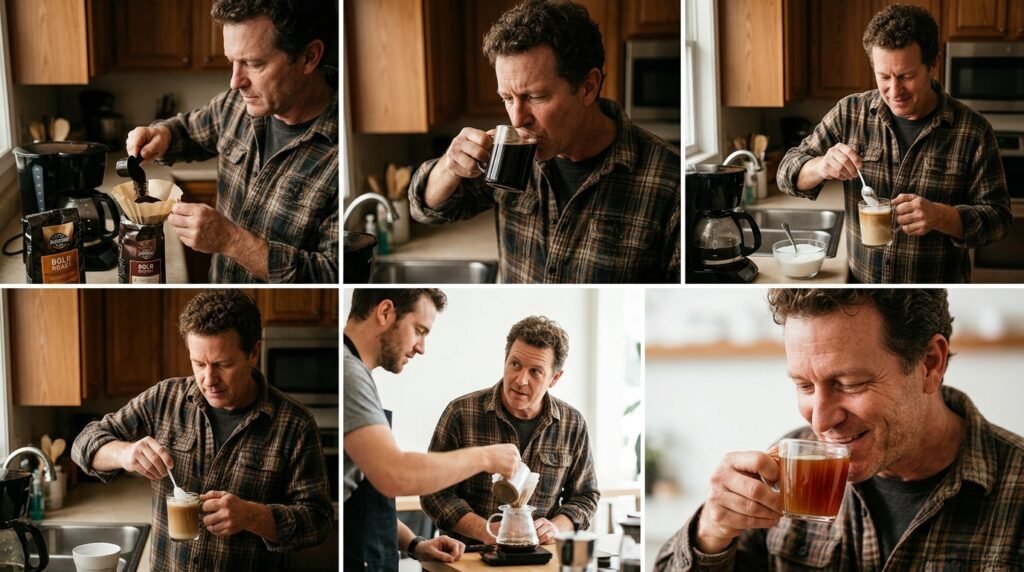
Every morning, I would scoop a generous amount of dark, almost black, oily coffee grounds into a paper filter. I would press the button on my cheap drip machine, and it would spit and sputter hot water over the grounds.
The resulting liquid was aggressive. It tasted like ash, burnt rubber, and harsh bitterness.
But for years, I equated that harsh bitterness with “strength.” I thought that if a coffee made me wince slightly when I drank it black, it meant it had a lot of caffeine. It meant it was doing its job. Because it tasted so aggressive, I would drown it in milk and sugar just to make it palatable. I wasn’t tasting coffee; I was tasting hot coffee-flavored milk.
I didn’t realize it at the time, but the coffee I was buying wasn’t strong. It was just burnt.
When you buy bulk commodity coffee, you are often buying beans that have been roasted to the absolute extreme. Why? Because the beans themselves are usually of incredibly low quality. They are often a mix of beans from different countries, harvested by machines, picking unripe, overripe, and defective cherries all at once.
To hide the terrible, inconsistent flavor of these cheap beans, massive commercial roasters use a technique simple enough to understand: they roast them until they are basically charcoal. When you burn something, you eliminate its original flavor.
That “bold, French roast” flavor I thought I loved was actually just the taste of the roasting process, designed to mask the taste of cheap, defective agricultural products.
The Awakening: A Cup of Ethiopian Guji
My perspective shattered completely during a weekend trip to a neighboring city. I was staying at a boutique hotel that happened to have a highly-rated specialty coffee shop attached to the lobby.
I walked in, completely jet-lagged, and asked for a large black coffee.
The barista asked if I wanted to try their current feature: a naturally processed Heirloom variety from the Guji region in Ethiopia. I had no idea what any of those words meant, but I nodded and paid.
When he handed me the cup, I immediately noticed the color. It wasn’t the pitch-black liquid I was used to. It was a deep, translucent ruby red, almost like a dark tea.
I took a sip. I stopped walking. I actually turned around and stared at the cup in my hand.
There was no burnt taste. There was no ash. Instead, my mouth was flooded with the most incredible flavors. It tasted vibrantly sweet, with distinct notes of ripe blueberries, jasmine flowers, and a smooth, syrupy finish that lingered on my tongue. It had a delicate, tea-like body that was incredibly refreshing.
It was a revelation. It tasted like a completely different beverage. If you have ever read about The First Time I Tried Ethiopian Coffee (And Loved It), you know that this specific region produces beans that can completely rewire your brain’s expectation of what coffee should be.
I went back to the counter and asked the barista what kind of syrup he had pumped into my cup.
He laughed. “There’s no syrup in there,” he said. “That is just the natural flavor of the coffee bean. It’s a fruit, after all.”
That single sentence completely changed my trajectory. Coffee is a fruit. ### Unmasking the Supermarket Tub
When I got home from that trip, I looked at the giant plastic tub of pre-ground coffee on my counter with deep suspicion.
I started researching. I fell down a rabbit hole of coffee agriculture, roasting chemistry, and global supply chains. The more I read, the more horrified I became at what I had been consuming for the past decade.
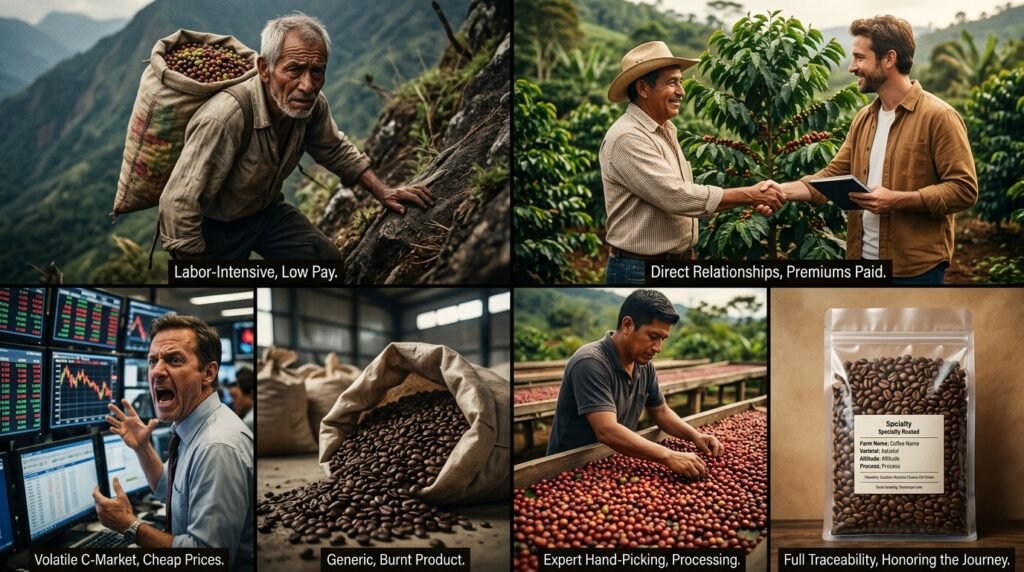
I learned about the “C-Market,” the global commodity exchange where coffee is traded like wheat or crude oil. When coffee is sold as a commodity, the focus is entirely on yield and volume, not flavor. Farmers are paid abysmally low prices, forcing them to cut corners.
I learned about the high allowable defect rate in commodity coffee. The cheap stuff often contains beans that have been eaten by insects, beans that have molded, and “quakers” (unripe beans that never developed sugars).
Suddenly, the extreme dark roasting made perfect sense. If you take a handful of high-quality, perfectly ripe blueberries and a handful of bruised, unripe, and moldy blueberries, and you burn them both to a crisp in an oven… they will both just taste like burnt matter.
By buying the cheapest coffee available, I wasn’t being financially savvy. I was actively funding a broken system that produced a terrible agricultural product.
The Freshness Factor: Why Pre-Ground Is a Trap
Beyond the quality of the beans themselves, I realized another fatal flaw in my old routine: buying pre-ground coffee.
Coffee beans are full of volatile aromatic compounds and delicate oils. These are the things that give coffee its amazing smells and flavors—the blueberry notes of an Ethiopian Guji, or the deep chocolate notes of a Brazilian bean.
However, these compounds are highly unstable. As soon as a coffee bean is roasted, it begins to slowly lose these flavors. But the real enemy is oxygen.
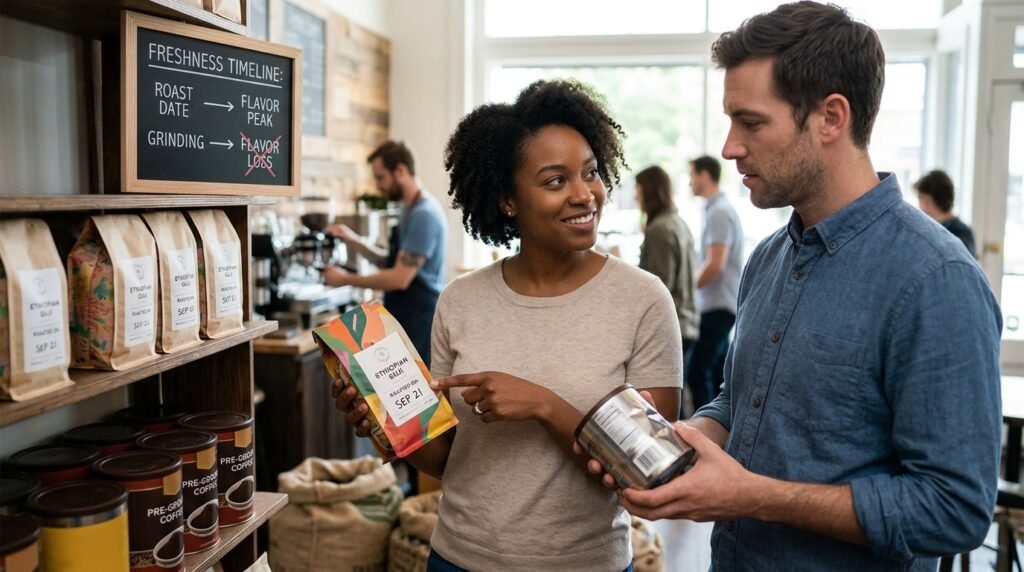
When you grind a coffee bean, you are exponentially increasing its surface area, exposing all those delicate oils to the air. The moment coffee is ground, it begins to go stale incredibly fast. Most experts agree that ground coffee loses the vast majority of its unique flavor characteristics within 15 to 30 minutes.
Think about that for a second.
The coffee sitting in that supermarket tub was roasted months, sometimes years, ago. It was then ground up, thrown into a container, and left to sit on a warehouse shelf, then a grocery store shelf, and finally, my pantry shelf.
By the time I scooped it into my machine, it wasn’t just low-quality coffee; it was entirely dead. It was a ghost of a beverage.
Understanding this timeline was crucial for me. In fact, learning Why I Check Coffee Dates Before Buying became my first real line of defense against bad coffee. I realized that looking for a “Roasted On” date, rather than an arbitrary “Best By” date, was the key to unlocking actual flavor in my cup.
Making the Switch: The Transition Period
I won’t lie; the transition from cheap bulk coffee to specialty coffee felt a little intimidating at first.
I didn’t have a fancy espresso machine or a high-end burr grinder. I was worried that buying expensive beans would be a waste if I didn’t know how to brew them like the barista at the boutique hotel.
But I decided to start small. I bought an inexpensive, entry-level hand grinder and a simple plastic V60 pour-over cone. I went to a local roaster in my city and bought a bag of whole beans that had been roasted just four days prior.
The first time I ground the beans in my kitchen, the aroma was intoxicating. It filled the entire room with the smell of toasted nuts and brown sugar. It was entirely different from the flat, cardboard smell of my old plastic tub.
Brewing it required a bit more attention than just pressing a button, but I quickly realized that this wasn’t a chore. It was a ritual. Pouring the water, watching the coffee bloom (the release of trapped carbon dioxide gas—a sign of fresh coffee), and taking those first few sips became a moment of mindfulness in my chaotic mornings.
I was learning on the fly. I discovered How I Started Recognizing Good Coffee Without Being an Expert simply by paying attention to what I was tasting. I didn’t need a certified palate to know that the fresh, locally roasted coffee tasted vibrant, clean, and naturally sweet, while my old coffee tasted like punishment.
The Financial Reality: Why “Expensive” Coffee Is Actually Cheaper
The biggest mental hurdle I had to overcome was the price.
A tub of my old commodity coffee cost maybe $10 and lasted a month. A bag of fresh, specialty coffee from a local roaster cost $20 and lasted two weeks. On paper, my coffee budget quadrupled.
But here is the fascinating psychological shift that occurred: my relationship with the beverage changed entirely.
When I drank cheap coffee, I drank a lot of it. I would drink three or four mugs a day, chasing caffeine and trying to mask the bad taste with constant sips. I was mindlessly consuming it.
Furthermore, because my home coffee tasted so bad, I would often cave by 2:00 PM and go to a commercial coffee chain, spending $6 on a sugary latte just to get through the afternoon.
When I switched to specialty coffee, everything slowed down. I was paying $20 for a bag of beans, which yielded about 15 to 18 excellent cups of coffee. That comes out to slightly over $1 per cup.
Because the coffee was so delicious, so complex, and so satisfying, I stopped mindlessly chugging it. One perfect, meticulously brewed cup in the morning was all I needed. I savored it. I stopped buying $6 sugary lattes in the afternoon because they no longer tasted good compared to what I could make at home.
In the end, by spending more on a bag of high-quality beans, I actually saved money. I eliminated the impulse café purchases, and I turned a mindless caffeine addiction into an affordable daily luxury.
Respecting the Farm, Respecting the Cup
The final reason I will never go back to cheap coffee is simply a matter of respect.
Specialty coffee is built on transparency. When I buy a bag of beans now, I usually know the name of the farm or the cooperative that grew it. I know the altitude, the processing method, and the specific varietal of the plant.
I know that the farmer was paid a premium price for producing a premium product, entirely separate from the volatile, exploitative commodity C-Market.
Coffee is one of the most labor-intensive agricultural products on earth. It is planted on steep mountainsides, hand-picked cherry by cherry, carefully fermented, washed, dried, sorted, shipped across the ocean, and meticulously roasted.
When you buy a bag of cheap, burnt dust, you are disrespecting that entire chain of human effort. When you buy properly sourced, freshly roasted whole beans, you are honoring the incredible journey that seed took to get into your cup.
Conclusion: Take the Leap
If you are still scooping pre-ground dark roast out of a plastic tub every morning, I completely understand. I was there for a decade. It’s easy, it’s familiar, and it provides the caffeine hit you need.
But I challenge you to break the cycle just once.
Find a local roaster. Buy one bag of freshly roasted, light-to-medium roast whole beans. If you don’t have a grinder, ask them to grind it for you (it’s not perfect, but it’s a huge step up). Go home, brew it carefully, and drink it black.
You might not taste blueberries and jasmine on your first try. You might just taste something that is surprisingly smooth, naturally sweet, and free of that harsh, ashy bitterness.
But I promise you, once you realize that coffee is an agricultural product full of vibrant, incredible flavors, the illusion of the supermarket aisle will shatter.
You will start chasing the perfect cup. You will start enjoying your mornings a little bit more. And, like me, you will completely stop buying cheap coffee and never look back.

My name is Daniel Carter, I am 35 years old, and I live in the United States. I have been passionate about aquariums for many years, and what started as a simple hobby quickly became a lifelong interest in aquatic life, fish behavior, and responsible tank care.
Through TheBrightLance, I share real experiences, practical knowledge, and honest lessons learned from maintaining different types of aquariums. I enjoy testing equipment, studying fish behavior, improving maintenance routines, and helping beginners avoid common mistakes.
My goal is to make aquarism easier, more ethical, and more enjoyable for everyone — whether you are setting up your very first tank or looking to refine your techniques.