
I almost sent my drink back to the barista.
I was sitting at a small, slightly wobbly wooden table near the window of a bustling, modern coffee shop. It was a Saturday morning, and the place was packed with people typing furiously on laptops and chatting over massive, foamy lattes.
But I wasn’t looking at a latte. I was staring down at a small glass carafe and a ceramic mug that had just been placed in front of me.
I had ordered a black coffee. I expected to receive a mug full of heavy, pitch-black, steaming liquid. The beverage sitting on my table, however, looked entirely wrong.
It wasn’t black at all. It was translucent. It had a deep, ruby-red, almost amber hue. When I held the glass carafe up to the light coming through the window, I could see right through it. It looked exactly like a strong cup of Earl Grey tea.
My immediate thought was that the barista had made a mistake. I assumed they had accidentally brewed my coffee with a used filter, or that the water-to-coffee ratio was wildly off, resulting in a weak, watery mess.
I was just about to stand up, walk back to the counter, and politely ask for a proper, strong cup of coffee.
But then, I leaned over the carafe.
The steam rising from the hot liquid hit my nose, and I physically froze in my chair. That single breath of air completely short-circuited my brain. It was the moment that split my coffee-drinking life into two distinct eras: everything before that Saturday, and everything after.
Here is the incredibly honest, sensory-overloading story of the first time I tried Ethiopian coffee, why it completely shattered my understanding of flavor, and how it sparked an obsession that I am still happily feeding today.
The Aromatic Confusion
Before I tell you how it tasted, I have to explain how it smelled, because the aroma was the first major clue that I was out of my depth.
For my entire adult life, the smell of coffee was singular. It smelled like roasted wood, smoke, caramel, and sometimes a faint hint of dark chocolate. It was a heavy, grounding scent.
The translucent red liquid sitting on my table did not smell like roasted wood.
It smelled like a botanical garden. It was intensely floral. The most dominant scent was a vibrant, sweet aroma of jasmine flowers. Right behind the jasmine was the undeniable, juicy scent of ripe peaches and fresh citrus.
I looked around the café, genuinely wondering if someone was slicing fresh fruit or pouring a heavily perfumed tea nearby.
But the smell was coming directly from my mug. It was intoxicating. It was elegant. I had absolutely no idea that a roasted coffee bean was biologically capable of producing a scent that delicate and sweet.

The First Sip
I poured the red liquid from the carafe into my ceramic mug. I let it sit for a minute, remembering a piece of advice I had heard: boiling hot water burns your tastebuds and hides the true flavor of a beverage.
I wrapped my hands around the warm mug, brought it to my lips, and took a slow, hesitant sip.
I braced myself for the harsh, metallic bitterness that usually accompanied a sip of black coffee. I waited for the scrape at the back of my throat. I waited for the dry, ashy aftertaste.
It never came.
There was zero bitterness. The liquid was incredibly smooth, light, and almost silky on my tongue. The body of the coffee—the physical weight of the liquid—felt exactly like drinking a fine tea.
And then, the flavors exploded.
It was naturally, remarkably sweet. I didn’t need to add a single grain of sugar. The sweetness wasn’t artificial or cloying; it was the crisp, refreshing sweetness of a ripe stone fruit. I could vividly taste fresh peaches, a hint of bright lemon zest, and a lingering, beautiful black tea finish.
I slowly lowered the mug and stared at it in absolute disbelief.
How was this coffee? I felt like I had been lied to my entire life. I had spent years choking down burnt, bitter sludge, completely unaware that coffee could taste like a vibrant, juicy fruit.
Seeking Answers at the Counter
I drank the entire carafe without looking at my phone once. I was completely captivated by how the flavors shifted and became even sweeter as the coffee cooled down to room temperature.
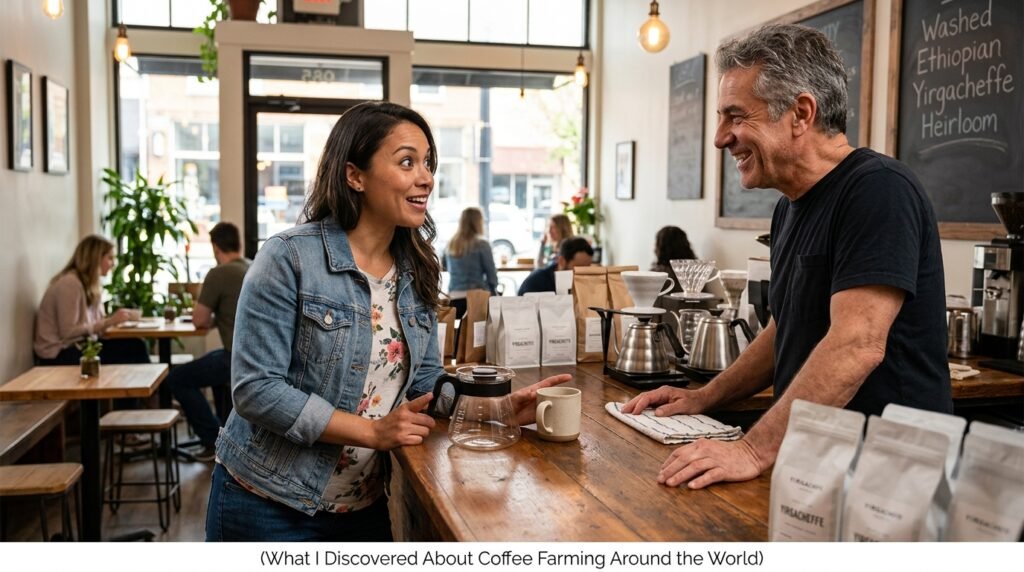
When my mug was empty, I grabbed the glass carafe, walked straight up to the barista who had served me, and placed it on the counter.
“What exactly did you just serve me?” I asked.
He grinned broadly. He knew exactly what had just happened. “That was a manual pour-over,” he said. “It’s a washed Ethiopian coffee from the Yirgacheffe region. Specifically, an Heirloom variety. I take it you liked it?”
I told him it was the most incredible thing I had ever tasted, and I demanded to know how it was physically possible for coffee to taste like peaches and jasmine flowers without any added syrups.
That morning, leaning against the counter of that bustling café, I received my first real education in coffee agriculture.
The barista explained that Ethiopia is the literal birthplace of the Arabica coffee plant. Unlike massive, mechanized farms in other parts of the world, Ethiopian coffee often grows wild in ancient, high-altitude forests.
Because the plants are ancient, naturally occurring varieties—referred to collectively as “Heirloom”—they possess a wildly complex genetic structure. They haven’t been cross-bred in a laboratory to prioritize high yields; their genetics are purely focused on flavor.
Learning about this wild, ancient farming method completely blew my mind. Understanding the incredible history behind these plants is exactly (What I Discovered About Coffee Farming Around the World), because it proved that human intervention isn’t always better than letting nature do its job.
The Magic of the High Altitudes
But the genetics of the Heirloom plant were only half of the story. The barista went on to explain the crucial role of the Ethiopian landscape.
Regions like Yirgacheffe, Sidamo, and Guji are situated at extreme altitudes, often well over 2,000 meters above sea level.
At these dizzying heights, the air is cold, especially at night. Because of the cold temperatures, the coffee cherries on the branches mature at an incredibly slow pace.
Think about a tomato grown quickly in a hot greenhouse versus a tomato grown slowly in a sunny, nutrient-rich garden. The slow-grown fruit is always sweeter and more complex.
The same rule applies to coffee. The slow maturation process in the Ethiopian mountains forces the coffee plant to push massive amounts of complex sugars and organic acids directly into the seed.
When those seeds are carefully harvested and gently roasted, those sugars and acids translate directly into the cup as notes of peach, blueberry, citrus, and jasmine.
The profound impact of this geography was a massive wake-up call for me. Realizing that the dirt, the elevation, and the climate dictate the flavor in my mug is precisely (Why I Now Pay Attention to Coffee Origin and Type), because I finally understood that I was drinking a map, not just a brand name.
The Washed vs. Natural Dilemma
Before I left the café, the barista gave me one final piece of knowledge that would shape my buying habits for years to come.
He explained that the specific coffee I drank that day was “Washed.”
This meant that immediately after the farmers picked the ripe red coffee cherries, they stripped the fruity pulp off the seed and washed it clean in water tanks before laying it out in the sun to dry.
Because the fruit was removed so quickly, the flavor I experienced was the pure, unadulterated genetic flavor of the seed itself. That is why the coffee tasted so clean, structured, and tea-like. It highlighted the crisp acidity and the delicate floral notes.
But he warned me that Ethiopia is also famous for another processing method: the “Natural” process.
In a Natural processed coffee, the farmers do not remove the fruit. They lay the entire, intact coffee cherry out on raised beds in the hot African sun. As the fruit dries and shrivels up like a raisin, it begins to ferment slightly. All of those heavy, syrupy fruit sugars seep directly through the skin and into the seed.
He told me that if I ever bought a Natural processed Ethiopian coffee, I shouldn’t expect a clean, tea-like cup with delicate jasmine notes. Instead, I should expect a wild, explosive, heavy cup that tastes remarkably like strawberry jam or blueberry pie.
The Start of a Lifelong Obsession
I left the café that Saturday morning a changed person. I bought a bag of those Ethiopian Yirgacheffe beans, a digital scale, and a simple pour-over cone before I walked out the door.
My journey into specialty coffee had officially begun, and it all started with that translucent, ruby-red cup of floral magic.
Over the next few years, I dedicated myself to exploring the incredible diversity of Ethiopian coffees. I moved from the bright, lemony profiles of Yirgacheffe to the heavy, blueberry-bomb profiles of the Sidamo region.
But eventually, I found my absolute holy grail: the Guji region.
Ethiopian Guji coffees seemed to perfectly bridge the gap. They offered the delicate, floral elegance of a Yirgacheffe, but with a deeper, juicier stone-fruit sweetness that I simply couldn’t get enough of.
Whether it was a crisp, peach-forward washed Guji on a sunny morning, or a wild, strawberry-laced natural Guji on a lazy Sunday, I was captivated.
The consistency of this sensory joy is the ultimate reason (Why I Keep Going Back to African Coffees). While I deeply respect the heavy, chocolatey comfort of South American beans, nothing makes my heart beat faster than the bright, floral awakening of a high-altitude Ethiopian roast.

Breaking the Bitterness Myth
The most important thing my first Ethiopian coffee did was break the myth of bitterness.
For my entire life, I believed that coffee was inherently, unavoidably bitter. I thought adding milk and sugar was a mandatory survival tactic.
But Ethiopian coffee proved that bitterness is usually the result of human error.
Bitterness comes from cheap, defective beans. It comes from massive commercial companies roasting their beans into dark, oily, carbonized rocks. It comes from brewing with water that is too hot, or grinding the beans too fine.
When you start with a flawless, hand-picked Ethiopian Heirloom seed, roast it gently to preserve its natural sugars, and brew it with care, bitterness simply does not exist.
You are left with a beverage that is as complex and elegant as a fine wine, but accessible enough to enjoy in your pajamas at seven in the morning.
Take the Leap
If you are reading this and you have never experienced a light-roast, single-origin Ethiopian coffee, I am incredibly jealous of you. I wish I could go back and experience that initial, mind-blowing shock for the very first time.
I know it can be intimidating. The coffee might look too light. It might look like tea. The idea of tasting flowers in your morning mug might sound completely absurd.
But I urge you to step out of your comfort zone.
Find a reputable local specialty roaster. Walk up to the counter and ask for a manual pour-over of their best washed Ethiopian coffee.
Do not add milk. Do not add sugar.
Just let it cool for a minute, bring the mug to your face, take a deep breath of that jasmine aroma, and take a sip.
I promise you, your definition of coffee will be completely shattered. You will discover an entire universe of vibrant, natural flavor that you never knew existed. And just like me, you might find yourself walking out the door with a bag of beans, completely obsessed, and never looking back at the dark, bitter sludge ever again.

My name is Daniel Carter, I am 35 years old, and I live in the United States. I have been passionate about aquariums for many years, and what started as a simple hobby quickly became a lifelong interest in aquatic life, fish behavior, and responsible tank care.
Through TheBrightLance, I share real experiences, practical knowledge, and honest lessons learned from maintaining different types of aquariums. I enjoy testing equipment, studying fish behavior, improving maintenance routines, and helping beginners avoid common mistakes.
My goal is to make aquarism easier, more ethical, and more enjoyable for everyone — whether you are setting up your very first tank or looking to refine your techniques.