
I kept standing in front of a massive, floor-to-ceiling chalkboard menu at a famous multi-roaster café in downtown Chicago, holding up the line.
The barista was staring at me patiently, a pen hovering over a paper cup. I had a seemingly impossible decision to make. This café was famous for sourcing the most exclusive, rare, and highly-rated coffees from all over the globe.
The menu was a coffee nerd’s absolute dream. There was a rare Gesha variety from Panama that promised notes of papaya and honey. There was a wild, experimental anaerobic fermentation from Colombia. There was a legendary, heavy-bodied dark roast from the volcanic slopes of Guatemala.
I stood there for three full minutes, mentally debating which exotic adventure I was going to take my palate on that morning. I wanted to be adventurous. I wanted to step outside my comfort zone.
But when the barista finally asked, “What can I get started for you?” my mouth betrayed my brain.
“I’ll have the washed Ethiopian pour-over, please,” I said.
I walked away from the counter shaking my head at myself. Out of all the incredibly rare, innovative, and unique coffees on that wall, I had instinctively defaulted to my absolute baseline. I had chosen the exact same flavor profile I brew in my own kitchen almost every single morning.
It was a profound realization of my own biases. I am a culinary homing pigeon. No matter how far I travel across the global coffee map, my palate always acts like a magnetic compass needle, snapping violently back to point toward East Africa.
Here is the honest, obsessive story of why I keep going back to African coffees, the brilliant agricultural science that makes them impossible to replicate, and why this specific continent holds an unbreakable grip on my morning routine.
The Problem with Perfection
To understand my obsession with Africa, you have to understand the concept of palate fatigue and the “problem” with absolute perfection.
There is no denying that South American coffees—specifically those from Brazil and Colombia—are spectacular. They are the backbone of the global industry. When they are grown at high altitudes and roasted by a skilled artisan, they offer an undeniably perfect, balanced cup of coffee.
They taste like rich milk chocolate, toasted almonds, sweet caramel, and warm brown sugar. They are the ultimate comfort beverages.
But for my personal taste, that comforting perfection eventually becomes a little too safe.
If I drink a perfectly balanced, chocolate-heavy South American coffee every single day for a week, my brain stops paying attention to it. It just becomes a warm background noise to my morning commute. It doesn’t challenge me. It doesn’t make me stop what I am doing and analyze the liquid on my tongue.
I realized that establishing a hierarchy in my kitchen was essential. When I finalized (My Personal Ranking of Coffee Origins I’ve Tried), I noticed a glaring trend at the very top of the list. The coffees that occupied the number one spot were never the safe, comforting ones.
They were always the wild, loud, vibrant coffees that demanded my undivided attention. And those coffees almost exclusively came from Africa.

The Illusion of Tea
The primary reason I am continually drawn back to the African continent is the physical texture of the coffee itself.
When you brew a high-altitude African coffee—especially if you use a paper filter method like a V60 or a Chemex—the resulting liquid does not look or feel like traditional coffee.
It is often translucent. It has a beautiful, glowing, ruby-red or pale amber color. When you take a sip, the physical weight of the liquid (the body) is incredibly light. It doesn’t coat your mouth with heavy, syrupy oils. It glides across your palate with the crisp, clean elegance of a fine Earl Grey or Jasmine green tea.
This tea-like quality completely redefined my mornings.
It feels refreshing. It feels like a vibrant awakening rather than a heavy, dark plunge into the day. It is a beverage that lifts my senses up instead of weighing them down. This delicate body is the perfect stage for the true magic of African coffee: the explosive acidity.
The Definition of “Bright”
If you tell a casual coffee drinker that your favorite coffee is highly acidic, they will usually look at you with a mixture of pity and disgust.
In the commercial coffee world, the word “acidic” is synonymous with “sour.” It conjures memories of cheap diner coffee that has been sitting on a scorching hot plate for four hours, resulting in a harsh, metallic, stomach-churning bitterness.
But in the specialty coffee world, acidity is a virtue. We call it “brightness.”
African coffees are the undisputed kings of brightness. Because the farms in Ethiopia, Kenya, Rwanda, and Burundi are situated at staggering altitudes, the freezing mountain nights force the coffee cherries to mature incredibly slowly.
This slow maturation allows the plant to pack massive amounts of complex, natural fruit acids into the seed.
When you roast these seeds very lightly and brew them with care, that acidity does not taste sour. It tastes like the crisp, mouth-watering snap of a fresh green apple. It tastes like the zesty spray of a freshly peeled orange. It tastes like biting into a ripe, juicy peach.
The first time I encountered this natural, vibrant fruit acidity was a massive turning point in my life. The sheer shock of that initial tasting is exactly (My Experience Trying Coffee From Africa for the First Time), because it completely shattered my preconceived notion that coffee had to taste like burnt wood and dark cocoa.
I keep going back to African coffees because I am completely addicted to that bright, fruit-forward spark.

The Ancient Library of Ethiopia
While I love the entire continent, the magnetic center of my coffee obsession will always be Ethiopia.
Ethiopia is the literal, biological birthplace of the Arabica coffee species. Walking through an Ethiopian coffee farm is not like walking through a mechanized, perfectly manicured agricultural facility in Brazil. It is like walking through an ancient, wild forest.
The genetics of Ethiopian coffee are completely untamed.
In most of the world, farmers plant specific, laboratory-tested hybrid varieties designed for high yields and disease resistance. But in Ethiopia, the coffee trees are a chaotic, beautiful mix of thousands of naturally mutating, ancient varieties collectively known as “Heirloom.”
Because the DNA of these plants is so wildly diverse and untouched by modern genetic engineering, the flavors they produce simply cannot be replicated anywhere else on the planet.
When I brew a washed Heirloom coffee from the Guji or Yirgacheffe regions, I am tasting ancient botany. The dominant notes are almost always intensely floral. It smells like a blooming garden of jasmine and honeysuckle, followed by the undeniable, sweet flavor of ripe stone fruit.
There is an elegance to Ethiopian coffee that feels almost aristocratic. It is so naturally sweet and perfumed that adding milk or sugar to it feels like an absolute crime against nature.
The Kenyan Loudspeaker
If Ethiopia is an elegant, acoustic string quartet, then neighboring Kenya is a massive, distorted electric guitar playing at maximum volume.
I constantly bounce back and forth between these two countries because they offer such a brilliant, whiplash-inducing contrast.
Kenyan coffee is famous for being incredibly aggressive. The soil on the slopes of Mount Kenya is a deep, vibrant red, packed with iron and phosphoric acid. The plants absorb this phosphoric acid directly into the seeds.
Furthermore, Kenyan farmers primarily grow a specific, legendary genetic variety called SL-28, which is famous for its intense fruit profiles.
When I brew a Kenyan SL-28, it does not taste like delicate jasmine flowers. It punches my palate with the sharp, acidic tartness of a pink grapefruit, followed by a massive, savory-sweet wave of dark blackberries and black currant.
It is a loud, bold, and incredibly complex cup of coffee. It makes the sides of my mouth water. It is the ultimate weekend coffee, meant for days when I have the time to sit down, stare out the window, and actively decipher the massive wall of flavor hitting my tongue.
The Rising Stars: Rwanda and Burundi
My obsession with the continent eventually led me slightly south, away from the giants of Ethiopia and Kenya, and into the incredibly beautiful, high-altitude hills of Rwanda and Burundi.
These countries are the rising stars of the specialty coffee world, and they have secured a permanent spot in my kitchen pantry.
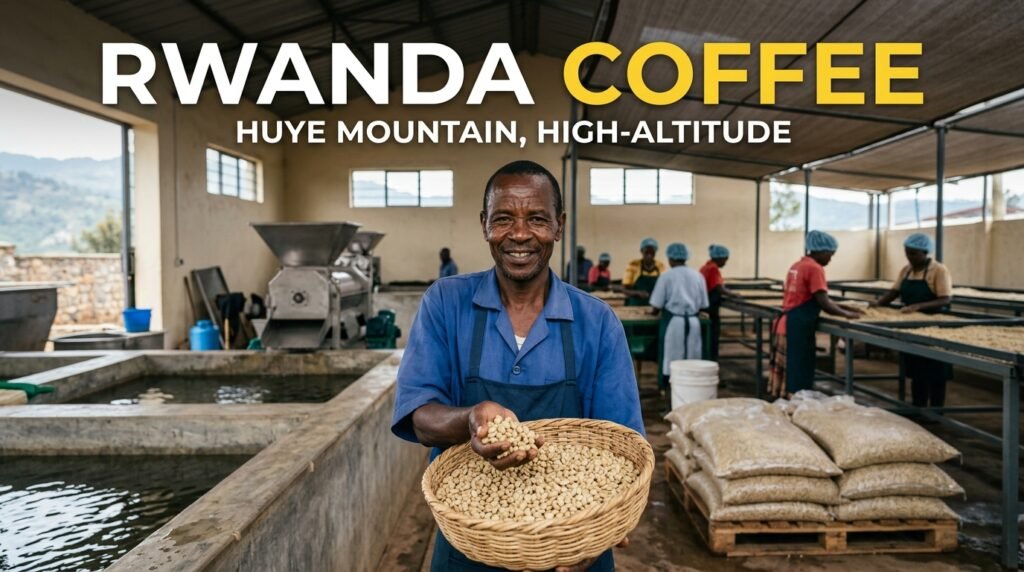
Rwandan coffees, often grown from the classic Bourbon genetic variety, offer a brilliant middle ground. They possess the bright, vibrant acidity of East Africa, but they carry a slightly heavier, syrup-like body.
When I drink a coffee from the Huye Mountain region of Rwanda, I often taste deep notes of red apple, baking spices, dark cherry, and a rich, brown-sugar sweetness. It bridges the gap between the wild fruit of Kenya and the comforting sweetness of South America.
Exploring these smaller, recovering nations expanded my understanding of the continent’s potential. It proved that my palate’s geographical bias was entirely justified. Understanding the profound impact these specific regions have on the global market is precisely (The Coffee Origin That Changed My Taste Preferences), because it forced me to realize that true culinary excitement usually lies off the beaten path.
The Ritual of Precision
There is one final, slightly masochistic reason why I keep returning to African coffees: they force me to be a better brewer.
A heavy, dark-roasted Indonesian or South American coffee is very forgiving. If you accidentally use water that is slightly too hot, or if you mess up your pouring technique, the coffee will still taste perfectly fine. The heavy chocolate notes will mask your mistakes.
African coffees do not forgive.
Because they are roasted so lightly to preserve their delicate floral and fruit notes, their cellular structure remains very tight and dense. They are notoriously difficult to extract properly.
If I grind my Ethiopian beans just a fraction of a millimeter too fine, the water gets trapped, over-extracts the tannins, and my beautiful peach tea turns into a bitter, aspirin-like disaster. If I use water that is too cold, the coffee tastes weak, sour, and hollow.
Brewing African coffee requires absolute, undivided attention. It requires a digital scale, a high-quality burr grinder, a gooseneck kettle, and a precise pouring technique.
I love this requirement.
It turns my morning routine into a mandatory meditation session. I cannot look at my phone or check my emails while I brew a Kenyan pour-over. I have to watch the bloom. I have to monitor the flow rate. I have to be completely present in the moment.
Finding Your North Star
I will never stop advocating for people to explore the entire global coffee map. You should absolutely buy bags from Colombia, Costa Rica, Sumatra, and Peru. You need to understand the heavy, comforting baseline of the coffee world to truly appreciate its peaks.
But I also believe that every coffee lover eventually finds their North Star.
You eventually find that one specific region, that one specific flavor profile, that makes your eyes widen and your heart beat just a little bit faster.
For me, that North Star is permanently fixed over the high-altitude, volcanic mountains and ancient, wild forests of East Africa.
No matter how many exotic, experimental, or wildly expensive coffees I try from the rest of the world, I know that when I am standing in front of a massive café menu, completely paralyzed by choice, I will always default to the bright, floral, tea-like elegance of an African pour-over.
It is the flavor that woke up my palate, and it is the flavor I will happily chase for the rest of my life.

My name is Daniel Carter, I am 35 years old, and I live in the United States. I have been passionate about aquariums for many years, and what started as a simple hobby quickly became a lifelong interest in aquatic life, fish behavior, and responsible tank care.
Through TheBrightLance, I share real experiences, practical knowledge, and honest lessons learned from maintaining different types of aquariums. I enjoy testing equipment, studying fish behavior, improving maintenance routines, and helping beginners avoid common mistakes.
My goal is to make aquarism easier, more ethical, and more enjoyable for everyone — whether you are setting up your very first tank or looking to refine your techniques.