
I cleared my entire dining room table on a Sunday morning. I pushed the fruit bowl aside, moved the mail pile, and wiped the wood completely clean.
I wasn’t preparing to host a massive family breakfast. I was preparing to build a caffeinated world map.
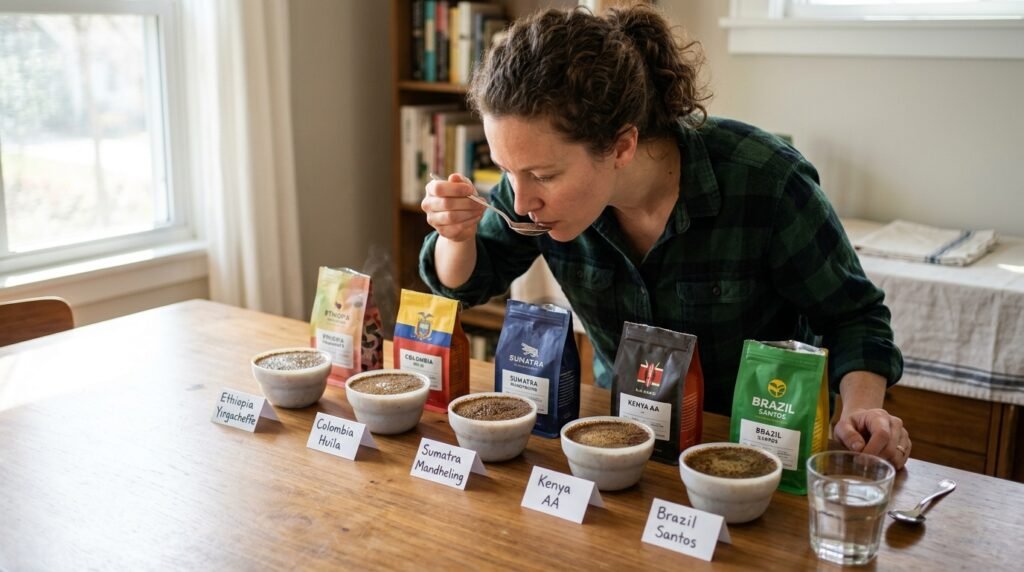
Lined up in front of me were five distinct bags of specialty coffee beans. They looked like five passports waiting to be stamped. I had deliberately spent the past few weeks visiting different local roasters to collect single-origin beans from five completely different coffee-producing nations across the globe.
For months, I had been jumping from bag to bag, enjoying my morning coffee but never truly understanding the contrast between regions. Human memory is flawed. You cannot accurately compare a coffee you drank in January to a coffee you drank in March.
I wanted to taste the globe all at once. I wanted to understand exactly how the soil, the climate, and the altitude of a specific country translated into the liquid in my mug.
So, I set up an industry-standard tasting experiment—a process called “cupping”—right in my own dining room. I compared coffees from five different countries side-by-side, and what I found completely shattered my understanding of global agriculture. Here is the honest, sensory-overloading breakdown of my worldwide tasting tour.
The Rules of the Global Tasting
Before I could travel the world, I had to lay down some strict ground rules.
If you want to honestly compare five different coffees, you cannot brew them in five different machines. You have to eliminate every single variable except the beans themselves.
I used a method called “cupping,” which is how professional coffee buyers evaluate beans.
I placed five identical, small ceramic bowls on my table. I weighed exactly 12 grams of coffee for each bowl. I ground them all on the exact same medium-coarse setting using my manual burr grinder. I boiled a massive kettle of filtered water to exactly 205 degrees Fahrenheit.
Instead of using paper filters, which can trap oils, you simply pour the hot water directly over the grounds in the bowl and let them steep. A crust of coffee grounds forms at the top. After exactly four minutes, you take a spoon, “break” the crust to release the aroma, and then skim the grounds off the top.
Once the bowls cooled down, I was ready to taste. I grabbed my spoon, a notebook, and prepared for departure.
Country 1: Brazil (The Heavyweight Hug)
My first stop was South America. I dipped my spoon into the Brazilian bowl and brought it to my lips.
When you slurp coffee from a spoon, you aerate it, spraying the liquid across your entire palate. The moment the Brazilian coffee hit my tongue, I felt a deep sense of comforting weight.
It was incredibly heavy and syrupy. There was absolutely zero sharpness or sourness to it. Instead, the flavor was dominated by a rich, dark sweetness. It tasted remarkably like a handful of roasted peanuts mixed with melted milk chocolate.
It didn’t challenge my palate. It just coated my mouth in a warm, familiar embrace.
Brazil is mostly characterized by vast, lower-altitude farms. Because the plants grow in warmer environments, the beans don’t develop sharp, complex fruit acids. Instead, they develop massive amounts of dense, sugary, nutty compounds.
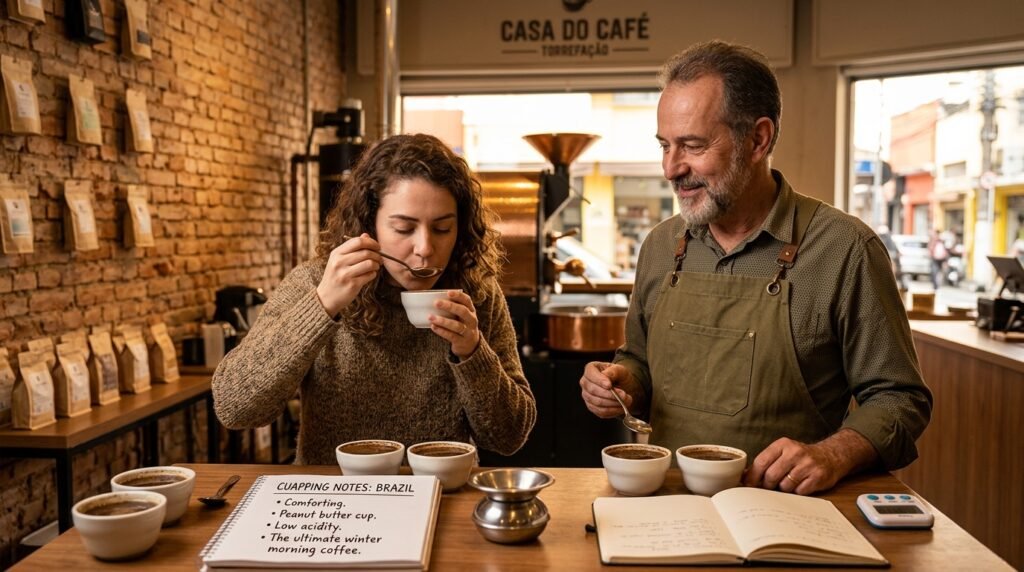
I wrote in my notebook: “Comforting. Peanut butter cup. Low acidity. The ultimate winter morning coffee.”
Country 2: Colombia (The Perfect Tightrope)
I rinsed my spoon in a glass of hot water to cleanse my palate and moved just a few thousand miles north to Colombia.
The contrast was immediate, yet still somehow familiar.
When I tasted the Colombian coffee, the heavy, syrupy body of the Brazilian cup was slightly reduced. The chocolate notes were still there, but they had shifted from milk chocolate to a sweeter, more refined caramel.
But the biggest surprise was the finish. Right as the caramel sweetness peaked, a bright, crisp spark of acidity cut right through the richness. It tasted exactly like biting into a crisp, red apple.
It was a masterclass in balance. Realizing this geographic diversity is the core of (What I Discovered About Coffee Farming Around the World), because the high-altitude volcanic slopes of the Andes mountains clearly injected that vibrant, apple-like acidity that the lower-altitude Brazilian farms simply couldn’t replicate.
I wrote down: “Balanced. Caramel apple. Clean. The ultimate crowd-pleaser.”
Country 3: Indonesia (The Wild Jungle)
It was time to leave the Americas. I crossed the ocean to Southeast Asia and dipped my spoon into the bowl holding coffee from Sumatra, Indonesia.
Before I even tasted it, the aroma rising from the bowl made me pause. It didn’t smell like chocolate, and it didn’t smell like fruit. It smelled earthy. It smelled like damp cedar wood, fresh pipe tobacco, and dark spices.
I took a slurp.
My palate was completely shocked. It was the heaviest coffee on the table by a wide margin. It felt like drinking velvet. The flavor was intensely savory, bold, and almost herbal. There were deep notes of dark chocolate, but they were wrapped in the spicy flavor of clove and black pepper.
The reason for this wild profile is unique to Indonesia. Because the climate is incredibly humid and it rains constantly, farmers use a unique processing method called “Wet-Hulling.” They remove the protective parchment layer of the coffee seed while it is still wet and soft, exposing the raw bean to the humid jungle air as it dries.
This environment physically alters the seed, muting the acidity and amplifying the deep, earthy, heavy characteristics.
I wrote: “Intense. Earthy. Cedar and Spice. Feels like walking through a humid forest.”
Country 4: Kenya (The Vibrant Wake-Up)
I needed a serious palate cleanser after the heavy Indonesian cup. I drank some water, took a deep breath, and traveled to East Africa.
I dipped my spoon into the Kenyan coffee. The moment the liquid aerated across my tongue, my eyes shot wide open.
If the Indonesian coffee was a heavy bassline, the Kenyan coffee was a screaming electric guitar solo.
It was explosive. The body of the coffee was incredibly light, almost resembling a fine wine or a strong juice. The acidity was front and center, but it wasn’t harsh or bitter. It was the sharp, mouth-watering tartness of dark berries.
I could vividly taste blackberries, black currant, and a distinct, savory sweetness that reminded me of sun-ripened cherry tomatoes.
It was aggressively complex. It made the sides of my mouth water. Kenyan coffees are grown in bright red, iron-rich volcanic soils at extreme altitudes, and they are processed with rigorous washing methods. This results in some of the cleanest, brightest, and most fruit-forward coffees on the planet.
It was almost too intense for a casual morning, but as an intellectual tasting experience, it was brilliant.
I wrote: “Explosive. Black currant. Wine-like. A punch of bright fruit.”

Country 5: Ethiopia (The Floral Epiphany)
Finally, I arrived at the birthplace of coffee itself.
I had saved the Ethiopian bowl for last. Specifically, this was a washed Heirloom variety from the Guji region. I had high hopes, but comparing it directly against the loud Kenyan and the heavy Indonesian was going to be the ultimate test.
I dipped my spoon, brought it to my lips, and slurped.
The entire dining room seemed to go quiet. The loud, aggressive berry notes of the Kenyan coffee vanished from my memory. The heavy, earthy spice of Sumatra was entirely forgotten.
The Ethiopian Guji was pure elegance.
It didn’t punch my palate; it glided over it. The liquid was delicate, sweet, and unbelievably fragrant. As it washed over my tongue, the unmistakable flavor of a ripe, juicy peach blossomed in my mouth.
But it was the finish that truly separated it from the rest of the world. As I swallowed, a sweet, lingering note of jasmine flowers settled in the back of my throat. It tasted like I had just drank a high-end Earl Grey tea infused with fresh stone fruit.
There was no bitterness. There was no heavy, earthy residue. It was a flawless, clean, naturally sweet miracle of agriculture.
The sheer consistency of this floral perfection is the undeniable reason (Why I Keep Going Back to African Coffees), because no matter how much I respect the rest of the globe, the ancient genetics of the Ethiopian forest simply cannot be duplicated anywhere else on Earth.
I wrote in my notebook: “Perfection. Peach juice. Jasmine. The undisputed champion.”
The Cooled-Down Revelation
After my first trip around the world, I walked away from the table for twenty minutes.
This is a crucial step in cupping. As coffee cools down to room temperature, the heat stops masking the flavors. The true nature of the bean—its deepest flaws and its greatest strengths—are fully exposed.
When I returned to the table, the results were even more polarizing.
The Brazilian coffee had lost a bit of its charm; without the comforting heat, it tasted a bit flat and one-dimensional. The Indonesian coffee became even more intensely savory, almost tasting too much like wet wood for my preference.
But the Colombian, the Kenyan, and the Ethiopian coffees had transformed into completely different beverages.
The Colombian had become incredibly sweet, tasting like a cold glass of apple cider. The Kenyan had turned into a refreshing, tart blackberry juice.
And the Ethiopian Guji? It had somehow become even sweeter. The peach notes were so vibrant and clear that it felt like drinking nectar.
What This Global Tour Taught Me
Staring at those five empty bowls on my dining room table, I realized how beautifully diverse the coffee world truly is.
I had taken five seeds from the exact same plant species, roasted them to a similar level, and brewed them with the exact same water. Yet, the liquid in those bowls tasted like five completely different beverages.
It proved to me that coffee is not a generic, factory-made product. It is a sponge that absorbs its environment.
When you drink a Brazilian coffee, you are tasting the vast, sun-drenched plains of Minas Gerais. When you drink a Sumatran coffee, you are tasting the humid, spicy air of the Indonesian jungle. When you drink a Kenyan cup, you are tasting the iron-rich red dirt of Mount Kenya.
And when you drink an Ethiopian Guji, you are tasting the ancient, wild, high-altitude forests where coffee first originated.
This experiment gave me the ultimate map for my morning routine. Formulating this mental map became the foundation of (My Personal Ranking of Coffee Origins I’ve Tried), giving me the confidence to buy exactly what I want, when I want it.
I now know that if I want a heavy, comforting hug on a rainy day, I buy South American. If I want a wild, exotic adventure, I buy Southeast Asian. And if I want bright, elegant, floral perfection, I buy East African.
Create Your Own Map
You do not need to be a professional coffee buyer or a certified Q-Grader to experience this global contrast. You don’t even need five bags.
If you want to completely revolutionize how you view your morning beverage, I challenge you to run a mini-version of this experiment this weekend.
Go to a local specialty coffee roaster. Buy two small bags of coffee from completely different continents. Get one washed coffee from South America, and one washed coffee from East Africa.
Brew a small cup of each on a quiet Saturday morning. Set them side-by-side. Do not add any milk or sugar.
Take a sip of the American coffee, rinse your mouth with water, and immediately take a sip of the African coffee.
The sudden, violent contrast between the chocolatey comfort of the Americas and the vibrant, fruity explosion of Africa will absolutely blow your mind. You will finally understand that the world is too vast, and agriculture is too beautiful, to settle for boring coffee ever again.

My name is Daniel Carter, I am 35 years old, and I live in the United States. I have been passionate about aquariums for many years, and what started as a simple hobby quickly became a lifelong interest in aquatic life, fish behavior, and responsible tank care.
Through TheBrightLance, I share real experiences, practical knowledge, and honest lessons learned from maintaining different types of aquariums. I enjoy testing equipment, studying fish behavior, improving maintenance routines, and helping beginners avoid common mistakes.
My goal is to make aquarism easier, more ethical, and more enjoyable for everyone — whether you are setting up your very first tank or looking to refine your techniques.