
If you spend enough time working in graphic design or building websites, you eventually develop a deeply annoying superpower: you start noticing bad typography everywhere you go.
There is a specific design concept called “kerning.” It refers to the microscopic amount of negative space between two individual letters in a word.
When you look at a high-end, luxury brand logo, the kerning is mathematically flawless. The letters breathe perfectly. But if you look at a cheap, amateur billboard, the letters are usually awkward. An “A” might be sitting just one single pixel too close to a “V.”
To the average person walking down the street, they might not know why the billboard looks cheap, but their brain subconsciously registers that something is wrong. The harmony is broken. Fixing that logo doesn’t require a brand new font or a different color; it just requires shifting one letter slightly to the right.
A microscopic detail completely changes the overall perception of quality.
A few years ago, my morning coffee routine was suffering from the exact same problem. I had all the right equipment, but the final result always felt slightly “off.”
My coffee wasn’t terrible. In fact, it was quite good. I was buying premium, light-roast specialty beans. I was using a high-quality burr grinder, a digital scale, and filtered water. I was doing all the big things perfectly.
But every time I took a sip, there was a tiny, jarring flaw hidden in the background of the flavor profile. It had a dry, slightly astringent finish that scratched the back of my throat. It lacked that heavy, syrupy sweetness I experienced at professional cafés.
I thought I had hit the ceiling of what I could achieve at home. I didn’t realize that my coffee was simply suffering from bad culinary kerning.
Here is the honest, highly technical story of how my coffee improved after changing one incredibly small detail, the invisible physics of water flow, and how a simple flick of the wrist completely transformed the harmony in my mug.
The Lunar Crater Autopsy
To figure out what was going wrong, I had to stop looking at my equipment and start looking at the crime scene itself.
Every morning, after I finished pouring hot water through my V60 paper filter, I would take the glass cone off my mug and throw the used paper filter in the trash. I never really looked inside.
One morning, I stopped and actually inspected the bed of wet, used coffee grounds.
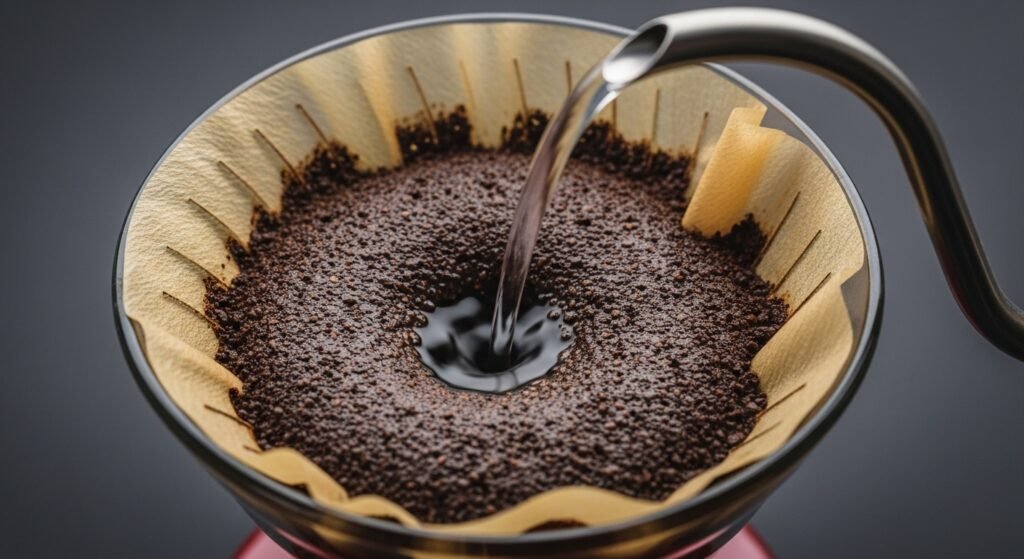
It looked exactly like a violent lunar crater.
There was a deep, empty hole right in the very center of the filter. Meanwhile, a thick, heavy layer of coffee grounds had been pushed high up onto the walls of the paper filter, clinging to the sides completely high and dry.
I thought this was just the normal way coffee looked after it was brewed. I assumed the water just naturally pushed the grounds out of the way as it drained.
I had absolutely no idea that this specific crater shape was the exact reason my coffee tasted dry and astringent. Failing to read the physical evidence left behind in the filter was undeniably (The Biggest Brewing Mistake I Didn’t Notice), because the shape of the coffee bed tells you everything you need to know about the extraction.

The Law of Lazy Water
To understand why the crater was ruining my expensive beans, I had to learn a fundamental law of fluid dynamics.
Water is inherently lazy. It will always, without exception, take the path of absolute least resistance.
When you pour hot water over a bed of coffee grounds, your entire goal is to make sure every single particle of coffee gets wet and extracts at the exact same time. You want an even, uniform extraction.
But when your coffee bed forms a crater, you create a massive physical imbalance.
The layer of coffee at the very bottom of the crater is incredibly thin. The layer of coffee stuck high up on the walls of the filter is incredibly thick.
Because water is lazy, it completely ignores the thick walls. It rushes straight down into the deep crater in the middle, violently blasting through that thin layer of coffee over and over again.
In the specialty coffee world, this phenomenon is called “Channeling.”
The Chemistry of Channeling
When channeling occurs, your coffee is simultaneously ruined in two completely different directions.
First, the water over-extracts the coffee in the center of the crater. Because all the water is rushing through that one specific spot, it quickly dissolves the sweet sugars and immediately starts ripping out the harsh, bitter, astringent plant tannins from those specific grounds.
Second, the water under-extracts the coffee stuck on the high walls. Those grounds barely get touched by the water at all. They are left high and dry, meaning their beautiful, heavy fruit sugars are completely left behind and thrown into the trash.
My morning coffee tasted dry and astringent because I was drinking a liquid that was simultaneously burnt and under-developed.
I was extracting the bitterness from the center and ignoring the sweetness on the edges. The math was right, but the physical execution was broken.
The Discovery of “The Spin”
I was determined to fix the crater.
I watched dozens of videos of professional baristas competing in the World Brewers Cup. I watched their hands closely. I noticed that almost every single champion did a very strange, subtle movement at the very end of their brewing routine.
After they finished pouring their final drops of water from the gooseneck kettle, they would put the kettle down.
Then, while the V60 cone was still full of hot water and coffee slurry, they would reach out, grab the glass cone by its edges, and give it a firm, gentle, circular swirl.
They physically spun the brewer.
It looked like someone swirling a glass of expensive wine to release the aromatics. But they weren’t doing it for the smell. They were using physics to restructure the coffee bed.
Applying the Centrifugal Force
The next morning, I stood in my kitchen and executed my standard brewing routine.
I weighed my 15 grams of light-roast Ethiopian coffee. I poured my 240 grams of water. I hit my ratios perfectly. But this time, right as my scale hit 240 grams and I put the kettle down, I grabbed the V60 cone.
I gave it two gentle, smooth, circular swirls.
Instantly, the thick, heavy walls of coffee grounds that were clinging to the paper filter collapsed. The centrifugal force of the swirling water grabbed the dry grounds off the walls and pulled them straight down into the liquid.
The chaotic, bubbling slurry aggressively mixed together.
I set the cone back down on my mug and watched the final drawdown. As gravity pulled the last bit of water through the filter, I looked inside.
The lunar crater was completely gone.
Instead of a deep hole and high walls, the used coffee grounds had settled into a perfectly flat, dense, horizontal pancake. It looked like a smooth bed of wet sand on a beach after the tide rolls out.
By flattening the bed, I had forced the water to pass through the coffee evenly. The path of least resistance was eliminated. Every single drop of water had to travel through the exact same depth of coffee, ensuring a mathematically perfect, uniform extraction.
The Sip of Absolute Harmony
I took the glass carafe, swirled the ruby-red liquid, and poured it into my pre-warmed mug.
I let it cool for a minute, anticipating the familiar, slightly scratchy finish on the back of my throat. I took a slow sip.
My eyes widened. The astringency was completely, entirely gone.
The harsh, dry bite that had haunted my coffee for years had vanished into thin air. Because I didn’t over-extract the center of the coffee bed, the bitter tannins stayed locked in the filter.
Because I didn’t under-extract the walls of the filter, the heavy, complex sugars were finally pulled into the mug. The coffee coated my tongue with an incredibly rich, heavy, syrupy sweetness. The bright fruit notes of the Ethiopian bean tasted round and smooth, rather than sharp and jagged.
It was the most perfectly balanced cup of coffee I had ever made.
Discovering that a simple physical action could yield such a profound chemical change is exactly (How I Improved My Coffee Without Buying New Equipment). I didn’t spend a single dollar. I just used gravity and motion to fix the flow of water.
The Secondary Detail: Rinsing the Canvas
Once I realized how much of an impact a tiny detail could make, I started looking for other microscopic errors in my routine.
I found a second one hiding in plain sight: the paper filter itself.
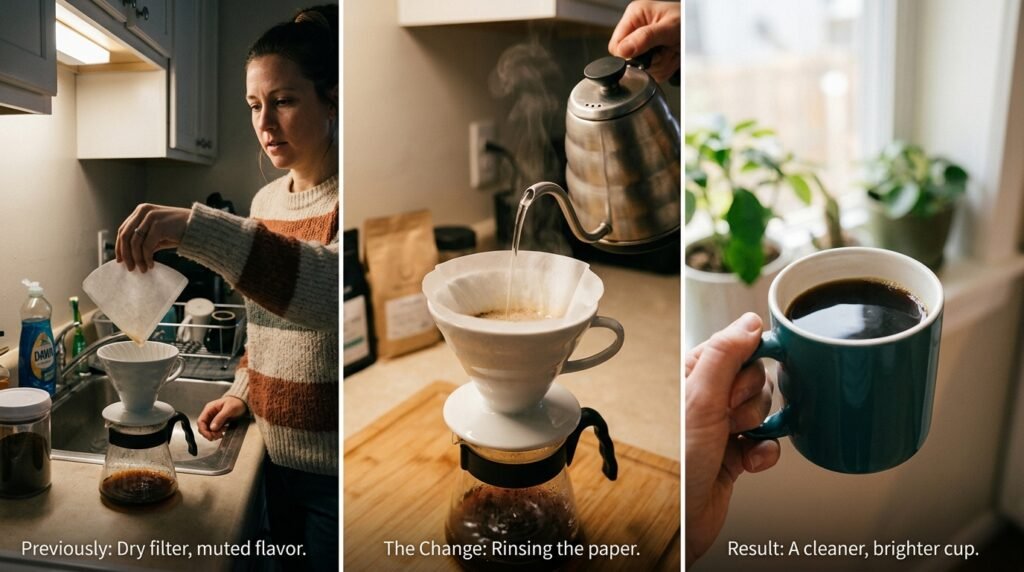
For years, I had been dropping the dry, folded paper filter into my V60 cone, dumping my ground coffee directly into it, and pouring hot water.
I never stopped to think about what paper actually tastes like.
Paper is made of bleached wood pulp. It tastes like dusty cardboard. When you pour hot water through a dry paper filter for the very first time, the water aggressively extracts that dry, dusty cardboard flavor and drops it directly into your coffee mug.
It acts as an invisible, muddy layer that mutes the vibrant acidity of the coffee bean.
I added one more tiny detail to my morning routine. Before I add my coffee grounds, I place the empty paper filter in the cone and pour a generous amount of hot water completely over it.
I let the hot water soak the paper, pre-heating the glass cone at the same time. Then, I take the mug, dump the rinse water down the sink, and proceed with my brew.
Washing away the paper taste before brewing was the ultimate final touch, perfectly illustrating (What I Changed to Improve My Coffee Instantly). By creating an absolutely blank, flavorless canvas, the true identity of the coffee was finally allowed to dominate the cup.
Mastery is in the Margins
We live in a culture that is obsessed with massive, sweeping changes.
If we are unhappy with a hobby, a creative project, or a cup of coffee, our immediate instinct is to throw everything away and buy a brand new, expensive piece of hardware. We want a magic bullet.
But true mastery rarely comes from the equipment. True mastery lives entirely in the margins.
It lives in the microscopic kerning between the letters. It lives in the subtle swirl of a glass cone. It lives in the five seconds it takes to rinse a piece of paper.
If you have a digital scale, a burr grinder, and high-quality beans, but your coffee still tastes slightly harsh or dry, do not pull out your credit card. Your equipment is not failing you. You are just suffering from channeling.
The next time you make a pour-over, watch the drawdown. If you see a crater, you know exactly what the problem is.
Grab the brewer. Give it a gentle, confident spin. Watch the grounds settle into a perfect, flat pancake, and prepare yourself to taste the absolute best cup of coffee you have ever engineered.

My name is Daniel Carter, I am 35 years old, and I live in the United States. I have been passionate about aquariums for many years, and what started as a simple hobby quickly became a lifelong interest in aquatic life, fish behavior, and responsible tank care.
Through TheBrightLance, I share real experiences, practical knowledge, and honest lessons learned from maintaining different types of aquariums. I enjoy testing equipment, studying fish behavior, improving maintenance routines, and helping beginners avoid common mistakes.
My goal is to make aquarism easier, more ethical, and more enjoyable for everyone — whether you are setting up your very first tank or looking to refine your techniques.