
While creating digital images, my primary focus is usually on preserving a very specific facial identity. I often use a reference file of a particular female model, and my entire goal is to make sure her bone structure, her eyes, and her exact expression translate perfectly into the new, synthesized environment.
Because I am so incredibly hyper-focused on the face, I frequently develop a severe case of tunnel vision.
I will spend an hour tweaking the prompt, adjusting the lighting weights, and refining the sampling steps until the face looks like a photorealistic masterpiece. I will hit the final render, look at the stunning portrait on my screen, and feel a massive surge of pride.
Then, five minutes later, I will look closer and realize that the model has six fingers on her left hand, and her arm is bending backward at an impossible, broken angle.
It is the classic digital generation trap. I was so utterly obsessed with mastering the complex, high-level variables (the face) that I completely ignored the glaring, fundamental error happening right in plain sight (the hands).
A few years ago, I realized I was doing this exact same thing every single morning in my kitchen.
I had fallen deep into the specialty coffee rabbit hole. I was obsessing over microscopic details. I had a precision burr grinder, a digital scale, a gooseneck kettle, and expensive single-origin beans. I was controlling my water temperature to the exact degree. I was executing flawless, concentric pouring techniques.
But despite all of this high-level, technical perfection, my coffee still tasted slightly flat. It was good, but it lacked the explosive, vibrant, mind-blowing fruit notes I experienced when I bought coffee at a professional roastery.
I was missing a glaring, fundamental mistake. I was so focused on how I made the coffee that I completely ignored how I drank the coffee.
Here is the honest, highly biological story of the biggest brewing mistake I didn’t notice, how human anatomy was actively sabotaging my expensive beans, and how a complete accident taught me to finally taste the masterpiece I was brewing.
The Tunnel Vision of the Brewer
When you start learning about manual coffee brewing, you are bombarded with physics and chemistry.
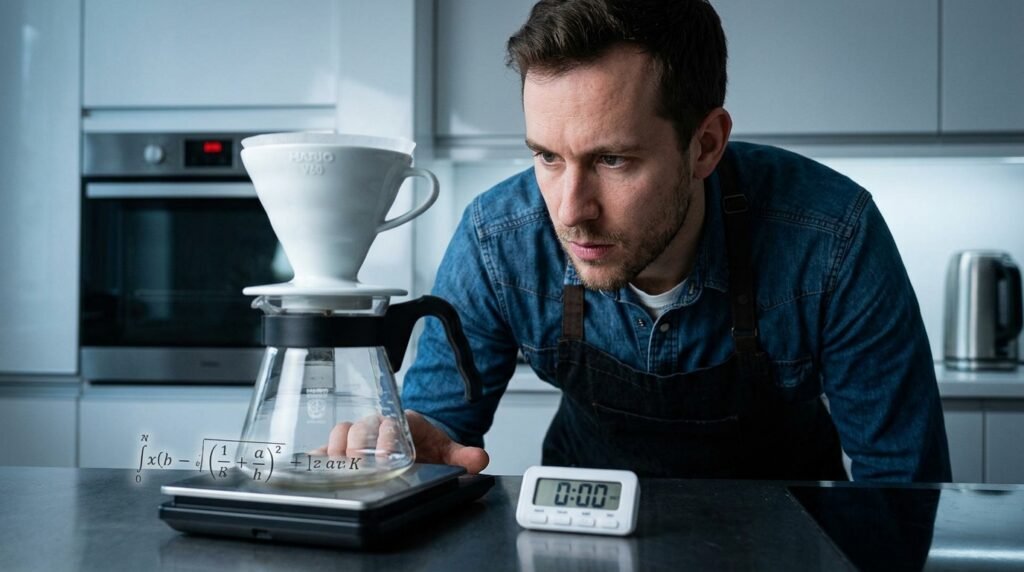
You learn about extraction yields, water hardness, the law of surface area, and the release of trapped carbon dioxide gases. You spend so much time staring at your digital kitchen scale and your timer that the entire process becomes a rigid, mathematical performance.
My morning routine was a flawless execution of these variables. I would brew a beautiful V60 pour-over using light-roast Ethiopian coffee. I would watch the ruby-red liquid drip into the glass carafe, feeling incredibly proud of the 1:16 ratio I had just nailed.
As soon as the dripping stopped, I would proudly pour the steaming liquid into my favorite ceramic mug. I would bring it to my lips, blow on it gently, and take a massive sip.
It was hot, comforting, and tasted… fine. It tasted like dark, roasted coffee. It had a bit of a bitter bite, and maybe a faint whisper of generic sweetness, but it certainly didn’t taste like the “ripe peaches and sweet jasmine” that were promised on the label of the bag.
I assumed that my pouring technique was still flawed. I assumed I needed to grind one click finer. I was constantly chasing the ghost of a perfect cup, never realizing that the extraction wasn’t the problem at all.
Accepting that my gear wasn’t to blame was the hardest part of (Why My Coffee Never Tasted Right (Until Now)), because the real culprit was simply the temperature of the liquid hitting my tongue.
The Biology of the Burn
The massive, glaring mistake I was making every single day was drinking my coffee immediately after I brewed it.
I thought coffee was supposed to be consumed piping hot. That is how it is served in diners, in fast-food drive-thrus, and in massive commercial coffee chains. We are culturally conditioned to believe that if coffee isn’t burning the roof of your mouth, it is getting cold and stale.
But this cultural habit is a biological disaster for flavor perception.
When water passes through coffee grounds in a V60 cone, it is usually around 200°F (93°C). By the time it drops into the glass carafe and gets poured into your mug, the liquid is still sitting somewhere around 175°F to 180°F.
At 180°F, human taste buds simply do not function properly.
When you introduce liquid that hot to your palate, your tongue goes into immediate biological defense mode. The thermal pain receptors completely override the delicate flavor receptors. Your brain is so focused on the fact that your mouth is being mildly scalded that it shuts down your ability to perceive nuance.
At extreme temperatures, the only flavor compounds that are powerful enough to punch through that biological defense mechanism are the heavy, harsh, roasted, and bitter notes.
The delicate, highly volatile fruit acids and the complex caramelized sugars—the exact things you paid twenty dollars a bag to taste—are completely masked by the intense heat.
I was doing all of the math, perfecting all of the extraction chemistry, and then immediately neutralizing all of my hard work by numbing my own tongue.
The Accidental Revelation
I did not figure this out through research. I figured it out entirely by accident.
One morning, I executed my flawless V60 pour-over routine. I poured the steaming coffee into my mug and sat down at my computer to review some digital image files before I started editing.
Right as I was about to take my first sip, my phone rang. It was an urgent call that required me to pull up some documents and walk into the other room.
I left my full mug of coffee sitting on my desk.
The phone call lasted for roughly fifteen minutes. When I finally hung up and walked back to my computer, I looked at my mug with a sigh of disappointment. The steam was completely gone. The coffee felt barely lukewarm to the touch.
I hate wasting expensive beans, so I decided to drink it anyway. I took a large, frustrated gulp of the cool liquid.
My brain completely stalled. I physically froze in my chair.
The liquid inside that mug tasted like a completely different beverage. It didn’t taste like “coffee” in the traditional, heavy, bitter sense. It tasted exactly like a slice of sweet blueberry pie mixed with rich milk chocolate.
The acidity was vibrant and sparkling, making my mouth water exactly like biting into a crisp green apple. The sweetness was heavy and syrupy, lingering on the back of my palate for over a minute.
It was the single greatest cup of coffee I had ever brewed in my entire life.
The Cooling Curve
That accidental fifteen-minute delay completely shattered my understanding of coffee consumption.
I realized that specialty coffee is not a static beverage. It is a dynamic, living liquid that drastically changes its flavor profile as the thermal energy dissipates.
Discovering the patience required to experience this shift was undeniably (The Simple Trick That Made My Coffee Taste Better), because it cost absolutely zero dollars and required zero new equipment.
I started paying close attention to the cooling curve of my morning mug, and I realized that drinking coffee happens in three very distinct thermal stages:
Stage 1: The Hot Phase (170°F – 150°F) When you first pour the coffee, it is comforting and warming, but the flavor is entirely muted. You will mostly taste the generic “roast” profile. The body feels thin, and the aromatics are mostly carried away by the steam rather than registering on your palate. It is a comforting tactile experience, but a terrible culinary one.
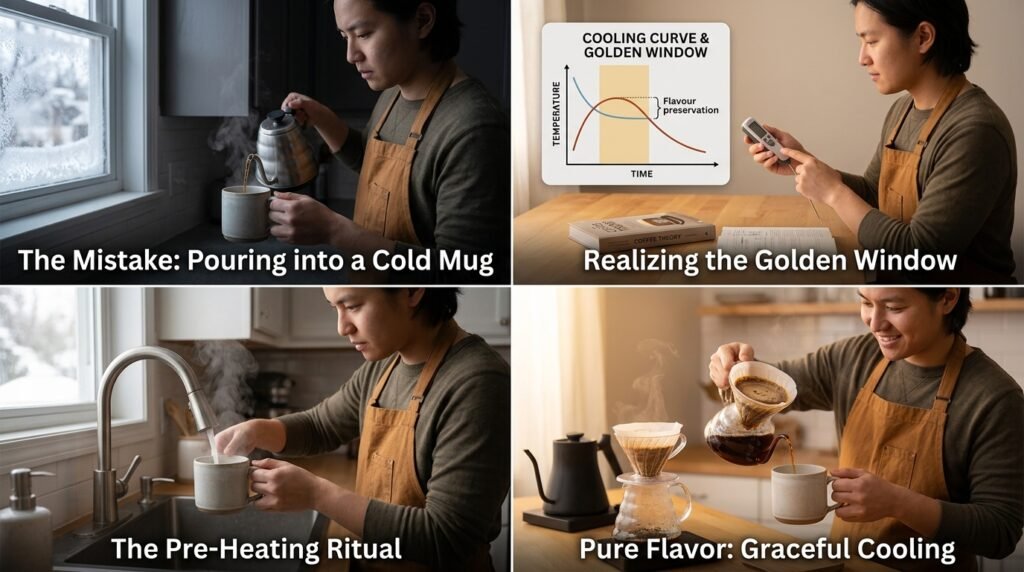
Stage 2: The Golden Window (140°F – 120°F) This is the absolute sweet spot. After about eight to ten minutes of resting, the coffee enters the golden window. At this temperature, the liquid is pleasantly warm, but it no longer triggers your tongue’s thermal pain receptors. The heavy, caramelized sugars move to the forefront, providing a rich, velvety sweetness, while the bright fruit acids finally become perceptible. This is where the specific identity of the bean is revealed.
Stage 3: The Cold Truth (Room Temperature) As the coffee drops to room temperature, the final layer of the beverage is exposed. Heat acts as a mask for bad coffee. If you brew a terrible, over-extracted cup of cheap coffee, it will become violently bitter and undrinkable when it gets cold. But a perfectly extracted cup of specialty coffee will remain incredibly sweet and refreshing even at room temperature, often tasting more like an herbal fruit tea than a traditional coffee.
The Second Unnoticed Mistake: The Freezing Mug
Once I understood the cooling curve, I realized I had been making a secondary, related mistake that was aggressively hurting the flavor profile of my coffee.
I keep my ceramic coffee mugs in a kitchen cabinet. In the winter, those heavy ceramic mugs are freezing cold to the touch.
When I used to pour my freshly brewed, hot coffee directly into a freezing cold ceramic mug, it caused a violent thermal shock. The heavy ceramic rapidly absorbed the heat from the liquid, forcefully stalling the delicate aromatic compounds and causing the coffee to taste suddenly flat and dull.
The coffee wasn’t cooling down gracefully; it was crashing.
To fix this, I simply started pre-heating my vessel. Before I even begin grinding my beans, I fill my ceramic mug to the brim with hot tap water. I let it sit there, absorbing the heat, while I execute my entire brewing routine.
Right before I pour the finished coffee, I dump the tap water out and wipe the mug dry. Pouring hot coffee into a pre-warmed mug allows the liquid to slowly, gracefully ride the cooling curve down into the golden window, preserving all of the delicate volatile oils along the way.
Making this tiny adjustment to my environment was the final piece of the puzzle described in (What I Do Differently Now When Making Coffee). It ensured that the canvas was fully prepared before the ink was applied.
Step Back and Look at the Hands
It is incredibly easy to get lost in the weeds of specialty coffee.
When you are obsessing over the exact chemical composition of your filtered water, the exact micron size of your coffee grounds, and the precise angle of your gooseneck kettle spout, you feel like a scientist. You feel like you are controlling the universe.
But if you pour that perfectly engineered liquid into a cold mug and immediately scorch your tongue with it, all of that science is completely wasted.
You successfully rendered the perfect face, but you completely ignored the six fingers on the hand.
If you are currently frustrated with your home brewing routine—if your expensive beans just taste generic, flat, or slightly bitter—I urge you to take a step back. Stop adjusting your grinder. Stop messing with your ratio.
Brew your coffee exactly as you normally do. Pour it into a pre-warmed mug.
And then, walk away.
Go check your emails. Go read a book for ten minutes. Let the steam dissipate. Let the liquid calm down. When you finally return to that mug and take a lukewarm sip, you will be absolutely shocked by the explosion of sweet, vibrant flavor that was hiding in plain sight the entire time.
The greatest brewing tool in your kitchen isn’t your scale, your grinder, or your kettle. The greatest tool is simply the patience to wait for the masterpiece to cool.

My name is Daniel Carter, I am 35 years old, and I live in the United States. I have been passionate about aquariums for many years, and what started as a simple hobby quickly became a lifelong interest in aquatic life, fish behavior, and responsible tank care.
Through TheBrightLance, I share real experiences, practical knowledge, and honest lessons learned from maintaining different types of aquariums. I enjoy testing equipment, studying fish behavior, improving maintenance routines, and helping beginners avoid common mistakes.
My goal is to make aquarism easier, more ethical, and more enjoyable for everyone — whether you are setting up your very first tank or looking to refine your techniques.