
I spend a ridiculous amount of my free time inside image editing software. I love taking a raw, unedited photograph and playing with the different layer blending modes to see how they alter the final mood.
If I take a bright, standard portrait and apply a “Multiply” blend mode, the image instantly becomes heavy, dense, and deeply shadowed. If I switch the mode to “Screen,” the exact same image becomes bright, airy, and delicate. If I use “Overlay,” the contrast is violently punched up, making the colors aggressive and loud.
The raw data—the actual pixels of the original photograph—never changed. The only thing that changed was the mathematical filter I used to process that data.
For the first few years of my specialty coffee journey, I was completely blind to this concept in my kitchen. I thought a coffee bean had one single, fixed flavor. I assumed that a bag of Ethiopian beans would always taste exactly the same, no matter how I made it.
I was completely wrong.
To prove this to myself, I decided to conduct a massive, highly caffeinated experiment on a quiet Sunday morning. I bought one single bag of premium, light-roast coffee from the Guji region of Ethiopia. I cleared off my kitchen counter, lined up four completely different coffee brewers, and brewed the exact same beans four different ways, back-to-back.
What I discovered completely shattered my understanding of coffee. Here is the honest, sensory-overloading story of what I learned after trying four brewing methods, the brilliant physics behind each tool, and how the brewer you choose acts as the ultimate filter for your palate.
The Rules of the Experiment
To ensure this was a fair scientific test, I had to lock down all of my other variables.
I used the exact same filtered water, heated to exactly 202°F (94°C) for every single cup. I used the exact same digital scale to ensure my coffee-to-water ratio was mathematically identical across the board.
The only variable I changed was the grind size, because different brewers physically demand different sizes of coffee particles to function properly. Locking in these strict parameters was a crucial lesson I picked up from (How I Finally Learned to Brew Coffee the Right Way), because if I didn’t control the math, the entire experiment would be useless.
I lined up my four contestants: The French Press, the Hario V60, the AeroPress, and the Chemex. I ground the beans, boiled the water, and started the brewing gauntlet.
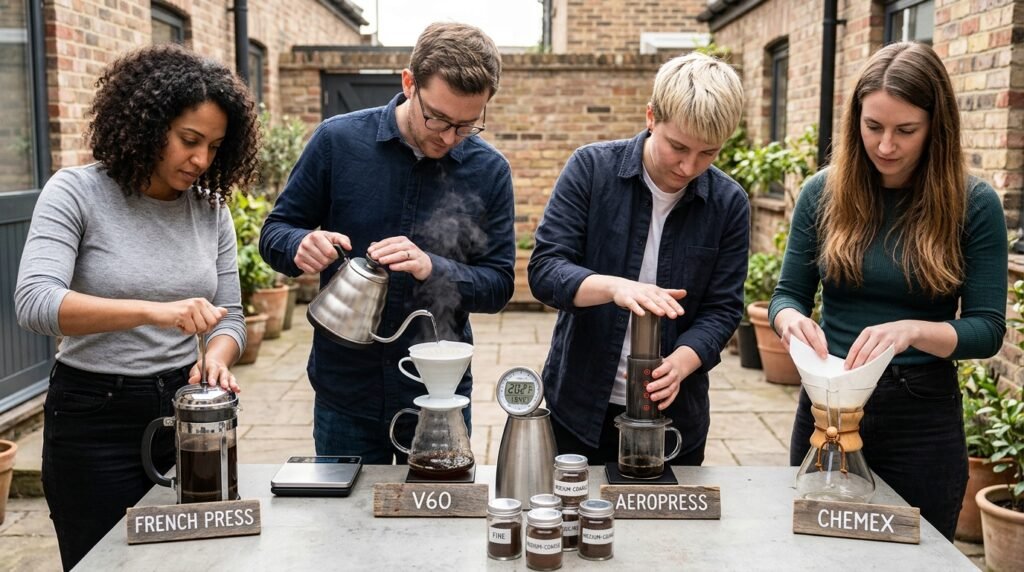
Method 1: The French Press (The Heavy Shadows)
I started with the most common, rugged manual brewer in the world: the glass French Press.
Because the French Press is an “Immersion” brewer—meaning the coffee and water sit together in a glass beaker for a long time—I had to grind the Ethiopian beans incredibly coarse, like heavy sea salt. I poured the hot water, waited four minutes, broke the crust, and gently plunged the metal mesh filter down.
I poured the coffee into my first tasting mug. It looked incredibly dark and cloudy.
When I took a sip, the physical weight of the liquid immediately coated my tongue. It was incredibly heavy, thick, and syrupy. The Ethiopian coffee, which was supposed to be bright and fruity, tasted almost entirely like dark chocolate and heavy roasted nuts.
What I Learned: The French Press is the “Multiply” blend mode of the coffee world. It makes everything heavy and dark.
Because the French Press uses a thin metal mesh instead of a paper filter, it allows all of the heavy, natural oils and microscopic coffee dust to pass directly into your mug. Those heavy oils completely mask the delicate fruit flavors of a light roast.
It taught me that if you want a comforting, thick, dessert-like coffee, the French Press is a masterpiece. But if you want to taste bright, delicate acidity, this brewer will completely smother it in mud.
Method 2: The Hario V60 (The High Contrast)
Next in the lineup was the famous Hario V60, a simple plastic pour-over cone that sits directly on top of your mug.
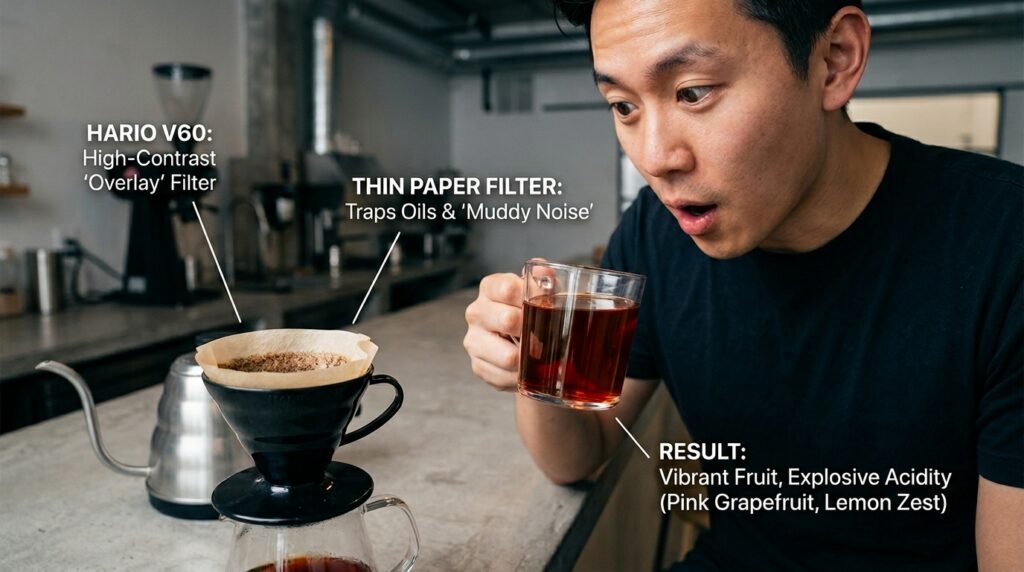
Unlike the French Press, the V60 uses the “Percolation” method. Gravity pulls the water straight through a thin paper filter. Because the water doesn’t sit with the grounds for four minutes, I had to use a much finer grind—like table sand—to create resistance.
I carefully poured the hot water in slow, concentric circles using my gooseneck kettle. The entire brew took about three minutes.
I poured the resulting liquid into my second tasting mug. It looked entirely different from the French Press. It wasn’t cloudy or dark; it was a beautiful, translucent ruby red.
I took a sip, and my eyes widened. The heavy, muddy chocolate flavor was completely gone. In its place was an explosive, sharp, aggressive burst of vibrant fruit. It tasted vividly like a crisp pink grapefruit mixed with sweet lemon zest. The acidity was loud and unapologetic.
What I Learned: The V60 is the high-contrast “Overlay” filter. It punches up the brightness to the absolute maximum.
Because the thin paper filter catches the heavy oils and the microscopic dust, the muddy “noise” is removed from the cup. Without the heavy oils weighing it down, the sharp, fast-dissolving fruit acids of the Ethiopian bean are thrust directly into the spotlight.
It taught me that the V60 is an incredibly aggressive, exciting brewer. It does not hide anything. If your coffee is beautifully acidic, the V60 will scream it from the rooftops.
Method 3: The AeroPress (The Smart Hybrid)
The third contestant was the weirdest-looking brewer in my kitchen: the AeroPress. It looks like a giant, dark gray plastic medical syringe.
The AeroPress is fascinating because it is a hybrid. It uses “Immersion” (the coffee steeps in the water like a French Press) but it also uses “Pressure” (you manually force the water through the grounds using a rubber plunger) and it uses a tiny paper filter.
I used a medium-fine grind, steeped it for just over a minute, and plunged the syringe down into my third tasting mug.
I let it cool and took a sip. I was absolutely mesmerized.
It tasted like a perfect, impossible compromise. It possessed the heavy, syrupy, velvety mouthfeel of the French Press, but because it utilized a paper filter, it was completely free of the gritty, muddy sludge.
The flavor was intensely sweet. It didn’t have the aggressive, sharp grapefruit bite of the V60, and it didn’t have the dark mud of the French Press. It tasted like warm caramel and a perfectly ripe, incredibly sweet peach.
What I Learned: The AeroPress is the ultimate problem solver.
Finding the balance between body and clarity is exactly (Why My Coffee Always Tasted Weak (And How I Fixed It)), because the AeroPress allows you to use physical pressure to force the sweet sugars out of the bean incredibly fast.
It taught me that if you want a coffee that is rich, incredibly sweet, and perfectly balanced, you cannot beat the power of manual pressure combined with a paper filter. It is the most forgiving, universally delicious brewer on the planet.
Method 4: The Chemex (The Absolute Clarity)
Finally, I reached the last brewer in my gauntlet: the iconic, elegant glass Chemex hourglass.
At first glance, the Chemex looks like a giant V60. It is a pour-over method that uses gravity. But the secret of the Chemex lies in its proprietary paper filters. The paper used in a Chemex is laboratory-grade, and it is roughly thirty percent thicker than a standard coffee filter.
I used a medium-coarse grind, carefully poured my water, and waited patiently as the thick paper slowed the draining process down to a slow, meditative drip.
When it finished, I poured the coffee into my final tasting mug.
Visually, it was the most stunning cup of the day. It caught the light like a precious gem. There was absolutely zero haze.
I took a slow sip. The texture was impossibly light, gliding across my palate with the delicate weight of a high-end jasmine green tea. It was the cleanest, most pristine beverage I had ever consumed.
The heavy chocolate from the French Press was gone. The aggressive grapefruit from the V60 was tamed. The syrupy caramel from the AeroPress was washed away.
What remained was pure, unadulterated floral elegance. It tasted like blooming honeysuckle and delicate white tea.
What I Learned: The Chemex is the ultimate noise-reduction tool. Discovering this extreme level of filtration was exactly (The Brewing Method That Changed Everything for Me), because it acted like an eraser, completely stripping away any distracting “watermarks” or muddy artifacts from the coffee.
It taught me that the thicker the paper filter, the more delicate and tea-like the resulting coffee will be. It isolates the most fragile, volatile aromatic notes of the bean and serves them to you on a crystal-clear platter.
The Grand Conclusion: You Are the Editor
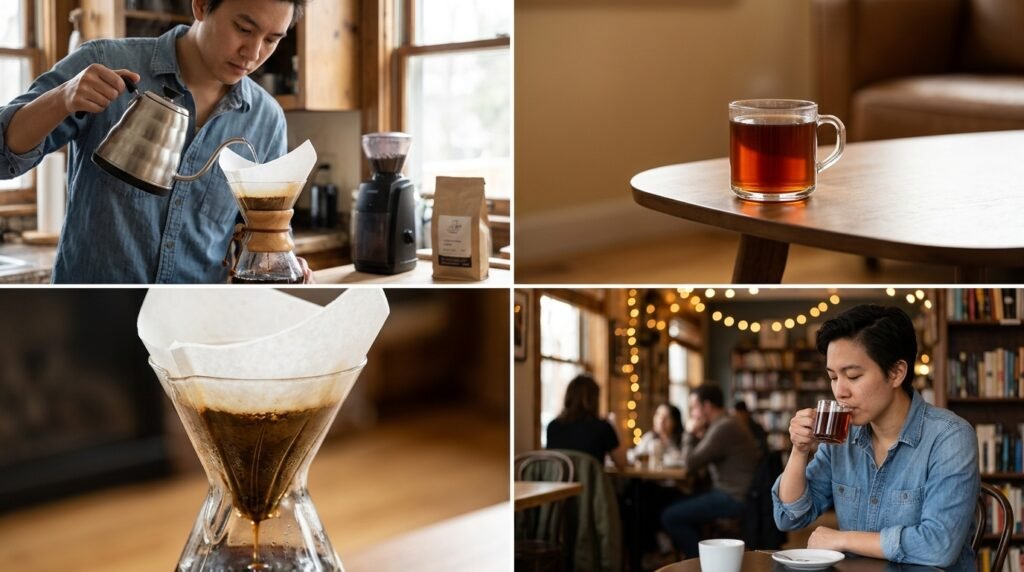
I sat at my kitchen table, surrounded by four mugs of coffee that were all brewed using the exact same bag of Ethiopian beans.
If you had blindfolded me and asked me to taste them, I would have sworn on my life that they were four completely different coffees from four different countries. The heavy, muddy chocolate of the French Press shared absolutely no DNA with the delicate, floral tea of the Chemex.
The raw data—the roasted bean—never changed. The only thing that changed was the physical filter I applied to the extraction.
This experiment completely revolutionized how I view my morning routine.
I realized that as a home brewer, I am the ultimate editor of my coffee. I have the power to completely manipulate the final image in the cup. I no longer just wake up and make “coffee.” I wake up and ask my palate exactly what mood it is in.
If it is a cold, rainy Sunday morning and I want a heavy, comforting, dark hug, I reach for the French Press. I want the oils. I want the texture.
If I am exhausted and need a sharp, aggressive, vibrant kick in the teeth to wake my brain up, I reach for the V60. I want the high-contrast acidity.
If I want a perfectly sweet, rich, full-bodied cup that I can brew in sixty seconds before rushing out the door to work, I reach for the trusty plastic AeroPress.
And if I have a lazy weekend afternoon, and I have a brilliant, expensive, highly complex coffee that I want to analyze in absolute silence, I reach for the Chemex. I want the pure, unfiltered clarity.
Expanding Your Own Toolbox
If you are currently trapped in a coffee rut, using the exact same automatic drip machine or the exact same French Press every single day, you are only experiencing a fraction of what your beans have to offer.
You are looking at a beautiful photograph, but you are only looking at it through one single, unchangeable filter.
I highly encourage you to expand your toolkit. You do not need to buy all four of these brewers immediately. Pick one that sounds like the exact opposite of what you currently use. If you drink heavy French Press coffee, go buy a cheap plastic V60 cone and a pack of paper filters.
When you take that same bag of beans you have been drinking for weeks, run it through a completely different brewing method, and suddenly taste flavors you didn’t even know existed, your mind will be blown.
You will finally realize that coffee is not a static, boring beverage. It is a dynamic, shifting, interactive art form. You just have to learn how to apply the right tools to edit the masterpiece hiding inside your mug.

My name is Daniel Carter, I am 35 years old, and I live in the United States. I have been passionate about aquariums for many years, and what started as a simple hobby quickly became a lifelong interest in aquatic life, fish behavior, and responsible tank care.
Through TheBrightLance, I share real experiences, practical knowledge, and honest lessons learned from maintaining different types of aquariums. I enjoy testing equipment, studying fish behavior, improving maintenance routines, and helping beginners avoid common mistakes.
My goal is to make aquarism easier, more ethical, and more enjoyable for everyone — whether you are setting up your very first tank or looking to refine your techniques.