
I spend a significant amount of my time focused on digital image editing. Whenever I am meticulously removing a distracting watermark from a photograph, or carefully replacing a piece of clothing to make a portrait look perfectly seamless, the ultimate goal is always absolute clarity.
You want to strip away the visual noise so the true subject of the image can shine through without any distractions.
For the first decade of my coffee-drinking life, my morning mug was the exact opposite of a clean, perfectly edited photograph. It was cluttered. It was noisy. It was full of heavy, sludgy artifacts that completely distracted my palate from the actual flavor of the roasted bean.
I was using a cheap automatic drip machine, and occasionally a French Press when I felt “fancy.” Both methods produced a heavy, muddy beverage. The coffee was always coated in a thick, slick layer of natural oils that muted any delicate flavors. I thought coffee was just supposed to taste like a dark, heavy, liquid brick.
I didn’t know that “clarity” was even a possibility in the coffee world.
That all changed on a brisk Saturday morning when I walked into a high-end roastery and ordered a single-origin pour-over. The barista didn’t use a standard plastic cone or a metal machine. Instead, he pulled out a stunning, elegant glass hourglass with a wooden collar tied together by a leather strap.
It was a Chemex.
Watching him brew with that beautiful glass vessel, and subsequently tasting the impossibly clean liquid it produced, completely shattered my culinary worldview. Here is the honest, transformative story of the brewing method that changed everything for me, the brilliant science behind its flawless clarity, and how a simple glass hourglass edited all the noise out of my morning routine.
The Problem with the Mud
To fully appreciate why this specific brewer was such a revelation, you have to understand the inherent flaw in most standard brewing methods.
Coffee beans are packed with natural fats and oils. They also produce a massive amount of microscopic dust when they go through a grinder.
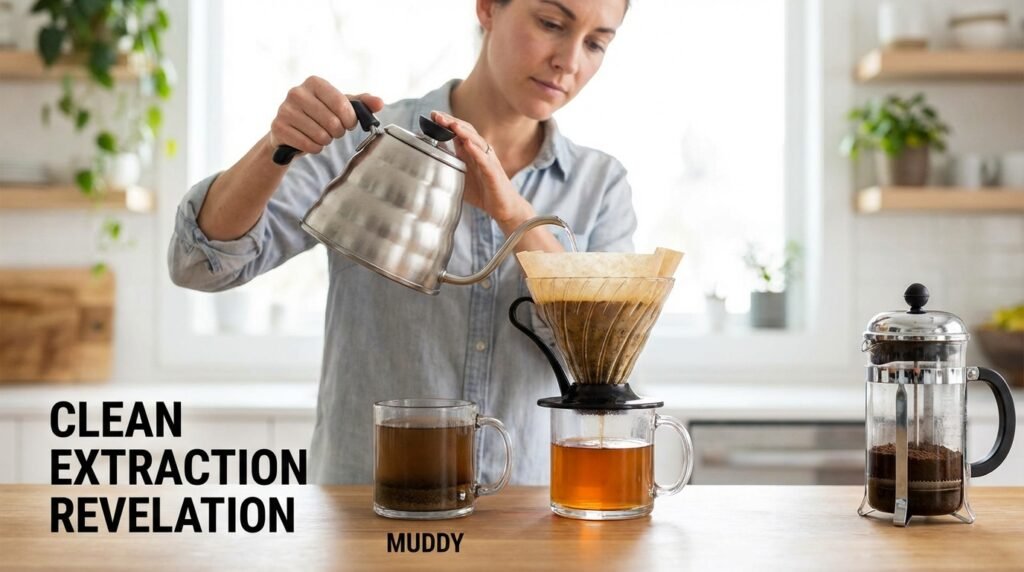
If you use a French Press, the metal mesh filter allows all of those heavy oils and a significant amount of that microscopic dust directly into your cup. The resulting beverage is thick, heavy, and leaves a gritty layer of mud at the bottom of your mug.
Even standard automatic drip machines use relatively thin, cheap paper filters. While they catch the big pieces of coffee, they still let a lot of the heavier oils and bitter compounds bleed through into the glass carafe.
I had grown so accustomed to this heavy, oily mouthfeel that I thought it was just a mandatory characteristic of the beverage. Experimenting to find a way out of this muddy rut is precisely (What I Learned After Trying 4 Brewing Methods), because I realized that different tools yield completely different chemical extractions.
I wanted a coffee that felt light. I wanted a coffee where I could actually taste the individual fruit and floral notes printed on the bag, rather than just tasting a generic, dark “roast” flavor.
I needed a method that acted like a high-end photo editor, masking out all the unwanted sludge.
The Genius of the Hourglass
When I bought my very own Chemex and brought it home, I spent a few minutes just admiring its design.
Invented in 1941 by an eccentric chemist named Peter Schlumbohm, the Chemex doesn’t look like a kitchen appliance. It looks like a piece of laboratory equipment that belongs in a modern art museum. It is made entirely of non-porous, borosilicate glass, which means it imparts absolutely no chemical flavors or metallic taint to the coffee.
But the glass hourglass shape is not the actual secret to this brewing method. The glass is just a beautiful vessel.
The true magic, the absolute game-changer, lies in the proprietary paper filters.
When you buy a box of Chemex filters, you immediately notice how drastically different they are from the flimsy, rippled paper filters you buy at the grocery store. Chemex filters are incredibly thick. They are made of laboratory-grade bonded paper, and they are roughly twenty to thirty percent thicker than any other coffee filter on the market.
This thick paper is the ultimate noise-reduction tool.
When hot water passes through this dense, bonded paper, it acts as an impenetrable microscopic wall. It catches every single speck of coffee dust. But more importantly, it acts like a sponge, completely absorbing and trapping all of the heavy, bitter coffee oils.
It strips away all the mud, all the fat, and all the grit, allowing only the purest, cleanest aromatic liquids to pass through into the bottom of the hourglass.
The First Attempt
The first time I set up the Chemex in my kitchen, I treated it with an almost ridiculous level of reverence.
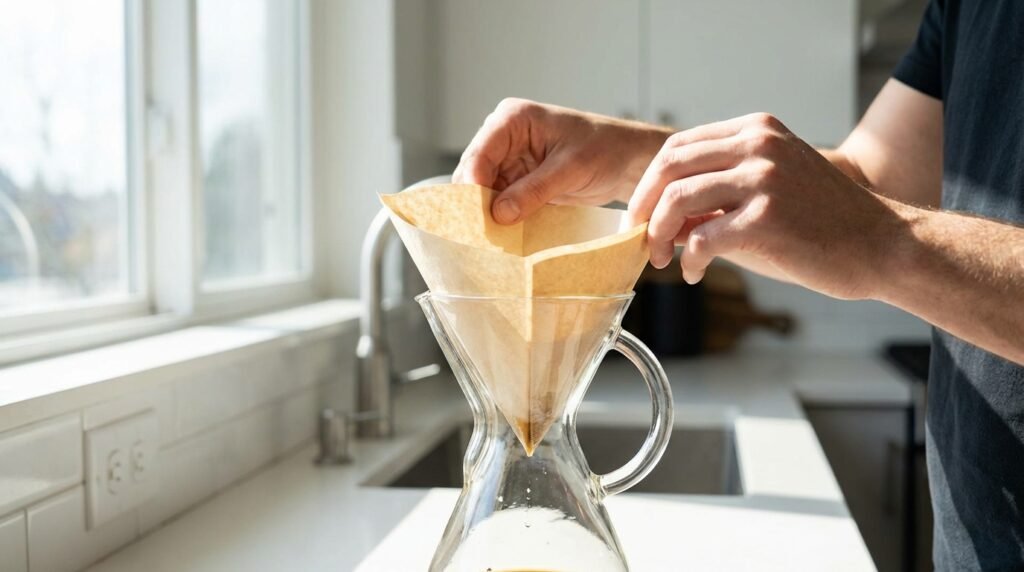
I folded the thick, square paper filter into a cone, making sure the three-layered side was resting against the pouring spout to prevent the glass from shattering under the heat.
I boiled my gooseneck kettle and gently poured hot water over the empty paper filter. This is a crucial step that many beginners skip. Rinsing the thick paper washes away any residual cardboard taste, and it pre-heats the thick glass of the brewer so it doesn’t instantly cool down the coffee.
I dumped the rinse water out. I placed the empty Chemex on my digital kitchen scale and hit the “tare” button to zero it out.
I had purchased a highly-rated, lightly roasted bag of washed coffee from the Guji region of Ethiopia. I weighed out exactly 30 grams of the pale brown beans.
I ran them through my manual burr grinder, aiming for a medium-coarse texture that looked like rough sea salt. Because the Chemex filter is so incredibly thick, the water naturally drains very slowly. If you grind your coffee too fine, the water will stall completely, resulting in a bitter, over-extracted mess.
I poured the grounds into the rinsed filter and shook the glass gently to level the coffee bed. I was ready to begin.
The Hypnotic Pour
Brewing with a Chemex is not a passive activity. You cannot press a button and walk away to check your emails. It demands your absolute, undivided attention.
I started my phone timer and began the “Bloom” phase.
I gently poured 60 grams of hot water (about 200°F) in a slow, tight circle, just enough to fully saturate the dry coffee grounds. The moment the water hit the coffee, the bed aggressively expanded and bubbled upward, releasing all the trapped carbon dioxide from the roasting process.
The aroma that instantly filled my kitchen was staggering. It smelled vividly of fresh jasmine blossoms and sweet lemon zest.
I waited for exactly forty-five seconds, watching the bubbles pop and the coffee settle.
Then, I began the main pour. I used my gooseneck kettle to deliver a slow, perfectly controlled, pencil-thin stream of water. I started in the very center of the coffee bed and slowly spiraled outward, tracing gentle concentric circles.
I watched the digital scale climb. I poured until the scale hit 300 grams, and then I paused, letting the water slowly filter through the thick paper. Once the water level dropped by an inch, I resumed pouring, repeating this slow, meditative pulse until the scale finally reached 500 grams.
This hyper-focused, incredibly tactile process is the very heart of (Why I Prefer Manual Brewing Over Machines). You are completely in control of the extraction, acting as the conductor of your own culinary orchestra.
The Visual Clarity
When the final drops of water filtered through the coffee bed, I removed the heavy, wet paper filter and threw it in the compost bin.
I picked up the Chemex by its wooden collar and gently swirled the coffee inside the glass.
The visual difference was immediately obvious. The liquid was not dark, muddy, or opaque. It was breathtakingly clear. It looked like a glowing, translucent, ruby-red jewel when the morning sunlight hit it.
There was no slick, iridescent oil slick floating on the surface. There was no cloudy haze. It was visually flawless.
I poured the coffee into my favorite white ceramic mug. I let it cool for a few minutes, knowing that extreme heat numbs the tastebuds and hides the true flavor profile of the beans.
The Sip of Absolute Purity
I brought the mug to my lips and took a slow, deliberate sip.
My brain completely stalled for a second. It didn’t taste like “coffee” in the traditional, heavy, diner-mug sense.
The texture was impossibly silky and light. It glided across my palate with the delicate, refreshing weight of a high-end Earl Grey tea. Because the thick filter had stripped away all the heavy fats and oils, there was absolutely zero bitterness and zero astringency.
With the heavy, distracting “noise” completely removed from the liquid, the true, naked flavor of the Ethiopian bean was thrust into the spotlight.
The clarity was shocking. I could vividly taste the crisp, mouth-watering snap of sweet peaches. Right behind the fruit notes, there was a brilliant, sparkling acidity that tasted like fresh lemonade. As the coffee finished on my palate, it left a lingering, perfumed sweetness of raw honey and blooming flowers.
It was the most elegant, structured, and profoundly delicious beverage I had ever made in my entire life.
Elevating the Beans
The Chemex didn’t just change the way my coffee tasted; it fundamentally changed how I purchased and appreciated the beans themselves.
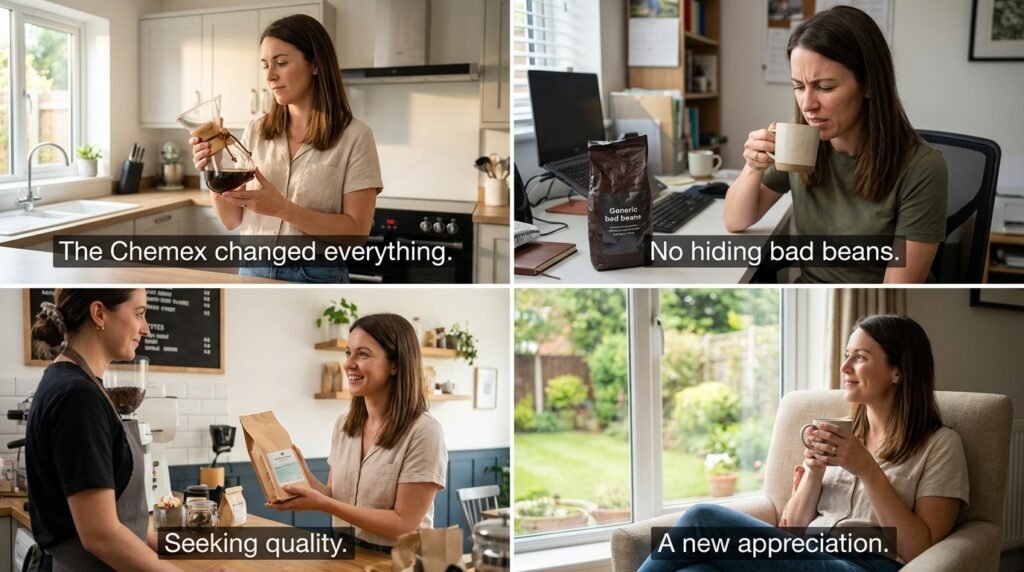
When you use a brewer that provides this level of microscopic flavor clarity, you can no longer hide bad coffee. If you put a cheap, dark-roasted, stale supermarket blend into a Chemex, it will taste incredibly flat, ashy, and hollow, because there are no delicate fruit notes to highlight.
The Chemex demands high-quality, lightly roasted, single-origin beans.
It forced me to start paying attention to the specific countries, regions, and processing methods of the coffees I bought. I realized that the Chemex was simply a magnifying glass. It was taking the incredible, hard work of the farmers and roasters and amplifying it without adding any of its own mud to the equation.
Learning how to utilize this magnifying glass effect is exactly (How I Made Better Coffee With Simple Changes), because the simple addition of a thicker piece of paper completely revolutionized the chemistry in my mug.
The Morning Meditation
Beyond the stunning flavor clarity, the Chemex ultimately changed everything for me because it forced me to slow down.
Before I bought this glass hourglass, my mornings were frantic. I was always rushing, trying to optimize every single second before I had to start working. Coffee was just a rushed injection of caffeine to keep my eyes open.
But you cannot rush a Chemex.
The thick paper filter dictates the pace of the brew. It forces you to stand at the kitchen counter for five solid minutes, holding a kettle, watching the water flow, and focusing solely on the task at hand.
It became my mandatory morning meditation.
During those five minutes, I don’t look at my phone. I don’t check my emails. I don’t stress about the deadlines I have to meet that day. I just watch the coffee bloom, smell the incredible aromatics filling the room, and listen to the quiet, rhythmic dripping of the water into the glass carafe.
It is a quiet, peaceful, analog ritual in a world that is completely dominated by glowing screens and instant gratification.
Finding Your Own Clarity
I still own other coffee brewers. I occasionally use an AeroPress when I travel, and I still fire up my espresso machine when I am craving an intense, heavy shot of milk-based comfort.
But the Chemex will always be my anchor. It is the brewer I use every single weekend when I want to sit down, clear my mind, and truly experience the brilliant complexity of a world-class coffee bean.
If you are currently frustrated with your morning coffee—if it tastes heavy, muddy, bitter, or boring—you might be suffering from too much culinary noise. You might just be tasting the oils and the dust, rather than the bean itself.
I highly encourage you to try this iconic brewing method.
Buy a glass Chemex and a box of their proprietary bonded filters. Buy a fresh, lightly roasted bag of single-origin coffee, preferably from East Africa or Central America.
When you slowly pour that hot water, watch the coffee bloom, and finally take a sip of that impossibly clean, sweet, translucent liquid, you will understand exactly what I mean. You will finally taste the coffee in high-definition, and just like it did for me, it will change your entire perspective on what a morning routine can be.

My name is Daniel Carter, I am 35 years old, and I live in the United States. I have been passionate about aquariums for many years, and what started as a simple hobby quickly became a lifelong interest in aquatic life, fish behavior, and responsible tank care.
Through TheBrightLance, I share real experiences, practical knowledge, and honest lessons learned from maintaining different types of aquariums. I enjoy testing equipment, studying fish behavior, improving maintenance routines, and helping beginners avoid common mistakes.
My goal is to make aquarism easier, more ethical, and more enjoyable for everyone — whether you are setting up your very first tank or looking to refine your techniques.