
I have a confession to make. I became a massive coffee snob, and I let my own arrogance blind me to one of the greatest brewing tools on the planet.
If you were to open the cabinet above my coffee station a few weeks ago, you would see a very clear hierarchy. Right in the front, proudly displayed, were my glass V60 cones, my Chemex, my digital scale, and my expensive paper filters.
I was obsessed with “pour-over” coffee. I loved the clarity, the bright acidity, and the delicate, tea-like body that paper filters provided.
But hiding in the very back of that cabinet, pushed behind a box of old tea bags and covered in a thin layer of dust, was a simple, glass French Press.
I bought it years ago when I first started drinking coffee. To me, it was a beginner’s tool. It was the blunt instrument you used before you learned how to properly extract a high-end specialty bean. I associated the French Press with sludgy, muddy, bitter coffee that left grit in your teeth.
But recently, I realized I was stuck in a rut. I was drinking the exact same style of coffee every single day. I decided I needed to completely shake up my routine.
So, I made a drastic decision. I washed the dust off the glass beaker, put my beautiful pour-over cones away in a box, and committed to a rigid experiment. For seven straight days, I would only brew my morning coffee using the French Press.
Here is the honest, messy, and highly educational story of what happened when I used a French Press for a week, how it completely shattered my prejudices, and the advanced technique that changed everything.
Day 1: The Muddy Disaster
My experiment started on a Monday morning. I was tired, slightly cranky, and missing my usual paper-filtered routine.
I decided to treat the French Press exactly like my pour-over. I weighed out 15 grams of a beautiful, lightly roasted Ethiopian coffee. I ran it through my hand grinder on my usual medium-fine setting, dumped the grounds into the glass beaker, and poured boiling water over them.
I waited exactly four minutes, grabbed the metal plunger, and forcefully shoved it down to the bottom of the glass.
I poured the dark liquid into my mug. It looked incredibly cloudy.
When I took a sip, I physically winced. It was a complete disaster. The coffee was harsh, aggressively bitter, and felt like drinking liquid sandpaper. The delicate peach and jasmine notes of the Ethiopian bean were completely destroyed, buried under a heavy, muddy extraction.
When I reached the bottom of the mug, there was a thick layer of black sludge staring back at me.
I almost quit the experiment right there. I remembered exactly why I had banished this brewer to the back of the cabinet. But I knew I couldn’t write it off after one bad cup. I had to figure out what went wrong.

Day 2: Understanding the Physics of Immersion
On Tuesday morning, I sat down with my coffee journal and analyzed my failure. I realized my massive mistake was treating the French Press like a drip brewer.
I had to understand the physics of what was happening inside the glass.
A pour-over (like a V60) is a Percolation brewer. The water constantly flows through the coffee grounds, extracting flavor quickly before dropping into the cup below. Because the water is moving fast, you need a finer grind size to create resistance.
But a French Press is an Immersion brewer. The coffee grounds and the water sit together in the same space for the entire duration of the brew.
If you use finely ground coffee in an immersion brewer, the water extracts the flavor far too quickly. By the time four minutes have passed, the water has pulled out all the harsh, bitter tannins from the beans, leading to over-extraction.
Furthermore, the metal mesh filter on a French Press is not a microscopic barrier like a paper filter. If you grind too fine, those tiny dust particles slip right through the metal mesh and end up in your mug, creating that horrible sludge.
Day 3: The Grind Size Epiphany
Armed with this new scientific understanding, Wednesday morning felt like a fresh start.
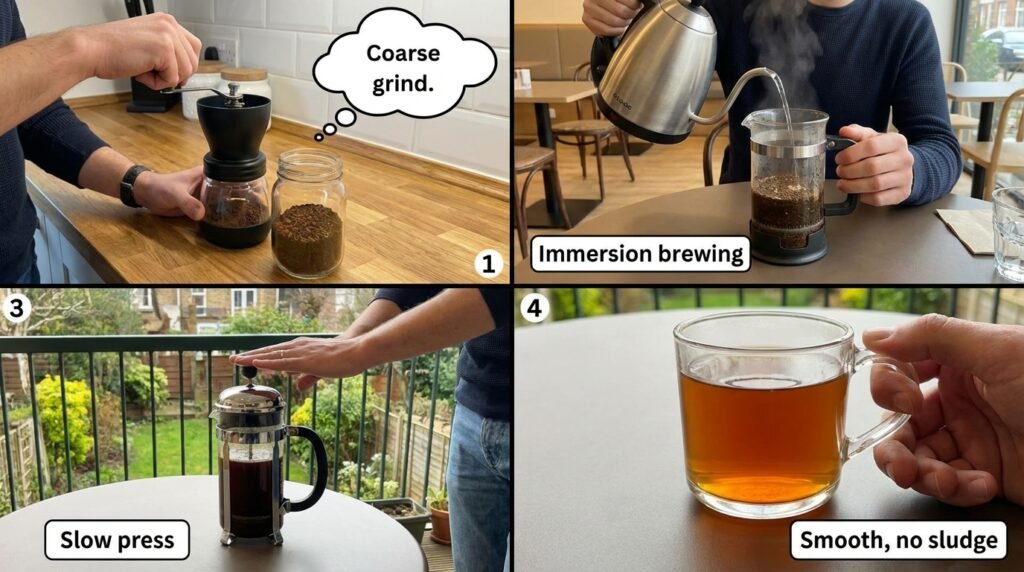
I opened my hand grinder and completely changed the settings. I adjusted the burrs to be as coarse as possible. When the coffee fell into the catcher, the grounds looked like heavy, chunky sea salt.
Learning to make this drastic adjustment is the exact premise of (How Grind Size Affected My Coffee More Than I Expected). You cannot force a fine grind into an immersion brewer and expect a clean cup. The tool demands coarse particles.
I put the coarse grounds into the glass beaker, poured the hot water, and waited four minutes.
I pressed the plunger down slowly. This time, there was very little resistance.
I poured the coffee into my mug. It was significantly clearer. When I took a sip, the harsh, aggressive bitterness from Day 1 was completely gone. The flavor was smooth, sweet, and perfectly extracted.
And most importantly, the bottom of my mug was almost entirely free of that dreaded black sludge.
Day 4: The Revelation of Oils and Body
By Thursday, I had the grind size dialed in perfectly. Now that the coffee actually tasted good, I could finally focus on the physical texture of the beverage.
This is where the French Press absolutely shines, and it is something a paper filter can never replicate.
Coffee beans are packed with natural, aromatic oils (specifically compounds called cafestol and kahweol). When you brew coffee through a thick paper filter, the paper acts like a sponge. It absorbs all of those heavy, delicious oils, preventing them from ever reaching your cup. This is why pour-over coffee feels so light and tea-like.
But the French Press only uses a thin, metal wire mesh.
The metal mesh stops the big coffee grounds, but it lets all of the microscopic natural oils pass right through into the final beverage.
When I drank my Thursday morning cup, I was blown away by the mouthfeel. The coffee felt thick, heavy, and incredibly velvety. It coated my entire palate with a syrupy richness. It felt like a luxurious dessert.
I realized that my obsession with paper filters had actually been depriving me of this massive, comforting texture for years. Enjoying the physical ritual of extracting these heavy oils is the core reason (Why I Prefer Manual Brewing Over Machines), because a standard drip machine simply cannot produce this level of viscous, heavy body.
Day 5: Choosing the Right Origin
On Friday, I learned a crucial lesson about pairing the French Press with the right coffee bean.
Earlier in the week, I had been trying to brew a highly acidic, floral Ethiopian coffee in the press. While the coarse grind fixed the bitterness, the heavy oils of the French Press completely masked the delicate, tea-like clarity that makes African coffees so special.
The French Press is a blunt, heavy instrument. It requires a coffee bean that can stand up to that weight.
So, I swapped my beans. I put the Ethiopian away and pulled out a naturally processed, medium-dark roast from the Cerrado Mineiro region of Brazil.
This was the perfect match.
Brazilian coffees naturally taste like heavy milk chocolate, toasted nuts, and sweet caramel. When I brewed this coffee in the French Press, the metal mesh amplified those heavy notes perfectly.
The resulting cup tasted like a massive, melted peanut butter cup. It was rich, decadent, and flawlessly balanced. I realized that if you are going to use a French Press, you need to use beans from South America or Indonesia that naturally lean toward heavy, comforting flavor profiles.
Day 6: The “No-Press” Technique (The Game Changer)
Saturday morning was the climax of my week-long experiment.
I was scrolling through specialty coffee forums online when I discovered a highly advanced technique popularized by James Hoffmann, a world-famous coffee expert. He claimed that the traditional way of using a French Press—forcefully shoving the plunger to the bottom—was completely wrong.
He argued that pressing the plunger violently churns up the grounds at the bottom, forcing microscopic dust into the cup.
I decided to try his legendary “No-Press” method.
I added my coarse grounds and poured the boiling water. I waited exactly four minutes.
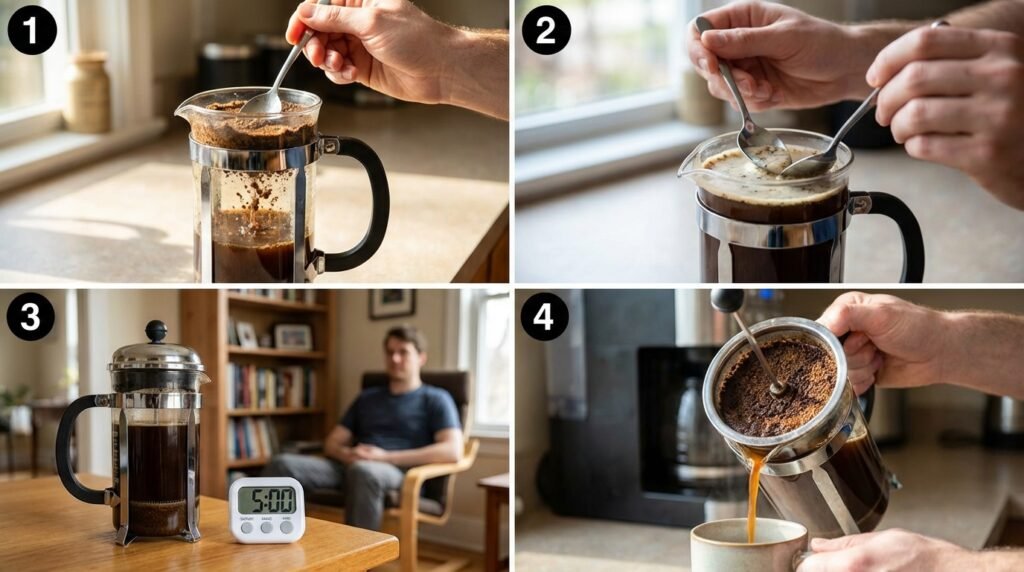
At the four-minute mark, a thick “crust” of floating coffee grounds had formed at the top of the glass. I took a spoon and gently stirred the top of the water, breaking the crust. Immediately, all the heavy grounds fell to the bottom of the beaker.
But a thin layer of pale foam and tiny floating particles remained on the surface. Using two spoons, I carefully skimmed this foam off the top and threw it in the sink.
Then came the hardest part: I set a timer and waited for five more minutes.
I didn’t touch it. I just let it sit there. During those five minutes, every single microscopic particle of coffee dust slowly settled to the very bottom of the glass.
Finally, I placed the metal plunger on top, but I did not press it down. I simply used the metal mesh as a strainer, resting it just below the surface of the liquid, and poured the coffee incredibly slowly into my mug.
The Ultimate Cup
When I tasted that Saturday morning cup, my reality shifted.
It was an absolute masterpiece.
Because I had skimmed the foam and let gravity do the work of settling the dust, the coffee was astonishingly clean. There was zero grit. There was zero muddy flavor.
But because I still used the metal mesh instead of paper, all of the heavy, sweet, syrupy oils were still present in the cup.
It was the Holy Grail of coffee brewing: the heavy, velvet body of a French Press, combined with the pristine, grit-free clarity of a pour-over. Discovering this advanced, patient technique was exactly (What I Wish I Knew About Coffee Brewing Earlier), because it proved that the tool wasn’t the problem; my impatient technique was the problem.
I had been using the French Press incorrectly for my entire life. The secret wasn’t pressing; the secret was patience.
Day 7: The Verdict and The Weekend Ritual
Sunday was the final day of my experiment.
I woke up, calmly executed the advanced “no-press” technique again, and sat on my porch with the most satisfying, heavy, chocolatey mug of coffee I had experienced in months.
When the week was over, I had a massive decision to make. Would I throw away my V60 and use the French Press forever?
No.
I still love the bright, acidic, tea-like clarity of a paper-filtered pour-over. When I have a brilliant, expensive bag of high-altitude Kenyan coffee, I will absolutely use my V60 to highlight those crisp grapefruit notes.
But the French Press has permanently earned its spot back on the front row of my coffee cabinet.
It is no longer a dusty, forgotten beginner’s tool. It is a highly specialized piece of equipment designed to extract heavy oils and create a massive, comforting body.
Dust Off Your Glass Beaker
My seven-day experiment taught me that we often blame our equipment when we should be analyzing our technique.
If you have a French Press sitting in the back of your cabinet right now, collecting dust because you think it makes muddy, bad coffee, I challenge you to pull it out tomorrow morning.
Do not use pre-ground supermarket dust. Go buy a fresh bag of high-quality coffee from Brazil or Colombia.
Grind the beans as coarse as sea salt. Use boiling water. Wait four minutes, break the crust, scoop the foam, and wait five more minutes. Use gravity, not force. Pour it gently into your favorite mug.
When that heavy, velvet-smooth, incredibly sweet liquid coats your palate without a single grain of grit, you will finally understand the magic of immersion brewing. You will realize that the French Press is a brilliant, elegant tool, and it absolutely deserves a place in your daily routine.

My name is Daniel Carter, I am 35 years old, and I live in the United States. I have been passionate about aquariums for many years, and what started as a simple hobby quickly became a lifelong interest in aquatic life, fish behavior, and responsible tank care.
Through TheBrightLance, I share real experiences, practical knowledge, and honest lessons learned from maintaining different types of aquariums. I enjoy testing equipment, studying fish behavior, improving maintenance routines, and helping beginners avoid common mistakes.
My goal is to make aquarism easier, more ethical, and more enjoyable for everyone — whether you are setting up your very first tank or looking to refine your techniques.