
If you have ever sat in a chair for a large-scale, traditional Japanese-style tattoo—perhaps a sprawling piece featuring a snake winding its way through dark waves and heavy peonies—you learn very quickly about the profound importance of pacing.
The tattoo artist cannot simply rush the process. When they are packing that heavy, dense black ink into the skin to create those iconic, fluid background waves, they have to maintain a highly specific rhythm.
If the artist moves the needle too fast, the ink won’t hold. The skin will be traumatized, the lines will look weak and patchy, and the final piece will lack that signature, bold contrast. On the other hand, if they move too slowly and linger in one spot for too long, they will overwork the skin, causing unnecessary pain, severe blowout, and a harsh, blurred mess.
The masterpiece is entirely dependent on the clock. It requires the exact right amount of contact time.
For the first few years of my specialty coffee journey, I completely ignored this concept in my kitchen.
I treated my morning coffee routine like a frantic race. I thought the only variables that mattered were the quality of the beans, the temperature of the water, and the size of the grounds. I viewed time as an annoyance. I wanted my caffeine, and I wanted it immediately.
Because I rushed the process, my coffee was constantly suffering from the culinary equivalent of a blown-out, overworked tattoo. It was either aggressively harsh, or completely weak and patchy.
Here is the honest, highly scientific story of why timing matters more than I ever thought in coffee brewing, the invisible chemical clock that dictates flavor, and how buying a simple stopwatch completely revolutionized my morning mug.
The Illusion of Instantaneous Extraction
My biggest misunderstanding about coffee was rooted in how I viewed the water.
I used to think that the moment hot water touched coffee grounds, the flavor was instantly, magically transferred into the liquid. I thought it was an immediate transaction.
I didn’t understand that coffee brewing is a slow, sequential chemical extraction.
The roasted coffee bean is a dense, complex structure packed with hundreds of different flavor compounds. These compounds do not dissolve into the water all at the same time. They dissolve in a very specific, strict, chronological order.
First, the water dissolves the bright, fruity organic acids. These compounds are highly soluble and jump into the water almost immediately.
Second, the water begins to dissolve the heavy, complex, caramelized sugars and natural fats. These take a little bit more time and effort to melt out of the cellular walls.
Finally, if the water stays in contact with the beans for too long, it begins to extract the harsh, dry, bitter plant tannins and woody fibers.
Realizing that patience is a chemical requirement was exactly (What I Wish I Knew About Coffee Brewing Earlier), because I had been ruining great beans simply by ignoring the clock.

The Fast Pour (The Sour Patch)
Before I understood this chronological sequence, my pour-over technique was incredibly aggressive.
I would boil my kettle, place my V60 cone on my mug, and relentlessly dump all the hot water over the coffee grounds as fast as humanly possible. I wanted to fill the cone to the brim and get it over with.
The water would rush violently through the coffee bed, and the entire brewing process would finish in about sixty to ninety seconds.
When I tasted the coffee, it was an absolute disaster. It was overwhelmingly sour. It tasted like biting into a raw lemon, mixed with weak, grassy tea. It made the sides of my jaw physically ache.
By rushing the water through the coffee so incredibly fast, I had severely “under-extracted” the beans.
The water only had enough time to pull out the first set of compounds: the fast-moving fruit acids. Because it drained so quickly, it never had the necessary time to penetrate deeper into the bean and dissolve the heavy, sweet sugars that are required to balance out that sharp acidity.
I was drinking an incomplete beverage. The image wasn’t fully rendered.
The Slow Choke (The Bitter End)
Determined to fix the awful sourness, I eventually tried the exact opposite approach.
I bought a manual burr grinder, and I decided to grind my coffee beans incredibly fine, almost like powdered sugar. I thought that by making the particles smaller, I would extract more flavor.
I poured the water into my V60. But because the coffee dust was so fine, it created a dense, cement-like mud at the bottom of the paper filter. The water was trapped. It couldn’t flow through the cone.
I stood in my kitchen and watched the water slowly, agonizingly drip into my mug. It took nearly six minutes for the water to finally drain.
When I tasted that cup, my palate was assaulted by a completely different nightmare.
The sourness was gone, but it was replaced by a violently harsh, dry, ashy bitterness. It tasted like burnt wood. It physically dried out my mouth and left a lingering metallic taste on the back of my tongue.
By trapping the water in the coffee grounds for six minutes, I had severely “over-extracted” the beans.
The water had enough time to pull out the acids, and it pulled out the sweet sugars, but then it just kept going. It lingered for so long that it began aggressively pulling out the bitter tannins and harsh woody fibers. I had overworked the canvas, completely destroying the delicate balance of the flavors.
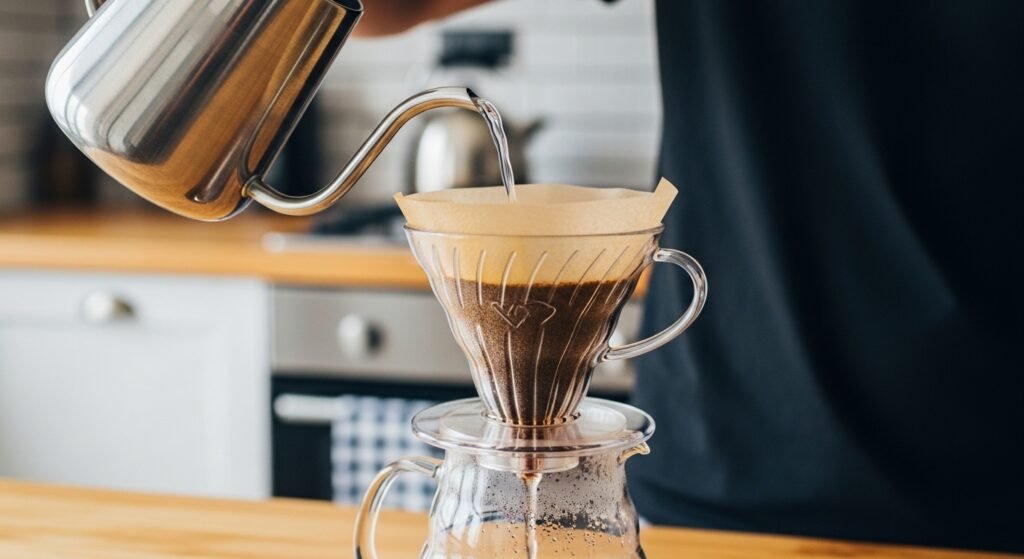
Phase 1: The Crucial 45 Seconds (The Bloom)
I finally realized that to get a perfect cup of coffee, I needed to respect the timer. I had to orchestrate the flow of water to hit the exact sweet spot between the sour acids and the bitter tannins.
The very first step of this chronological dance is the most important, and it requires absolute stillness.
When hot water hits fresh coffee grounds, the beans rapidly release trapped carbon dioxide gas. The coffee bed bubbles, expands, and swells upward. This is known as the “Bloom.”
If you just keep pouring water while the coffee is degassing, the gas acts as a physical shield, repelling the water and preventing extraction.
Ignoring this crucial degassing window was undeniably (The Biggest Brewing Mistake I Didn’t Notice), as the trapped gas completely shielded the grounds and ruined my flow rate.
Now, I start a timer on my phone the exact second the first drop of water hits the dry coffee. I pour just 45 grams of water to wet the bed, and then I put the kettle down.
I do not touch it. I watch the clock tick up to exactly 45 seconds. I let the coffee exhale completely. Only then do I proceed to the next phase.
Phase 2: The Three-Minute Window
Once the bloom is finished, the actual extraction begins.
For a standard V60 pour-over, using roughly 15 grams of coffee and 240 grams of water, the industry standard for a perfect extraction time is roughly three minutes (including the 45-second bloom).
This three-minute window is the ultimate sweet spot. It provides the exact right amount of contact time for the water to dissolve the bright acids, immediately followed by the heavy, caramelized sugars, before the water drains away—leaving the bitter tannins safely locked inside the wet filter.
To achieve this three-minute finish, you have to manually control your pouring speed.
You cannot dump the water in all at once, or it will drain too fast. You cannot trickle it in drop by drop, or it will drain too slow.
I had to learn how to pour in slow, steady, hypnotic concentric circles, keeping the water level perfectly consistent. I watch the timer tick up alongside the digital scale. By the time my scale hits 240 grams of water, my timer usually reads about one minute and forty-five seconds.
Then, I put the kettle down and watch the final “drawdown” as gravity pulls the remaining water through the grounds. If the water finishes draining right as the clock hits three minutes, I know with absolute certainty that the coffee is going to taste incredible.
The Tool Dictates the Clock
As I became more advanced in my brewing, I realized that the three-minute rule is not a universal law for all coffee. The ideal timing is completely dictated by the specific tool you are using.
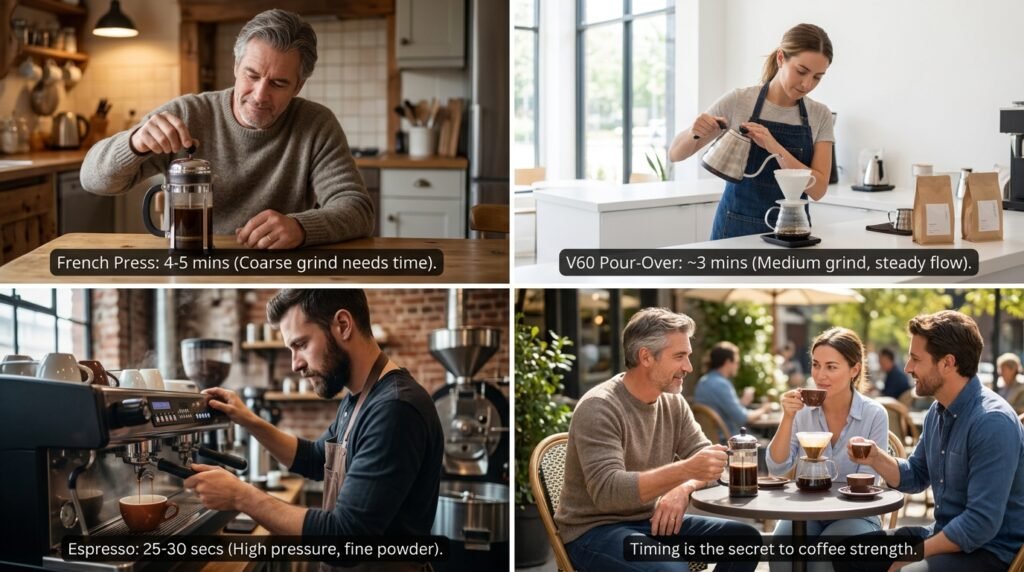
A V60 pour-over relies on a medium-fine grind and a continuous flow of water. Therefore, it needs three minutes.
But a French Press is an entirely different beast. It is an “immersion” brewer. The coffee and the water sit together in a glass beaker. Because they sit together, you have to use a much coarser grind to prevent the coffee from over-extracting.
Because the chunks of coffee are so large and coarse, the water needs significantly more time to penetrate the cellular walls and dissolve the sugars. A French Press requires a minimum of four to five minutes of contact time. If you plunge a French Press at the two-minute mark, it will taste like sour, weak water.
An espresso machine operates on the complete opposite end of the spectrum.
An espresso machine forces near-boiling water through a tightly packed puck of microscopic coffee powder using nine bars of intense atmospheric pressure. Because the pressure is so violent and the particles are so small, the extraction happens almost instantaneously.
A perfect shot of espresso takes exactly 25 to 30 seconds. If an espresso shot takes 45 seconds, it will taste like burnt rubber.
Discovering how to manipulate this specific contact time is the exact secret to (How I Learned to Control Coffee Strength), because you are physically engineering the chemical concentration of the liquid.
The Liberation of the Stopwatch
The single greatest purchase I made to fix my coffee was a digital kitchen scale that featured a built-in digital timer right next to the weight display.
Before I bought it, I was constantly trying to juggle my phone timer, the kettle, and the scale. It was a chaotic, frustrating mess.
Having the timer built directly into the scale changed everything. It completely removed the guesswork from my morning routine.
If I buy a new bag of coffee, grind it, pour my water, and the drawdown finishes at two minutes flat, I don’t even need to taste the coffee to know it will be slightly sour. I know immediately that tomorrow morning, I need to adjust my grinder one click finer to slow the water down and increase the contact time to hit that three-minute mark.
The timer acts as a diagnostic tool. It tells me exactly what my water is doing, even when I can’t see the microscopic chemistry happening inside the filter.
A Lesson in Intentionality
In a modern world that prioritizes speed above all else, forcing yourself to stand in a kitchen and respect a three-minute timer can feel almost agonizing at first.
We are conditioned to want immediate gratification. We want to push a button and receive a product.
But true quality cannot be rushed. You cannot force a masterpiece into existence simply because you are running late for work. You have to respect the rhythm of the process.
If your coffee consistently tastes thin, sharp, and sour, you are moving too fast. You are not giving the canvas enough time to absorb the ink. You need to grind finer and slow your pour down.
If your coffee consistently tastes heavy, ashy, and leaves a dry bitterness on your palate, you are overworking the canvas. You are lingering too long. You need to grind coarser and speed the water up.
When you finally stop treating coffee like an instant transaction and start treating it as a timed, chronological extraction, the results will absolutely blow your mind. You will unlock levels of sweetness and clarity you never thought possible, simply because you finally decided to give the water the exact amount of time it needed to do its job.

My name is Daniel Carter, I am 35 years old, and I live in the United States. I have been passionate about aquariums for many years, and what started as a simple hobby quickly became a lifelong interest in aquatic life, fish behavior, and responsible tank care.
Through TheBrightLance, I share real experiences, practical knowledge, and honest lessons learned from maintaining different types of aquariums. I enjoy testing equipment, studying fish behavior, improving maintenance routines, and helping beginners avoid common mistakes.
My goal is to make aquarism easier, more ethical, and more enjoyable for everyone — whether you are setting up your very first tank or looking to refine your techniques.