
Whenever someone finds out that I am deeply passionate about specialty coffee, they almost always ask me the exact same question. They usually lean in, lower their voice as if asking for a winning lottery ticket number, and say: “Okay, so what is the absolute best brand I should buy?”
I always disappoint them with my answer.
I have to gently explain that I don’t really care about brands. A coffee roaster’s logo does not dictate the flavor of the beverage. The logo is just the final step in a massive global supply chain.
If you truly want to find the best coffee in the world, you have to stop looking at the shiny packaging and start looking at a map. You have to look at the dirt, the altitude, and the agricultural history of the land where the seed was planted.
Over the years, I have tasted coffees from the high volcanic slopes of Colombia, the rainy jungles of Sumatra, and the windy, beautiful mountains of Costa Rica. I respect them all deeply.
But there is one specific country that completely stole my heart. There is one origin that consistently ruins all other coffees for me, delivering a sensory experience so profoundly beautiful that I find myself chasing it every single morning.
Here is the honest, aromatic story of the country that produces my absolute favorite coffee, why its ancient geography creates an impossible flavor profile, and why I will never stop buying it.
The Misconception of “Strong” Coffee
Before I reveal my favorite country, I have to explain the flawed mindset I used to have.
For the first decade of my coffee-drinking life, I thought a great cup of coffee was supposed to be a heavy, dark, bitter experience. I thought it was supposed to taste like roasted nuts, dark chocolate, and a little bit of smoke.
I bought coffees from Central and South America exclusively, assuming that heavy, syrupy comfort was the ultimate peak of the coffee world.
I had absolutely no idea that coffee was biologically capable of tasting light, delicate, and sweet. I didn’t know that coffee is literally the roasted seed of a tropical fruit, and that if you treat it right, it will actually taste like fruit.
My palate was completely locked in a dark-roast prison.
It wasn’t until a barista forced me to try a completely different origin that my worldview shattered. Recalling that initial sensory shock is exactly (The First Time I Tried Ethiopian Coffee (And Loved It)), because it was the moment I stopped viewing coffee as a generic brown liquid and started viewing it as a vibrant agricultural miracle.
That first sip completely rewired my brain, and it introduced me to my undisputed favorite coffee-producing nation on Earth: Ethiopia.

The Birthplace of the Bean
To understand why Ethiopian coffee is so spectacular, you have to look at the history of humanity and agriculture.
Ethiopia is not just another country that happens to grow coffee. It is the biological birthplace of the entire Arabica coffee species. Every single Arabica coffee plant growing in Brazil, Colombia, Hawaii, or Indonesia can trace its genetic roots directly back to the ancient forests of the Ethiopian highlands.
In most coffee-producing countries, farmers buy specific hybrid seeds that were developed in agricultural laboratories to resist diseases and produce massive yields.
But in Ethiopia, the coffee grows wild.
When you buy a bag of Ethiopian coffee, the label usually doesn’t list a specific, engineered plant variety. Instead, it will just say Heirloom.
This single word means that the coffee was harvested from thousands of naturally mutating, ancient, wild coffee trees that have been growing in the deep African forests for centuries. Understanding the sheer genetic diversity of these ancient forests perfectly explains (The Coffee Variety That Surprised Me the Most), as those wild Heirloom plants simply cannot be replicated in a laboratory.
They are delicate, low-yielding, and fiercely unique. Because they haven’t been genetically modified to prioritize volume, all of the plant’s energy goes into producing an incredibly complex, sweet, and aromatic seed.
The Altitude Advantage
Genetics alone do not make a perfect cup of coffee. The environment has to cooperate.
Ethiopia possesses arguably the most perfect coffee-growing geography on the planet. The coffee regions are situated at dizzying altitudes, often between 1,800 and 2,200 meters above sea level.
At this elevation, the air is thin, and the temperature drops drastically at night.
This cold mountain air is the true secret weapon of Ethiopian coffee. The cold forces the coffee cherries to mature at an incredibly slow, agonizing pace. Because the fruit takes so long to ripen on the branch, the plant pushes massive amounts of complex organic acids and dense natural sugars deep into the seed.
When those seeds are harvested and lightly roasted, those trapped acids and sugars translate directly into the cup.
They do not taste like chocolate or roasted wood. They taste vibrantly, undeniably like fresh fruit and blooming flowers. It is a flavor profile that is completely unique to the Ethiopian highlands.

The Magic of the Guji Region
Even within my favorite country, I have a specific, undeniable preference.
Ethiopia is massive, and its different regions produce surprisingly different flavor profiles. For a long time, the Yirgacheffe region was the most famous. Yirgacheffe coffees are brilliant, known for their sharp, lemony acidity and intense, perfume-like notes of bergamot and Earl Grey tea.
But a few years ago, I discovered a neighboring region that completely stole the crown.
The Guji region lies just south of Yirgacheffe. The coffees grown in the dense, high-altitude forests of Guji share the floral elegance of their neighbors, but they add something entirely mesmerizing to the mix: intense, juicy stone fruit.
Whenever I brew a washed Ethiopian Guji, the dry aroma alone is enough to stop me in my tracks. It smells like a blooming garden.
When I take a sip, the liquid is incredibly light and silky, almost translucent. It washes over my palate with zero bitterness. Instantly, the flavor of sweet, ripe peaches and fresh nectarines explodes in my mouth.
As I swallow, the peach note gently fades into a lingering, delicate finish of jasmine flowers and raw honey.
It is a culinary masterpiece. That reliable, mouth-watering sweetness is the core reason (Why I Keep Going Back to African Coffees), even when I have dozens of other excellent options sitting in my pantry. Nothing else provides that specific, elegant spark of joy.
The Processing Puzzle: Washed vs. Natural
Ethiopia also taught me that human intervention can drastically alter a country’s natural flavor profile.
In my kitchen, I keep two different types of Ethiopian Guji, depending on my mood. This is because Ethiopian farmers are masters of two very distinct processing methods.
When I want clarity, elegance, and that crisp peach-tea flavor, I buy a Washed Ethiopian coffee. This means the farmers stripped the fruity cherry off the seed immediately after picking it, washing it clean before drying it in the sun. The washed process highlights the pure, crisp genetics of the Heirloom bean.
But when I want a wild, syrupy, intense experience, I buy a Natural Ethiopian coffee.
In the Natural process, the farmers leave the entire fruit intact and let it dry in the hot African sun. As the fruit shrivels like a raisin, the sticky, fermenting fruit sugars seep through the skin and into the seed.
A natural Ethiopian Guji does not taste like a delicate peach tea. It tastes like a massive, heavy, syrupy slice of warm blueberry pie. The berry notes are so intense that it almost tastes like a sweet, complex red wine.
Having the ability to experience both the elegant, washed clarity and the wild, natural fermentation from the exact same region is why I never get bored of Ethiopian coffee. It is a country that offers an entire spectrum of flavor.
The Requirement of Respect
There is a catch to loving Ethiopian coffee, however. It demands absolute respect in the kitchen.
If you buy a dark-roasted Brazilian coffee, it is very forgiving. If your water is a little too hot, or your grind size is slightly off, the coffee will still taste like dark chocolate and roasted nuts. It will survive your mistakes.
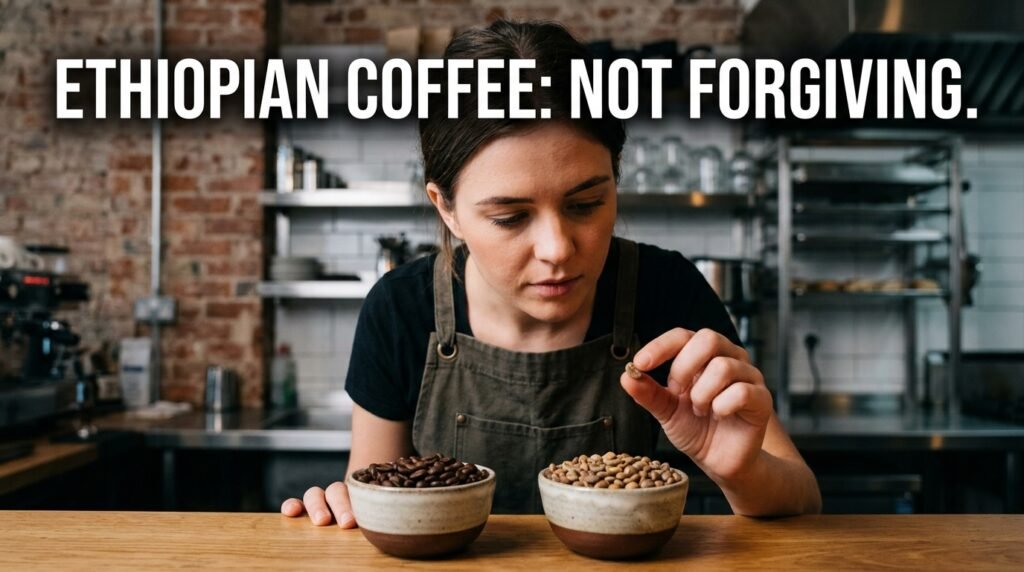
Ethiopian coffee is not forgiving. It is a fragile, delicate agricultural product.
If you buy an Ethiopian Heirloom bean that has been roasted dark, it is completely ruined. The intense heat of a dark roast instantly destroys the delicate floral compounds and the volatile fruit acids. You will be left with a burnt, ashy cup of disappointment.
To experience the magic of Ethiopia, you must buy a Light Roast.
Furthermore, you cannot just dump these beans into a cheap, automatic drip machine. The water will flow too unpredictably, and you will end up with a sour, under-extracted mess.
Ethiopian coffee demands precision. It demands a digital scale to weigh the beans perfectly. It demands a burr grinder for an even particle size. And most importantly, it shines brightest when brewed manually, using a pour-over cone like a V60 or a Chemex.
When you take the time to brew it properly, the beans reward your patience with a level of sweetness and complexity that no commercial coffee could ever dream of achieving.
The Daily Anchor
I still love to travel the world through my coffee cup. I will always buy bags from Colombia, Costa Rica, and Indonesia to keep my palate sharp and to appreciate the incredible diversity of global agriculture.
But Ethiopia is my anchor.
When I wake up on a quiet weekend morning, and I want a cup of coffee that forces me to sit down, close my eyes, and truly savor the moment, I reach for a bag of washed Guji.
I love that the flavor is tied to ancient forests rather than modern laboratories. I love that the sweetness comes from the cold mountain air rather than a bottle of artificial syrup. I love that every single sip is a testament to the country where this incredible plant was born.
My Advice to the Curious
If you are reading this and you have never experienced a light-roast specialty coffee from Ethiopia, you are standing at the edge of an incredible culinary precipice.
Do not let the idea of “fruity” or “floral” coffee intimidate you. It does not taste like flavored water. It tastes like the highest, purest, and most complex expression of the coffee seed.
Find a reputable specialty roaster online or in your local city. Look for a bag with a bright, pale brown roast profile. Check the label for the word “Ethiopia,” and if you can find the word “Guji,” buy it immediately.
Take it home, grind it fresh, and brew it with care.
When that aroma of fresh jasmine and ripe peaches fills your kitchen, and you take your very first sip of that sweet, vibrant, completely bitter-free liquid, you will understand exactly why my search for the best coffee in the world ended in the ancient highlands of Africa.

My name is Daniel Carter, I am 35 years old, and I live in the United States. I have been passionate about aquariums for many years, and what started as a simple hobby quickly became a lifelong interest in aquatic life, fish behavior, and responsible tank care.
Through TheBrightLance, I share real experiences, practical knowledge, and honest lessons learned from maintaining different types of aquariums. I enjoy testing equipment, studying fish behavior, improving maintenance routines, and helping beginners avoid common mistakes.
My goal is to make aquarism easier, more ethical, and more enjoyable for everyone — whether you are setting up your very first tank or looking to refine your techniques.