
When I first started taking my coffee habit seriously, I thought I had it all figured out.
I had learned to stop buying cheap, pre-ground supermarket dust. I had invested in a decent burr grinder. I had even learned how to read a coffee label, making sure to look for the specific country of origin and the exact roast date.
I felt like an expert standing in the coffee aisle of my local specialty roaster. I would confidently buy a bag from Colombia, then a bag from Guatemala, and then maybe a bag from Indonesia. I thought the country of origin was the absolute final frontier of coffee flavor.
I was completely unaware that there was an entire biological layer underneath the country name that I was completely ignoring.
I didn’t know anything about coffee varieties.
I thought that a coffee plant was just a coffee plant. If it grew in Brazil, it tasted like Brazil. If it grew in Kenya, it tasted like Kenya. I assumed the dirt and the weather did 100% of the work.
I didn’t realize that, just like apples or wine grapes, coffee has thousands of different botanical sub-varieties, each with its own drastically different genetic flavor code.
It wasn’t until a highly knowledgeable barista handed me a very specific bag of beans that my eyes were truly opened. That bag contained a coffee variety that didn’t just surprise me; it completely rewired my brain and forever changed what I look for in a morning cup.
Here is the story of my botanical awakening, and the incredible coffee variety that I simply cannot stop drinking.
The Illusion of “100% Arabica”
To understand why this specific variety shocked me so much, you have to understand the misleading marketing that most of us grow up with.
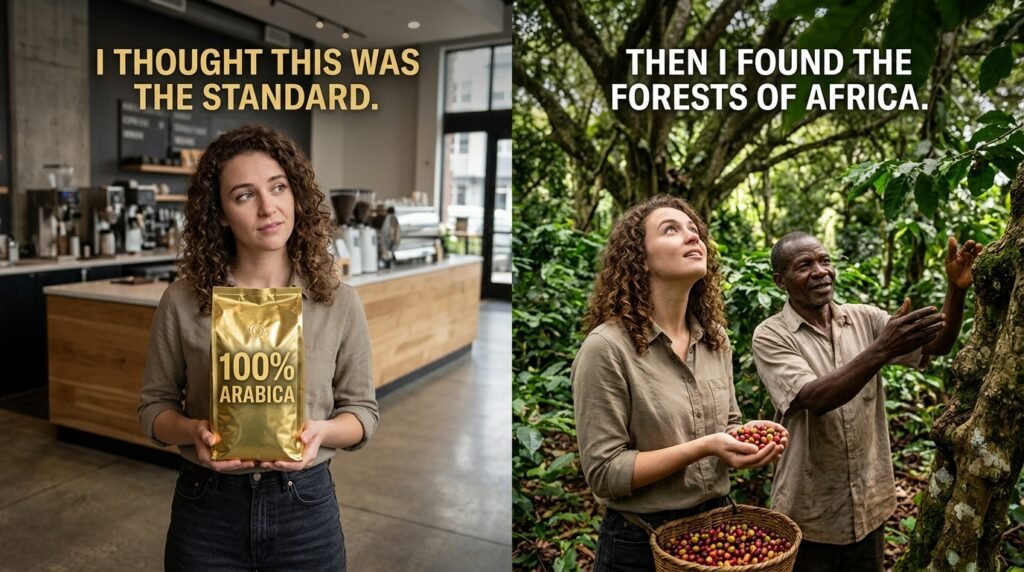
For years, I bought bags that proudly shouted “100% Arabica” in shiny gold letters. I thought this was the highest standard of coffee botany.
Nobody told me that “Arabica” is just a massive, overarching species category. It is a giant umbrella. Underneath that umbrella, there are dozens of different cultivated varieties (called cultivars or varietals).
In the specialty coffee world, farmers plant specific varieties based on what they want to achieve. Some varieties, like Caturra or Catimor, were created in laboratories or bred specifically to resist diseases and produce massive yields of cherries. They are tough, reliable plants, but their flavor is often just… ordinary. It tastes like traditional, comforting coffee.
Other varieties, like Bourbon or Typica, are older, classic genetics. They produce fewer cherries, but they offer a much sweeter, cleaner, and more complex flavor in the cup.
For the first few months of my specialty coffee journey, I was unknowingly drinking standard, high-yield varieties. They were good, certainly better than supermarket coffee, but they still tasted within the boundaries of what I expected coffee to be.
That is, until I encountered the wild forests of Africa.
The Recommendation That Changed Everything
It happened on a rainy Thursday afternoon. I walked into my favorite local roastery looking to buy a new bag of beans for the weekend.
I was standing in front of the retail shelf, debating between a washed coffee from Honduras and a honey-processed coffee from Costa Rica. The head roaster, who had helped me pick out beans several times before, walked out from the back room.
He looked at what I was holding and shook his head.
“Put those down,” he said with a smile. “You’re ready for something a little more challenging. I just finished roasting a new batch this morning, and it is going to completely mess with your head.”
He reached behind the counter and handed me a minimalist, white paper bag.
I looked at the label. It read: Origin: Ethiopia Region: Guji Process: Washed Variety: Heirloom
I recognized the country, but I stopped at the last word. “What does Heirloom mean?” I asked. “Is that the brand name?”
The roaster laughed. “No. Heirloom isn’t a brand. It’s the genetics. And it is going to blow your mind.”
I trusted him, so I paid for the bag, took it home, and waited until Saturday morning to open it. I had absolutely no idea that I was about to experience a flavor profile that would completely redefine my mornings.
The Sensory Shock of the Heirloom Bean
Saturday morning arrived. I walked into my kitchen, grabbed my digital scale, and broke the seal on the bag of Ethiopian Guji.
I leaned in to smell the whole beans, expecting the usual scent of toasted nuts or chocolate.
Instead, a wave of intense, sweet perfume hit my face. It didn’t smell like coffee. It smelled vividly like a bouquet of fresh jasmine flowers and ripe peaches. The aroma was so delicate and floral that I actually looked around my kitchen, half-expecting to see a vase of flowers I had forgotten about.
I poured fifteen grams of the beans into my manual burr grinder. As I started to crush them, the floral aroma amplified exponentially. It was intoxicating.
I set up my V60 pour-over cone, boiled my water to exactly 205 degrees Fahrenheit, and started the brewing process.
Even the bloom was different. As the hot water hit the fresh grounds, the steam rising from the carafe smelled like Earl Grey tea and bergamot. It was elegant.
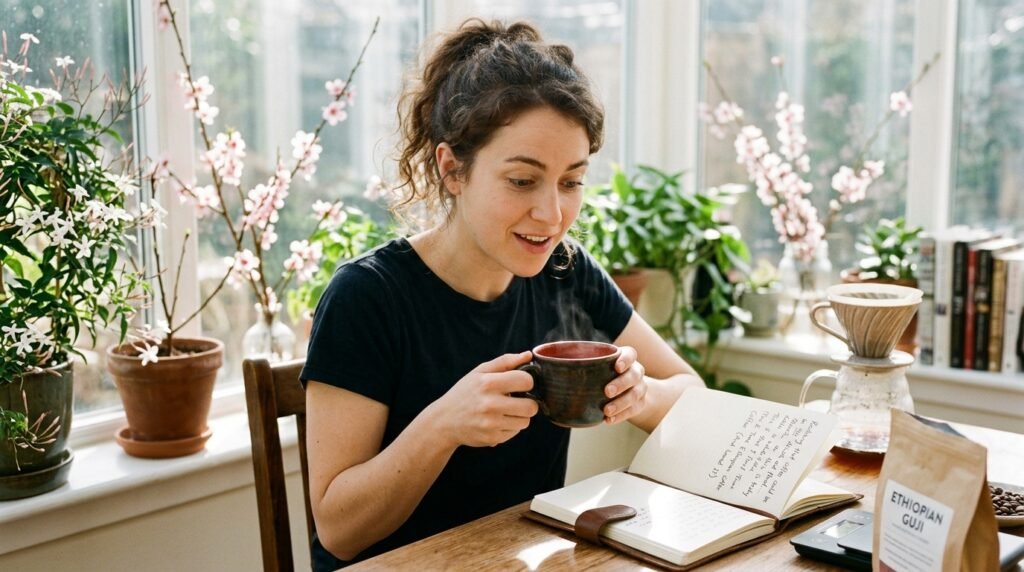
I let the coffee finish dripping, poured it into my favorite ceramic mug, and sat down at the table. I let it cool for a full two minutes, knowing that extreme heat masks delicate flavors.
I took my first sip.
I physically stopped moving. My brain could not reconcile what my eyes were seeing with what my tongue was tasting.
I was looking at a dark, ruby-red liquid that I knew was coffee. But my tongue was telling me I was drinking a sweet, vibrant, fruit-infused black tea.
There was absolutely zero bitterness. It was incredibly light-bodied. As the liquid washed over my palate, the flavor of juicy, ripe peach exploded in my mouth, followed instantly by a distinct, sweet honey note. The finish was clean, lingering with the taste of jasmine blossoms.
It was an absolute masterpiece.
I sat there in the quiet kitchen, staring at the mug. Discovering this exact sensory experience is precisely (The First Time I Tried Ethiopian Coffee (And Loved It)), because it was the moment I realized that coffee could be delicate, floral, and naturally sweet without a single grain of added sugar.
What Makes “Heirloom” So Special?
I drank the entire cup in a state of mild shock. As soon as I finished, I grabbed my laptop. I needed to understand the science behind what I had just tasted.
Why did this Ethiopian Guji taste so drastically different from the South American coffees I had been drinking?
The secret, I discovered, was entirely in that one word on the label: Heirloom.
To understand Ethiopian Heirloom coffee, you have to look at the history of the world. Ethiopia is the undisputed biological birthplace of all Arabica coffee. Centuries ago, the coffee plant grew wildly in the dense, high-altitude forests of the Ethiopian highlands.
When coffee was eventually smuggled out of Ethiopia and planted in places like Brazil, Colombia, and Vietnam, humans started breeding the plants. They took a few specific varieties and genetically crossed them to create plants that were resistant to bugs and produced massive amounts of fruit.
But in Ethiopia, things remained wild.
In regions like Guji, Yirgacheffe, and Sidamo, coffee isn’t always grown on neat, organized, commercial farms. It often grows wild in the forest, or in small “garden farms” in the backyards of local villagers.
Because these plants have been growing naturally for thousands of years, they have mutated and cross-pollinated organically. It is estimated that there are over 10,000 distinct, uncatalogued coffee varieties growing wild in Ethiopia today.
When a label says “Heirloom,” it essentially means “Wild Ancient Genetics.”
The farmers in Guji aren’t planting lab-created hybrids. They are harvesting the original, ancient, delicate genetics of the coffee plant. And because these plants haven’t been genetically modified to prioritize high yield, all of the plant’s energy goes into producing an incredibly complex, sweet, and floral seed.
Learning this was a massive “aha” moment for me. Understanding the biology behind the flavor perfectly explained (Why Some Coffees Taste So Different (My Personal Discovery)), proving that the plant’s ancient DNA is just as important as the soil it grows in.
The Contrast of Terroir and Variety
The Heirloom variety completely ruined standard coffee for me in the best way possible.
It taught me that while the environment (terroir) is incredibly important, the genetics of the plant are the true architects of flavor.
If you take a standard, high-yield coffee plant and grow it in the beautiful, high-altitude mountains of Guji, it will taste good, but it won’t taste like magic.
But when you take ancient, wild Heirloom genetics and allow them to grow slowly in the cool, high-altitude Ethiopian air, you get a perfect storm of agricultural perfection. The cool air develops the intense peach sugars, while the wild genetics provide the delicate jasmine and black tea characteristics.
I had been drinking coffee my entire adult life, but it felt like I was tasting the actual fruit for the very first time.
Why the Guji Region Stands Out
As I continued to explore different African coffees, I realized that even within the Heirloom category, the specific region of Guji produced something entirely unique.
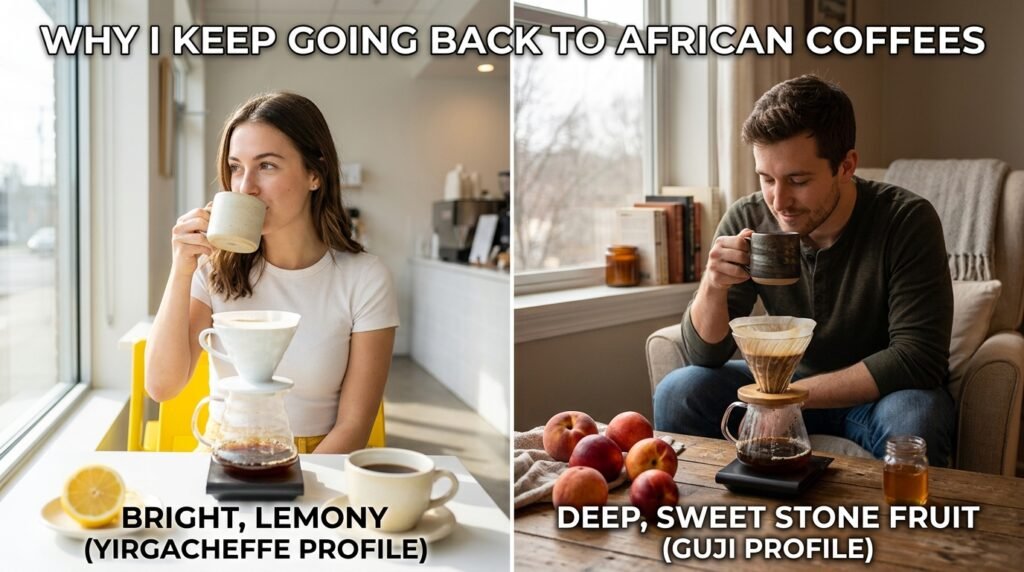
While coffees from the neighboring Yirgacheffe region are famous for being incredibly bright and lemony, the coffees from Guji tend to have a deeper, sweeter fruit profile.
Every time I bought a washed Guji Heirloom, I found those same intoxicating notes of stone fruit—peaches, nectarines, and sometimes even a hint of melon—wrapped in a heavy, honey-like sweetness.
It became my ultimate comfort cup. But not the kind of heavy, dark-roast comfort I used to rely on. It was a refreshing, uplifting comfort. It was the kind of coffee that made me want to sit by a window on a Sunday morning and read a book, savoring every single drop.
This specific, reliable sweetness is the core reason (Why I Keep Going Back to African Coffees). No matter how many incredible coffees I try from Central America or Asia, my palate always craves the wild, untamed floral complexity of an Ethiopian Heirloom.
Expanding the Botanical Horizon
The discovery of the Heirloom variety changed the way I shop for coffee forever.
I stopped looking exclusively at the country name on the bag. I started treating the coffee aisle like a botanical garden.
I started hunting for other famous varieties. I tried the Gesha variety, famous for its intense bergamot and floral notes. I tried the Pacamara variety, a massive bean that produces a surprisingly juicy, savory cup. I tried the Pink Bourbon variety from Colombia, known for its incredible pink cherries and vibrant, sweet flavor.
Every new variety I tried was a completely different experience. It felt like unlocking a secret level in a video game that I had been playing my entire life.
But despite all the incredible and expensive varieties I have tasted since that rainy Thursday afternoon, the Ethiopian Heirloom remains my absolute favorite.
The Ultimate Advice for the Curious
If you are reading this, and you are still buying bags of coffee that simply say “100% Arabica Blend,” I completely understand. The world of coffee botany is intimidating, and the labels can feel like they are written in a foreign language.
But I urge you to step outside of your comfort zone just once.
The next time you visit a specialty coffee roaster, don’t just ask for a medium roast. Don’t just ask for a coffee from South America.
Look the barista in the eye and say, “I want to try a washed Ethiopian Heirloom from the Guji region.”
Take it home. Grind it fresh. Brew it carefully. And most importantly, drink it black. Let it cool for a minute so the heat doesn’t hide the magic.
When you take that first sip, and the flavor of fresh peaches and jasmine flowers floods your palate, you will finally understand.
You will realize that coffee is not a factory-made commodity. It is a wild, ancient, and incredibly diverse fruit. And I promise you, the Heirloom variety will surprise you just as much as it surprised me. Your mornings will never, ever be the same.

My name is Daniel Carter, I am 35 years old, and I live in the United States. I have been passionate about aquariums for many years, and what started as a simple hobby quickly became a lifelong interest in aquatic life, fish behavior, and responsible tank care.
Through TheBrightLance, I share real experiences, practical knowledge, and honest lessons learned from maintaining different types of aquariums. I enjoy testing equipment, studying fish behavior, improving maintenance routines, and helping beginners avoid common mistakes.
My goal is to make aquarism easier, more ethical, and more enjoyable for everyone — whether you are setting up your very first tank or looking to refine your techniques.