
Imagine walking onto a used car lot to buy a vehicle. A salesman walks up to you, points to a car under a shiny tarp, and tells you it is a “Premium, Gourmet Edition.”
You naturally ask a few basic questions. You ask for the year it was manufactured. You ask for the mileage on the odometer. You ask to see the service history, and you ask how many previous owners it has had.
The salesman waves his hand dismissively. “Don’t worry about any of that data,” he says. “Trust me, it’s a hundred percent car. It has four wheels, and it’s good to drive until the year 2028.”
If this happened in real life, you would immediately turn around and run away. You would never hand over your hard-earned money for a machine without knowing its exact history, mileage, and specifications. It would be financial suicide.
Yet, millions of people do this exact same thing in the grocery store every single day.
For the first decade of my adult life, I was one of them. I bought my morning coffee blindly. I trusted the shiny foil bags, the fancy fonts, and the meaningless marketing buzzwords. And as a result, I drank terrible, bitter, stale coffee for years.
Eventually, I got tired of being scammed by clever marketing departments. I decided to learn how to read the actual data.
Here is the honest, highly practical story of how I avoid buying bad coffee, the massive red flags I look for on every single label, and how adopting a strategy of “defensive buying” completely revolutionized the quality of my morning routine.
The Missing Odometer: The Expiration Date Trap
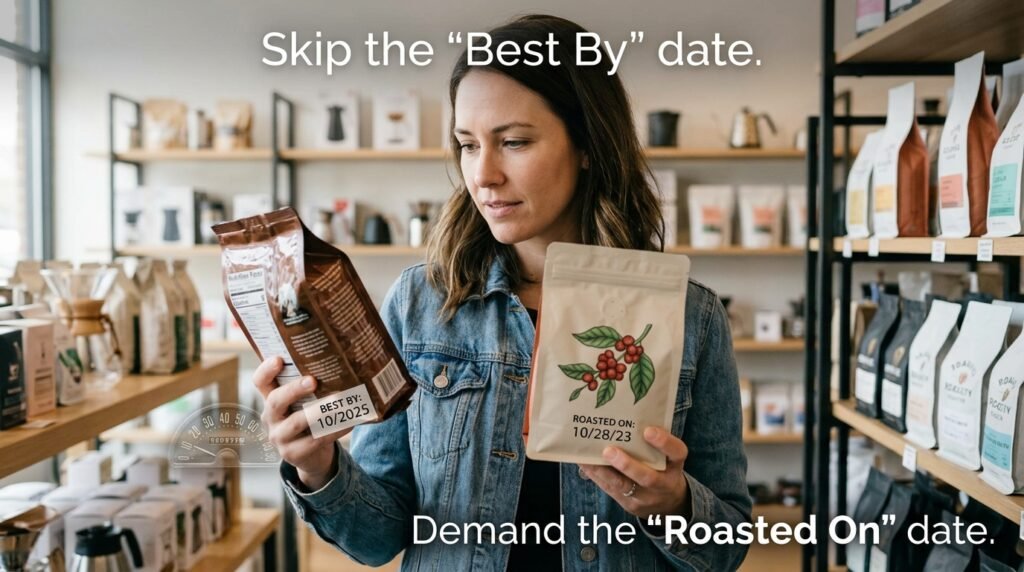
The absolute fastest way to identify a bad bag of coffee is to look for the “odometer.” In the coffee world, the odometer is the roast date.
When I used to buy commercial coffee, I would look at the bottom of the bag for the expiration date. If the label said the coffee was “Best By” a date eighteen months in the future, my brain assumed the product was fresh.
I was falling for the greatest lie in the food industry.
Coffee is not a can of soup. It is a highly volatile, chemically sensitive agricultural seed. During the roasting process, the intense heat creates delicate aromatic oils. These oils are entirely responsible for the sweet, floral, and fruity flavors in your mug.
But the exact second the beans leave the roasting drum, they begin to aggressively oxidize. Within three to four weeks, the vast majority of those complex flavor compounds evaporate into the air.
If a bag of coffee only gives you an expiration date that is a year away, the roaster is deliberately hiding the mileage. By the time you buy that bag, the coffee inside could already be eight months old. It is a dead, stale product.
Learning to avoid this trap was the foundational lesson of (Why I Check Coffee Dates Before Buying). Now, if a bag of coffee does not have a specific “Roasted On” date printed clearly on the label, I put it right back on the shelf. I refuse to buy a car without knowing the mileage.
The “100% Arabica” Distraction
Once I started looking for roast dates, I had to learn how to filter out the meaningless marketing noise printed on the front of the packaging.
The most common red flag you will see in any grocery store aisle is a massive, bold banner proudly declaring that the coffee is “100% Arabica.”
When you do not know any better, this sounds incredibly premium. It sounds like a guarantee of luxury. But in the modern specialty coffee industry, advertising “100% Arabica” is the exact equivalent of a car dealership advertising that their vehicles have “100% Real Tires.”
It is the absolute bare minimum requirement.
There are two main species of coffee consumed globally: Arabica and Robusta. Robusta is generally cheaper, hardier, and tastes like burnt rubber and harsh wood. Arabica is sweeter, more complex, and more delicate.
Virtually all specialty coffee is Arabica. Telling me that your coffee is Arabica tells me absolutely nothing about how carefully it was grown, how high the altitude was, how it was processed, or whether the beans are defective. It is a distraction designed to make a low-tier product sound sophisticated.
When I see a bag leaning heavily on the “100% Arabica” claim without providing any other agricultural data, my defensive buying instincts immediately kick in, and I walk away.
The “Mystery Meat” Blend
Another massive red flag that helps me avoid buying bad coffee is the ubiquitous “House Blend” or “Breakfast Blend.”
There is nothing inherently wrong with blending different coffees. Some of the best roasters in the world create masterful blends to achieve a specific, balanced flavor profile—like mixing a bright, acidic Ethiopian bean with a heavy, chocolatey Brazilian bean to create the perfect espresso base.
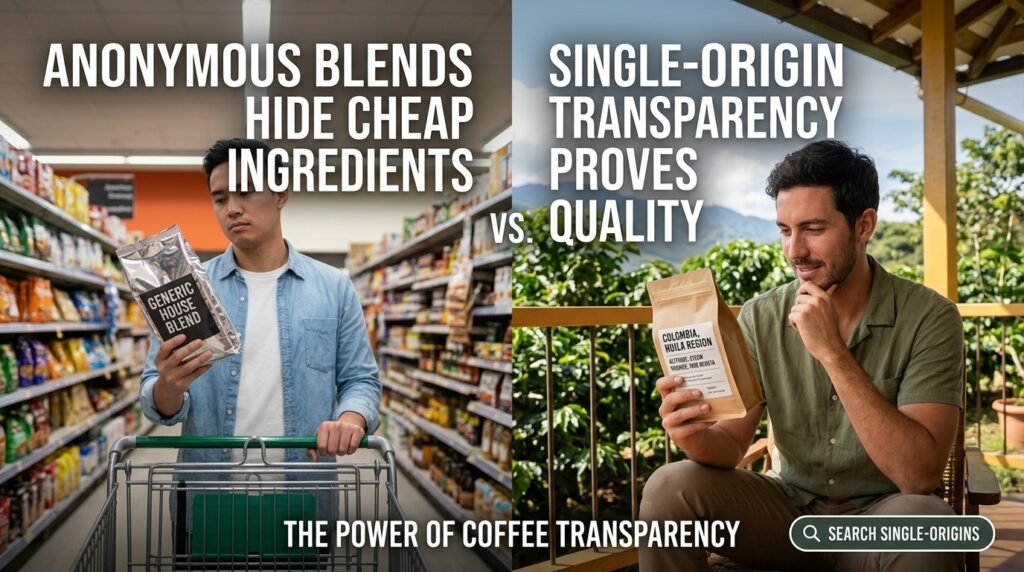
But in the commercial grocery store world, a “Blend” is usually a clever way to hide cheap, defective, or incredibly old ingredients.
Think about it like cooking. If a restaurant has an expensive, prime cut of fresh steak, they will serve it on a plate by itself so you can taste the quality. But if they have a pile of leftover, tough, expiring meat, they will chop it up, cover it in heavy sauce, and serve it as a mystery stew.
Many commercial blends are simply a dumping ground for whatever cheap commodity beans the company could source that quarter.
Realizing how transparency dictates quality was the exact moment (How I Started Recognizing Good Coffee Without Being an Expert). I stopped buying anonymous blends.
Now, I look for extreme geographical transparency. I want single-origin coffee. I don’t just want a bag that says “Colombia.” I want a bag that names the specific region, the specific altitude, and ideally, the name of the actual farmer or cooperative that grew the crop. Transparency is the ultimate proof of quality.
The Cheap Paint Job: The Shiny Bean
Sometimes, the red flags aren’t on the label; they are inside the bag itself.
Before I understood the chemistry of coffee, I used to think that a dark, pitch-black, incredibly shiny and oily coffee bean was the mark of a strong, premium roast. I thought the oil meant the coffee was rich and flavorful.
I didn’t realize that I was looking at a cheap paint job designed to cover up rust.
When a coffee bean is exposed to extreme, prolonged heat in a roasting drum, its cellular structure literally fractures. As the physical walls of the bean break down, the internal aromatic oils are violently forced out onto the surface of the bean.
Once those oils are on the outside of the bean, they are immediately exposed to oxygen and light. They turn rancid incredibly fast.
But why do massive commercial companies roast their beans so dark? Because they are buying cheap, low-grade coffee that tastes terrible. If they roasted it lightly, you would taste the mold, the dirt, and the agricultural defects. By roasting it until it is black and oily, they burn away all the bad flavors and replace them with a uniform taste of heavy carbon and ash.
I avoid dark, oily beans at all costs. I look for beans that are matte, dry, and light brown. A light roast means the roaster is proud of the raw agricultural ingredient and wants you to taste the actual fruit of the coffee cherry, not the smoke of the oven.
The Squeeze Test: Checking for Life
There is one final, highly physical test I perform when I am evaluating a bag of coffee in person, assuming the bag has a one-way degassing valve.
Freshly roasted coffee is a living, breathing product. For the first week or two after it leaves the roaster, it aggressively releases carbon dioxide gas. This is why high-quality coffee bags have a tiny plastic valve on the back—to let the gas escape without letting staling oxygen in.
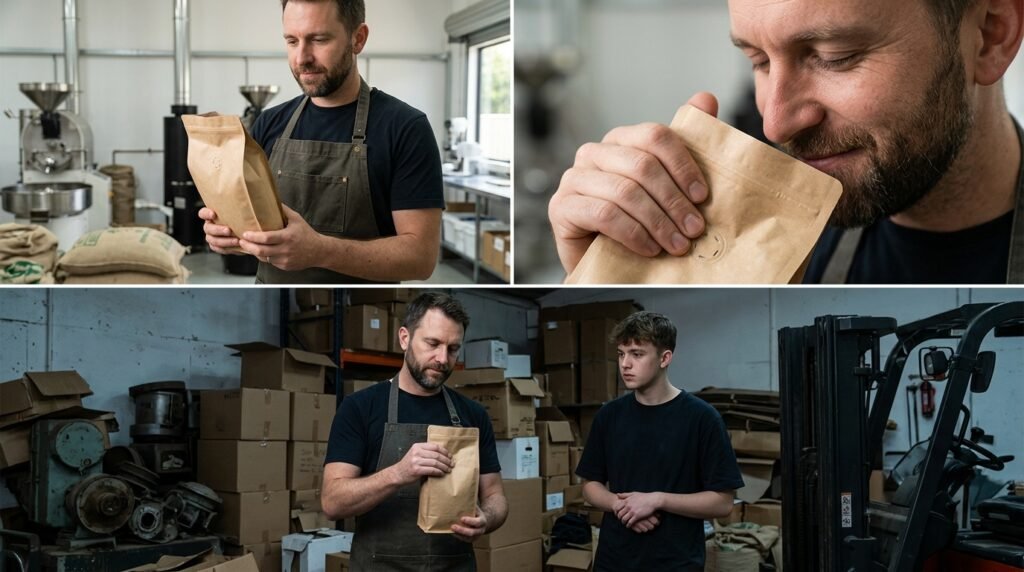
If I am unsure about a bag, I will gently squeeze it, forcing a tiny puff of air out through the one-way valve, and I will smell it.
If the air smells incredibly explosive, sweet, and complex—like fresh berries, brown sugar, or jasmine—I know the coffee is vibrant and alive.
But if I squeeze the bag and the air smells like nothing, or worse, if it smells like dusty cardboard, stale wood, or an old ashtray, I know the coffee is dead. The aromatic oils have already completely degraded. The carbon dioxide is gone.
I will never buy a bag of coffee that fails the squeeze test. It is the ultimate, undeniable proof of the product’s true age, regardless of what the marketing label claims.
Escaping the Supermarket Entirely
As I learned all of these red flags, an uncomfortable reality began to set in. The more I learned how to avoid bad coffee, the harder it became to actually find good coffee in a massive commercial grocery store.
Supermarkets are built on massive, sluggish, centralized supply chains. It takes weeks or months for a product to travel from a factory to a regional distribution center, and finally onto a retail shelf. By definition, a supermarket is the absolute worst environment for a highly perishable, time-sensitive product.
I finally decided to stop fighting a losing battle.
Taking the ultimate defensive step to protect my mornings was the catalyst for (Why I Stopped Buying Cheap Coffee and Never Looked Back).
I completely stopped buying coffee at the grocery store. I started driving directly to small, independent specialty roasteries in my city. Or, I order directly from the roasters online, ensuring the beans are shipped to my door the exact same day they are roasted.
When you buy directly from the source, you do not have to worry about missing roast dates, anonymous blends, or stale, oily beans. The roaster is acting as your quality control.
Become a Defensive Buyer
We work incredibly hard for our money, and the fifteen minutes we spend drinking coffee in the morning is often the only quiet, peaceful moment we get before the stress of the day begins.
Do not surrender that moment to bad ingredients.
You do not need to be a certified sensory expert to drink world-class coffee. You just need to stop trusting the salesman on the used car lot.
Tomorrow, take a hard look at the bag of coffee sitting in your kitchen. Does it have a specific roast date? Does it tell you the exact region and altitude where it was grown? Are the beans matte and light brown, or are they black and covered in rancid oil?
When you finally learn how to read the data and avoid the massive marketing traps, you take total control over your morning routine. You will never waste another dollar on a bitter, stale, lifeless cup of coffee again, and your daily mug will instantly transform into the masterpiece you actually deserve.

My name is Daniel Carter, I am 35 years old, and I live in the United States. I have been passionate about aquariums for many years, and what started as a simple hobby quickly became a lifelong interest in aquatic life, fish behavior, and responsible tank care.
Through TheBrightLance, I share real experiences, practical knowledge, and honest lessons learned from maintaining different types of aquariums. I enjoy testing equipment, studying fish behavior, improving maintenance routines, and helping beginners avoid common mistakes.
My goal is to make aquarism easier, more ethical, and more enjoyable for everyone — whether you are setting up your very first tank or looking to refine your techniques.