
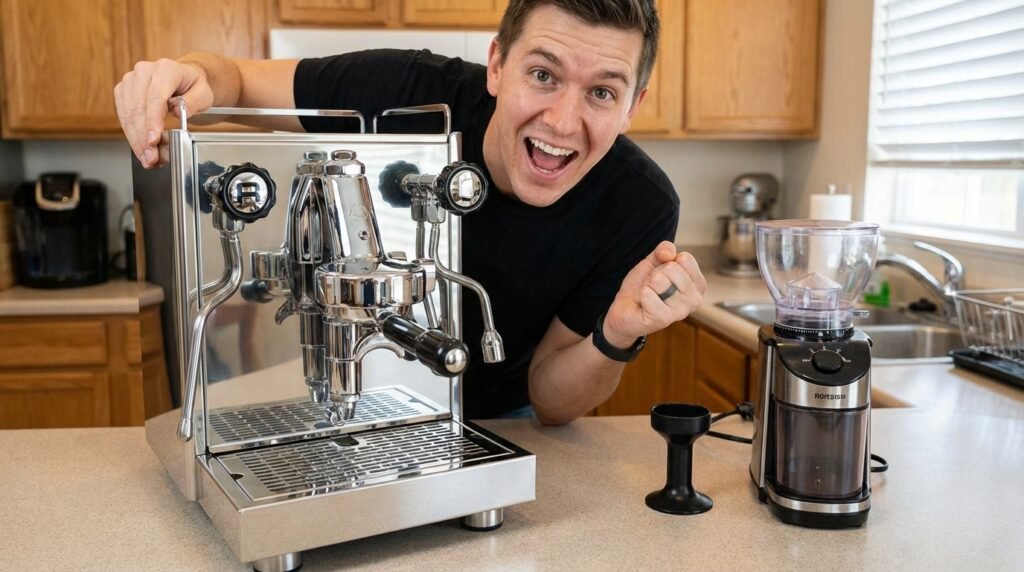
I stood still in my kitchen, staring at a massive, gleaming stainless steel box sitting on my countertop.
It was a brand-new, highly-rated, semi-automatic home espresso machine. I had spent months saving up for it. I watched dozens of cinematic, slow-motion videos on social media of professional baristas pulling thick, syrupy, beautiful shots of espresso that looked like liquid gold.
I was completely seduced by the romantic aesthetic of it all. I thought buying the machine was the finish line. I genuinely believed that this expensive piece of metal was a magic box. I assumed I would just pour some coffee beans into the top, press a shiny button, and instantly be holding a café-quality beverage in my hand.
I grabbed a bag of beans, loaded the portafilter, locked it into the machine, and flipped the brew switch.
Instead of a beautiful, slow drip of liquid gold, a violent, chaotic stream of pale brown water aggressively blasted out of the spouts, filling my cup in less than five seconds.
I took a sip. It tasted like hot, sour battery acid mixed with dirt.
My heart sank. That catastrophic first shot was the beginning of a long, frustrating, messy, and incredibly expensive journey. I realized very quickly that making real espresso at home is not a relaxing morning chore; it is a high-stakes scientific experiment.
Here is the honest, unfiltered truth about brewing espresso at home, the harsh physical and financial lessons I had to learn the hard way, and exactly what I wish I knew before I bought my first machine.
The Grinder is More Important Than the Machine
If I could travel back in time and give myself one single piece of advice, it would be this: Your shiny new espresso machine is completely useless if you have a terrible coffee grinder.
When I bought my machine, I exhausted my entire budget on the brewer itself. I thought the machine did all the heavy lifting. I planned to use the same cheap, entry-level electric burr grinder I had been using for my French Press and pour-over coffees.
This was my greatest architectural failure.
Espresso is a pressurized brewing method. The machine is forcing near-boiling water through a tightly packed bed of coffee grounds at nine bars of atmospheric pressure.
For the water to extract the flavor properly, that bed of coffee grounds has to provide the exact right amount of physical resistance. If the coffee is ground too coarse, the water shoots through it instantly (resulting in a sour, watery mess). If it is ground too fine, the water gets trapped, choking the machine and burning the coffee (resulting in a bitter, ashy nightmare).
The window of success is microscopic.
My cheap grinder simply did not have the micro-adjustments required to find that sweet spot. I would move the dial one notch, and the shot would be way too fast. I would move it back one notch, and the machine would completely choke.
I quickly learned that the grinder is the actual heart of an espresso setup. The machine is just pumping hot water; the grinder dictates the flavor. You must invest in a specialized, high-quality espresso grinder that allows for stepless, infinite micro-adjustments.
The Illusion of “Push and Play”
Before I got into home espresso, I thought a morning coffee routine took about five minutes.
I had no idea what the term “Dialing In” meant. I assumed you just set the grinder once and never touched it again.
I learned the hard way that espresso is a moving target.
Every single time you buy a new bag of coffee, you have to calibrate your grinder and your machine to match the specific density, roast level, and age of those exact beans. You have to pull a shot, taste it, adjust the grinder, pull another shot, weigh the output, and taste it again.
Sometimes, dialing in a new bag of coffee takes me three or four failed shots before I finally get a drinkable beverage. That means I am actively throwing expensive specialty coffee down the sink just to find the correct mathematical formula.
And the worst part? As the coffee beans age over the next two weeks, they lose moisture and naturally release carbon dioxide. Because their internal structure changes, you have to constantly adjust your grinder slightly finer every few days just to maintain the same flavor.
It is a daily puzzle. You are constantly chasing a variable that never stops moving.
The Mandatory Mathematics
If you hate math, home espresso will drive you completely insane.
You cannot trust your eyes when making espresso. You cannot trust the volume lines on a shot glass. You have to rely entirely on a digital scale that measures in increments of a tenth of a gram.
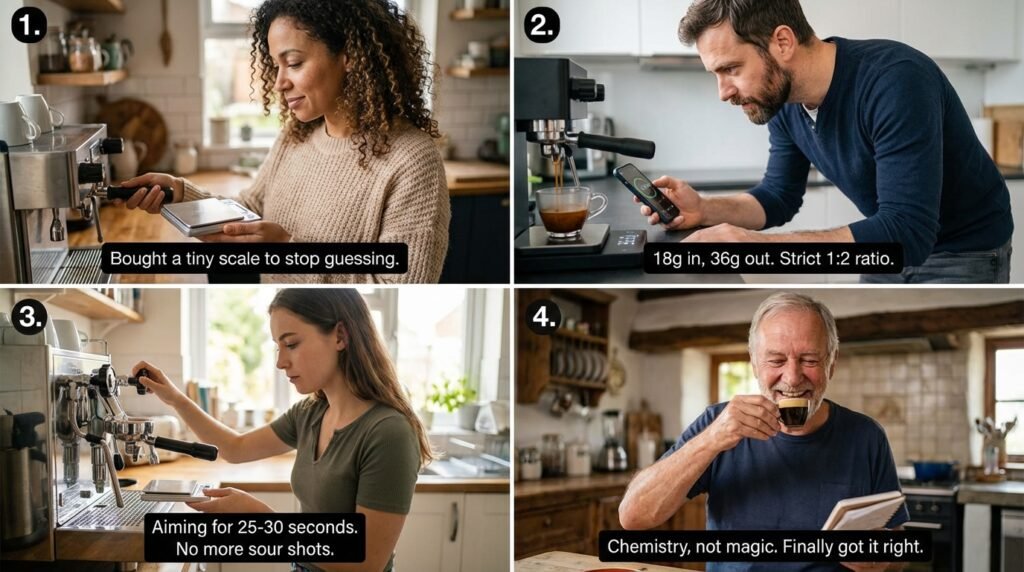
I learned that espresso is built on a strict ratio. The golden rule is usually a 1:2 ratio. This means if I put 18 grams of dry coffee grounds into the portafilter, I need to extract exactly 36 grams of liquid espresso into the cup.
And it has to happen in roughly 25 to 30 seconds.
If it takes 15 seconds to hit 36 grams, the coffee will be sour. If it takes 45 seconds, it will be bitter.
I had to buy a specialized, tiny, waterproof digital scale just to fit under my espresso machine. I weigh the portafilter empty. I weigh it full. I weigh the shot as it pours, stopping the pump exactly two grams before my target so the residual drips hit the final number perfectly.
Figuring out this strict mathematical relationship was a massive turning point, which is exactly (The Day I Finally Got My Coffee Ratio Right). Once you accept that espresso is chemistry, you stop guessing and start brewing with intentional precision.
The Secret of Puck Prep
Another massive shock was the physical labor required before the portafilter even touches the machine.
In a commercial café, the barista makes it look effortless. They grind the coffee, give it a quick tamp, and lock it in. But at home, using a lighter, less forgiving machine, “Puck Prep” is everything.
If the bed of coffee (the puck) is even slightly uneven, the pressurized water will find the weakest point. It will carve a tiny tunnel through the grounds, bypassing the rest of the coffee entirely. This is called “Channeling.”
To prevent channeling, I had to buy a specialized tool that looks like a tiny whisk made of acupuncture needles. I have to stir the dry coffee grounds vigorously in the basket to break up any microscopic clumps.
Then, I have to use a heavy, perfectly level metal tamper to compress the grounds into a perfectly flat, dense puck. If I tamp at even a one-degree angle, the water will flow unevenly, and the shot will be completely ruined.
The pursuit of the perfect puck is exhausting, and it generates an incredible amount of mess.
The Kitchen Is Now a War Zone
Nobody warned me about the mess.
When you grind coffee fine enough for espresso, it becomes highly susceptible to static electricity. As it leaves the grinder, it clings to everything. It jumps out of the portafilter. It covers your hands. It coats the kitchen counter in a fine, brown dust.
And then there is the “Bottomless Portafilter” incident.
I bought a bottomless portafilter (a handle with the bottom cut out so you can watch the espresso flow through the basket) because it looked beautiful on Instagram.
What the videos didn’t show me was that if your puck prep is slightly flawed, the highly pressurized water will find a micro-channel and aggressively spray a jet of hot, dark espresso sideways.
I have ruined two white dress shirts before work because my bottomless portafilter suddenly decided to spray a fountain of espresso directly at my chest. I spend more time wiping down my countertop and scrubbing my machine than I actually do drinking the coffee.
The Unforgiving Nature of Supermarket Beans
When my first bag of specialty coffee ran out, I made a grave mistake. I went to the grocery store and bought a bag of cheap, dark-roast coffee off the shelf to save some money.
I brought it home, put it in my grinder, and pulled a shot.
The liquid poured out incredibly fast, violently splashing into the cup. There was absolutely zero “crema”—the beautiful, thick, golden foam that floats on top of a great espresso. It was just a flat, black, terrifying liquid that tasted like burnt rubber.
I realized that espresso machines completely expose bad coffee.
You cannot use stale coffee for espresso. The crema is created by the carbon dioxide trapped inside fresh coffee beans. When beans sit on a supermarket shelf for six months, all the gas is gone. Without that gas, there is no resistance, no crema, and no flavor.
Learning this harsh reality is the primary reason (Why I Check Coffee Dates Before Buying). If the bag does not have a specific “Roasted On” date printed on the back, it is strictly banned from my espresso machine.

The Milk Steaming Nightmare
Once I finally managed to pull a decent shot of black espresso, I thought I was in the clear. I thought I could easily whip up a beautiful latte with flawless, symmetrical latte art.
I poured some cold milk into a stainless steel pitcher, turned on the steam wand, and plunged it in.
The machine immediately let out a deafening, high-pitched screech that sounded like a dying banshee. Massive bubbles erupted everywhere, and the milk quickly boiled into a stiff, rigid foam that looked like a dry bath sponge.
I tried to pour it into my espresso, and it just plopped out in one solid, white clump. No latte art. Just a depressing blob.
Steaming milk is an entirely separate, incredibly difficult skill. You have to introduce the exact right amount of air in the first five seconds, and then find the perfect angle to create a “whirlpool” that breaks those bubbles down into a silky, wet paint texture known as microfoam.
It took me three solid months of screeching, boiling, and wasting gallons of milk before I could pour a simple, basic heart shape.
The Bottomless Pit of Accessories
I also wish I knew that buying the machine was just the down payment on the hobby.
Espresso at home is a massive financial black hole.
Once you get the machine and the grinder, you realize you need a precision tamper. Then you need a knock box to dump the used grounds. Then you need the acupuncture needle tool (WDT). Then you need a specialized dosing funnel to keep the grounds from spilling. Then you need specialized cleaning powder to backflush the machine so it doesn’t build up rancid coffee oils.
You find yourself constantly chasing tiny, expensive upgrades, convincing yourself that a fifty-dollar piece of metal will magically fix your sour shots.
The Reward That Justifies the Madness
Reading all of this, you might think I deeply regret buying my espresso machine.
The truth is the exact opposite. I love it more than almost anything in my kitchen.
Yes, the learning curve was a vertical cliff. Yes, I wasted expensive coffee. Yes, I sprayed my kitchen walls with brown liquid.
But I will never forget the morning it finally clicked.
I dialed in the grinder perfectly. My puck prep was flawless. I locked the portafilter in, hit the button, and watched the scale.
A slow, thick, syrupy stream of dark liquid descended from the basket, slowly tapering into a beautiful, golden-brown cone. The kitchen filled with the aroma of dark chocolate and toasted almonds. The scale hit exactly 36 grams in exactly 28 seconds.
I took a sip.
It was a revelation. It was thick, heavy, intensely sweet, and perfectly balanced. The acidity was vibrant, but it melted seamlessly into a rich, caramel finish that lingered on my palate for ten minutes. It was significantly better than the espresso I was paying five dollars for at my local café.
Experiencing that profound level of self-sufficiency and mastery is exactly (How I Made Café-Quality Coffee in My Kitchen). The sheer difficulty of the process makes the final product taste exponentially better.
Enter With Open Eyes
If you are thinking about buying an espresso machine for your home, I highly encourage you to do it. It is one of the most rewarding culinary hobbies on the planet.
But you must enter with your eyes wide open.
Do not expect push-button perfection. Expect a chaotic, messy science experiment. Budget for a high-end grinder before you even look at the machine. Buy fresh beans, buy a precise digital scale, and accept that you are going to drink some truly terrible coffee during your first few weeks.
If you are willing to endure the frustration, the math, and the mess, you will eventually pull that one perfect, syrupy, golden shot. And when you do, you will realize that the struggle wasn’t just necessary; it was the entire point of the journey.

My name is Daniel Carter, I am 35 years old, and I live in the United States. I have been passionate about aquariums for many years, and what started as a simple hobby quickly became a lifelong interest in aquatic life, fish behavior, and responsible tank care.
Through TheBrightLance, I share real experiences, practical knowledge, and honest lessons learned from maintaining different types of aquariums. I enjoy testing equipment, studying fish behavior, improving maintenance routines, and helping beginners avoid common mistakes.
My goal is to make aquarism easier, more ethical, and more enjoyable for everyone — whether you are setting up your very first tank or looking to refine your techniques.