
If you are standing in your kitchen making a massive pot of beef stew for a Sunday family dinner, you have an incredible amount of creative freedom.
You can throw in a handful of chopped carrots. If you feel like it, you can add an extra pinch of salt, a heavy splash of red wine, or a rough spoonful of garlic. You do not need to use a measuring cup or a digital scale. You simply stir the heavy iron pot, taste the hot broth with a wooden spoon, and adjust the flavors as you go.
Cooking a stew is an art form. It is based entirely on feeling, instinct, and constant correction.
But if you try to apply that exact same philosophy to baking a delicate pastry or a loaf of bread, you will create an absolute, inedible disaster.
Baking is not an art. Baking is strict, unforgiving chemistry. If you guess the amount of baking powder, your cake will collapse. If your oven is twenty degrees too hot, your bread will burn on the outside and remain raw dough on the inside. You cannot “adjust as you go.” Once the pan goes into the oven, the chemical reaction is locked in.
For the first decade of my adult life, I treated my morning coffee like a beef stew.
I just threw things together. I guessed the measurements. I boiled the water aggressively and dumped it over whatever coffee grounds I had lying around. And every single morning, I was confused as to why my coffee tasted like bitter, harsh ash.
I didn’t realize that brewing coffee is baking. It is a strict chemical extraction.
Here is the honest, highly transparent story of the mistakes that were ruining my coffee every morning, the culinary habits I had to unlearn, and the simple adjustments that finally turned my daily cup into a masterpiece.
The Plastic Scoop of Lies
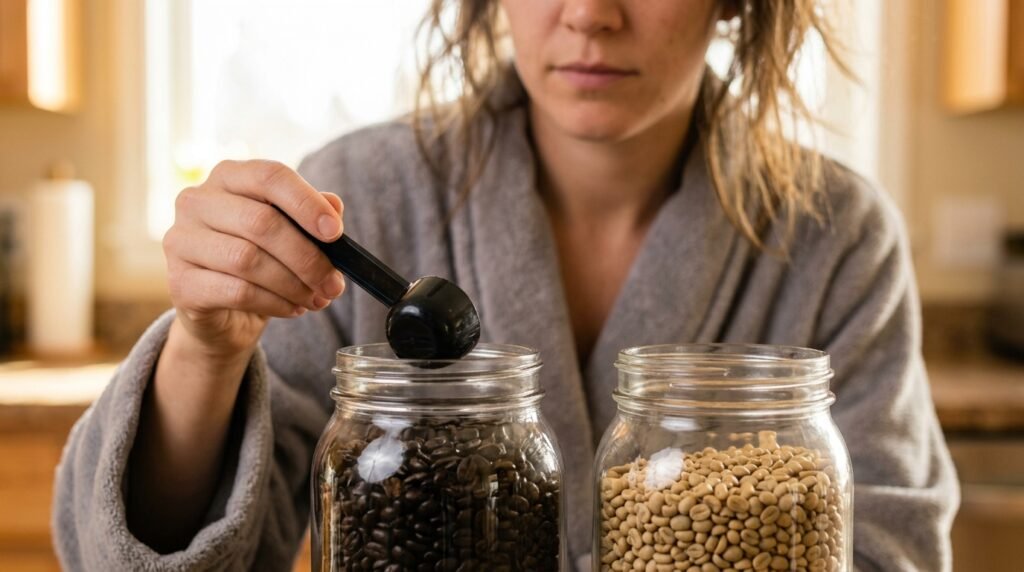
The very first, and arguably the most destructive, mistake I made every single morning was relying on a cheap plastic scoop.
When I bought my first coffee machine, it came with a little black plastic spoon. The instructions on the back of the generic coffee bag said to use “two rounded scoops per cup of water.” I followed this vague instruction blindly for years.
But I was completely ignoring the basic laws of physics.
I did not realize that measuring coffee by volume (using a scoop) is an incredibly flawed strategy because different coffee beans have vastly different densities.
If you take a heavily roasted, pitch-black French roast bean, it has been cooked so long that all of its internal moisture has evaporated. The bean expands like popcorn. It becomes very large and incredibly light.
But if you take a lightly roasted, single-origin Ethiopian bean, it is dense, small, and heavy.
If you use a plastic scoop for the dark roast, you might be getting 10 grams of coffee. If you use that exact same scoop for the light roast, you might be getting 18 grams of coffee. You think you are using the same amount, but your chemical ratio is wildly inconsistent every single morning.
Realizing that this chaotic inconsistency was destroying my routine was the defining moment of (The Simple Brewing Mistakes I Used to Make Every Day). I realized I was just guessing the recipe.
I threw the plastic scoop in the trash and bought a digital kitchen scale. I started measuring my coffee in absolute grams. Ten grams of coffee is exactly ten grams, regardless of the roast level. The very first morning I used a scale, the unpredictable chaos completely vanished.
The Blade Grinder Massacre
My second massive mistake was how I treated the coffee beans before the water ever touched them.
I knew that freshly ground coffee was better than pre-ground coffee, so I went to a big-box retail store and bought a cheap, twenty-dollar electric spice grinder. It had a small metal blade that spun around like a tiny helicopter rotor.
Every morning, I would throw a handful of beans into the plastic chamber, press the button, and listen to the machine scream like a jet engine for ten seconds.
I thought I was grinding my coffee. I was actually massacring it.
A spinning blade does not grind coffee; it chops it violently and randomly. When I opened the lid, the coffee bed was a complete disaster. Half of the beans were chopped into massive, jagged boulders. The other half had been pulverized into microscopic, powdery dust.
When you pour hot water over this chaotic mixture, the chemistry breaks down entirely. The microscopic dust extracts almost instantly, releasing harsh, bitter, and astringent flavors. The massive boulders barely extract at all, releasing weak, sour, and acidic flavors.
My morning mug was simultaneously bitter and sour—a completely confused, muddy beverage.
Upgrading my equipment and finally learning (How Grind Size Affected My Coffee More Than I Expected) changed everything. I bought a manual burr grinder, which uses two grooved steel plates to crush the beans into perfectly uniform, symmetrical pieces. The water was finally able to extract the exact same flavor from every single particle.
The Scorched Earth Policy
Even after I bought a digital scale and a proper burr grinder, my coffee still had a harsh, metallic bite to it. I couldn’t figure out why, until I looked closely at how I was heating my water.
I was using a traditional stovetop kettle that whistled when the water boiled.
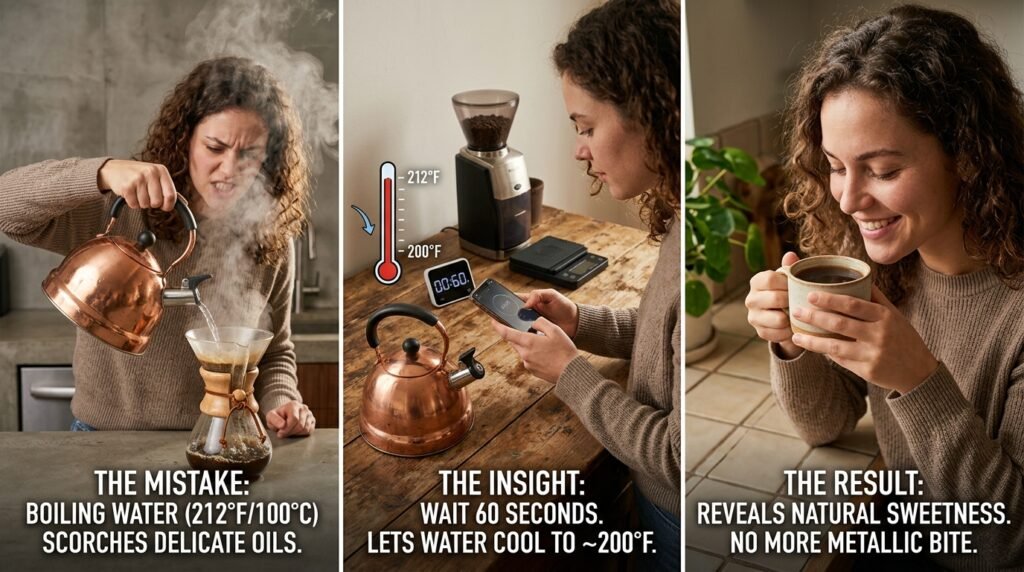
The second the kettle started screaming, I would pull it off the stove and immediately dump the rolling, aggressively boiling water directly over my delicate coffee grounds.
I was committing the culinary equivalent of turning my oven up to 600 degrees to bake a delicate sponge cake. I was scorching the ingredients.
Coffee beans are packed with highly volatile, delicate aromatic oils. These oils are responsible for the sweet fruit notes, the floral jasmine aromas, and the smooth chocolate finishes. If you hit those oils with water that is 212 degrees Fahrenheit (100 degrees Celsius), you instantly burn them.
The boiling water destroys the sweetness and extracts the harsh, carbonized ash flavors hidden deep inside the cellulose structure of the bean.
Discovering the catastrophic effect of boiling water was the core lesson of (How Water Temperature Changed My Coffee Completely). I learned that coffee requires patience.
Now, when my kettle reaches a boil, I take it off the heat and I simply wait for sixty seconds. I let the water cool down to a gentle 200 degrees Fahrenheit. That tiny, one-minute pause stopped the scorched-earth extraction and brought the natural sweetness back into my mug.
The Stale Oxygen Trap
Another invisible mistake that was constantly ruining my mornings was my complete lack of respect for oxygen.
Because I treated coffee like a dry good—like pasta or rice—I assumed it would last forever. I would buy a massive, two-pound bag of coffee, open it, and leave it sitting on my kitchen counter in a clear glass jar. I thought the glass jar looked rustic and aesthetic.
I was actually building a death chamber for my coffee beans.
The two greatest enemies of roasted coffee are oxygen and ultraviolet light. When you expose coffee beans to the air, the delicate oils immediately begin to oxidize. They dry out, go stale, and lose all of their complex flavor. When you expose them to the sunlight streaming through your kitchen window, the ultraviolet rays accelerate the staling process even faster.
Within a week, my beautiful, expensive coffee beans tasted like stale cardboard.
I had to completely redesign my storage habits. I stopped buying massive quantities. I now only buy small, 12-ounce bags from local roasters. When I bring the bag home, I keep the beans in an opaque, airtight, vacuum-sealed canister. I store it in a dark, cool cabinet.
I protect the beans from the air and the light with the exact same care I would use for an expensive bottle of wine or a delicate cut of fresh fish.
The Impatient Pour
The final mistake I had to correct was purely psychological. I was deeply impatient.
When you wake up early and you have a massive list of tasks waiting for you at your computer, you just want the caffeine in your bloodstream. You do not want to stand in the kitchen.
When I first started making pour-over coffee, I would take my kettle and dump all the water over the grounds as fast as possible, filling the glass cone to the absolute brim. I just wanted the water to drain so I could drink it.
But fresh coffee actively resists being rushed.
When coffee is roasted, carbon dioxide gas gets trapped inside the cellular walls of the bean. When you hit fresh coffee grounds with hot water, they release that gas in a violent, bubbling reaction known as the “bloom.”
If you dump all your water in at once, the massive release of gas physically repels the water. The water cannot penetrate the coffee grounds. Instead, it just channels around the edges, sliding down the paper filter and into your mug without actually extracting any flavor.
You end up with a watery, weak, deeply disappointing beverage.
To fix this, I had to force myself to slow down. Now, I pour just a tiny splash of water over the grounds—just enough to get them wet. Then, I stop. I put the kettle down, and I watch the coffee bed bubble and expand for forty-five agonizingly slow seconds.
I let the coffee release its defensive gas. Only after the bloom has settled do I begin the slow, hypnotic, circular pour.

Respecting the Chemistry
Brewing a perfect cup of coffee is not magic, and it does not require you to be a pretentious culinary snob.
But it does require you to acknowledge that you are operating a small chemistry laboratory in your kitchen every single morning. You are balancing mass, temperature, surface area, and time.
If you are currently treating your morning coffee like a casual pot of beef stew—guessing the measurements, boiling the water aggressively, and using a cheap blade grinder—you are sabotaging your own mornings.
You are taking a beautiful, complex agricultural product and completely destroying it before it ever reaches your lips.
I highly challenge you to stop guessing. Throw away the plastic scoop and buy a digital scale. Invest in a manual burr grinder. Let your boiling water cool down for sixty seconds before you pour. Store your beans in the dark, and have the patience to let your coffee bloom.
When you finally stop making these careless, rushed mistakes and start respecting the strict chemistry of the extraction, your entire perspective will shift. You will stop drinking a bitter chore, and you will start waking up to an absolute daily masterpiece.

My name is Daniel Carter, I am 35 years old, and I live in the United States. I have been passionate about aquariums for many years, and what started as a simple hobby quickly became a lifelong interest in aquatic life, fish behavior, and responsible tank care.
Through TheBrightLance, I share real experiences, practical knowledge, and honest lessons learned from maintaining different types of aquariums. I enjoy testing equipment, studying fish behavior, improving maintenance routines, and helping beginners avoid common mistakes.
My goal is to make aquarism easier, more ethical, and more enjoyable for everyone — whether you are setting up your very first tank or looking to refine your techniques.