
If you were to purchase a rare, original, two-hundred-year-old watercolor painting at an art auction, you would never bring it home and tape it to the wall of your bathroom.
You would immediately consult a professional art conservator. They would tell you that the painting is incredibly fragile. They would frame it behind specialized, UV-blocking museum glass. They would instruct you to hang it in a room with strictly controlled humidity and a stable, cool temperature.
If you ignored their advice and hung the painting in direct sunlight, the ultraviolet rays would completely bleach the vibrant colors within a year. If you hung it in a damp environment, the moisture would warp the canvas and invite mold.
You would be actively destroying a masterpiece simply because you did not respect the physical environment it required to survive.
For a massive portion of my life, I treated my morning coffee like a cheap, mass-produced poster.
I assumed that because coffee beans felt hard and dry, they were practically indestructible. I thought they were a non-perishable pantry staple, just like dried pasta, white flour, or canned beans. I would buy a massive bag, rip the top open, and leave it sitting on my kitchen counter for months.
I had absolutely no idea that I was committing culinary sabotage.
I was taking a delicate, chemically complex agricultural product and subjecting it to an incredibly hostile environment. Here is the honest, highly practical story of how I started storing coffee the right way, the incredibly common mistakes I had to unlearn, and how protecting the bean completely transformed the flavor in my mug.
The Myth of the Non-Perishable Seed
The very first psychological hurdle I had to overcome was completely redefining what a coffee bean actually is.
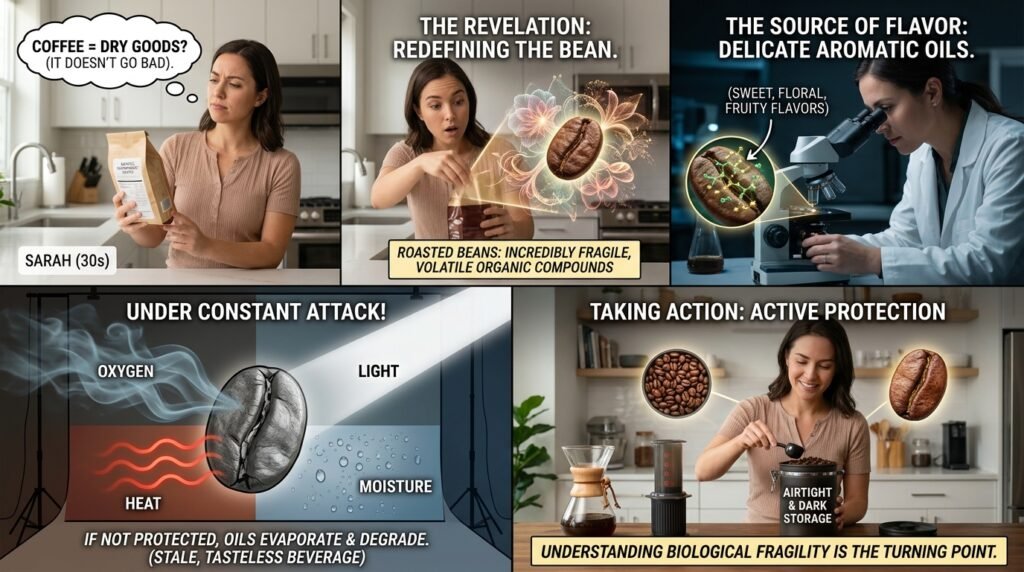
Because we buy coffee in the dry goods aisle of the supermarket, we are culturally conditioned to believe that it does not go bad. But a roasted coffee bean is actually an incredibly fragile, highly volatile organic compound.
During the roasting process, the intense heat breaks down the cellular structure of the seed, creating hundreds of complex, delicate aromatic oils. These oils are entirely responsible for the sweet, floral, and fruity flavors you taste in a high-quality cup of coffee.
But the exact second the bean leaves the roasting drum, those oils are under constant attack from the outside world.
Understanding the sheer biological fragility of this product was a massive turning point, and it perfectly aligns with (What I Wish I Knew When I Started Drinking Coffee). I realized that coffee has a highly specific lifespan, and the clock starts ticking the moment it is roasted.
If you do not actively protect those aromatic oils, they will evaporate, degrade, and vanish, leaving you with a stale, wooden, tasteless beverage. To protect the painting, I had to identify the four primary enemies of the coffee bean: oxygen, light, heat, and moisture.
Enemy Number One: The Invisible Thief
The single greatest enemy of roasted coffee is oxygen.
When coffee beans are exposed to the ambient air in your kitchen, a chemical process called oxidation immediately occurs. It is the exact same chemical reaction that causes a sliced apple to turn brown or a piece of iron to develop rust.
The oxygen physically attacks the aromatic oils in the coffee, causing them to dry out and turn rancid.
For years, my storage method consisted of rolling up the top of the foil coffee bag and securing it with a cheap plastic chip clip or a rubber band. I thought this was sufficient. But a chip clip does absolutely nothing to stop microscopic oxygen molecules from constantly circulating through the bag.
By the second week, my beautiful, expensive specialty coffee tasted like flat cardboard.
Recognizing this invisible thief was the exact catalyst for (How I Stopped Wasting Good Coffee). I realized that I was throwing away half of my money because the bottom of the bag was always completely undrinkable. I was letting the oxygen steal the flavor before I even had a chance to brew it.
Enemy Number Two: The Pinterest Trap
Once I realized that oxygen was a problem, I made a very common, highly aesthetic mistake.
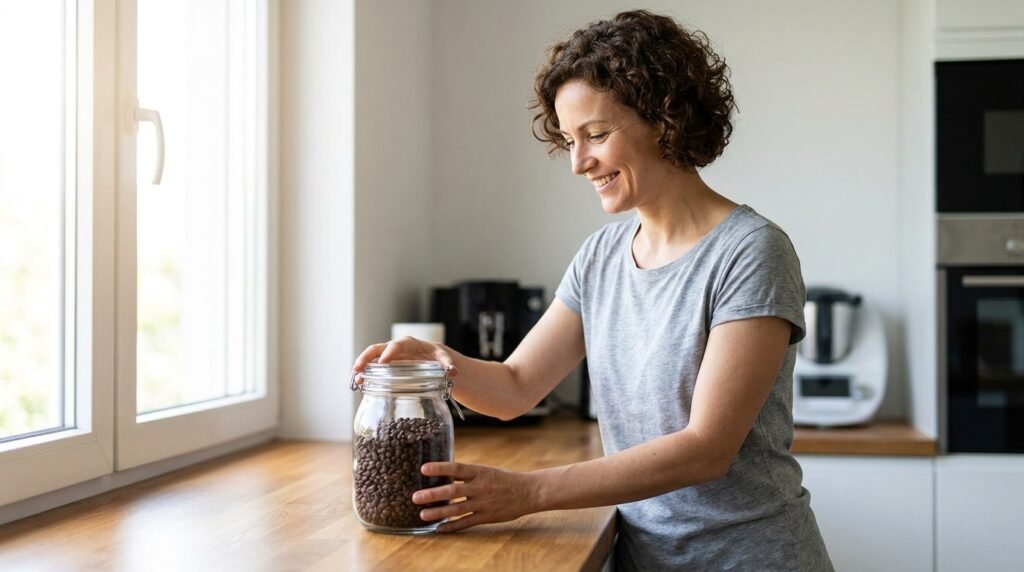
I went to a home goods store and bought a beautiful, clear glass mason jar with a heavy rubber gasket and a metal clasp. It was perfectly airtight. I poured my freshly roasted coffee beans into the jar and placed it proudly on my kitchen counter, right next to the window.
It looked incredible. It looked like a photograph from a high-end interior design magazine.
But I had accidentally introduced my coffee to enemy number two: ultraviolet light.
Coffee beans are highly photosensitive. When you expose them to direct or even indirect sunlight, the UV rays act like a microscopic laser beam. The light physically breaks down the chemical compounds and the organic molecules inside the bean. It literally bleaches the flavor out of the coffee.
By storing my coffee in a clear glass jar on a sunlit counter, I was accelerating the staling process even faster than when I had left them in the original bag.
I learned a harsh truth: coffee does not want to be a display piece. It wants to hide in the dark.
Enemy Number Three: The Refrigerator Disaster
When I told a friend that my coffee was going stale too quickly, they gave me a piece of advice that has been passed down through generations of casual coffee drinkers.
They told me to put my coffee beans in the refrigerator or the freezer.
The logic seems sound. We put milk, meat, and vegetables in the refrigerator to preserve them, so why wouldn’t we do the same for coffee?
I put my glass jar of beans directly into the fridge. A week later, I brewed a cup, and the result was absolutely catastrophic. The coffee tasted vaguely like leftover garlic and chopped onions.
I had fallen victim to enemies number three and four: profound temperature shifts and moisture.
Coffee beans are incredibly porous. They act like tiny, organic sponges. If you place them in a refrigerator, they will immediately absorb all of the ambient odors floating around inside the confined space.
Furthermore, every time you take the cold jar out of the fridge and open it in a warm kitchen, the sudden temperature change causes instant condensation. Microscopic water droplets form directly on the surface of the beans. This moisture immediately degrades the oils and can even cause the beans to develop invisible mold.
Unless you are deep-freezing completely unopened, vacuum-sealed bags of coffee for long-term archival storage (which is a highly advanced technique), the refrigerator is a complete death trap for daily coffee use.
The Art Conservator’s Solution
After ruining several expensive bags of single-origin coffee, I finally decided to treat the beans with the respect of an art conservator. I needed to build a specialized environment that eliminated all four enemies simultaneously.
I threw away the clear glass mason jar and the plastic chip clips.
I invested in a specialized, opaque, vacuum-sealed coffee canister. These containers are specifically engineered for one purpose: preserving the aromatic integrity of roasted coffee.
Because the canister is made of matte black stainless steel, absolutely zero ultraviolet light can penetrate the walls. It creates a pitch-black environment, protecting the photosensitive oils.
But the true magic is in the lid. When you pour the beans inside and press the lid down, a mechanical valve actively forces all of the ambient oxygen out of the container. It creates a near-vacuum environment.
Finding the Perfect Location
Having the right equipment was only half of the battle. I also had to change where I kept the equipment.
I stopped leaving the canister out on the kitchen counter next to the oven or the window, where the ambient temperature constantly fluctuates.
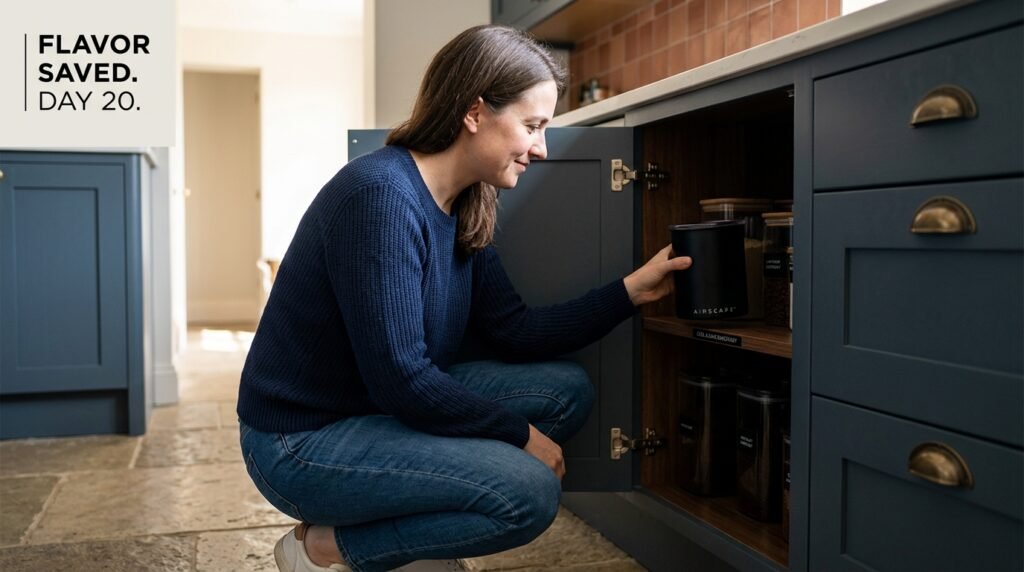
I cleared out a dedicated space in a low cabinet, far away from the stove, the dishwasher, and any external walls that might get hot during the summer. I created a dark, cool, temperature-stable sanctuary.
The difference this made in my daily routine was absolutely staggering.
For the first time in my life, the coffee I brewed on day twenty tasted exactly as vibrant, sweet, and complex as the coffee I brewed on day two. The delicate fruit notes and the floral aromas survived the entire month. I was no longer racing against the clock.
The Ultimate Storage Hack: Buying Less
While the vacuum canister completely solved the environmental threats, I also had to make a massive adjustment to my consumer habits.
You can have the most advanced, expensive storage container on the planet, but it cannot reverse the flow of time. Even in a vacuum, coffee will eventually degrade.
In my old life, I would buy massive, two-pound bags of coffee to save money. It would take me six weeks to drink it all.
I learned that the ultimate storage hack is simply buying smaller quantities, more frequently.
Now, I only buy standard 12-ounce bags from local roasters. I buy exactly enough coffee to last me two weeks. By the time the coffee naturally begins to lose its peak freshness, the bag is already empty, and I am heading back to the roastery to buy a fresh batch.
Ensuring that I only bring fresh products into my home is the exact philosophy behind (Why I Check Coffee Dates Before Buying). If the coffee is already three months old sitting on the store shelf, putting it in a fancy vacuum canister will not magically bring it back to life. You cannot protect a painting that is already ruined.
Respect the Chemistry
We spend so much time obsessing over expensive burr grinders, gooseneck kettles, and precise pouring techniques. We watch countless videos on how to extract the perfect cup of coffee.
But none of that matters if the raw ingredient is dead before the hot water ever touches it.
If your coffee tastes flat, wooden, or bitterly stale, do not immediately blame your brewing skills. Look at how you are treating the beans.
Are they rolled up in a paper bag with a plastic clip? Are they sitting in a clear jar soaking up the afternoon sun? Are they sitting next to yesterday’s leftovers in the refrigerator?
I challenge you to treat your coffee like the delicate, beautiful agricultural masterpiece that it is. Buy an opaque, airtight canister. Keep it in a cool, dark cabinet. Buy smaller bags more frequently.
When you finally start storing your coffee the right way, you are not just preserving the beans. You are protecting the thousands of hours of human labor, the incredible geographical terroir, and the intense culinary potential hidden inside every single seed. And your morning mug will reward you with a flawless performance, every single time.

My name is Daniel Carter, I am 35 years old, and I live in the United States. I have been passionate about aquariums for many years, and what started as a simple hobby quickly became a lifelong interest in aquatic life, fish behavior, and responsible tank care.
Through TheBrightLance, I share real experiences, practical knowledge, and honest lessons learned from maintaining different types of aquariums. I enjoy testing equipment, studying fish behavior, improving maintenance routines, and helping beginners avoid common mistakes.
My goal is to make aquarism easier, more ethical, and more enjoyable for everyone — whether you are setting up your very first tank or looking to refine your techniques.