
I used to hate buying coffee.
Not the act of drinking it, of course, but the actual process of standing in the coffee aisle, staring at a massive wall of shiny bags, and trying to figure out what to spend my money on. It felt like standing in a foreign country without a translator.
Every single bag seemed to be yelling at me in bold, metallic letters. They all claimed to be “Premium.” They all claimed to be “Gourmet.” They all promised a “Rich and Bold Morning Experience.”
For years, my strategy was embarrassingly simple: I would pick the bag that had the coolest logo, or the one that was on sale, and hope for the best.
Most of the time, the best did not happen. I would get home, brew a pot, and end up with a harsh, bitter liquid that required a generous pour of milk and sugar just to be drinkable. I thought I just had bad luck. I thought finding good coffee was a lottery.
I didn’t realize that the secret to a perfect cup wasn’t luck at all. The secret was printed right there on the bag. I just didn’t know how to read the language.
When I finally crossed over into the world of specialty coffee, the confusion only amplified. Suddenly, the bags didn’t just say “Dark Roast.” They had paragraphs of text. They had numbers, altitudes, foreign farm names, and bizarre flavor descriptions like “bergamot” and “stone fruit.”
I realized that if I wanted to stop wasting my money on bad beans, I had to educate myself. I had to decode the jargon.
It took some time, a lot of trial and error, and entirely too many conversations with patient baristas, but I finally cracked the code. Here is the honest story of how I learned to read coffee labels without confusion, and how you can use these exact same tricks to completely transform your morning routine.
Step 1: Ignoring the Marketing Illusion
The first and most important lesson I learned was discovering what not to read.
When I looked at my past buying habits, I realized that falling for shiny adjectives was (The Biggest Mistake I Made When Buying Coffee), because those words are completely unregulated.
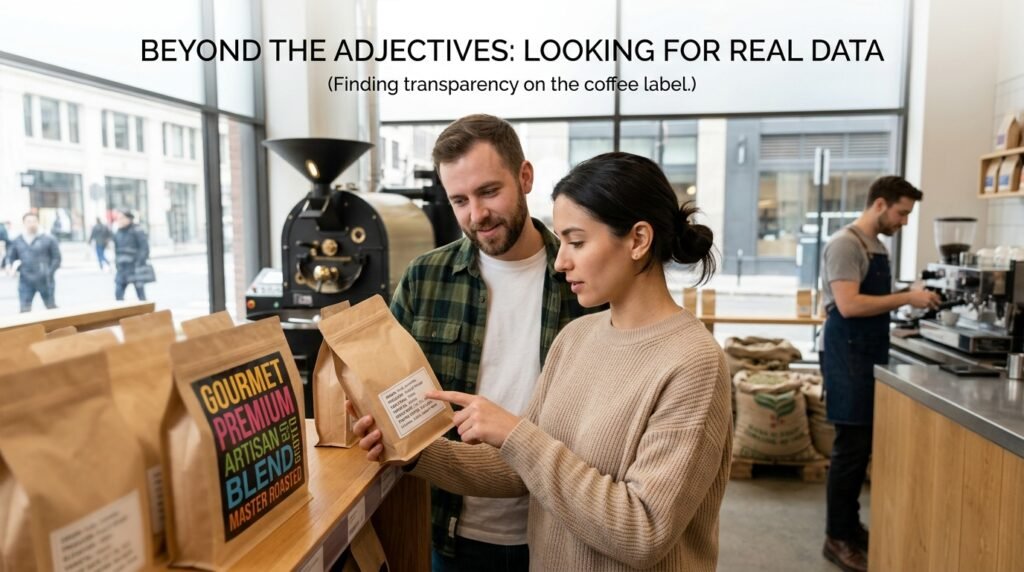
In the coffee industry, words like “Gourmet,” “Premium,” “Artisan,” and “Master Roasted” legally mean absolutely nothing. There is no governing body that tests a coffee and awards it the title of “Gourmet.” Any massive commercial factory can sweep low-grade, defective beans off the floor, roast them black, and print “Premium Artisan Blend” on the front of a million plastic bags.
I had to train my brain to completely ignore these buzzwords. They are designed to distract you from the fact that the bag lacks real, transparent data.
When I look at a coffee label today, I immediately search for numbers and specific locations. If a bag is yelling at me with adjectives but refusing to tell me exactly where the beans came from, I put it right back on the shelf.
Step 2: The Geography Lesson (Origin Transparency)
Once I stopped looking at the marketing fluff, I started looking for the origin.
In the old days, I thought a label saying “100% Colombian Coffee” was the ultimate mark of quality. But as I dove deeper into specialty coffee, I learned that a whole country is way too broad.
Colombia is a massive country with incredibly diverse microclimates. Saying a coffee is “from Colombia” is like saying a wine is “from Europe.” It doesn’t actually tell you anything about how it is going to taste.
I learned to look for micro-regions.
A high-quality specialty roaster wants to be transparent. They want to brag about the specific farm. They won’t just say “Ethiopia.” They will say “Ethiopia, Guji Region, Uraga Washing Station.”
The more specific the geography on the label, the higher the quality of the beans inside. It means the coffee is traceable. It means the roaster knows exactly who grew it, and they likely paid a premium price to get that specific lot.
Figuring out this geographical puzzle was a game-changer for my palate. It was exactly (How I Learned to Identify Coffee by Origin), which eventually allowed me to predict how a coffee would taste before I even opened the bag.
For example, when I finally learned to read these labels properly, it led me straight to my absolute favorite coffee profile. I found myself consistently searching for labels that listed “Ethiopia” as the country and “Guji” as the region. I learned that this specific area consistently produced the vibrant, floral, and naturally sweet coffees that completely revolutionized my mornings. If I hadn’t learned to read past the word “Africa,” I never would have found my perfect cup.
Step 3: Decoding the “Altitude” or “MASL”
This was the part of the label that confused me the most in the beginning.
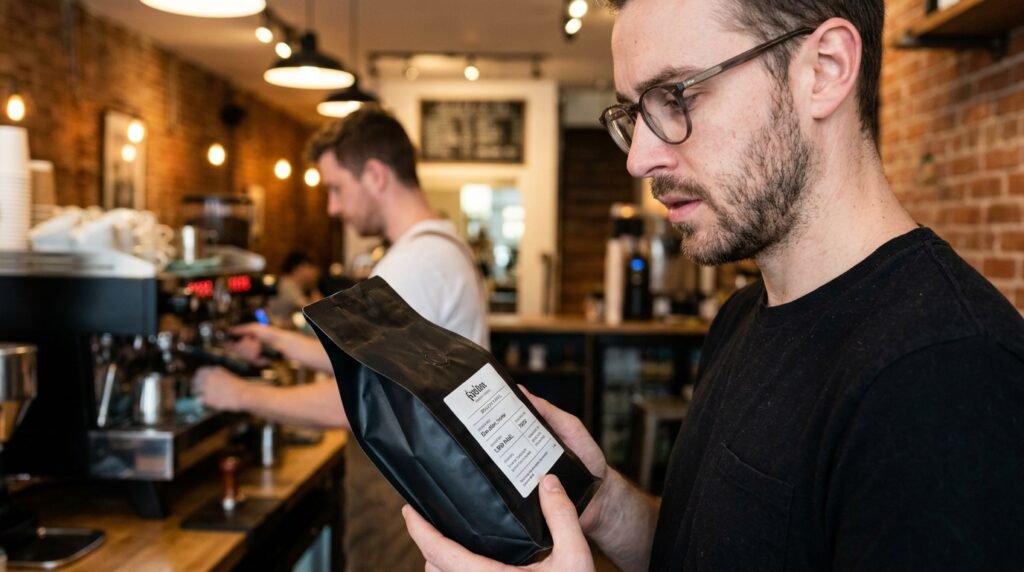
I would pick up a bag of expensive specialty coffee, and right there on the front, it would say: Elevation: 1,800 – 2,000 MASL.
I used to think MASL was some kind of shipping code or a random factory serial number. I had no idea it stood for Meters Above Sea Level.
Why on earth would a coffee drinker care how high up a mountain the plant was grown? As it turns out, altitude is the secret cheat code for sweetness.
Arabica coffee plants (the species used for all specialty coffee) thrive in high altitudes. When a coffee tree grows high up in the mountains, the air is cooler, especially at night. Because of these cool temperatures, the coffee cherries mature much slower than they would in a hot, low-altitude jungle.
This extended ripening process gives the seed inside the cherry (the coffee bean) a long time to develop complex sugars, organic acids, and dense cellular structures.
If you see a coffee grown at 1,500 MASL or higher, you can almost guarantee that it is going to have a complex, sweet, and highly acidic flavor profile. If a bag doesn’t list the altitude at all, it usually means the coffee was grown in massive, low-altitude commercial farms where the cherries grow incredibly fast, resulting in a bland, earthy, or overly bitter cup.
Now, when I read a label, the MASL number is one of the first things I look for. It is a mathematical promise of flavor complexity.
Step 4: The Plant Genetics (Varietal)
The next confusing word I had to conquer was “Varietal.”
The label would say something like “Varietal: Bourbon,” “Varietal: Caturra,” or “Varietal: Heirloom.”
At first, I thought Bourbon meant the coffee was aged in whiskey barrels. I was very wrong.
I eventually learned that “varietal” simply refers to the specific botanical subspecies of the coffee plant. It is exactly like apples. You can buy a Granny Smith apple, a Fuji apple, or a Honeycrisp apple. They are all apples, but their genetics make them look and taste completely different.
In the coffee world, there are thousands of varietals. A “Gesha” varietal is famous for tasting like delicate jasmine tea and costs a fortune. A “Caturra” varietal usually tastes bright and citrusy.
When I look at my favorite bags of Ethiopian Guji coffee, the varietal almost always says “Heirloom.” This means the coffee comes from ancient, wild, naturally occurring coffee plants in the Ethiopian forests, rather than genetically modified farm hybrids. These Heirloom genetics are directly responsible for the intense peach and floral notes I love so much.
You don’t need to memorize every varietal in the world, but seeing the varietal listed on the label is a massive green flag. It proves the roaster respects the agricultural science behind the bean.
Step 5: The Process (How They Handled the Fruit)
If there is one single piece of information on a coffee label that dictates how your morning is going to taste, it is the Processing Method.
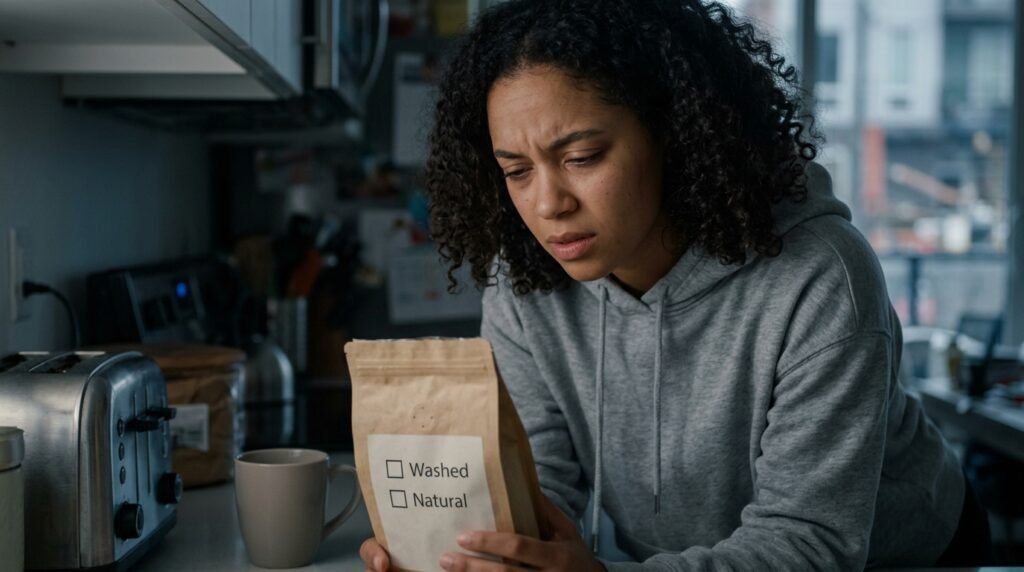
For a long time, I ignored words like “Washed,” “Natural,” or “Honey Process” on the bags because I had no idea what they meant. I just assumed they were cleaning terms.
I learned that processing refers to how the farmer removed the coffee seed from the fruity cherry after harvesting.
The Washed Process: If the label says “Washed,” it means the farmers stripped the fruit off the seed immediately after picking it, washed it clean in water tanks, and dried the naked seed in the sun. Washed coffees are my go-to for a clean, crisp, highly structured morning cup. You taste the pure genetics of the seed itself, which usually results in bright acidity and tea-like clarity.
The Natural Process: If the label says “Natural” or “Unwashed,” get ready for a wild ride. This means the farmers left the whole, intact fruit on the seed and laid them out in the sun to dry like raisins. As the fruit dries and ferments around the seed, all the heavy sugars and intense fruit flavors seep directly into the bean. When you brew a Natural coffee, it often tastes explosively like strawberry jam, blueberries, or dark wine.
Understanding processing changed everything for me. If I want a refreshing, floral cup, I look for “Washed.” If I want a heavy, syrupy, fruit-bomb weekend coffee, I look for “Natural.”
Step 6: The Ultimate Truth Teller (The Date)
All the high altitudes and fancy processing methods in the world do not matter if the coffee is dead.
This was the hardest habit for me to break. I was trained by supermarkets to look for a “Best By” date. I would buy a bag of coffee because it said it was good until October of next year.
I didn’t realize that coffee is a fresh agricultural product full of volatile oils that evaporate quickly.
A “Best By” date is a meaningless factory metric. It just means the coffee won’t grow mold and kill you by that date. It has absolutely nothing to do with flavor.
Specialty coffee roasters do not use “Best By” dates. They use “Roasted On” dates.
This is the non-negotiable rule of reading a label. Realizing the importance of this timeline is exactly (Why I Check Coffee Dates Before Buying) religiously. If I am holding a bag of coffee and it does not tell me the exact day it came out of the roasting machine, I will not buy it.
I want to buy coffee that was roasted within the last seven to fourteen days. This ensures that all the beautiful aromatic compounds are still locked inside the bean, ready to explode when I grind them in my kitchen.
Step 7: Demystifying Tasting Notes
The final piece of the puzzle was the tasting notes.
When I first started reading specialty labels, I would see things like: Tasting Notes: Milk Chocolate, Ripe Plum, Brown Sugar.
I genuinely thought the roasters were spraying the beans with artificial flavor syrups. I used to avoid these bags because I hated flavored coffee. I just wanted it to taste like coffee.
Nobody told me that these notes are naturally occurring.
Because coffee is a complex fruit seed, the roasting process caramelizes its natural sugars and amino acids. Depending on the soil, altitude, and roast level, the human brain interprets these natural chemical compounds as recognizable flavors.
There is no actual plum in a bag of coffee with “plum” notes. The roaster is just trying to give you a roadmap. They tasted the coffee and thought, “Wow, the natural acidity in this bean reminds me exactly of biting into a ripe plum.”
Once I realized that tasting notes were just a sensory guide, I stopped being intimidated by them. I started using them to navigate my preferences. I realized that if a bag listed “Dark Cocoa and Toasted Walnut,” it would be a heavy, comforting cup. If it listed “Lemon Zest and Jasmine,” it would be bright and lively.
The Confidence of the Coffee Aisle
Today, walking into a specialty coffee shop or browsing a roaster’s website is no longer an anxiety-inducing experience.
I don’t get distracted by shiny logos or meaningless adjectives. I know exactly how to read the language of the bean.
I look at a bag, and the data paints a picture in my mind. Origin: Ethiopia, Guji. (It’s going to be complex and African). Altitude: 2,100 MASL. (It’s going to be incredibly sweet). Process: Washed. (It’s going to be clean and tea-like). Roasted On: Five days ago. (It’s perfectly fresh).
By learning to read the label without confusion, I stopped throwing my money away on bad, stale, commodity coffee. I took control of my morning routine, and I empowered myself to buy agricultural products that actually deliver on their promises.
If you are currently feeling lost in the coffee aisle, take a deep breath. Ignore the marketing hype. Look for the farm, look for the date, and look for the process.
Once you learn to read the true story printed on the bag, you will never have to drink a disappointing cup of coffee ever again.

My name is Daniel Carter, I am 35 years old, and I live in the United States. I have been passionate about aquariums for many years, and what started as a simple hobby quickly became a lifelong interest in aquatic life, fish behavior, and responsible tank care.
Through TheBrightLance, I share real experiences, practical knowledge, and honest lessons learned from maintaining different types of aquariums. I enjoy testing equipment, studying fish behavior, improving maintenance routines, and helping beginners avoid common mistakes.
My goal is to make aquarism easier, more ethical, and more enjoyable for everyone — whether you are setting up your very first tank or looking to refine your techniques.