
If you have ever learned how to drive a car with a manual transmission, you will never forget the sheer terror of your first few days behind the wheel.
You sit in the driver’s seat, staring down at three pedals while only having two feet. You slowly release the heavy clutch while nervously pressing the gas pedal, praying that you find that invisible, magical “friction point.”
If you get it wrong, the car violently lurches forward, the engine sputters, and the entire vehicle violently stalls in the middle of a busy intersection. While the cars behind you honk their horns, you sit there in a pool of nervous sweat, aggressively wondering why you didn’t just buy an automatic.
But if you keep practicing, something incredible happens. Your muscle memory takes over. You stop thinking about the pedals. You shift gears smoothly, and suddenly, you feel a profound, exhilarating sense of control. You are no longer just steering a machine; you are physically connected to the road.
For the first year of my specialty coffee journey, I was the terrified teenager stalling the car in the middle of traffic.
I had thrown away my automatic, plastic drip coffee maker. I wanted to experience the romantic, high-end world of manual brewing. I bought a glass V60 cone, a gooseneck kettle, and expensive beans. But every single morning, my coffee tasted like a chaotic, bitter, sour disaster. I was grinding the gears and stalling the engine.
I almost gave up and went back to the automatic machine. But I am incredibly glad I didn’t.
Here is the honest, highly technical, and deeply personal story of how I learned to brew better coffee at home, the frustrating mechanical failures I had to overcome, and how mastering the manual transmission of coffee completely revolutionized my mornings.
The First Stall: Ignoring the Fuel
When I first bought my manual pour-over equipment, I made a massive, fundamental mistake. I bought premium equipment, but I was fueling it with terrible gas.
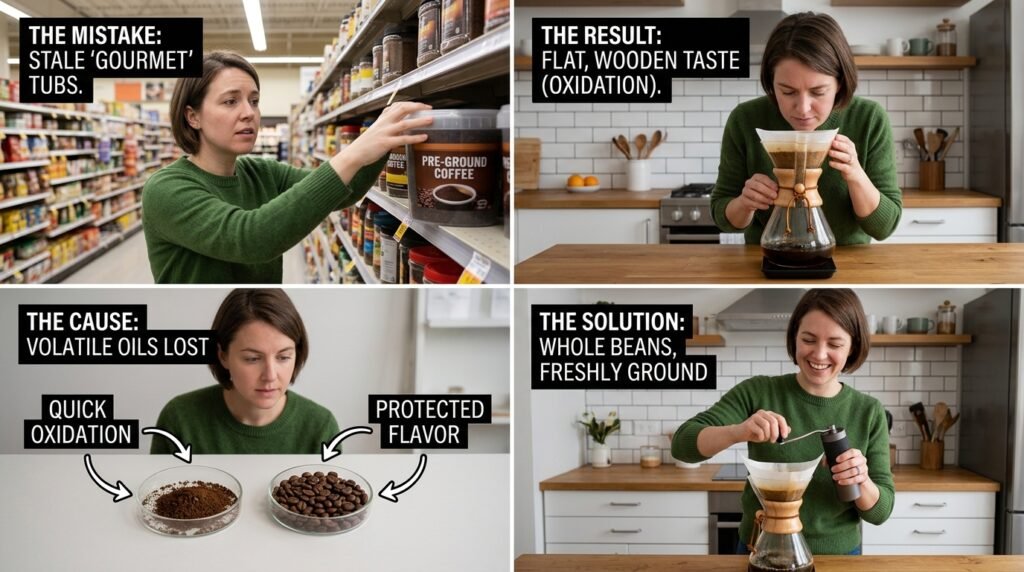
Because I was intimidated by the idea of grinding my own beans, I went to the supermarket and bought a massive tub of premium, but pre-ground, coffee. I assumed that because the label said “Gourmet,” it would taste amazing in my new glass brewer.
I was completely ignoring the harsh chemical reality of oxidation.
When a coffee bean is whole, its dense outer shell acts like a biological vault, protecting the delicate, highly volatile aromatic oils trapped inside. But the exact second a factory machine crushes that bean into a fine powder, the vault is blown wide open. All of those delicate flavor oils are instantly exposed to the oxygen in the air.
While a whole coffee bean might stay fresh for three weeks, pre-ground coffee loses its peak flavor in about fifteen minutes.
I was trying to drive a high-performance sports car using stale, watered-down gasoline. The coffee I brewed was flat, woody, and completely devoid of any sweetness. Understanding this devastating loss of flavor was the exact catalyst for (Why I Gave Up Pre-Ground Coffee).
I finally swallowed my pride, bought a grinder, and learned that fresh, whole-bean coffee is the absolute, non-negotiable foundation of any good brew.
Finding the Friction Point: The Digital Scale
Once I started buying fresh, whole-bean coffee, I ran into my second massive mechanical failure. I could not figure out how to make the coffee taste consistent.
On Monday, the cup would be heavy, muddy, and overwhelmingly bitter. On Tuesday, using the exact same bag of beans, the cup would be thin, watery, and aggressively sour. I felt like I was completely out of control.
My problem was that I was measuring my ingredients with a cheap plastic scoop.
I would dump “two or three” scoops of ground coffee into the filter, and then I would pour hot water from my kettle until the ceramic mug “looked full.” I was entirely relying on visual guesswork.
In the culinary world, and especially in coffee extraction, guessing the volume is a recipe for disaster. Different coffee roasts have vastly different densities. A scoop of a dark roast might weigh 10 grams, while a scoop of a light roast might weigh 16 grams.
I had to find the friction point. I had to lock in my variables.
I threw the plastic scoop in the garbage and bought a cheap, fifteen-dollar digital kitchen scale. I started weighing my coffee beans in exact grams. Then, I placed my entire brewing apparatus on the scale, zeroed it out, and weighed the exact amount of hot water I was pouring.
I started following a strict 1:16 ratio—one gram of coffee for every sixteen grams of water.
The very first morning I used the scale, the chaotic, wild swings in flavor instantly vanished. I was no longer guessing. I had found the friction point, and the car finally started moving smoothly.
Grinding the Gears: The Blade Grinder Massacre
My coffee was finally consistent, but it still possessed a harsh, dry, astringent aftertaste that hurt the back of my throat.
I had fixed my ratio, but I was still violently destroying the physical beans before the water ever touched them.
When I first decided to start grinding my own coffee, I went to a big-box store and bought a cheap, twenty-dollar electric spice grinder. It featured a small metal blade that spun around like a tiny helicopter propeller. I would press the button, listen to the deafening scream of the motor, and watch the beans get chopped to pieces.
I thought I was saving time. But a spinning blade does not grind coffee; it massacres it.
When you open a blade grinder, you will find a chaotic, completely uneven mess. Half of the coffee is chopped into massive, jagged boulders. The other half is completely pulverized into microscopic, powdery dust.
When you pour hot water over this chaotic mixture, the physics of extraction completely break down. The microscopic dust particles extract instantly, releasing harsh, bitter tannins. The massive boulders barely extract at all, releasing weak, sour water.
Your mug becomes a muddy, confused battlefield of under-extracted and over-extracted flavors.
Discovering the catastrophic damage caused by that cheap machine perfectly illustrates (How Grind Size Affected My Coffee More Than I Expected). I realized that the grinder is the steering wheel of the entire operation.
I upgraded to a manual burr grinder. A burr grinder uses two heavy steel plates to crush the beans into perfectly uniform, symmetrical pieces. The water was finally able to extract the exact same amount of flavor from every single particle. The harsh bitterness disappeared entirely.

Overheating the Engine: The Boiling Water Mistake
Even with a perfect ratio and a uniform grind size, I still felt like the vibrant, sweet fruit notes promised on the coffee bag were hiding from me. The coffee was smooth, but it lacked a certain bright clarity.
I was making a very common, invisible thermal mistake.
I was using a traditional stovetop kettle. I would wait for the water to reach a violent, rolling, screaming boil, and then I would immediately dump it straight over my delicate coffee grounds.
I was treating the coffee like dry pasta. I didn’t realize that light-roast specialty coffee is incredibly sensitive to heat.
The beautiful flavor compounds in coffee—the jasmine, the blueberry, the brown sugar—are highly volatile. When you hit them with 212-degree Fahrenheit (100-degree Celsius) water, you commit instant culinary arson. You scorch the oils. You literally burn the sweetness away, forcing the harsh, carbonized ash to the surface.
I had to learn how to monitor the engine temperature.
Now, when my kettle reaches a boil, I take it off the hot stove and I simply let it sit on my kitchen counter for sixty seconds. I allow the temperature to drop to a gentle, forgiving 200 degrees Fahrenheit.
This one-minute pause cost absolutely no money, but it completely saved my mornings. The scorching stopped. The bright, sweet fruit notes finally survived the brewing process and made it directly into my mug.
Smoothing Out the Ride: The Gentle Pour
The final mechanical adjustment I had to make involved the actual physical act of pouring the water.
Because I was usually rushed in the mornings, I would hold my kettle high in the air and dump the water into the brewing cone as aggressively as possible. I wanted the water to drain fast so I could drink the coffee and go to work.
But coffee extraction requires a delicate touch.
When you pour water from a high altitude, the heavy stream crashes violently into the coffee bed. It aggressively churns the grounds, pushing all the microscopic fine particles to the very bottom of the paper filter.
Those fines act like a layer of wet cement. They clog the microscopic pores of the filter, completely stalling the flow of water. A brew that should take three minutes suddenly takes five minutes, resulting in a bitter, over-extracted mess.
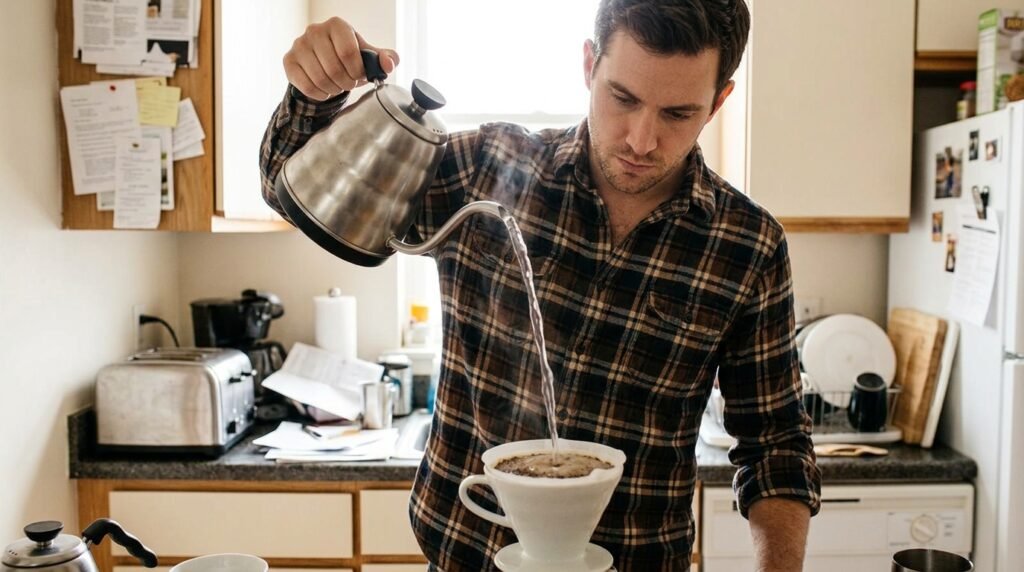
I learned to lower my kettle. I keep the metal spout just an inch above the coffee slurry. I pour in slow, hypnotic, gentle circles. I do not violently agitate the grounds. I just let the fresh water glide evenly over the surface.
The Joy of the Open Road
When you spend your entire life pushing a button on a plastic, automatic drip machine, the idea of manual brewing seems completely exhausting.
Why would anyone want to weigh their beans, grind them by hand, monitor the water temperature, and slowly pour the water in circles? It sounds like an unnecessary, pretentious chore.
But that is exactly what people who drive automatic cars say about driving a manual transmission.
When you finally eliminate the careless mistakes—when you stop buying stale pre-ground coffee, throw away the plastic scoop, buy a burr grinder, and stop scorching your beans—the entire paradigm shifts.
Realizing the profound satisfaction of this analog ritual is exactly (Why I Prefer Manual Brewing Over Machines).
It stops being a chore. It becomes fifteen minutes of absolute, unbothered peace. It is a moment of total control in a chaotic, digital world. You are taking a raw agricultural ingredient and, through strict chemistry and personal technique, crafting it into an absolute masterpiece.
If you are currently frustrated with the bitter, muddy coffee coming out of your automatic machine, I highly encourage you to take the wheel.
Buy a cheap digital scale. Buy a glass pour-over cone. Buy a bag of freshly roasted, whole-bean coffee from a local artisan.
Yes, you might stall the engine a few times on your first week. You might mess up the ratio or pour the water too fast. But when you finally find that perfect friction point, and you take a sip of the sweetest, cleanest, most vibrant cup of coffee you have ever tasted, you will never go back to the automatic machine ever again. You will finally understand the joy of the open road.

My name is Daniel Carter, I am 35 years old, and I live in the United States. I have been passionate about aquariums for many years, and what started as a simple hobby quickly became a lifelong interest in aquatic life, fish behavior, and responsible tank care.
Through TheBrightLance, I share real experiences, practical knowledge, and honest lessons learned from maintaining different types of aquariums. I enjoy testing equipment, studying fish behavior, improving maintenance routines, and helping beginners avoid common mistakes.
My goal is to make aquarism easier, more ethical, and more enjoyable for everyone — whether you are setting up your very first tank or looking to refine your techniques.