
When you try to learn a foreign language using only a textbook, you are essentially memorizing a giant list of direct translations. You learn that the English word “bread” translates to “pan” in Spanish or “pain” in French.
You memorize the literal definition, and you assume the job is done.
But when you finally pack your bags, step off an airplane, and walk into a foreign city, you immediately realize that your textbook lied to you. The dictionary definition of a word might be universal, but the cultural context changes everything.
If you ask for “dinner” in the United States, you will sit down at 6:30 PM. If you ask for “dinner” in Madrid, you will sit down at 10:00 PM, and the meal will last past midnight. The chemical composition of the food might be similar, but the human execution is entirely different.
For a long time, I operated under a very strict, textbook definition of coffee.
I thought coffee was just a hot, caffeinated liquid extracted from a roasted seed. I assumed that because the biological plant was the same, the global human experience of drinking it must also be the same.
I was completely wrong.
As I began to explore the global landscape of this incredible beverage, I realized that coffee is a culinary chameleon. The liquid in the cup is completely defined by the cultural lighting of the room it is served in.
Here is the honest, highly observant story of the cultural differences I noticed in coffee drinking, how physical posture and unwritten rules change the flavor of the bean, and how learning these global translations completely rewired my own morning routine.
The American Translation: The Culture of Motion
To truly appreciate the nuances of global coffee culture, I first had to critically examine my own default setting.
In the United States, the culture of coffee drinking is defined by a single, undeniable physical state: motion.
We do not drink coffee; we transport it. The ultimate symbol of Western coffee culture is the massive, 16-ounce paper cup with a plastic, spill-proof lid. It is specifically engineered to be placed in the cup holder of a car, carried onto a crowded subway train, or balanced on top of a laptop while speed-walking down a busy sidewalk.
In this culture, sitting down to drink a cup of coffee is often viewed as a luxury, or worse, a waste of productive time.
We use coffee as a biological override. It is the fuel that powers the relentless engine of modern corporate life. Because the primary goal is rapid caffeine delivery, the actual taste of the coffee is frequently masked by heavy artificial syrups, whipped cream, and caramel drizzle.
I lived in this culture of motion for years. I drank my coffee out of insulated metal travel mugs while staring at traffic lights. I was completely disconnected from the beverage itself.

The Italian Translation: The Strict Social Contract
When you look at the coffee culture in Italy, the textbook definition completely shatters.
If the American translation is about motion and isolation, the Italian translation is about absolute stillness and deep communal integration. But it is a very specific, highly regulated type of stillness.
In Italy, coffee is deeply democratic, but it is governed by strict, unwritten social rules.
You do not order an espresso to-go. If you ask a traditional Italian barista for a paper cup so you can walk down the street, they will look at you like you have committed a crime. You are expected to drink the coffee exactly where it is made.
When you walk into a neighborhood bar, you do not sit at a table with your laptop for four hours. You stand at the banco (the counter). You stand shoulder-to-shoulder with strangers, businessmen, and construction workers.
The barista hands you a thick, pre-warmed porcelain cup. You drink the heavy, crema-topped espresso in three quick sips. You talk loudly with the person next to you, you leave a coin on the zinc counter, and you walk out.
The entire interaction takes less than three minutes, but it is deeply human. Immersing myself in these vastly different social dynamics was the core of (What I Learned About Coffee Culture Around the World). It taught me that speed doesn’t have to mean isolation.
There are also the strict chronological rules. In Italy, you do not order a cappuccino after 11:00 AM. Milk is considered a heavy breakfast food, and drinking a massive, milk-heavy coffee after a large plate of pasta is a massive cultural faux pas.
The Parisian Translation: The Art of Observation
If you cross the border from Italy into France, the cultural translation of coffee shifts once again.
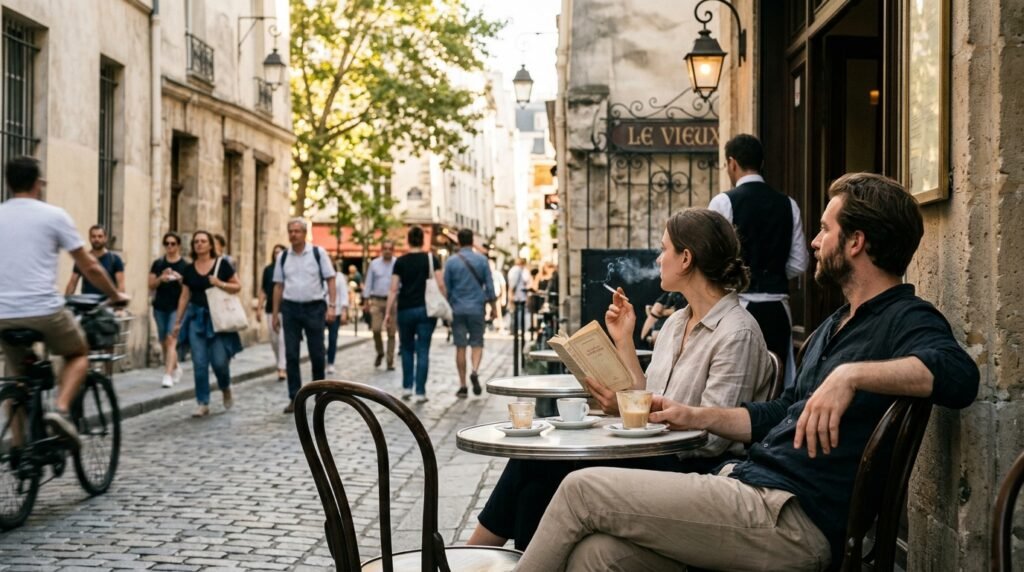
In Paris, the coffee shop is not a place for a quick, three-minute shot of espresso at the counter. The traditional Parisian café is a theater, and the coffee is simply your ticket to the show.
If you look closely at the architecture of a classic French café, you will notice something fascinating about the seating arrangement. The tiny, round tables on the outdoor terrace are not facing each other. The chairs are arranged side-by-side, facing outward toward the street.
In this culture, coffee is a companion to the art of observation.
You order a café crème or a simple black espresso, and you sit down. The waiter will not rush you. They will not bring you the check until you explicitly ask for it. You are renting that chair for the afternoon.
The goal is not to consume caffeine. The goal is to sit in the afternoon sun, read a physical book, smoke a cigarette, and watch the chaotic, beautiful parade of humanity walking down the sidewalk.
The beverage itself is secondary to the act of existing in a public space. It is a culture that actively celebrates the romantic art of doing absolutely nothing.
The Ethiopian Translation: The Investment of Time
While Europe perfected the café environment, the cultural translation in Ethiopia—the biological birthplace of the coffee plant—operates on an entirely different plane of existence.
In Ethiopia, the concept of a “quick cup of coffee” simply does not exist.
Coffee is not a background activity; it is a sacred, focal event. The Ethiopian coffee ceremony is an ancient tradition that requires a massive, deliberate investment of time, usually lasting for a minimum of two to three hours.
The host begins with raw, green seeds. They wash them, roast them in a pan over an open fire, and crush them by hand. The physical sensory overload is incredible. You smell the raw earth, the heavy smoke of the roasting beans, and the burning incense that accompanies the ritual.
The liquid is boiled in a clay pot and served in three distinct rounds.
In this culture, coffee is the ultimate expression of hospitality and respect. You are literally sharing a piece of your day that you can never get back. Exploring the agricultural roots that birthed this heavy tradition was the defining moment of (What I Learned From Drinking Coffee From Different Regions).
When I learned about the Ethiopian ceremony, I felt a deep sense of embarrassment about my own habits. I realized that by trying to consume my coffee in forty-five seconds while driving a car, I was deeply disrespecting a plant that other cultures treat with the utmost reverence.
The Nordic Translation: The Mandatory Boundary
If you travel to the dark, freezing winters of Scandinavia, you will discover yet another completely different translation of the coffee bean.
The populations of Sweden and Finland consume more coffee per capita than almost anyone else in the world. But they do not drink it with the frantic, stressful energy of the American corporate worker.
In Sweden, they use coffee as a psychological boundary line, a tradition known as Fika.
Fika is a socially mandated pause. In Swedish offices, you are actively encouraged to step away from your glowing computer monitor twice a day. You physically leave your workspace, gather with your colleagues in a communal room, and pour a cup of hot black filter coffee.
You eat a sweet cinnamon pastry, and you talk about life.
The coffee provides the physical warmth required to survive the freezing Nordic winter, but the tradition provides the emotional warmth required to survive the isolation of the modern digital workday.
It is a culture that recognizes that human beings are fundamentally fragile. We cannot work for eight hours straight without breaking down. Coffee is the culturally accepted tool used to enforce rest.
The Middle Eastern Translation: The Muddy Fortune
Finally, if you look at the ancient traditions of the Middle East, specifically in Turkey, you will find a culture that uses coffee to bridge the gap between the physical world and the spiritual one.
They do not use clean, bleached paper filters. They embrace the grit.
The coffee is ground into a microscopic powder, mixed with water and heavy spices like cardamom, and boiled in a brass pot—often buried in scorching hot sand.
Because it is unfiltered, it is poured directly into a tiny cup. You must sit still and wait patiently for the heavy, muddy grounds to settle to the bottom before you can take a careful sip. The liquid is thick, syrupy, and intense.
But the cultural difference is most apparent when the cup is empty. The drinker flips the cup upside down onto the saucer. A designated reader will then look at the chaotic, abstract shapes left behind by the coffee mud and interpret them to predict the drinker’s future.
In this culture, the coffee bean is an oracle. It is a mystical translator.

Editing the Daily Routine
When I finally stepped back and looked at this massive, global tapestry of cultural translations, my own kitchen felt incredibly boring.
I realized that I was fluent in the vocabulary of coffee, but I was completely illiterate when it came to the culture. I was treating a profoundly complex, historical beverage like a cheap battery charger.
Realizing the emotional weight that this simple seed carries across the globe was the exact reason (Why Coffee Means More Than Just Caffeine to Me). It is a mirror that reflects the values of the people drinking it.
I decided to stop drinking coffee on autopilot. I started intentionally changing my cultural translations depending on what my mind and body needed on any given day.
If I am feeling deeply isolated by remote digital work, I channel the Parisian culture. I pack my laptop away, I walk to a local café, I order a black pour-over, and I simply sit and watch the people walking down the street.
If my brain feels fried from editing images and answering stressful emails, I channel the Swedish Fika. I close my software, walk into the kitchen, manually grind a batch of beans, and force myself to stare out the window in absolute silence for fifteen minutes.
And if a friend comes over to visit, I channel the Ethiopian spirit. I do not rush the brewing process. I use the time it takes for the hot water to pass through the glass V60 cone as an excuse to stand together and talk about life.
Put Down the Paper Cup
We live in a world that constantly encourages us to strip the humanity out of our daily routines. We want everything faster, cheaper, and more convenient.
But convenience is the enemy of culture.
The next time you make a cup of coffee, I challenge you to think about the physical posture you are adopting. Are you standing over the sink, gulping it down before you rush out the door? Are you holding a disposable paper cup with a plastic lid?
You are drinking the textbook definition of the beverage, but you are missing the entire cultural context.
Try to borrow a tradition from another part of the world. Pre-heat a thick porcelain cup. Sit down at a table. Do not look at your phone. When you finally allow the coffee to dictate your pace, rather than forcing the coffee to match your anxiety, you will realize that the dark liquid in your mug is the greatest cultural translator on the planet.

My name is Daniel Carter, I am 35 years old, and I live in the United States. I have been passionate about aquariums for many years, and what started as a simple hobby quickly became a lifelong interest in aquatic life, fish behavior, and responsible tank care.
Through TheBrightLance, I share real experiences, practical knowledge, and honest lessons learned from maintaining different types of aquariums. I enjoy testing equipment, studying fish behavior, improving maintenance routines, and helping beginners avoid common mistakes.
My goal is to make aquarism easier, more ethical, and more enjoyable for everyone — whether you are setting up your very first tank or looking to refine your techniques.