
When you are a child, or even a young student in university, the architecture of your life is specifically designed to force you to make friends.
You are constantly placed in rooms with dozens of other people your exact same age. You share the same schedule, the same cafeteria, and the same agonizingly boring lectures. Friendship in those environments is almost entirely automatic. It is born out of sheer proximity and shared survival.
But when you become an adult, the architecture completely changes.
You move into your own apartment. You start a demanding career—especially if it involves remote digital work—and suddenly, the built-in community vanishes. You realize very quickly that making a new friend in your thirties requires a terrifying amount of deliberate, intentional effort.
Asking another adult to “hang out” feels incredibly heavy.
If you invite someone to dinner, it feels like a massive financial and temporal commitment. There is pressure to dress up, order expensive food, and maintain a high-level conversation for three hours. If you invite someone to a bar, it is often too loud to actually hear what they are saying, and the focus shifts entirely to alcohol.
But a few years ago, I discovered a social loophole. I found the ultimate, universal adapter for human connection.
I stopped trying to plan elaborate social events and simply started asking people if they wanted to get a cup of coffee. Here is the honest, highly observant story of how coffee became a social habit in my life, how a bitter, isolating morning drug transformed into my greatest community-building tool, and why this simple agricultural seed is the ultimate cure for modern loneliness.
The Era of the Solitary Drinker
To understand the magnitude of this social shift, I have to confess how aggressively isolating my relationship with coffee used to be.
During the early years of my career, coffee was not a social event. It was the exact opposite. It was a tool I used specifically to isolate myself from the world.
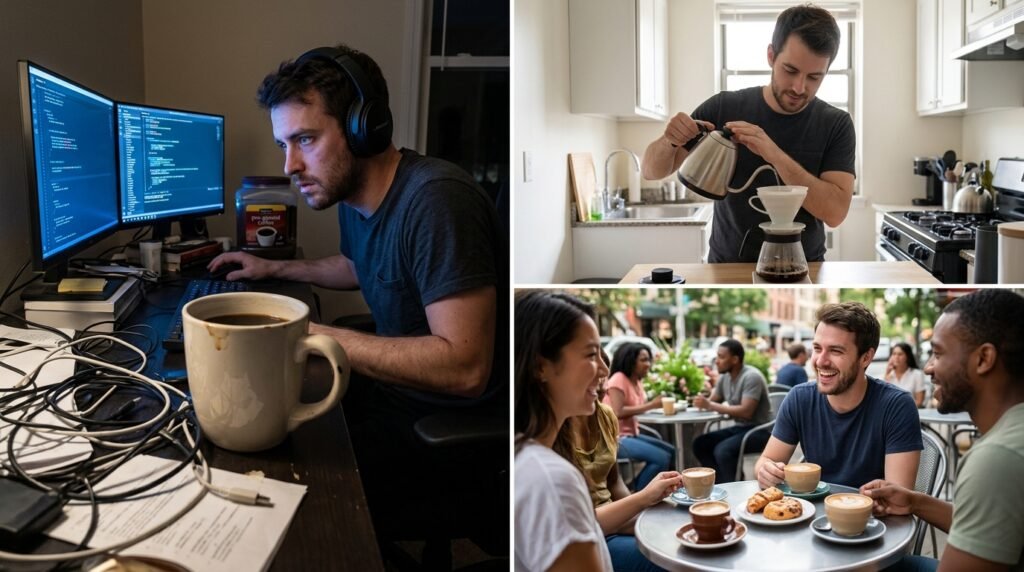
I would buy massive, cheap plastic tubs of pre-ground dark roast from the grocery store. I would brew a sputtering pot of bitter black sludge in my kitchen at ten o’clock at night. I would pour it into a massive ceramic mug, carry it to my desk, shut the door, and put my headphones on.
I used the caffeine as a biological weapon to force my eyes to stay open so I could meet my digital deadlines.
The coffee was fuel for my solitude. It was the companion of the lonely freelancer, working in the dark while the rest of the world was asleep. I never once considered sharing that harsh, burnt liquid with another human being, mostly because it tasted absolutely terrible.
The Accidental Discovery of Craft
My entire perspective shifted the day I decided I could no longer stomach the bitter taste of that supermarket powder.
I stumbled into the world of specialty coffee. I bought my first bag of light-roast, single-origin Ethiopian beans from a local independent roastery. I bought a manual burr grinder, a digital scale, and a glass V60 pour-over cone.
The first time I successfully brewed a cup of specialty coffee, I stood in my kitchen in absolute silence.
The liquid wasn’t harsh or ashy. It tasted like sweet peaches, bright jasmine flowers, and caramelized honey. It was an explosion of natural, unadulterated flavor. It was a culinary masterpiece that I had engineered with my own two hands using gravity, heat, and time.
My immediate, involuntary reaction was not just happiness. It was a desperate urge to share it.
I realized that keeping this incredible sensory experience to myself felt almost selfish. I wanted someone else to taste it, just to confirm that I wasn’t going crazy. Exploring this sudden desire to bridge the gap between my kitchen and the outside world was the exact foundation of (Why Coffee Brings People Together).
The quality of the beverage had become so high that it practically demanded an audience.
The Kitchen Counter Confessional
The very next weekend, I invited a friend over to my apartment. I didn’t invite them to watch a movie or to have a few beers. I explicitly invited them over to “try this insane new bag of coffee I just bought.”
When they arrived, I didn’t just hand them a pre-made mug. I initiated the ritual.
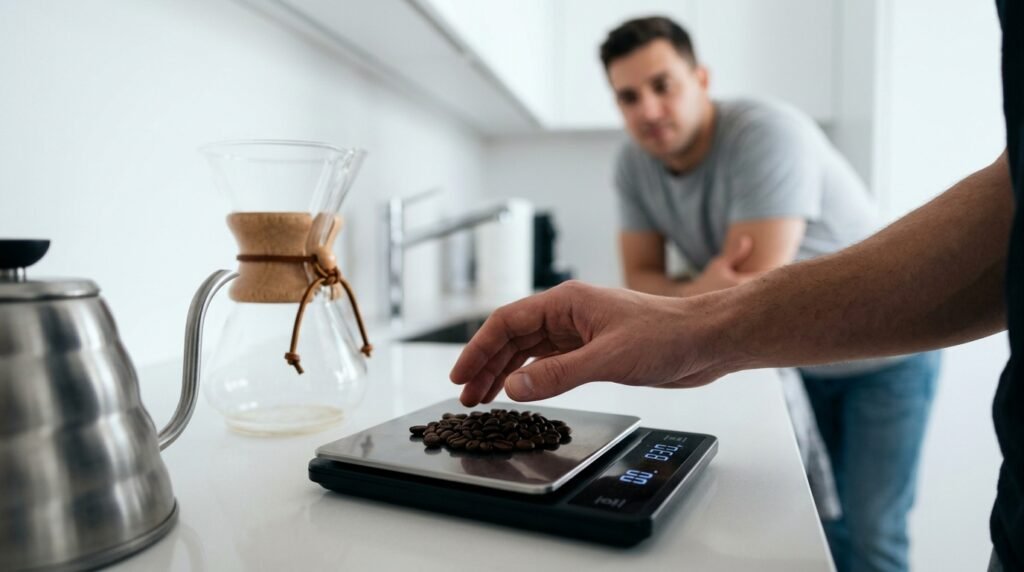
I pulled out the digital scale. I weighed the beans. I hand-ground the coffee, letting the explosive, sweet aromatics fill the entire kitchen. I heated the gooseneck kettle and began to pour the water in slow, deliberate circles over the coffee bed.
Because the manual pour-over process takes exactly four minutes of continuous attention, I was physically anchored to the kitchen island. I couldn’t check my phone. I couldn’t walk into the living room.
My friend naturally leaned against the counter to watch the process.
In those four minutes, something magical happened. The slowness of the ritual, the warmth of the steam, and the mechanical crunch of the grinder created a perfectly safe, unhurried environment. The silence was broken, but not by superficial small talk.
We immediately bypassed the awkwardness and started talking about real life. We talked about our anxieties, our careers, and our families. The kitchen counter transformed into a confessional booth.
When I finally handed them the steaming ceramic mug and they tasted the complex fruit notes of the coffee, their eyes widened in surprise. We had shared an experience, not just a beverage.
The Ultimate Low-Stakes Invitation
Once I realized the social power of the beverage in my own kitchen, I started deploying it out in the real world.
I realized that “getting coffee” is the greatest, most low-stakes social invitation ever invented by human society. It completely removes the pressure of modern adult friendships.
If you ask an acquaintance to get a cup of coffee at two o’clock on a Tuesday afternoon, there is an unspoken agreement that the interaction has a natural expiration date. A cup of coffee only takes about forty-five minutes to drink.
If the conversation is awkward or you don’t actually click with the person, you can simply finish your drink, say you have to get back to work, and walk away without any offense taken.
But if the conversation is incredible, you can order a second cup. You can sit there for three hours as the afternoon light shifts across the wooden tables of the cafe. It is an infinitely scalable social interaction.
It is completely neutral territory. You are not trapped in a restaurant waiting for a check. You are just holding a warm cup, which gives your hands something to do and naturally lowers your defensive posture.
The Parasocial World of the Cafe
As my social coffee habit expanded, I started spending more and more time working from local, independent coffee shops instead of my isolated home office.
This introduced me to a completely different type of social habit: the ambient community.
When you go to the same local roastery two or three times a week, you inevitably become a “regular.” You don’t have to plan this; it just happens organically.
First, you start recognizing the baristas. You learn their names. They learn how you like your Colombian pour-over. You share a quick, genuine smile and a two-minute conversation about their weekend before you take your drink.
Then, you start recognizing the other regulars. You see the graphic designer who always claims the corner table. You see the older gentleman reading the physical newspaper by the window.
You might never actually learn their last names, but you develop a quiet, unspoken bond with them. You are all sharing the exact same sanctuary.
Absorbing the profound comfort of this shared environment was precisely (What I Learned From Visiting Different Coffee Shops). I realized I was participating in a community without the exhausting pressure of having to constantly perform. I was alone, but I was entirely together.
Bridging the Generational Gap
One of the most beautiful and unexpected ways coffee became a social habit in my life was how it allowed me to connect with people far outside my own demographic.
I work in the digital space. When I try to talk to my parents or my older relatives about what I do for a living, there is a massive technological barrier. They don’t understand the software, the rendering times, or the digital algorithms.
Finding common ground can feel like trying to speak two entirely different languages.
But coffee is an ancient, universal language.
When I go to visit my family, I pack my manual burr grinder and a bag of premium, lightly roasted specialty coffee. In the morning, I offer to make them a cup.
My grandfather may not understand my digital career, but he absolutely understands the comfort of a hot mug on a cold morning. When I hand him a perfectly extracted, naturally sweet cup of coffee and explain that the beans were grown at a high altitude in Guatemala, his eyes light up.
We sit at the dining table and talk about the flavor profile. We talk about the craftsmanship. The coffee acts as an analog bridge across a massive generational divide.
Understanding how this simple agricultural product can transcend age, culture, and technology was the defining moment of (The First Time I Explored Coffee Culture Deeply). It proved to me that no matter how fast the world moves, human beings will always bond over warmth and flavor.

The Excuse for Connection
We live in a deeply lonely era. We are hyper-connected digitally, yet physically isolated. We spend hours scrolling through social media, looking at the curated lives of our peers, but we rarely look them in the eyes.
We all desperately want more physical connection, but we are terrified of the vulnerability required to ask for it.
Coffee is the excuse we use to be human.
No one actually needs to go to a cafe to get caffeine. You can buy a caffeine pill at a pharmacy for ten cents. You can drink an energy drink from a gas station.
We pay five dollars for a hand-crafted pour-over at a local coffee shop because we are paying for the theater of humanity. We are paying for the smile of the barista. We are paying for the ambient hum of conversation. We are paying for a socially acceptable reason to occupy a chair in a public space.
The Open Invitation
If you are currently feeling the heavy weight of adult isolation—if your routine consists entirely of waking up, staring at a screen, and going back to sleep—I challenge you to use the loophole.
Do not plan a massive dinner party. Do not try to organize a complex weekend trip.
Just buy a high-quality bag of specialty coffee and a manual brewer. Text a friend you haven’t seen in six months and ask if they want to come over to your kitchen for twenty minutes to try it.
Or, send a message to a colleague and ask if they want to step away from their desk and walk to the local roastery down the street.
When you stop treating coffee as a private, utilitarian drug and start treating it as an open invitation, your entire lifestyle will shift. The bitter isolation will fade, and you will quickly realize that the greatest value of the coffee bean is not the energy it gives your body, but the warmth it brings to your relationships.
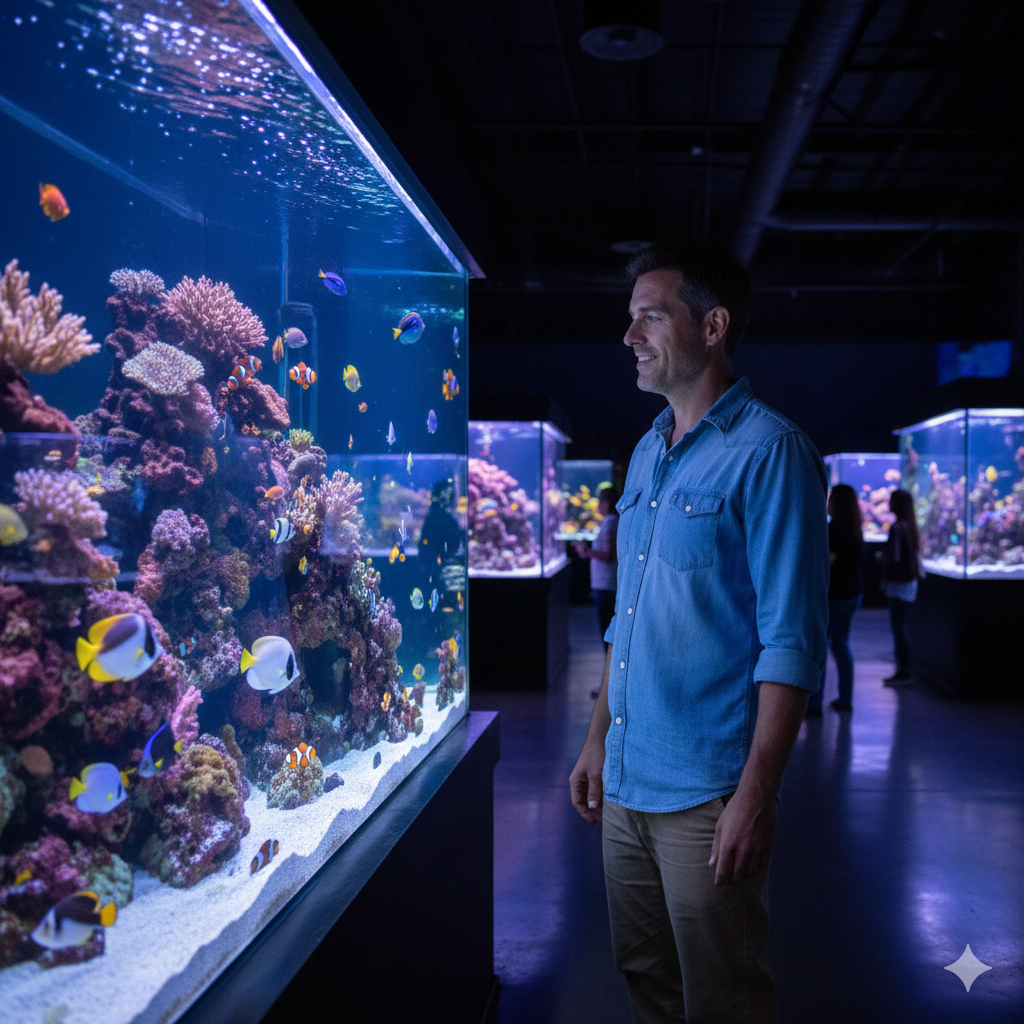
My name is Daniel Carter, I am 35 years old, and I live in the United States. I have been passionate about aquariums for many years, and what started as a simple hobby quickly became a lifelong interest in aquatic life, fish behavior, and responsible tank care.
Through TheBrightLance, I share real experiences, practical knowledge, and honest lessons learned from maintaining different types of aquariums. I enjoy testing equipment, studying fish behavior, improving maintenance routines, and helping beginners avoid common mistakes.
My goal is to make aquarism easier, more ethical, and more enjoyable for everyone — whether you are setting up your very first tank or looking to refine your techniques.