
If you ask a professional, classically trained chef to cook you a plate of simple scrambled eggs, they will likely hand you a culinary masterpiece.
The eggs will be incredibly soft, velvety, and rich. They will practically melt in your mouth. But if you walk into the kitchen and watch that chef cook, you will notice something fascinating. They are not using a thousand-dollar, high-tech piece of equipment. They are using the exact same cheap, basic ingredients that you have in your own refrigerator: eggs, a little bit of butter, and a pinch of salt.
So, why do your scrambled eggs at home taste like dry, rubbery, sulfur-scented sponges, while the chef’s eggs taste like luxury?
It has absolutely nothing to do with the budget. It has entirely to do with the technique.
When an amateur cooks scrambled eggs, they turn the stove burner up to the maximum heat setting. They aggressively whisk the eggs, dump them into a screaming hot pan, and forcefully scrape them around for sixty seconds until they are stiff and completely dry. They destroy the delicate proteins with violent heat and impatience.
The professional chef does the exact opposite. They turn the heat down to the lowest possible setting. They pour the eggs into a warm, gentle pan. They stir slowly, deliberately, and constantly. They take the pan off the heat before the eggs even look fully cooked, letting the residual warmth finish the job gently.
They make a masterpiece using the exact same ingredients simply by changing how they handle them.
For the first decade of my adult life, my morning coffee routine was the culinary equivalent of rubbery, overcooked eggs.
I was buying decent coffee beans, but I was aggressively burning them, rushing the process, and making incredibly violent mistakes in the kitchen. I thought I needed to spend hundreds of dollars on a fancy espresso machine to fix the harsh, bitter flavor.
I was completely wrong. Here is the honest, highly practical story of how I made better coffee with simple changes, the invisible mistakes I was making every single morning, and how learning to cook the “eggs” properly completely transformed my daily mug.
Simple Change One: Respecting the Liquid Canvas
The very first change I made cost me absolutely nothing, yet it fundamentally altered the entire flavor profile of my morning routine. I had to rethink the most abundant, dominant ingredient in my kitchen.
We spend so much time obsessing over the exact origin of our coffee beans. We look for bags that say Ethiopia, Colombia, or Guatemala. We worry about the roast level and the processing method.
But we completely ignore the fact that a cup of coffee is 98.5 percent water.
For years, I was filling my stovetop kettle directly from the kitchen tap. I lived in a city with heavily treated, hard water. If I drank a cold glass of it straight from the faucet, it tasted faintly of swimming pool chlorine, old metal pipes, and heavy chalk.
I incorrectly assumed that the dark, roasted, intense flavor of the coffee beans would somehow magically overpower the bad-tasting water.
This is a massive culinary error. The chemical minerals in your tap water actively interact with the flavor compounds in the coffee. Heavy calcium and chlorine act like a thick, chemical blanket, completely suffocating the bright, sweet, and complex notes of the bean. You cannot paint a beautiful masterpiece if your canvas is already covered in mud.
I finally stopped ignoring (The Biggest Brewing Mistake I Didn’t Notice) and completely changed my liquid foundation.
I did not go out and buy expensive, bottled artisan spring water from the Swiss Alps. I simply stopped using the tap and started using the built-in, charcoal-filtered water dispenser on my refrigerator.
By running the water through a basic carbon filter to strip out the chlorine and heavy minerals, the harsh, metallic aftertaste in my coffee vanished instantly. The beverage became soft, vibrant, and incredibly smooth. The fog had finally lifted.

Simple Change Two: Lowering the Stove
Once my water was clean, I had to address how I was physically heating it. This was the second major change, and it perfectly mirrored the scrambled eggs metaphor.
Because my mornings were usually rushed, I wanted my coffee finished as quickly as possible. I would place my stovetop kettle on the burner, crank the gas dial to the maximum setting, and wait for the water to scream with a violent, rolling, aggressive boil.
The exact second the kettle started whistling, I would grab it by the handle and dump that bubbling, 212-degree Fahrenheit (100-degree Celsius) water directly onto my delicate coffee grounds.
I thought that hotter water meant a faster, more efficient extraction.
I didn’t realize that I was physically scorching my own breakfast. Lightly roasted specialty coffee is incredibly sensitive to thermal energy. The complex, sweet sugars and the highly volatile aromatic oils that make the coffee taste like fruit and chocolate simply cannot survive boiling water.
When you hit those delicate oils with boiling water, you commit instant culinary arson. You burn the sweetness away, leaving behind a harsh, carbonized, bitter ash.
The change I made requires absolutely no new equipment. It just requires one minute of patience.
Now, when my kettle reaches a aggressive boil, I turn the stove off. I take the kettle off the hot burner, set it on the cold kitchen counter, and I wait for exactly sixty seconds. This short pause allows the water temperature to naturally drop to a gentle, forgiving 200 degrees Fahrenheit.
By simply lowering the heat, I stopped burning the eggs. The natural sweetness of the coffee cherry finally survived the extraction process and landed safely in my mug.
Simple Change Three: The Thirty-Second Breath
Even with clean water and a safe temperature, I still had a terrible habit of rushing the actual physical pour.
I would stand over my glass V60 brewing cone, tip my kettle forward, and pour all of my hot water into the paper filter as fast as physically possible. I would fill the cone to the absolute brim, creating a massive, swirling puddle, and just stare at it impatiently, waiting for the liquid to drain.
I was completely ignoring the biological reality of roasted coffee.
During the roasting process, carbon dioxide gas gets permanently trapped inside the dense cellular structure of the bean. When hot water hits fresh coffee grounds, that trapped gas aggressively rushes out.
If you dump all your water into the filter at once, that escaping gas physically repels the liquid. The water cannot properly penetrate the coffee grounds to extract the sweet sugars. Instead, the water finds the path of least resistance, aggressively channeling down the sides of the paper filter and straight into your mug, bypassing the coffee entirely.
The result is a watery, weak, and highly acidic beverage.
I learned to give the coffee time to breathe. Now, I pour just a tiny splash of hot water over the dry grounds—just enough to get them evenly wet. Then, I put the kettle down and completely step away.
I watch the coffee bed bubble, heave, and expand. This is called the “bloom.” I wait for forty-five seconds, allowing all of the defensive gas to escape. Only after the coffee has fully exhaled do I begin my actual pour. This tiny pause ensures that the water evenly saturates the grounds, extracting a deep, rich, perfectly balanced flavor.
Simple Change Four: Controlling the Agitation
The fourth simple change involved taming my own physical movements.
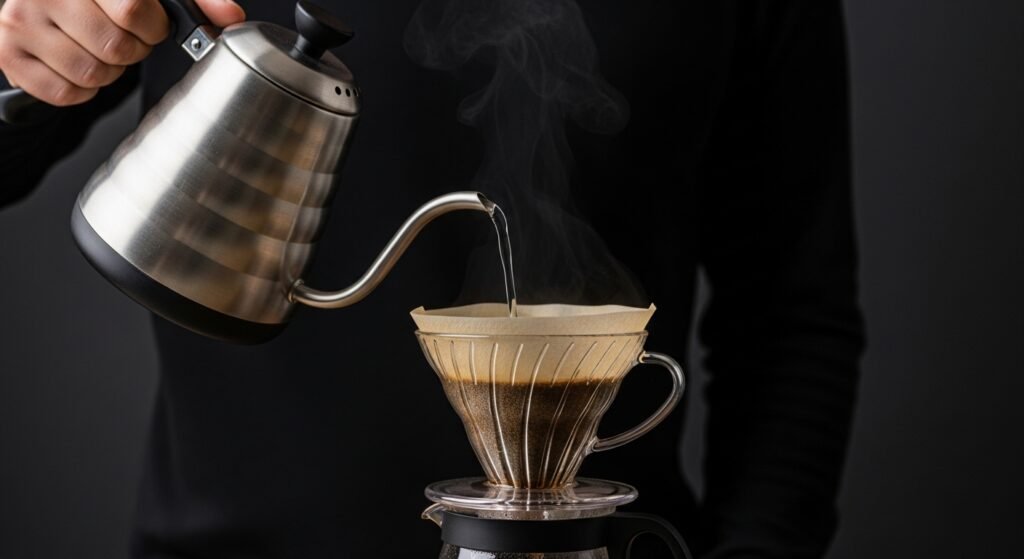
Because I had seen professional baristas pouring water from long, elegant gooseneck kettles, I tried to mimic their posture. I would hold my cheap kettle high in the air, letting the heavy stream of water crash violently into the coffee bed.
I thought I was making sure all the grounds got wet. In reality, I was causing a massive mechanical failure.
When a heavy stream of water falls from a high distance, it builds up kinetic energy. When it crashes into the coffee, it aggressively churns the grounds. It pushes all the microscopic, powdery fine dust particles to the very bottom of the paper filter.
Those fine particles act like a layer of wet cement. They clog the microscopic pores of the paper filter, completely stalling the flow of water. My brew time would double, resulting in a harsh, painfully bitter, over-extracted mess.
When people ask me (How I Made Café-Quality Coffee in My Kitchen), they usually expect me to list a bunch of expensive equipment. But the real answer is simply learning to control gravity.
Now, I lower my kettle until the spout is less than an inch away from the surface of the coffee slurry. I pour in slow, gentle, hypnotic concentric circles. I do not violently agitate the grounds. I just let the fresh water glide evenly across the surface.
By removing the violent agitation, the water flows through the filter perfectly every single morning.
Simple Change Five: The Thermal Battery
The final change I made happened after the coffee was already brewed, and it completely saved my mornings from constant disappointment.
I would spend ten minutes meticulously grinding, blooming, and brewing a beautiful cup of coffee. The liquid falling from the glass cone was steaming hot. But by the time I walked to my desk, opened my laptop, and took my first sip two minutes later, the coffee was already completely lukewarm.
I was ignoring the laws of thermodynamics.
I was brewing 200-degree coffee directly into a heavy, thick ceramic mug that had been sitting in a cold kitchen cabinet all night. The physical temperature of that ceramic mug was roughly 68 degrees Fahrenheit.
Heavy ceramic loves to absorb heat. When you introduce hot liquid into a cold ceramic vessel, the mug violently attacks the liquid. It aggressively steals the thermal energy from the coffee in order to warm itself up.
To fix this, I added one microscopic step to my routine.
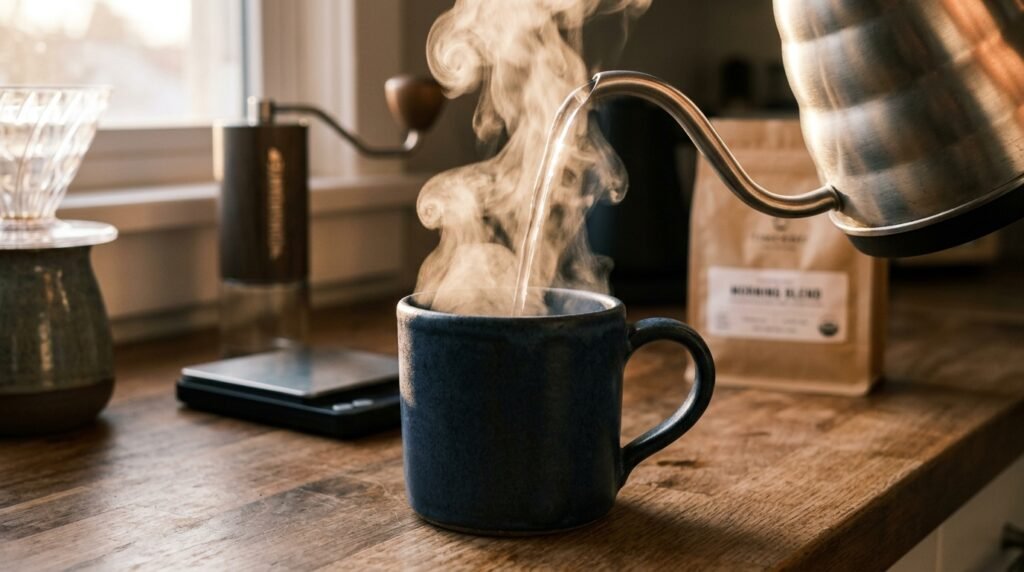
Before I brew my coffee, I pour an ounce of hot water from my kettle directly into my empty ceramic mug. I let it sit there for thirty seconds while I weigh and grind my beans. This acts as a massive thermal pre-heater.
When I dump the waste water and brew my actual coffee, the liquid falls into a steaming hot environment. The ceramic is already fully charged with heat, so it doesn’t steal any energy from my beverage. The coffee stays piping hot for twenty minutes.
The Masterpiece in the Details
When we want to improve a hobby, our consumer brains are constantly looking for a magical, expensive silver bullet. We convince ourselves that our coffee tastes bad simply because we haven’t spent enough money yet.
But reflecting on (What Drinking Better Coffee Taught Me About Flavor), I can confidently say that culinary excellence is almost never about your budget. It is always about your attention to detail.
You do not need a three-thousand-dollar espresso machine to drink a world-class cup of coffee. You just need to stop burning the eggs.
I challenge you to audit your morning routine tomorrow. Stop using heavily chlorinated tap water. Let your boiling water rest for sixty seconds before you pour. Give the coffee a forty-five-second bloom to release its gas. Lower your kettle to reduce the violent agitation, and pre-heat your ceramic mug.
These five simple changes cost absolutely nothing. They require no new equipment and add less than two minutes to your morning routine. But when you finally implement them, the harsh, bitter, muddy flavor will vanish entirely. You will be left with a flawless, vibrant, incredibly sweet masterpiece, crafted from the exact same simple ingredients you have had all along.

My name is Daniel Carter, I am 35 years old, and I live in the United States. I have been passionate about aquariums for many years, and what started as a simple hobby quickly became a lifelong interest in aquatic life, fish behavior, and responsible tank care.
Through TheBrightLance, I share real experiences, practical knowledge, and honest lessons learned from maintaining different types of aquariums. I enjoy testing equipment, studying fish behavior, improving maintenance routines, and helping beginners avoid common mistakes.
My goal is to make aquarism easier, more ethical, and more enjoyable for everyone — whether you are setting up your very first tank or looking to refine your techniques.