
I remember the very first time I installed a professional, industry-standard image editing software on my computer.
I had spent years using simple, one-click filter apps on my phone. You took a picture, swiped left to apply a vintage color grade, and posted it. It required absolutely zero brain power.
But when I opened that professional desktop software for the first time, my heart instantly sank. The screen was an intimidating, chaotic cockpit of confusing tools. There were dozens of floating panels, complex layer masks, blending modes, healing brushes, and confusing histogram graphs.
I almost closed the program immediately. It felt entirely too complicated. I just wanted to make a photo look good; I didn’t want to learn a new programming language.
A few years later, I experienced that exact same overwhelming sensation of panic and confusion in my own kitchen.
I had decided to upgrade my morning routine. I threw away my cheap automatic drip machine and bought a manual pour-over setup. But when I lined all the new equipment up on my kitchen counter, the romantic illusion of specialty coffee completely vanished.
It looked like a chemistry laboratory. It felt incredibly intimidating.
Here is the honest, deeply relatable story of why pour-over coffee felt so incredibly complicated at first, the overwhelming variables that almost made me quit, and how pushing through the steep learning curve eventually unlocked the greatest cups of coffee I have ever tasted.
The Comfort of the “One-Click” Filter
To understand my initial frustration, you have to understand where I was coming from.
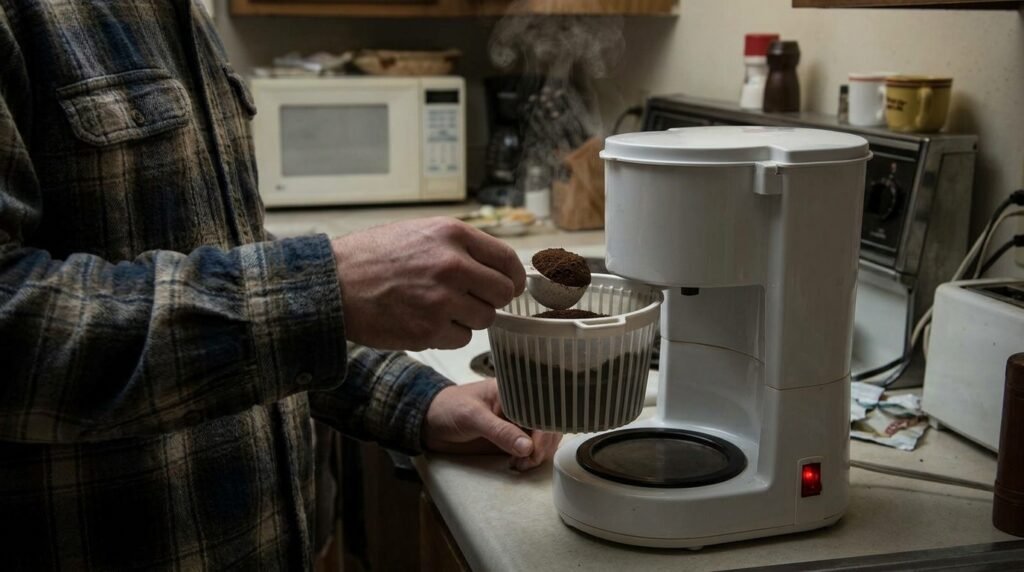
For the vast majority of my adult life, making coffee was a thoughtless, automated chore. I would buy a bag of pre-ground coffee, scoop a random amount into a plastic basket, fill a reservoir with cold tap water, and press a blinking plastic button.
It was the culinary equivalent of an Instagram filter. I pushed the button, and the machine did whatever it wanted. The resulting liquid was usually dark, harsh, and heavily bitter, but it was caffeinated, and it required zero effort.
When I finally decided I wanted to taste the delicate fruit and floral notes I kept reading about on specialty coffee bags, I was told that manual pour-over was the only way to go.
So, I ordered the gear.
When the boxes arrived, I unpacked a glass Hario V60 cone, a box of specialized paper filters, a heavy stainless steel gooseneck kettle with a bizarre, curved spout, and a digital kitchen scale that measured in precise tenths of a gram.
I set them all on the counter and stared at them. I felt completely ridiculous. I was just trying to wake up and drink a beverage. Why did I need a precision digital scale? Why did my kettle look like a strange metal swan?
The First Attempt at Piloting the Ship
My very first attempt at brewing a pour-over was a highly stressful, chaotic blur.
I had watched a professional barista do it online, and they made it look like a graceful, effortless dance. They poured the water in smooth, hypnotic circles.
But when I tried to replicate it, the reality was violently different. I quickly realized that manual brewing is completely unforgiving, a harsh truth that is the absolute core of (Why My First V60 Coffee Was a Disaster). If you make a mistake, the brewer does not hide it; it amplifies it.
I placed the glass cone on my mug and put the whole thing on the digital scale. I added the ground coffee. I boiled the water.
Then, the true panic set in.
I realized I had to manage five different things at the exact same time.
I had to hold the heavy kettle at the perfect angle. I had to watch the red digital numbers on the scale to make sure I was hitting my target water weight. I had to simultaneously watch the timer on my phone to make sure I wasn’t pouring too fast. I had to monitor the coffee bed to ensure it wasn’t overflowing. And I had to try and move my wrist in smooth, concentric circles.
My hand was physically shaking.
I poured the water way too aggressively. The water splashed against the side of the paper filter. I blew past my target weight on the scale. The timer kept ticking. The coffee bed turned into a muddy, chaotic swamp.
When I tasted the final cup, it was a mess. It was incredibly sour on the front end, but it left a dry, harsh, bitter finish in my throat. I felt completely defeated by a piece of glass and a paper filter.
The Overload of Variables
The reason pour-over coffee feels so complicated at first is that you are suddenly forced to take manual control of every single variable that the automatic machine used to handle in the background.
You are no longer just pushing a button. You have to manually adjust all the complex “sliders” of the extraction process.
The first overwhelming slider was The Ratio.
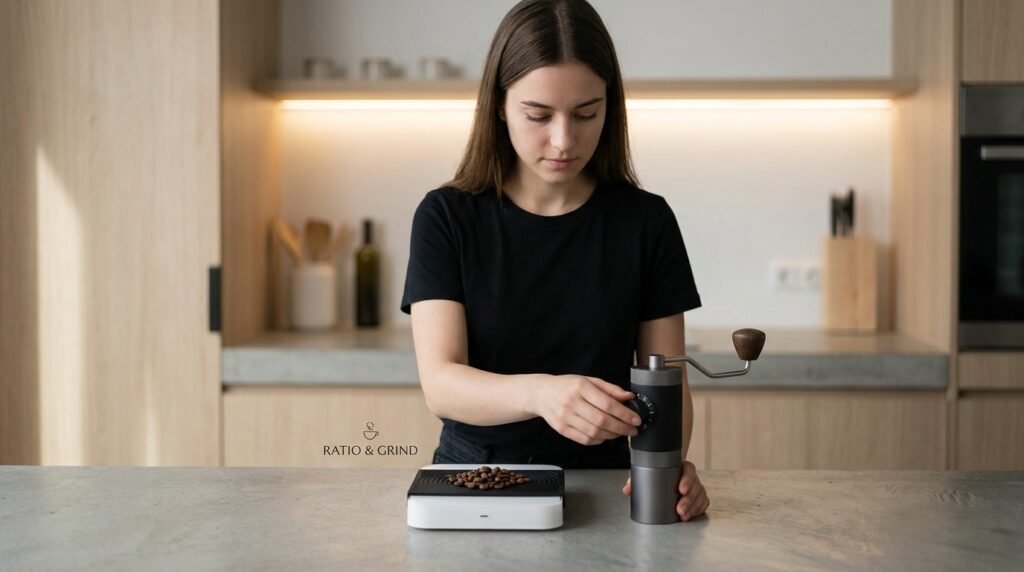
I had to learn coffee mathematics. I couldn’t just use a soup spoon anymore. I had to calculate exactly how many grams of water I needed for every gram of coffee. I had to memorize the 1:16 ratio and execute it perfectly on a digital scale before the water got cold.
The second overwhelming slider was The Temperature.
I learned that boiling water burns the beans, and cool water makes the coffee sour. I had to stand by the stove, wait for the kettle to boil, take it off the heat, and stare at a clock for exactly forty-five seconds to let the kinetic energy drop into the perfect 200°F sweet spot.
The third, and most frustrating slider, was The Grind Size.
This was the variable that almost made me throw my brewer in the trash. I didn’t understand that the physical size of the coffee particle dictated the speed of the water. Learning how to manipulate this specific physical parameter is exactly (How Grind Size Affected My Coffee More Than I Expected), because a change as tiny as a grain of sand can completely ruin the extraction.
If I ground it too coarse, the water rushed through in sixty seconds. If I ground it too fine, the water choked and stalled for five minutes. I was constantly tweaking the dial on my grinder, feeling like I was trying to crack a bank vault combination.
The Physical Agony of the Pour
Even if you get the math, the temperature, and the grind size perfectly aligned, the pour-over method introduces a purely physical challenge.
Agitation is a massive factor in coffee brewing.
When a professional barista uses a gooseneck kettle, they are deliberately controlling the physical agitation of the coffee bed. They pour in a gentle, slow, pencil-thin stream to ensure the coffee grounds are evenly saturated without being violently churned up.
My early pouring technique was an absolute disaster.
The kettle felt heavy and awkward in my hand. I couldn’t maintain a steady stream. I would pour too fast, creating a massive crater in the center of the coffee bed. This caused “channeling,” where the water violently rushes through a single hole, over-extracting the center and completely ignoring the dry coffee on the edges of the filter.
Then, in a panic, I would stop pouring entirely. The water level would drop, the coffee bed would dry out, and the temperature of the slurry would plummet, ruining the extraction.
It felt like I was trying to pat my head and rub my stomach at the same time while doing algebra.
The Turning Point: Muscle Memory
For the first two weeks, making a pour-over every morning felt like a highly stressful chore. It took me ten minutes. I was constantly staring at instruction guides on my phone.
But then, something magical happened.
Just like learning that intimidating photo editing software, the interface suddenly started to make sense.
I didn’t have to look up the ratio on my phone anymore; my brain just knew that 15 grams of coffee meant 240 grams of water. I didn’t have to stress about the grind size; I could just look at the texture of the grounds and instinctively know if they were right.
The physical act of holding the gooseneck kettle stopped feeling awkward. My wrist developed the necessary muscle memory.
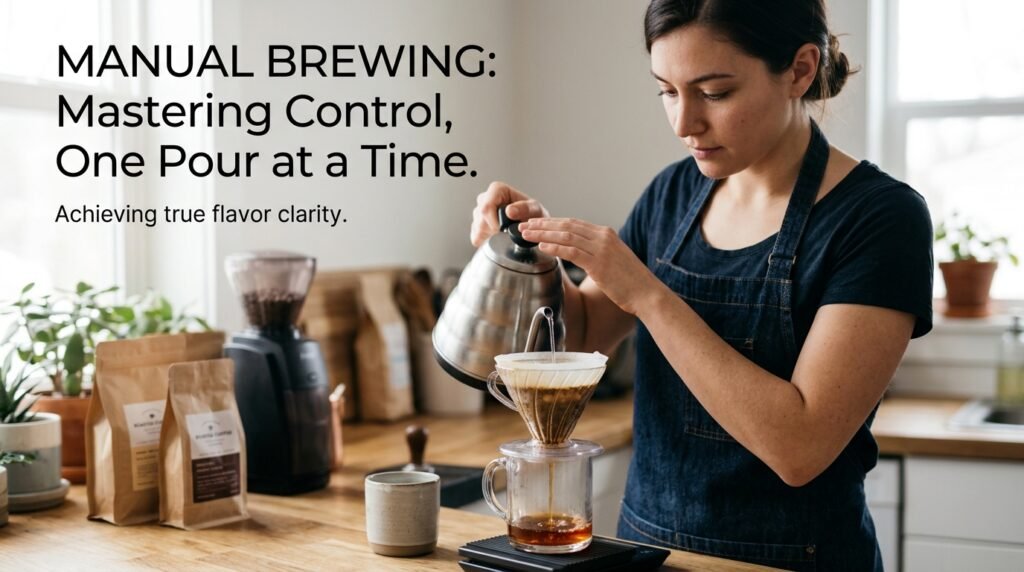
I learned how to gently wet the grounds and watch them “bloom.” I learned how to pour in slow, steady, hypnotic circles, keeping the water level perfectly consistent. I learned how to watch the flow rate and adjust the angle of my spout without even thinking about it.
The panic completely vanished. The chaotic, multi-tasking nightmare transformed into a smooth, rhythmic, subconscious dance.
The Reward of the Steep Learning Curve
When the process finally clicked, the liquid in my mug completely transformed.
The harsh bitterness and the aggressive sourness disappeared entirely. Because I was finally controlling the extraction perfectly, the true flavor of the roasted beans was allowed to shine through with absolute, breathtaking clarity.
I was brewing Ethiopian coffees that tasted vividly like sweet peaches and jasmine flowers. I was brewing Colombian coffees that tasted like heavy milk chocolate and toasted almonds.
The coffee wasn’t just “good.” It was spectacular.
I realized that the massive complexity of the pour-over method wasn’t designed to be difficult just for the sake of being difficult. The complexity is actually just a byproduct of absolute, uncompromised control.
When you remove all the automated training wheels, you are left with raw physics and chemistry.
Grasping this level of profound control is the ultimate reason (Why I Prefer Manual Brewing Over Machines). An automatic machine will never be able to look at a coffee bed and adjust the water flow in real-time. Only a human hand can do that.
The Morning Meditation
Today, the very thing that used to cause me so much anxiety is the absolute highlight of my entire day.
The pour-over routine is no longer a complicated, stressful chore. It is my mandatory morning meditation.
I look forward to the ritual of placing the glass cone on the scale. I love the mechanical, analog sound of the burr grinder crushing the beans. I love standing quietly at my kitchen counter, pouring the hot water in slow circles, and watching the coffee bloom.
It takes exactly three minutes of my undivided attention. It forces me to put my phone down. It forces me to be entirely present in the moment before the chaos and emails of the workday begin.
Push Past the Interface
If you are just starting your specialty coffee journey, and you are staring at a V60 cone and a gooseneck kettle feeling completely overwhelmed, I understand exactly how you feel.
It feels like you are looking at a dashboard with too many buttons. It feels like you are going to ruin your expensive beans.
Do not give up. Do not pack the gear back in the box and plug your automatic drip machine back into the wall.
Embrace the steep learning curve. Accept that your first five cups of coffee are probably going to taste terrible. Allow yourself to make a mess.
Keep using the scale. Keep adjusting the grinder. Keep practicing the pouring motion with the kettle.
Eventually, the complex software interface will disappear. The numbers and the timers will fade into the background. Your hands will take over, and you will find yourself completely immersed in the beautiful, analog art of extraction.
When you finally take a sip of that impossibly clean, intensely sweet, perfectly balanced cup of coffee that you engineered with your own two hands, you will realize that the initial frustration was worth every single second. The complexity is just the price of admission to an entirely new world of flavor.

My name is Daniel Carter, I am 35 years old, and I live in the United States. I have been passionate about aquariums for many years, and what started as a simple hobby quickly became a lifelong interest in aquatic life, fish behavior, and responsible tank care.
Through TheBrightLance, I share real experiences, practical knowledge, and honest lessons learned from maintaining different types of aquariums. I enjoy testing equipment, studying fish behavior, improving maintenance routines, and helping beginners avoid common mistakes.
My goal is to make aquarism easier, more ethical, and more enjoyable for everyone — whether you are setting up your very first tank or looking to refine your techniques.