
I have always been captivated by the quiet, meditative elegance of a high-end specialty coffee shop.
Before I ever attempted to brew coffee manually in my own kitchen, I used to sit at the counter of my local roastery and just watch the baristas work. Their movements were hypnotic. They would place a beautiful ceramic cone over a glass carafe, carefully pour hot water in slow, hypnotic, concentric circles, and watch the coffee grounds rise and fall like a living thing.
It looked like an ancient, graceful ritual. It looked like art.
Naturally, my ego got the better of me. I watched this delicate process and thought to myself, I can totally do that. It’s just pouring hot water over ground coffee. How hard can it possibly be?
I immediately went online and purchased the exact same brewer the barista was using: the legendary Hario V60. It was just a simple, ten-dollar plastic cone with some paper filters.
When the package arrived at my apartment a few days later, I was thrilled. I felt like I had just unlocked the secret to making café-quality coffee at home. I grabbed a bag of expensive, light-roast specialty beans I had picked up earlier that week, ready to recreate the magic I had seen in the shop.
Fifteen minutes later, I was standing over my kitchen sink, pouring the most vile, offensive, undrinkable liquid I had ever created directly down the drain.
It was a total, unmitigated culinary catastrophe. Here is the highly embarrassing, brutally honest story of why my first V60 coffee was a disaster, the harsh physics lessons I had to learn the hard way, and how this humbling experience forced me to completely rebuild my brewing technique from scratch.
The Illusion of Simplicity
My first massive mistake was underestimating the brewer itself.
The Hario V60 is arguably the most famous pour-over brewer in the world, beloved by coffee champions and home enthusiasts alike. It is named after the 60-degree angle of its cone. The inside of the cone features distinctive, swirling ridges that help the water flow, and at the very bottom, there is a massive, gaping hole.
That massive hole is the defining feature of the V60, and it is the exact reason it destroys beginners.
In a standard automatic drip machine, or a flat-bottomed brewer, the water flow is restricted by the brewer itself. It holds the water back, acting as a set of training wheels to ensure the coffee steeps for a set amount of time.
The V60 has no training wheels. Because the hole at the bottom is so large, the brewer does not restrict the water flow at all.
You have to restrict the water flow. The only things holding the water back are the coffee grounds themselves and the speed at which you pour. If you mess up either of those variables, the water will rush right through, and your coffee is ruined.
I didn’t know any of this. I thought the plastic cone was going to do all the work for me.
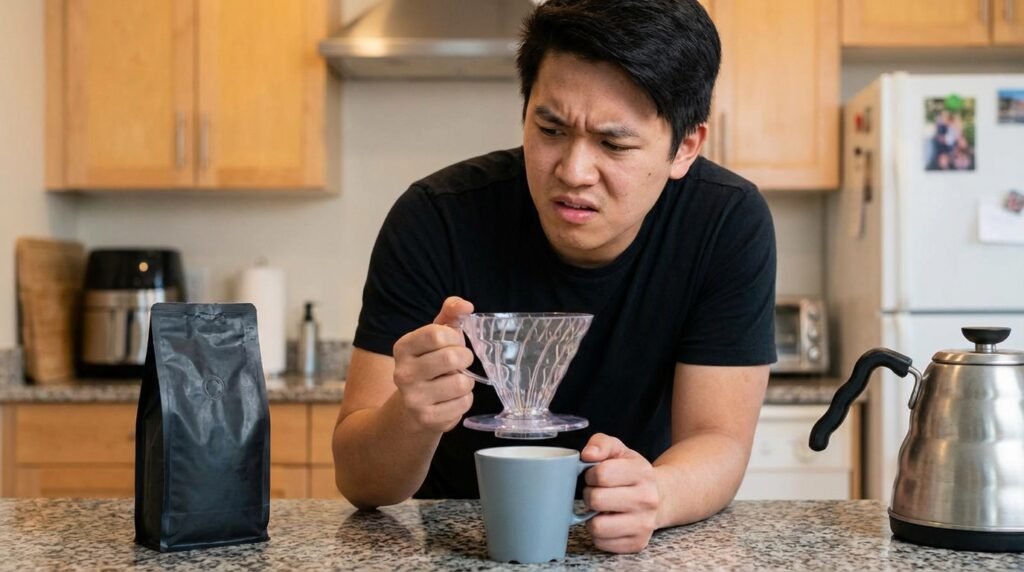
The Crime Scene Preparation
To fully understand my disaster, you have to look at the “tools” I brought to the counter that morning.
I did not own a digital scale. I didn’t think I needed one. I just took a random soup spoon from my cutlery drawer and blindly scooped four or five massive mounds of coffee beans out of the bag.
I did not own a high-quality burr grinder. I owned a cheap, noisy electric blade grinder—the kind that spins a metal blade like a tiny lawnmower to chop the beans into pieces.
And finally, I did not own a precision gooseneck kettle. I just had a massive, heavy, stainless steel whistling tea kettle that I used to boil water for pasta.
I was bringing a sledgehammer to a delicate surgical procedure.
Realizing that precision is mandatory, not optional, was the core lesson of (The Simple Brewing Mistakes I Used to Make Every Day), because my arrogance had ruined a perfectly good bag of premium beans before the water even touched them.
The Execution of the Disaster
I threw my unweighed coffee beans into the blade grinder and held the button down for about twenty seconds until it sounded like sand. I dumped the chaotic mixture into the paper filter sitting inside my V60.
Then, the water boiled.
I grabbed my massive, heavy whistling tea kettle and tilted it over the plastic cone.
I tried to pour slowly, like the barista did. But a standard tea kettle has a wide, blunt spout. The water didn’t pour in a delicate, elegant stream; it violently rushed out in a heavy, turbulent waterfall.
The aggressive wave of boiling water smashed into the dry coffee grounds, completely blowing a massive crater into the center of the coffee bed.
I panicked. I tried to move the kettle around to fix the crater, but the water was coming out way too fast. Within ten seconds, I had flooded the entire plastic cone all the way to the absolute brim.
I stopped pouring and watched in horror.
Because the blade grinder had created massive, chunky boulders of coffee alongside microscopic dust, the water flow was completely broken. The water found the path of least resistance, rushing violently through the large chunks, while the fine dust sank to the bottom and completely clogged the paper filter.
It took almost five agonizing minutes for the water to finally choke its way through the muddy, sludgy mess.
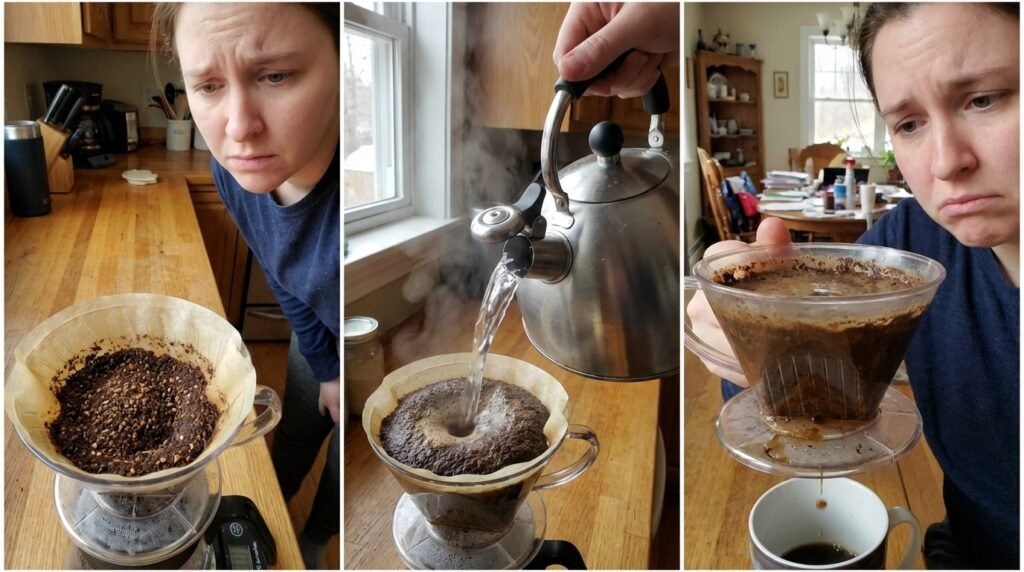
The Sip of Absolute Regret
When the dripping finally stopped, I looked at the liquid in the glass carafe. It didn’t look like the glowing, ruby-red, translucent tea I had seen in the café. It looked like muddy, dark swamp water.
But I was stubborn. I poured it into a mug, let it cool for a second, and took a sip.
My face instantly contorted. My palate was assaulted by a paradox of terrible flavors.
The coffee was unbelievably, aggressively sour—like biting into a raw, unripe lemon. It made the sides of my jaw physically ache. But immediately underneath that sourness was an intense, harsh, drying bitterness that tasted like burnt aspirin and dry wood.
It was sour and bitter at the exact same time. It was the worst beverage I had ever tasted in my life. I poured the entire mug down the kitchen sink, thoroughly defeated by a ten-dollar piece of plastic.
Diagnosis 1: The Blade Grinder and Channeling
I refused to let the V60 beat me. I opened my laptop and started heavily researching pour-over brewing physics to figure out what had gone so horribly wrong.
My first major discovery was the absolute failure of my blade grinder.
When you use a blade grinder, you do not get an even grind. You get massive, rock-sized chunks of coffee, and you get super-fine, powdery dust.
When hot water hits that mixture, it acts like a river flowing down a mountain. The water is lazy; it always takes the easiest path. It violently rushes past the massive boulders of coffee without extracting any flavor, which creates an intensely sour, weak, under-extracted taste.
This phenomenon is called “Channeling.”
Meanwhile, all of that microscopic coffee dust sinks to the very bottom of the V60 and gets trapped against the paper filter. The water gets stuck there, over-extracting the dust and pulling out harsh, dry, bitter tannins.
Understanding the physics of this water flow is precisely (How Grind Size Affected My Coffee More Than I Expected), as those microscopic dust particles act like cement, completely destroying the flow rate of the brewer.
The V60 demands absolute grind uniformity. It needs every single particle of coffee to be the exact same size, which is only possible with a high-quality burr grinder.
Diagnosis 2: The Agitation of the Kettle
My second fatal error was the weapon of mass destruction I used to pour the water.
The V60 is incredibly sensitive to agitation. If you pour water too aggressively, you churn up the coffee bed, lifting the bitter compounds and destroying the filter’s efficiency.
By using a heavy whistling tea kettle, I had essentially dropped a waterfall onto a delicate bed of sand. The sheer force of the water had blasted a hole right through the center of the grounds, causing severe channeling.
To brew a successful V60, you absolutely must use a Gooseneck kettle.
A gooseneck kettle has a long, thin, curved spout that restricts the flow of water. It allows you to pour a gentle, precise, vertical stream of water exactly where you want it. You can gently wet the grounds without aggressively churning them up.
I realized that the barista’s graceful, concentric circles weren’t just for show. They were a necessary, calculated physical movement designed to evenly extract the coffee without disturbing the bed.
Diagnosis 3: The Missing Mathematics
My final, and perhaps most embarrassing, mistake was scooping the beans with a soup spoon.
Coffee brewing is chemistry. It requires a precise ratio of coffee mass to water mass. If you use too much water, the coffee is weak and over-extracted. If you use too much coffee, it is heavy and sour.
Measuring by volume instead of mass is a fundamental error, and fixing this was exactly (The Day I Finally Got My Coffee Ratio Right), because coffee beans have wildly different densities depending on their origin and roast level.
A dark roast bean is puffy and light. A light roast Ethiopian bean is tiny and dense. One scoop of dark roast will weigh significantly less than one scoop of a light roast. You simply cannot trust your eyes or a spoon.
You must use a digital scale. You have to weigh the coffee in grams, and you have to place the entire V60 brewer on the scale so you can weigh the exact amount of water you are pouring in real-time.
Rebuilding the Arsenal
That disastrous Monday morning completely humbled me. It proved that specialty coffee is not magic, but it does require respect, physics, and the proper tools.
I couldn’t fake it anymore. If I wanted to drink café-quality coffee at home, I had to invest in the ecosystem.
I threw my blade grinder in the trash and purchased a high-quality steel burr hand grinder. I bought a relatively cheap, battery-powered digital kitchen scale that measured in precise, single-gram increments. And finally, I ordered a stainless steel gooseneck kettle.
When the new equipment arrived, I felt like a scientist walking into a freshly sterilized laboratory. I was ready for redemption.
The Redemption Brew
I set the V60 on my glass carafe, placed it all on the digital scale, and hit the “tare” button to zero it out.
I weighed exactly 15 grams of my Ethiopian beans. I ran them through my new burr grinder. The grounds came out looking beautifully uniform, like perfectly even sea salt. No boulders. No dust.
I poured the grounds into the rinsed paper filter. I grabbed my new gooseneck kettle.
This time, I was in absolute control. I gently poured 45 grams of water in a tight circle, saturating the grounds perfectly without blasting a crater into them. I watched the coffee bubble and “bloom,” releasing its trapped carbon dioxide.
After thirty seconds, I slowly, gently poured the rest of the water in slow, mesmerizing, concentric circles, watching the scale tick up until it hit exactly 250 grams.
The water flowed through the uniform coffee bed smoothly and evenly. It didn’t choke. It didn’t flood.
When the dripping stopped, the coffee bed was perfectly flat, looking like a wet sandbox.
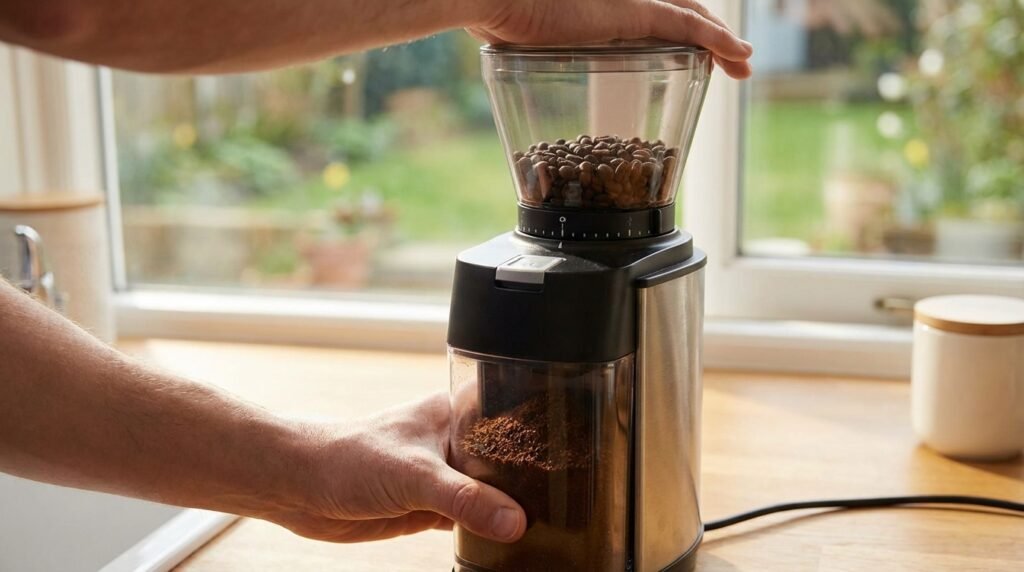
The Reward of Precision
I poured the hot, ruby-red liquid into my favorite mug. The aroma filling my kitchen was breathtaking. It smelled like jasmine flowers and sweet lemon zest.
I let it cool. I took a sip.
It was an absolute masterpiece.
There was no sourness. There was no harsh, drying bitterness. The liquid was silky, elegant, and perfectly balanced. The bright, juicy peach notes of the Ethiopian coffee sang on my palate with absolute clarity. It tasted exactly like the coffee I had bought at the specialty café weeks ago.
I sat at my kitchen table, nursing that perfect mug of coffee, feeling an overwhelming sense of pride.
A Tool That Demands Respect
The V60 is not a beginner’s brewer. It is an unforgiving, hyper-sensitive, precision instrument. If you disrespect it by using bad equipment or careless technique, it will violently punish your palate with a disastrous cup of coffee.
But that is exactly why I love it so much.
The V60 does not hide your mistakes. It forces you to be better. It forces you to pay attention to your grind size, your water temperature, and the speed of your pour. It demands your absolute focus.
If your first experience with a pour-over cone was a muddy, sour, bitter disaster, do not blame the brewer. Blame your tools, and blame your technique.
Invest in a decent burr grinder. Buy a cheap digital scale. Get a gooseneck kettle.
When you finally put those pieces together and execute a technically flawless brew, the V60 will reward you with a level of flavor clarity, sweetness, and complexity that a standard drip machine could never dream of achieving. The disaster is just a necessary rite of passage; the redemption in the cup is worth every single drop of effort.

My name is Daniel Carter, I am 35 years old, and I live in the United States. I have been passionate about aquariums for many years, and what started as a simple hobby quickly became a lifelong interest in aquatic life, fish behavior, and responsible tank care.
Through TheBrightLance, I share real experiences, practical knowledge, and honest lessons learned from maintaining different types of aquariums. I enjoy testing equipment, studying fish behavior, improving maintenance routines, and helping beginners avoid common mistakes.
My goal is to make aquarism easier, more ethical, and more enjoyable for everyone — whether you are setting up your very first tank or looking to refine your techniques.