
If you stop and analyze the first ten minutes of an average adult’s morning, you will likely witness a quiet, invisible robbery.
Most of us use our smartphones as our alarm clocks. When that alarm rings at six or seven in the morning, we reach out in the dark, turn off the noise, and while the screen is still glowing in our hands, we make a fatal mistake. We open our notifications.
Before we have even brushed our teeth, washed our faces, or spoken a single word out loud, we are instantly bombarded by the demands of the outside world. We see urgent emails from frustrated coworkers. We see stressful news headlines about global economies. We see perfectly curated social media feeds that make us feel like we are already falling behind.
In that exact moment, you have successfully surrendered the ownership of your morning. You are no longer living your life; you are simply reacting to everyone else’s emergencies.
For a very long time, I was a victim of this daily robbery. My mornings were frantic, anxiety-inducing, and entirely devoid of joy.
But a few years ago, I discovered a physical, analog escape route. I found a way to build an impenetrable wall around the first fifteen minutes of my day, effectively locking the chaotic world out of my kitchen.
Here is the honest, deeply personal story of how coffee became my favorite daily moment, how the slow, deliberate process of manual brewing cured my morning anxiety, and why reclaiming your time is the most important thing you can do for your mental health.
The Era of the Utilitarian Sludge
To truly understand why this daily moment is so precious to me now, you have to understand how bleak my mornings used to be.
During the most stressful years of my career, I did not view coffee as an experience. I viewed it as a harsh, biological necessity. I was constantly exhausted, running on adrenaline, and desperate for anything that would force my eyes to stay open.
My kitchen was equipped with a cheap, plastic automatic drip coffee maker. I bought massive, vacuum-sealed bricks of dark roast coffee from the bottom shelf of the supermarket. I had no idea when it was roasted, where it came from, or what it was supposed to taste like.
I would stumble into the kitchen, dump a vague amount of that stale brown powder into a paper filter, press a plastic button, and immediately go back to staring at my phone.
The machine would violently sputter and hiss, eventually producing a pot of boiling, black sludge. It tasted like bitter, metallic ash. I would pour it into an insulated travel mug, dump sugar into it to mask the terrible flavor, and drink it as fast as possible while sitting in traffic.
I was essentially treating my body like a cheap machine, pouring low-grade fuel into the gas tank just to keep the engine running.

The Accidental Culinary Awakening
My perspective completely shattered the day I walked into an independent, local specialty coffee roastery.
I was out of town, away from my cheap plastic machine, and I just needed a quick dose of caffeine. I ordered a simple black pour-over. I expected the barista to hand me the usual bitter, dark liquid.
Instead, she handed me a heavy ceramic mug filled with a translucent, ruby-red beverage. I took a sip, and my brain completely stalled.
There was no harsh bite. There was no ashy aftertaste. It tasted incredibly bright, resembling sweet peaches, caramelized honey, and jasmine flowers. It was complex, vibrant, and undeniably delicious without a single drop of milk or sugar.
Realizing that this simple agricultural seed possessed such an incredible, natural flavor profile was the exact catalyst for (The Coffee That Changed My Morning Routine Completely). I couldn’t stop thinking about it. I realized that I had been drinking burnt carbon my entire life, completely missing the actual culinary masterpiece hidden inside the bean.
The Introduction of the Analog Anchor
I left that cafe determined to replicate that flawless cup of coffee in my own apartment.
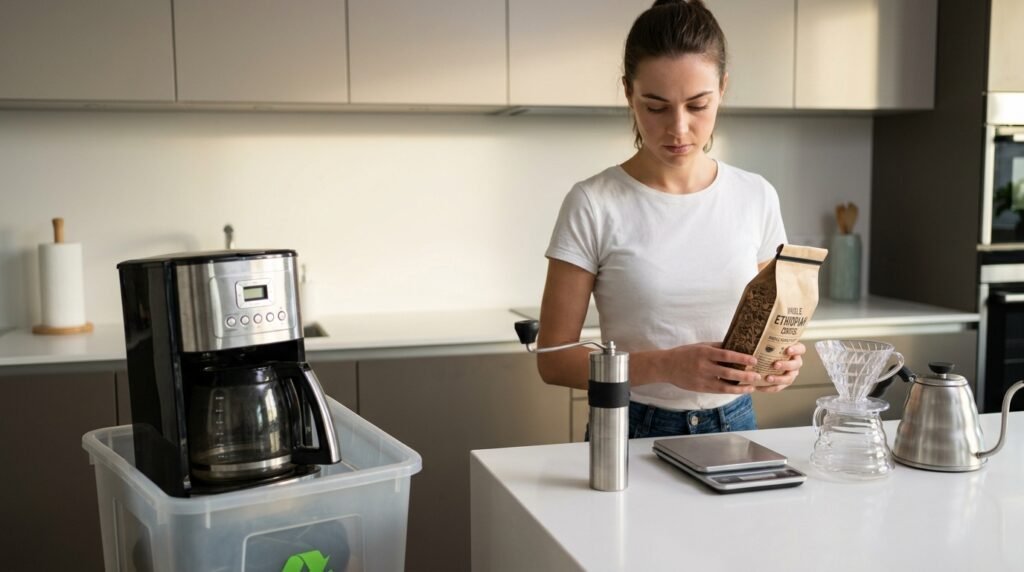
I threw my automatic drip machine into the recycling bin. I went to a specialty store and bought a manual stainless steel burr grinder, a digital kitchen scale, a glass V60 pour-over cone, and a gooseneck kettle.
I bought a bag of single-origin Ethiopian whole beans, brought the equipment home, and set it up on my kitchen counter.
The very next morning, my entire life changed.
When my alarm went off, I reached for my phone, but I forced myself not to look at the notifications. I walked into the kitchen and stood in front of my new equipment.
I quickly realized that I could no longer just press a button and walk away. Manual coffee brewing is not a passive activity. It is a highly specific, scientific process that demands absolute, undivided physical attention.
The Mandatory Fifteen Minutes
I placed the glass cone on the digital scale. I carefully weighed exactly 15 grams of the light-roast beans. I poured them into the top chamber of the hand grinder and began to turn the heavy metal crank.
The physical resistance of the dense seeds breaking apart against the steel burrs provided an incredibly satisfying, tactile feedback. The mechanical crunching sound filled the quiet kitchen. Within seconds, the intense, sweet aromatics of the freshly ground coffee hit the air.
I heated my filtered water in the gooseneck kettle, waiting patiently for the thermometer to read exactly 200 degrees Fahrenheit.
And then, I began to pour.
When the hot water hits the dry coffee grounds, the “bloom” occurs. The coffee bed swells and bubbles as the trapped carbon dioxide gas violently escapes. From that moment on, you are entirely at the mercy of gravity and thermal extraction.
You cannot fast-forward the timer. You have to stand at the kitchen counter, holding the heavy steel kettle, and pour the water in slow, precise, concentric circles for exactly three and a half minutes.
If you lose focus and dump the water in too fast, the coffee will channel, and the drink will taste wildly sour. The physical reality of the process forces you to be present.
Establishing this strict, physical parameter was undeniably (The One Habit That Improved My Coffee Every Day). It forced me to respect the chemistry of the extraction, and in return, it gave me a perfect cup of coffee.
Building the Psychological Shield
But as the weeks went by, I realized that the actual taste of the coffee was only a secondary benefit. The true magic was the boundary line I had drawn around my morning.
For those fifteen minutes, the outside world simply ceases to exist.
I am not an employee, I am not a boss, and I am not a consumer. I am simply a person standing in a quiet kitchen, executing a deliberate, ancient process. I listen to the gentle trickle of the water. I smell the caramelized sugars. I watch the steam rise in the dim morning light.
I refuse to look at my phone until the entire process is complete.
This simple act of analog defiance creates an impenetrable psychological shield around my brain. By the time I finally pour the finished, steaming liquid into my pre-warmed ceramic mug, I am completely calm. I am centered.
I have already accomplished a highly complex, deliberate task before the sun has even fully risen. I have secured a quiet victory.

The Art of Sitting Still
The final piece of the ritual happens when the brewing is finished.
I do not take my coffee back to my desk to start working. I carry my mug to a comfortable chair in my living room, and I sit down. I do not turn on the television, and I do not open a book.
For ten minutes, I just sit and drink the coffee.
In a modern society that constantly demands our attention and makes us feel incredibly guilty for not being highly productive every single second of the day, sitting and doing nothing feels like a radical act of rebellion.
But I am not doing nothing. I am experiencing the culmination of a massive global effort.
I am tasting the volcanic soil of a high-altitude farm in South America. I am tasting the bright, crisp acidity of the African highlands. I am actively participating in a quiet, human tradition that spans thousands of miles and centuries of history.
Understanding the sheer mental health value of this quiet morning anchor is the ultimate reason (Why Coffee Means More Than Just Caffeine to Me). The caffeine spike is merely a bonus. The true medicine is the deliberate slowness of the routine itself.
Reclaiming Your Own Morning
We are constantly told that the secret to a successful life is to optimize everything. We are told to automate our tasks, speed up our workflows, and eliminate any friction in our day so we can get more work done.
But when you eliminate all the friction, you also eliminate all the texture. Life becomes a smooth, featureless, stressful blur.
If your mornings currently feel like a frantic, anxiety-inducing sprint—if you are waking up with dread and immediately surrendering your attention to the glowing screen of your smartphone—I highly encourage you to steal your time back.
You do not have to become an obsessive coffee snob to change your mornings.
You just need to introduce a tiny bit of deliberate friction. Buy a bag of whole beans from a local roaster instead of the supermarket. Buy an inexpensive manual grinder. Wake up just fifteen minutes earlier tomorrow morning.
Leave your phone in the bedroom. Stand in the quiet kitchen. Feel the weight of the equipment in your hands. Smell the dry grounds. Watch the water interact with the coffee bed.
Do not treat the preparation as a frustrating delay to your day. Treat it as the very first accomplishment of your day. When you finally stop rushing through the motions and allow yourself to simply exist in the analog reality of your kitchen, you will quickly discover that this simple, dark liquid has the power to become the absolute best moment of your entire day.

My name is Daniel Carter, I am 35 years old, and I live in the United States. I have been passionate about aquariums for many years, and what started as a simple hobby quickly became a lifelong interest in aquatic life, fish behavior, and responsible tank care.
Through TheBrightLance, I share real experiences, practical knowledge, and honest lessons learned from maintaining different types of aquariums. I enjoy testing equipment, studying fish behavior, improving maintenance routines, and helping beginners avoid common mistakes.
My goal is to make aquarism easier, more ethical, and more enjoyable for everyone — whether you are setting up your very first tank or looking to refine your techniques.