
If you rely entirely on a digital GPS application on your smartphone to navigate your own city, you are likely experiencing a very modern illusion of competence.
You get into your car, type in the destination, and blindly follow the blue line on the screen. You turn left when the voice tells you to turn left. You take the highway exit when the voice tells you to take the exit. You eventually arrive at your destination, and you feel like you successfully navigated the journey.
But imagine what happens if the GPS suddenly loses its signal, or if there is unexpected road construction blocking your primary route.
Because you were just blindly following instructions, you have absolutely no idea where you actually are. You do not know how the streets connect to each other. You do not know which neighborhoods run parallel to the highway. The moment the digital instructions fail, you are completely lost, frustrated, and paralyzed in the middle of traffic.
For the first several years of my specialty coffee journey, I was driving blindly with the GPS turned on.
I was following generic instructions I found online. I was measuring out “two scoops” of coffee. I was boiling the water and pouring it over the grounds. Sometimes the coffee tasted decent, and I felt like a master barista.
But when the coffee tasted violently bitter, incredibly sour, or just completely flat, I was totally lost. I had no idea how to fix it because I didn’t actually understand how the brewing process worked. I didn’t know the streets.
Eventually, I decided to turn the GPS off and actually learn the map.
Here is the honest, highly detailed story of what I do differently now when making coffee, the invisible variables I finally learned to control, and how understanding the underlying chemistry completely transformed my morning routine from a chaotic guessing game into a flawless, predictable masterpiece.
I Stopped Treating All Beans the Same
The first major shift in my routine happened before the water ever touched the coffee. I had to completely change how I viewed the raw ingredient.
In my early days, I treated coffee like a generic, uniform utility. I thought a brown bean was just a brown bean. I would use the exact same brewing recipe, the exact same grind size, and the exact same water temperature regardless of what I was actually brewing.
I was completely ignoring the incredible agricultural diversity of the seed.
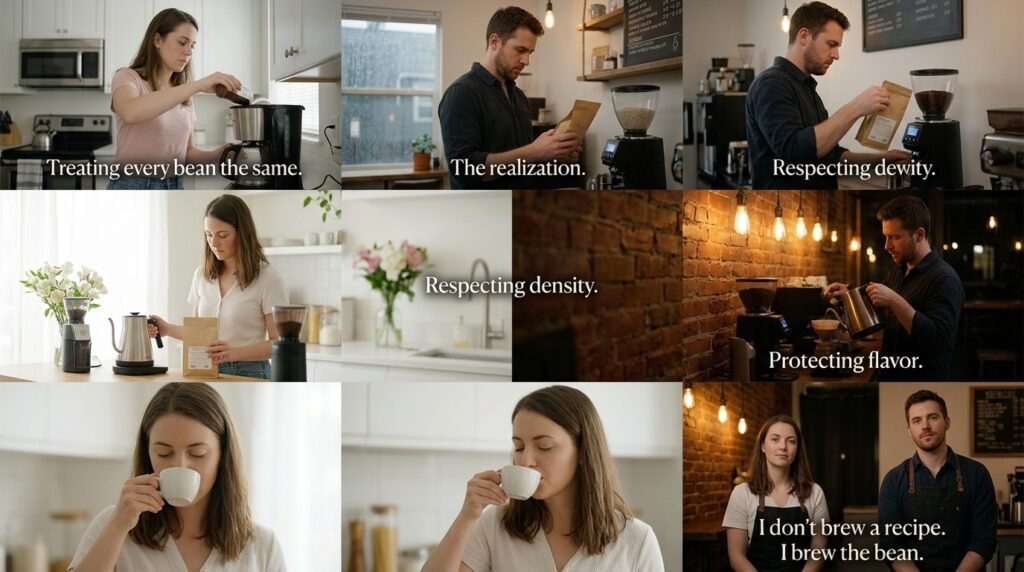
Now, the very first thing I do is analyze the specific terrain of the coffee I am about to brew. I understand that the bright, wildly floral notes of an Ethiopian Yirgacheffe require a completely different approach than the deep, heavy, chocolatey body of a Colombian Supremo, or the crisp, complex spice of a high-altitude Guatemalan roast.
If I am brewing a dense, lightly roasted Ethiopian coffee, I know the beans are incredibly hard. The water is going to struggle to extract those delicate fruit notes. So, I will use slightly hotter water and a slightly finer grind to aggressively pull that flavor out.
But if I am brewing a rich, slightly darker Colombian coffee, the cellular structure of the bean has already been broken down by the roaster. If I use that same aggressive recipe, the coffee will become violently bitter. So, I lower the water temperature and coarsen the grind to protect the sweet chocolate notes.
Understanding how to respect the unique origin of the seed was the profound realization of (The First Time I Understood Coffee Terroir). I no longer brew a generic recipe; I brew the specific bean.
I Stopped Guessing the Fuel
The second massive change I made was completely eliminating volume measurements from my kitchen.
When you are following the generic “GPS instructions” of coffee brewing, the bag almost always tells you to use “two rounded tablespoons for every six ounces of water.” This is the most destructive, inaccurate piece of culinary advice on the planet.
Measuring coffee by volume is an absolute disaster because different coffees have vastly different densities. Two tablespoons of a puffy, dark roast will weigh significantly less than two tablespoons of a dense, light roast.
I was throwing my extraction ratio completely out of balance every single morning without even realizing it.
I threw the plastic tablespoons in the trash. The most important thing I do differently now is turning on a digital kitchen scale. I weigh my coffee beans in exact grams, and then I place my entire brewing cone on the scale to weigh the exact amount of water I am pouring.
I lock my recipe into a strict mathematical ratio, usually 1:16 (one gram of coffee for every sixteen grams of water).
Discovering the absolute, unshakable consistency of this math was the exact foundation of (The Day I Finally Got My Coffee Ratio Right). By using a scale, I established a perfect baseline. If the coffee tastes wrong, I know with absolute certainty that the amount of coffee and water is not the problem. The fuel mixture is perfect.
I Started Steering with the Grinder
Once I established a perfect 1:16 ratio, I had to learn how to navigate the actual extraction time.
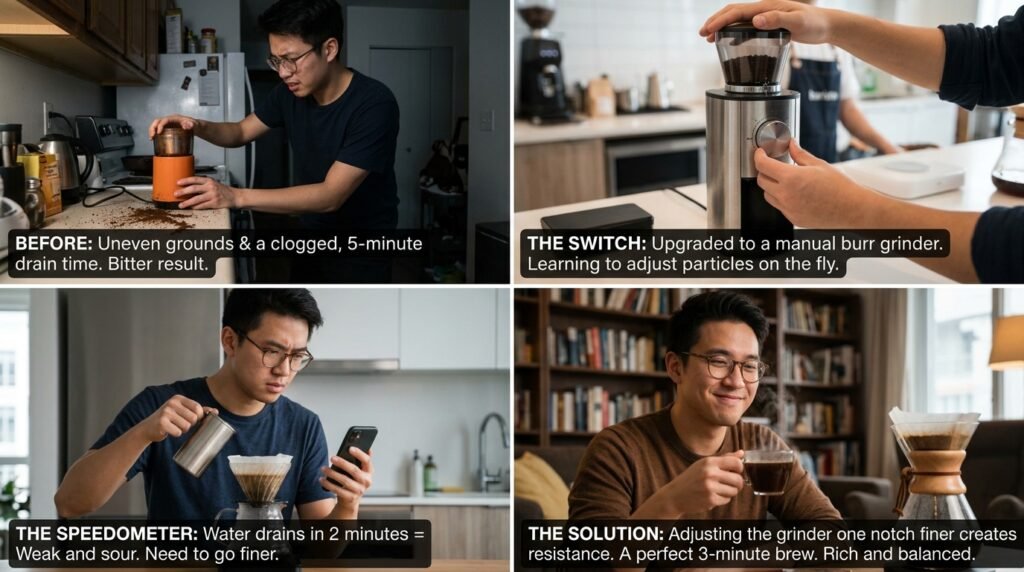
In the past, I used a cheap electric blade grinder. It violently chopped the beans into a chaotic mixture of giant boulders and microscopic dust. When I poured the water, it would just pool up at the top of the filter, clogging the paper, and taking five agonizing minutes to drain. The resulting coffee was incredibly bitter and harsh.
I didn’t understand that the physical size of the coffee grounds is the steering wheel of your entire brew.
I upgraded to a manual burr grinder, which produces perfectly uniform particles. But more importantly, I learned how to adjust those particles on the fly based on what my palate was telling me.
Now, I treat the drawdown time like a speedometer. If I brew a cup of coffee and the water drains through the filter in just two minutes, the resulting beverage will taste weak, thin, and unpleasantly sour. The water moved too fast.
To fix this, I do not add more coffee. I simply turn the dial on my burr grinder one notch finer.
The finer particles pack together more tightly, creating physical resistance. The next morning, the water struggles to pass through the dense coffee bed. The brew time slows down to three minutes, and the coffee becomes rich, sweet, and perfectly balanced.
Learning to read the speed of the water and twist the grinder dial was the ultimate lesson of (How Grind Size Affected My Coffee More Than I Expected). I finally knew how to steer the car.
I Stopped Scorching the Engine
Another massive habit I completely reversed was how I managed my thermal energy.
When you are rushing in the morning, the natural instinct is to turn the stove on high, wait for the stovetop kettle to scream with a violent, rolling boil, and immediately dump that bubbling water directly onto the coffee grounds.
I thought that hotter water meant a faster, more efficient brew.
I was completely oblivious to the fact that I was physically destroying the delicate organic compounds inside the coffee. The complex, sweet sugars and the highly volatile aromatic oils that make specialty coffee taste like fruit and flowers cannot survive boiling water.
When you hit those delicate oils with 212-degree Fahrenheit (100-degree Celsius) water, you commit instant culinary arson. You burn the sweetness away, leaving behind a harsh, carbonized, ashy bite that ruins the entire cup.
What I do differently now requires absolutely zero new equipment. It just requires a tiny fraction of patience.
When my kettle reaches a boil, I take it off the heat element. I set it on the cold counter, and I wait for exactly sixty seconds. This short, one-minute pause allows the water temperature to naturally drop to a gentle, forgiving 200 degrees Fahrenheit.
By simply lowering the heat, I stopped scorching the engine. The natural sweetness of the bean finally survives the extraction process and lands safely in my mug.
I Started Pouring with Intention
The final, and perhaps most meditative, change I made to my routine involves the physical act of pouring the water.
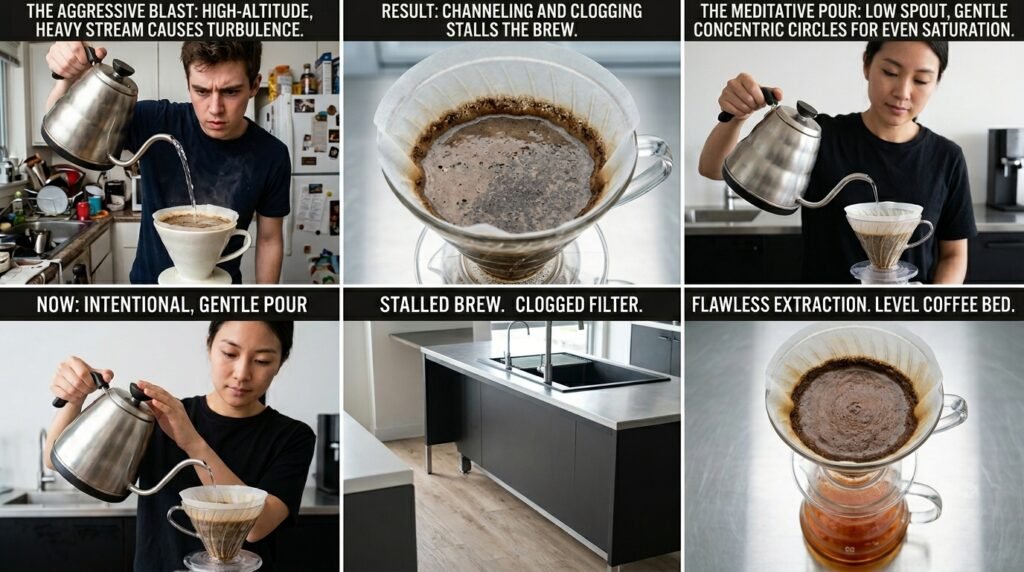
In my early days, I treated the gooseneck kettle like a garden hose. I would hold it high in the air and aggressively blast the coffee bed with a heavy stream of water. I thought I was making sure all the grounds got wet.
I was actually ruining the extraction through sheer physical violence.
When a heavy stream of water crashes into the coffee from a high altitude, it forcefully churns the grounds. It pushes the microscopic fine dust particles to the very bottom of the paper filter, which acts like a layer of wet cement, completely clogging the pores and stalling the brew.
It also causes “channeling,” where the water drills deep holes into the coffee bed, bypassing the majority of the grounds entirely.
Now, I pour with absolute, deliberate intention.
I lower the metal spout of the kettle until it is just an inch above the surface of the coffee slurry. I pour in slow, gentle, hypnotic concentric circles. I do not let the stream dig into the coffee bed. I simply let the fresh water glide evenly across the surface, ensuring that every single particle of coffee is gently and evenly saturated.
This gentle technique guarantees a perfectly flat, level coffee bed at the end of the brew, which is the undeniable visual proof of a flawless extraction.
The Joy of Knowing the Map
When you first start making specialty coffee at home, it is incredibly tempting to just look for a magic recipe. You want someone to just give you the GPS coordinates so you can turn your brain off and get a good cup of coffee.
But the reality of this beautiful, complex agricultural product is that the variables are always changing. The beans age. The humidity in your kitchen fluctuates. The roast levels vary.
If you are blindly following a set of rules and your coffee starts tasting bitter or sour, you will be completely paralyzed.
The greatest thing I do differently now is that I actually understand why things go wrong. I know the map of my own kitchen.
If my cup is bitter, I know I need to grind coarser or lower my water temperature. If my cup is sour and weak, I know I need to grind finer or pour slower. I am no longer at the mercy of a generic online tutorial. I am the master of my own extraction.
I challenge you to turn off the autopilot tomorrow morning. Stop using the plastic scoop. Buy a scale. Pay attention to how fast the water is draining. Let your kettle cool down for sixty seconds, and pour the water with gentle intention.
When you finally stop guessing and start navigating the chemistry of the bean, your morning routine will transform from a chaotic chore into an absolute culinary masterpiece. You will finally arrive at the perfect destination, and you will know exactly how you got there.

My name is Daniel Carter, I am 35 years old, and I live in the United States. I have been passionate about aquariums for many years, and what started as a simple hobby quickly became a lifelong interest in aquatic life, fish behavior, and responsible tank care.
Through TheBrightLance, I share real experiences, practical knowledge, and honest lessons learned from maintaining different types of aquariums. I enjoy testing equipment, studying fish behavior, improving maintenance routines, and helping beginners avoid common mistakes.
My goal is to make aquarism easier, more ethical, and more enjoyable for everyone — whether you are setting up your very first tank or looking to refine your techniques.