
If you look at the modern music industry, there is a fascinating paradox happening right now. We have access to virtually every song ever recorded in human history, available instantly on our smartphones for a few dollars a month.
Digital streaming is the ultimate peak of musical convenience.
Yet, against all logical and technological odds, the sales of physical vinyl records have completely exploded over the last decade. People are spending hundreds of dollars on heavy, delicate, inconvenient discs of plastic.
Why would anyone do that when they have a digital streaming app right in their pocket?
Because human beings do not just want convenience. We crave physical interaction. When you listen to a playlist on your phone, the music is just background noise while you do something else. But when you play a vinyl record, it is a deliberate physical event.
You have to pull the cardboard sleeve off the shelf. You have to carefully slide the heavy record out, place it on the turntable, and manually drop the needle onto the grooves. You are forced to sit down and actually listen to the album from start to finish. You cannot skip tracks easily. You are physically participating in the art.
For the first half of my adult life, my morning coffee was the exact equivalent of a digital streaming app on shuffle.
It was pure, thoughtless convenience. It was a background activity. But over the years, my relationship with that dark liquid completely transformed. I threw away the digital convenience and started building my “vinyl collection.”
Here is the honest, deeply personal story of why coffee means so much more than just caffeine to me, how it evolved from a utilitarian drug into a daily sanctuary, and why the physical ritual of brewing saved me from the chaotic speed of the modern world.
The Era of the Pure Stimulant
To understand the emotional weight that coffee holds in my life today, I have to be brutally honest about how I used to treat it.
In my early twenties, I viewed my own body as a machine. I was constantly working, constantly staring at screens, and constantly trying to push past my natural limits to meet deadlines. In that mindset, sleep was the enemy, and fatigue was a weakness.
Coffee was the weapon I used to fight that weakness.
I did not drink it because I liked the taste. In fact, I actively hated it. I bought the absolute cheapest, largest tubs of pre-ground dark roast I could find at the massive commercial supermarket. I would dump spoons of that stale powder into a plastic automatic drip machine.
When the machine sputtered out a pot of boiling, black sludge, I would pour it into a massive travel mug. It tasted like bitter, metallic ash.
To make it drinkable, I would drown it in cold milk and artificial sweeteners. I drank it as fast as physically possible, usually while staring at my phone or driving my car.
I was essentially taking a caffeine pill that happened to be in liquid form. I just wanted the chemical spike in my bloodstream. I wanted the fast heartbeat. I wanted the artificial energy.

The Awakening of the Senses
Living purely on adrenaline and cheap caffeine is a terrible long-term strategy for human health. Eventually, the crashes became too severe, and the bitter taste of the cheap coffee started upsetting my stomach.
One afternoon, desperately needing a break from my computer screen, I walked into a small, independent specialty coffee shop in my neighborhood.
I ordered a black pour-over, fully expecting to power through the harsh bitterness.
The barista handed me a ceramic mug. The liquid inside wasn’t pitch black; it was a translucent, dark ruby red. I took a sip, and my entire culinary worldview completely stopped spinning.
It was impossibly smooth. There was absolutely no ashy, burnt bitterness. Instead, the coffee coated my palate with the heavy, natural sweetness of caramelized sugar and the bright, vibrant acidity of ripe blueberries.
It did not taste like a dark, roasted factory product. It tasted like a fresh agricultural fruit.
Experiencing that incredible explosion of natural flavor was the exact catalyst for (The First Time I Noticed Coffee Quality Actually Matters). It was the moment I realized that coffee had a culinary ceiling that I had never even imagined.
The Tactile Rebellion
That single cup of Ethiopian pour-over sent me down a massive rabbit hole. I wanted to know how to replicate that exact flavor profile in my own kitchen.
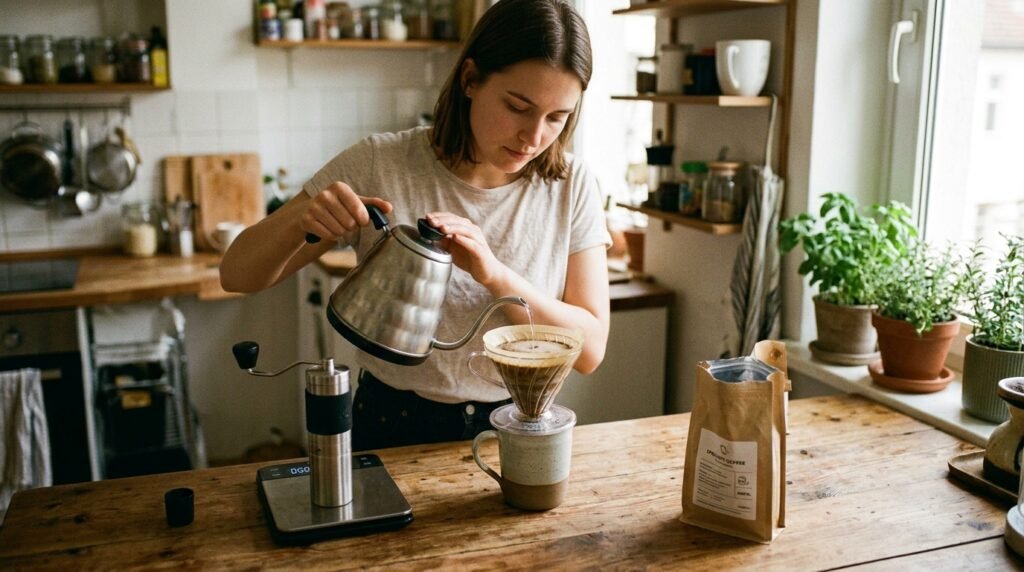
I bought a bag of specialty whole beans. I bought a manual hand grinder with stainless steel burrs. I bought a digital kitchen scale and a glass V60 brewing cone.
I thought I was just upgrading my kitchen equipment to make a better-tasting beverage. I didn’t realize that I was actually initiating a tactile rebellion against the speed of my own life.
The very first morning I used my new equipment, I noticed something profoundly different.
I could no longer just press a button and walk away. The manual brewing process demanded my absolute, undivided physical attention. I had to weigh exactly 15 grams of beans on the digital scale. I had to physically turn the crank on the grinder, feeling the dense resistance of the beans breaking apart.
I had to stand perfectly still and pour hot water from a gooseneck kettle in slow, hypnotic circles.
For four entire minutes, I was physically anchored to my kitchen counter. I could not check my emails. I could not scroll through social media. The process required my hands, my eyes, and my sense of smell.
The Daily Sanctuary
This mandatory physical engagement quickly evolved into something far more important than the beverage itself.
In a modern lifestyle where everything is digital, intangible, and incredibly fast, we are constantly living in our own heads. We are worrying about the future or stressing about the past. We rarely exist purely in the present moment.
My morning coffee ritual became my daily sanctuary of presence.
When I wake up now, I actively look forward to the brewing process. It is a fifteen-minute window of absolute peace where the chaotic demands of the outside world simply do not exist.
If I try to rush the pour of the hot water, the coffee bed will channel, and the drink will taste sour. The physics of the extraction literally force me to be patient. It forces me to slow down my breathing and match the gentle rhythm of the dripping water.
Coffee means more to me than caffeine because it is the one reliable anchor in my day. It is a quiet, analog meditation that recalibrates my brain before I have to face the glowing screens and the stressful emails.
The Social Currency
As my appreciation for the craft of coffee deepened, I noticed that it was also actively changing the way I interacted with the people around me.
In my era of cheap, automatic drip coffee, the beverage was entirely isolating. It was something I consumed alone in my car or alone at my desk to increase my personal productivity.
But specialty coffee practically begs to be shared.
Once I learned how to brew a flawless, sweet, complex cup of coffee, I wanted other people to experience it. I started inviting friends over to my apartment specifically to make them a pour-over.
When you prepare a manual cup of coffee for someone else, it is a genuine act of service. It takes time, math, and effort. You are crafting something specifically for them.
I noticed that when I handed a steaming ceramic mug to a friend and we leaned against the kitchen counter, the tone of the conversation naturally shifted. We didn’t talk about superficial things. The warmth of the mug and the deliberate slowness of the drink naturally lowered our defensive shields.
Recognizing this powerful interpersonal dynamic perfectly illustrates (How Coffee Became a Social Habit in My Life). Coffee transformed from a solitary tool of isolation into the ultimate social currency. It became my favorite excuse to invite someone into my physical space.
The Connection to the Earth
Perhaps the most profound reason coffee means so much more to me than a simple stimulant is the staggering global reality hidden inside every single bean.
When I used to buy anonymous plastic tubs of ground coffee, I felt no connection to the product. But when you buy a bag of single-origin specialty coffee, you are holding a passport.
The label tells you the name of the country. It tells you the altitude of the mountain where the tree was planted. It tells you the specific processing method used to remove the fruit from the seed.
I started realizing that every time I made a cup of coffee, I was holding the final baton in an incredibly long, exhausting human relay race.
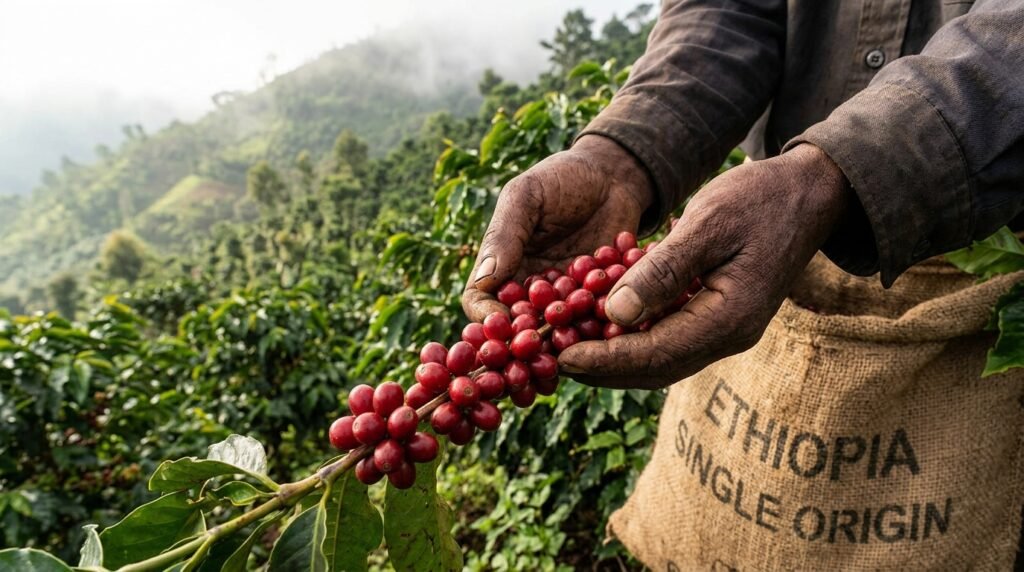
A farmer in Colombia or Ethiopia had to spend years nurturing a tree. Human hands had to hike up a steep, dangerous mountainside to meticulously pick only the perfectly ripe red cherries. Workers had to wash and ferment the seeds.
A massive ocean freighter had to transport those delicate green seeds across the world, battling unpredictable weather. A local roaster in my city had to apply the exact perfect mathematical curve of heat to unlock the sugars inside the bean.
The Weight of the Mug
When you truly grasp the sheer volume of human labor, geographical luck, and botanical science required to produce a single cup of coffee, it completely rewrites your perspective.
You are not drinking a factory product. You are drinking a massive collaborative effort.
You are tasting the volcanic soil of Central America. You are tasting the high-altitude, freezing nights of the African plateau. You are experiencing the agricultural dedication of a family you will never meet.
Understanding this epic, invisible chain of humanity is exactly (Why Coffee Is More Than Just a Beverage Worldwide). It is a liquid testament to global cooperation.
When I hold my mug now, I feel a deep sense of respect and gratitude. I refuse to rush the drinking process, because I refuse to disrespect the thousands of miles and thousands of hours of labor that went into creating it.
Escaping the Shuffle
If your current relationship with coffee is strictly utilitarian—if you just buy whatever is on sale, throw it into a machine, and gulp it down to survive the morning—you are missing out on one of the greatest analog experiences available in the modern world.
You are listening to a compressed music file on shuffle. You are getting the noise, but you are missing the soul of the album.
I challenge you to buy your first vinyl record.
Go to a local, independent roastery. Buy a bag of whole beans that lists the specific country of origin on the front. Buy a cheap manual hand grinder and a simple French Press or a pour-over cone.
Tomorrow morning, do not look at your phone. Stand in your kitchen, grind the beans by hand, and smell the explosive aromatics. Watch the hot water hit the grounds. Wait patiently for the extraction to finish.
When you take that first sip and taste the complex, natural sweetness of the bean, you will finally understand. You will realize that the caffeine is just a tiny, secondary byproduct. The true power of coffee is its ability to ground you in the present moment, connect you to the earth, and remind you of your own humanity.
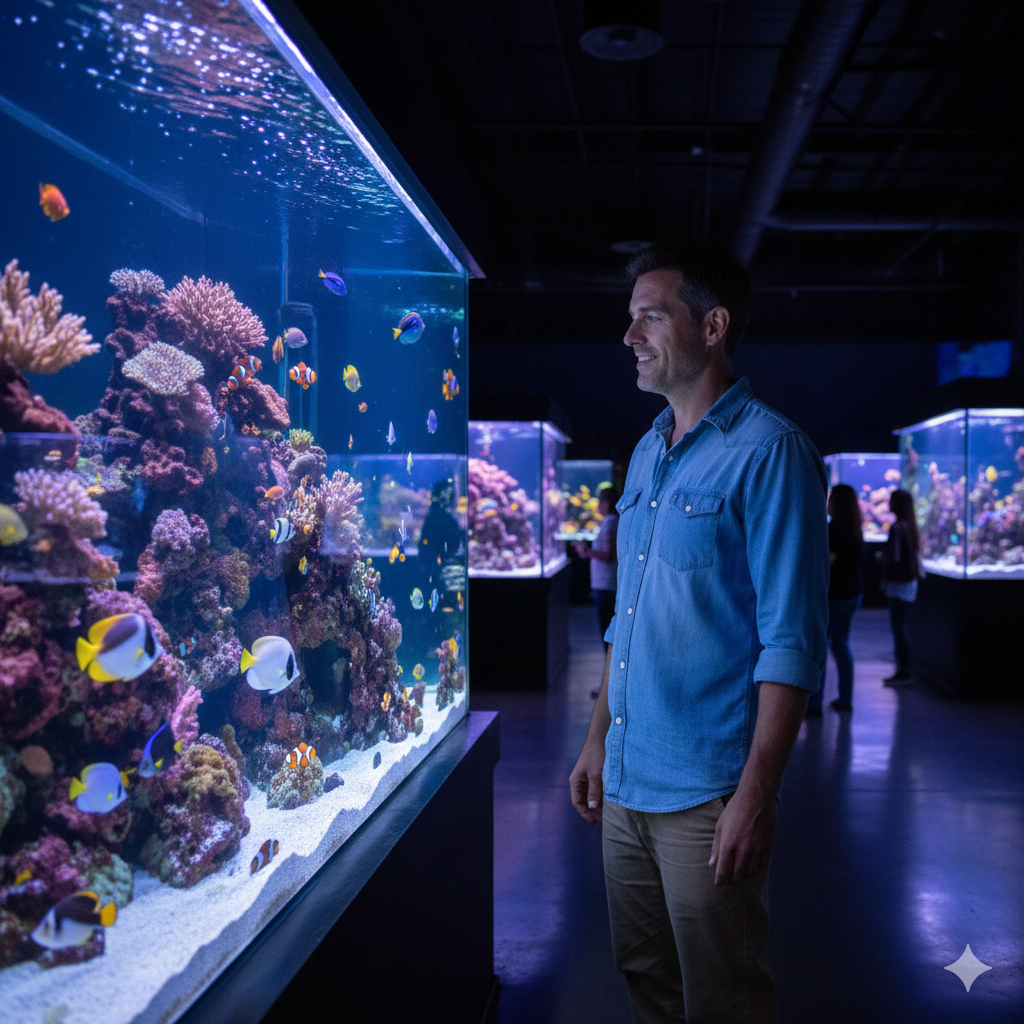
My name is Daniel Carter, I am 35 years old, and I live in the United States. I have been passionate about aquariums for many years, and what started as a simple hobby quickly became a lifelong interest in aquatic life, fish behavior, and responsible tank care.
Through TheBrightLance, I share real experiences, practical knowledge, and honest lessons learned from maintaining different types of aquariums. I enjoy testing equipment, studying fish behavior, improving maintenance routines, and helping beginners avoid common mistakes.
My goal is to make aquarism easier, more ethical, and more enjoyable for everyone — whether you are setting up your very first tank or looking to refine your techniques.