
When I am deep into an image editing session, spending hours meticulously replacing a distracting piece of clothing in a portrait or carefully erasing an ugly, intrusive watermark from the background, I become completely obsessed with the tiny details.
I know that if I leave even one stray pixel, or if I leave a slight, messy blur where the text used to be, the entire illusion of the photograph is ruined. The viewer’s eye will instantly bypass the beautiful subject and zoom straight into the careless mistake. The masterpiece is destroyed by a fraction of an inch of bad execution.
For a very long time, I applied this obsessive attention to detail to my creative work, but I completely abandoned it the moment I walked into my kitchen to make breakfast.
I was buying gorgeous, expensive specialty coffee beans. I was sourcing incredible single-origin bags from Ethiopia and Colombia. But I was treating them with absolute, reckless carelessness. I was ruining the final “picture” of my morning coffee with a series of tiny, daily, careless smudges.
I used to wonder why my home-brewed coffee never tasted as vibrant, clean, and sweet as the cups I bought at the local roastery. I blamed the equipment. I blamed the beans. But the painful truth was that I was actively sabotaging my own beverage every single morning.
Here is the honest, humbling story of the simple brewing mistakes I used to make every day, the science behind why they were destroying my cup, and the easy corrections that finally allowed me to taste the masterpiece hidden inside the bean.
Mistake 1: Trusting the “Scoop”
The very first, and arguably the most destructive, mistake I made every single morning was refusing to use mathematics.
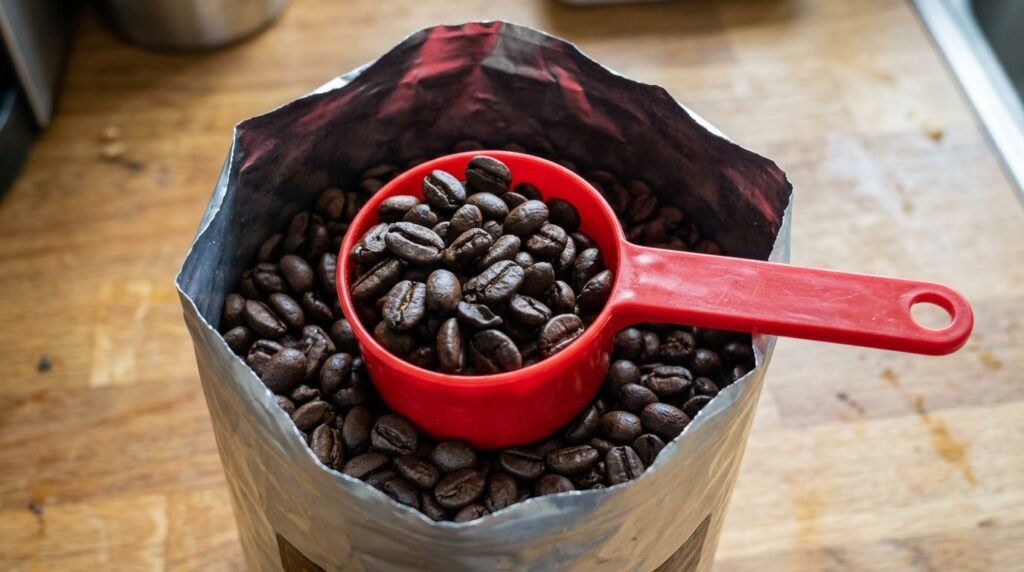
I relied entirely on the “eyeball” method. I kept a standard plastic scoop—the kind that comes free in cheap tubs of commercial coffee—buried inside my bag of premium beans. Every morning, I would grab that scoop and casually toss what looked like “two healthy spoonfuls” into my grinder.
I never measured my water, either. I would just hold my mug under the sink tap, fill it to the brim, and pour that exact volume into my coffee maker.
I thought I was being efficient. In reality, I was guaranteeing absolute chaos.
Coffee brewing is a delicate chemical extraction. You are using water as a solvent to pull specific flavor compounds out of a roasted seed. To control that extraction, you have to control the ratio of coffee mass to water mass.
The major flaw with my plastic scoop was that coffee beans have wildly different densities.
If I bought a dark roast coffee from Brazil, the beans were puffy, light, and full of air because they had been roasted longer. If I bought a high-altitude, light roast coffee from Kenya, the beans were tiny, rock-hard, and incredibly dense.
One visual scoop of the puffy dark roast weighed significantly less than one visual scoop of the dense light roast. By trusting my eyes instead of a scale, my coffee-to-water ratio was fluctuating wildly every single day. Some days my coffee was weak and watery; other days it was overwhelmingly heavy and sour.
I finally threw the plastic scoop in the trash.
I bought a cheap digital kitchen scale that measures in single grams. I started weighing exactly 15 grams of coffee beans and precisely 250 grams of water. Realizing that the kitchen scale is the ultimate foundation of consistency was precisely (The Day I Finally Got My Coffee Ratio Right). It completely eliminated the daily guessing game and gave me total control over the strength of my beverage.
Mistake 2: The Blade Grinder Massacre
My second daily mistake was happening right inside my coffee grinder.
For years, I used a cheap, twenty-dollar electric blade grinder. It was a small plastic cylinder with a spinning metal blade at the bottom, functioning exactly like a miniature blender. I would pour my beans in, hold the button down for fifteen seconds, and watch the blade violently chop the coffee to pieces.
I thought coffee grounds were just coffee grounds. I didn’t realize that uniformity is the key to a sweet cup.
When a spinning blade chops coffee, it does so completely randomly. It creates massive, rock-sized chunks of coffee (boulders) right alongside microscopic, powdery coffee dust.
When you pour hot water over this chaotic mixture, the water acts like a lazy river. It finds the path of least resistance. It rapidly flows around the massive boulders, barely extracting any flavor from them at all, which results in a sour, weak, under-extracted taste.
Simultaneously, that microscopic coffee dust sinks to the bottom and gets completely over-extracted by the hot water, releasing harsh, dry, astringent tannins that taste like burnt aspirin.
Because of the blade grinder, my morning mug was simultaneously sour and bitter. It was a sensory nightmare.
To fix this, I had to upgrade my tools. I purchased a high-quality manual burr grinder. Instead of chopping the beans blindly, a burr grinder crushes the beans between two precision-cut steel plates, ensuring that every single coffee particle is the exact same size.
Understanding this physical dynamic was an absolute revelation. Grasping the physics of extraction is exactly (How Grind Size Affected My Coffee More Than I Expected), because the uniform sand-like texture from my new burr grinder finally allowed the water to extract the sweet sugars evenly, completely erasing the sour and bitter notes.
Mistake 3: Drowning the Bloom
Even after I bought the scale and the burr grinder, I was still making a massive physical error during the actual pouring process.
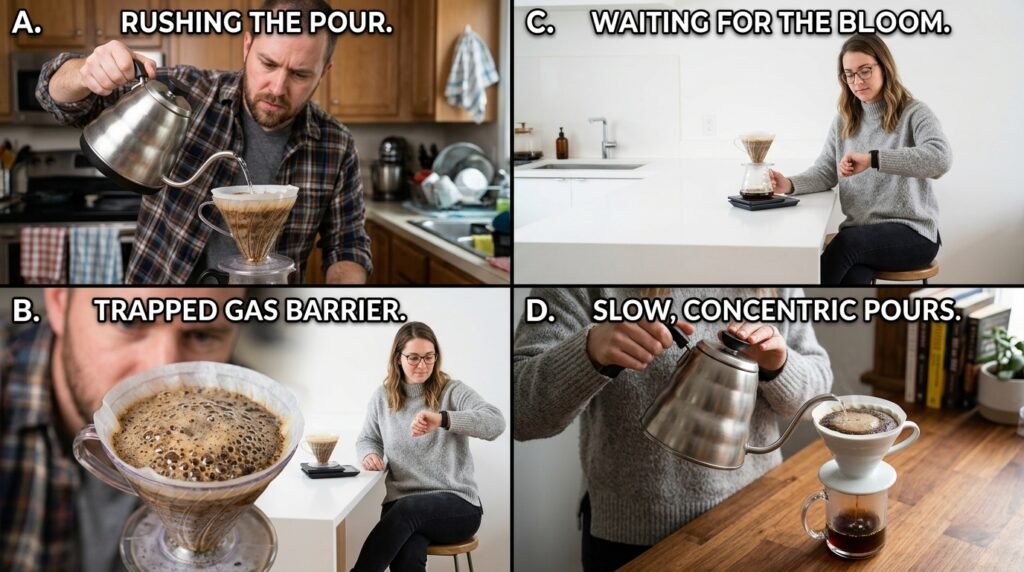
I primarily brew using a V60 pour-over cone. In the early days, as soon as my kettle boiled, I would aggressively dump all of my hot water directly into the center of the coffee grounds as fast as possible, filling the plastic cone to the absolute brim.
I wanted my coffee quickly, so I rushed the water. I didn’t realize I was suffocating the beans.
During the roasting process, coffee beans trap a massive amount of carbon dioxide gas inside their cellular structure. When hot water hits fresh coffee grounds, that gas violently escapes. The coffee bed physically expands, bubbles, and swells upward. In the industry, this is known as the “Bloom.”
If you just dump a massive wave of water onto the dry grounds all at once, that escaping gas acts as a shield. It literally repels the water, preventing it from penetrating the coffee particles. The water just slides past the gas bubbles and drops into your mug, completely empty of flavor.
I had to learn patience.
Now, when I start my morning brew, I gently pour just enough water (about 45 grams) to completely wet the coffee bed. Then, I put the kettle down and I wait.
I watch the coffee bubble and rise. I wait for exactly forty-five seconds, allowing all the trapped carbon dioxide to fully escape into the air. Only after the coffee has “exhaled” do I begin pouring the rest of my water in slow, gentle circles. Giving the coffee time to breathe resulted in a cup that was exponentially richer and more flavorful.
Mistake 4: Ignoring the 98 Percent
There was another invisible mistake happening right under my nose, and it involved the most abundant ingredient in the entire recipe.
A cup of black coffee is roughly 98 percent water. It is mathematically illogical to think you can brew a delicious cup of coffee if you are using bad-tasting water.
For years, I would just turn on my kitchen sink and fill my kettle with hard, heavily chlorinated municipal tap water.
The heavy metals, calcium, and chlorine in my tap water were completely hijacking the chemical extraction process. Those minerals would bind to the delicate floral and fruit compounds of my expensive specialty coffee, essentially muting them. My coffee always tasted flat, dull, and slightly metallic.
I wasn’t tasting the beans; I was tasting the plumbing of my apartment building.
I started using a simple, inexpensive charcoal water filter pitcher in my fridge. I stopped using tap water and only used clean, filtered, neutralized water for my coffee.
The difference was staggering. Suddenly, the “blueberry” and “jasmine” tasting notes printed on the front of the coffee bags weren’t just marketing lies anymore. I could actually taste them vividly, because the water was no longer fighting against the beans.
Mistake 5: The Freezer Trap
The final mistake I used to make every single day happened before the brewing process even began. It was a massive error in how I handled the raw ingredient.
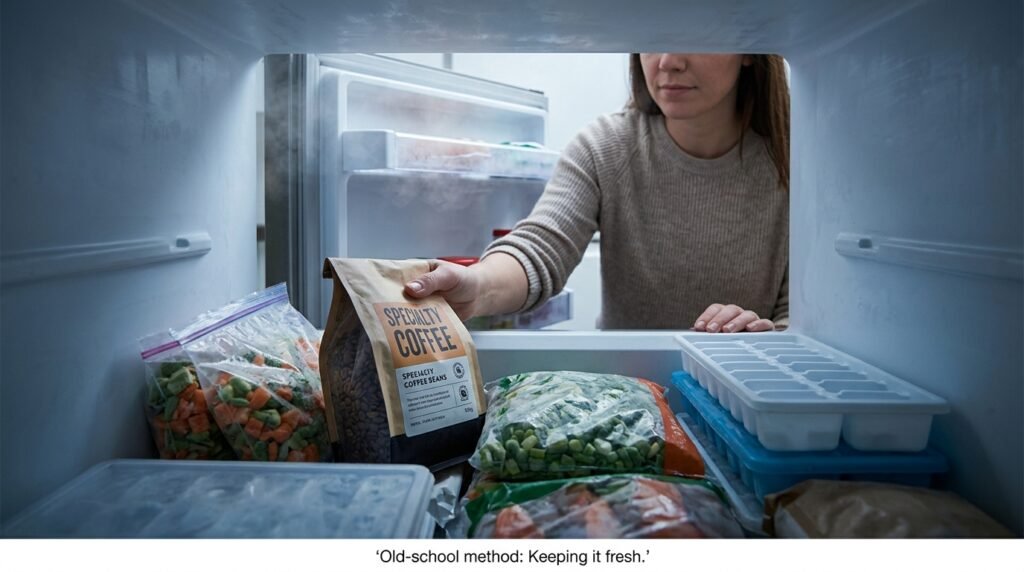
When I first started buying expensive specialty coffee, I was terrified of it going stale. I had heard a pervasive, old-school myth passed down from previous generations: if you want to keep your coffee fresh, you should store it in the freezer.
So, every time I bought a new bag, I would immediately toss it into the back of my freezer, right next to the frozen vegetables and the ice trays.
I was actively destroying the flavor profile of the beans.
Coffee beans are incredibly porous. They act like tiny, dry sponges. Every time I took the bag out of the freezing cold environment and opened it in my warm, humid kitchen, condensation would instantly form on the surface of the beans.
Moisture is the ultimate enemy of roasted coffee. That condensation would cause the delicate, water-soluble oils on the surface of the beans to degrade rapidly. Furthermore, because the beans act like sponges, they were actively absorbing the ambient odors of my freezer. My premium Ethiopian coffee was slowly absorbing the faint, lingering scent of frozen onions.
I had to completely rethink my preservation strategy.
I took my beans out of the freezer for good. Learning to protect the delicate oils from moisture and light was a vital step, which perfectly explains (How I Started Storing Coffee the Right Way).
Today, I keep my coffee beans in an opaque, airtight, vacuum-sealed canister, sitting quietly in a dark, room-temperature cabinet. They stay incredibly fresh, they never suffer from condensation shock, and they never taste like last week’s leftovers.
The Masterpiece in the Mug
When I look back at my old routine, I cringe at how many careless mistakes I was stacking on top of each other.
I was using the wrong water, measuring with a spoon, chopping the beans with a violent blade, rushing the pour, and storing the beans in the freezer. It is an absolute miracle that the coffee was even drinkable at all.
Brewing excellent coffee is not about owning a five-thousand-dollar espresso machine. It is not about possessing a genetically superior palate.
It is simply about respect. It is about paying attention to the tiny, seemingly insignificant details, just like editing a photograph.
If your morning coffee is currently tasting flat, sour, weak, or bitter, I highly encourage you to audit your routine. Look at your tools. Look at your water. Look at your grinder.
Stop guessing. Buy a scale. Buy a burr grinder. Let your coffee bloom, and keep your beans out of the freezer. When you finally eliminate these simple, daily mistakes from your kitchen, you will clear away all the distracting noise, and you will finally be able to taste the absolute masterpiece hidden inside your mug.

My name is Daniel Carter, I am 35 years old, and I live in the United States. I have been passionate about aquariums for many years, and what started as a simple hobby quickly became a lifelong interest in aquatic life, fish behavior, and responsible tank care.
Through TheBrightLance, I share real experiences, practical knowledge, and honest lessons learned from maintaining different types of aquariums. I enjoy testing equipment, studying fish behavior, improving maintenance routines, and helping beginners avoid common mistakes.
My goal is to make aquarism easier, more ethical, and more enjoyable for everyone — whether you are setting up your very first tank or looking to refine your techniques.