
There is a specific feeling of culinary heartbreak that happens right after you pour your morning coffee into a glass mug and hold it up to the light.
Instead of seeing a rich, dark, mysterious liquid that promises comfort and energy, you see right through it. It is entirely translucent. It looks like pale, dirty water. It looks like brown tea.
When you do a lot of image editing, you become very familiar with the “opacity” slider. If you have a bold, vibrant photograph and you drag that slider down to twenty percent, the image becomes a ghost. It loses all its impact, its contrast, and its life.
For the first few years of my coffee-brewing journey, I felt like someone had permanently dragged the opacity slider on my morning mug all the way to the bottom.
Every time I tried to brew a premium bag of specialty coffee at home, it tasted hollow. It lacked weight. When I took a sip, it tasted like warm, slightly sour water with a faint memory of a roasted coffee bean in the background.
I was incredibly frustrated. I was buying expensive beans, but I was ruining them every single morning. I thought the roasters were lying to me.
Eventually, I realized the beans weren’t the problem. My brewing technique was a complete disaster. Here is the honest, scientific story of why my coffee always tasted weak, the fundamental extraction mistakes I was making, and exactly how I fixed them to finally get the rich, heavy cup I craved.
The Difference Between “Weak” and “Under-Extracted”
Before I could fix my coffee, I had to understand the vocabulary of my failure.
In the specialty coffee world, “weak” and “under-extracted” are two entirely different concepts, even though beginners usually experience them at the exact same time.
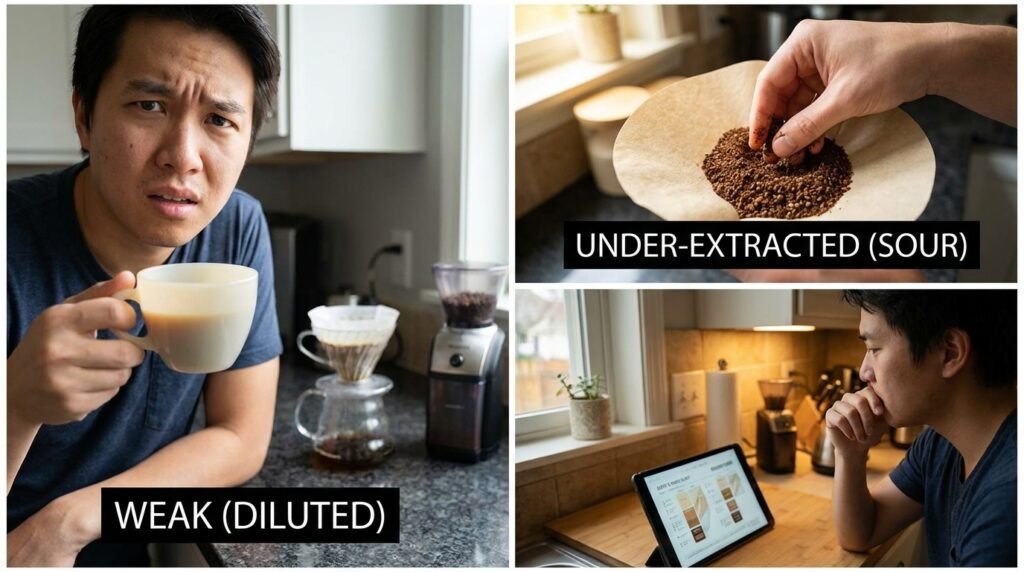
Weak coffee is a problem of concentration. It means there literally isn’t enough dissolved coffee material in the water. It is like making a pitcher of lemonade but using only one single lemon for a gallon of water. The flavor is just diluted.
Under-extracted coffee is a problem of chemistry. It means the water didn’t stay in contact with the coffee grounds long enough to pull out the sweet, complex sugars. It only pulled out the fast-dissolving, harsh organic acids. This makes the coffee taste aggressively sour, salty, and hollow.
My morning coffee was suffering from both. It was diluted, and it was sour. To fix this catastrophic combination, I had to investigate the crime scene in my kitchen and identify the culprits.
Culprit 1: The Soup Spoon Delusion
The absolute biggest reason my coffee tasted like water was my refusal to measure anything properly.
I was relying on the “eyeball method.” Every morning, I would open my bag of expensive beans, grab a random soup spoon from the cutlery drawer, and scoop what looked like “enough” coffee into my grinder. I never measured the water; I just filled the kettle and poured until my mug was full.
This is a recipe for guaranteed failure.
Coffee beans are agricultural products, which means their density varies wildly. A dark roast bean has been roasted longer, meaning it has lost a lot of its internal moisture. It is puffy and light. A light roast bean from a high altitude is incredibly dense and heavy.
One visual scoop of a dark roast contains significantly less actual coffee mass than one scoop of a light roast.
By trusting my eyes, I was constantly starving my water of coffee. Understanding this physical reality was a monumental turning point, and establishing a strict mathematical baseline was exactly (The Day I Finally Got My Coffee Ratio Right).
The Fix: I banished the soup spoon. I bought a cheap digital kitchen scale. I started using a strict 1:15 ratio (one gram of coffee for every fifteen grams of water). By weighing exactly 20 grams of coffee and pouring exactly 300 grams of water, I instantly solved the concentration problem. The coffee was no longer diluted.
Culprit 2: The Bucket of Baseballs
Once I fixed the ratio, the coffee had more weight to it, but it still tasted terribly sour and hollow. The extraction was still broken.
I looked at my coffee grinder. I was using a cheap, entry-level hand grinder, and I had the setting dialed incredibly coarse. The coffee grounds looked like chunky sea salt or gravel.
I had to learn a harsh lesson about physics and surface area.
When you pour hot water over coarse coffee grounds, it is like pouring a bucket of water over a bucket full of baseballs. The water finds massive gaps between the large chunks and violently rushes straight to the bottom.
Because the water moves so fast, it doesn’t have the time to penetrate the thick, coarse coffee chunks. It only washes the outside of the bean, grabbing the fast-dissolving sour acids before escaping into your mug. It leaves all the heavy, sweet, complex sugars trapped inside the coarse boulder.
Realizing that water is fundamentally lazy is the core reason (How Grind Size Affected My Coffee More Than I Expected). If you give water an easy exit, it will take it, and your coffee will taste terribly weak.
The Fix: I tightened the burrs on my grinder. I changed the setting from “coarse gravel” to “medium-fine sand.” By grinding the coffee finer, I forced the water to work harder. The water had to slowly navigate through the tightly packed sand, giving it the necessary time to dissolve the deep, heavy sugars hidden inside the seed.

Culprit 3: The Fear of the Boil
The third reason my coffee tasted so lifeless was a lingering myth I had read on a random internet forum years ago.
Someone had boldly claimed that using boiling water “burns” the coffee and makes it bitter. Terrified of ruining my expensive beans, I started using water that was far too cold. I would boil the kettle, turn it off, and let it sit on the stove for five or ten minutes before I poured it over my V60 pour-over cone.
I was effectively trying to brew coffee with lukewarm bathwater.
Coffee beans, especially specialty light roasts, are incredibly dense. They are tight, hard little cellular structures. To break those structures down and melt the sugars trapped inside, the water needs kinetic energy. It needs heat.
If you use water that is below 195°F (90°C), the water simply lacks the energy to do its job. It will lazily wash over the grounds, failing to extract the heavy, sweet, complex compounds that give coffee its rich body.
Understanding the relationship between heat and solubility is precisely (How Water Temperature Changed My Coffee Completely). The moment I introduced proper heat, the liquid in my mug transformed from a pale ghost into a vibrant masterpiece.
The Fix: I stopped fearing the boil. For light-roasted specialty coffee, I now boil the water, take it off the heat, wait exactly thirty seconds for the aggressive bubbling to stop, and pour immediately. The high heat acts as a powerful solvent, pulling out a massive amount of rich flavor.
Culprit 4: The Lack of Agitation
There was one final variable keeping me from brewing a truly strong, robust cup of coffee: my pouring technique.
When I was making pour-over coffee, I would grab my heavy kettle and dump all the water directly into the center of the plastic cone as fast as possible.
I thought the goal was just to get the water into the brewer. I didn’t realize that coffee brewing requires physical agitation.
When you dump all the water in one spot, it blasts a hole straight through the coffee bed. The water tunnels through that single hole, completely ignoring the dry coffee grounds sitting on the edges of the filter. This means half of your coffee is being over-extracted, and the other half isn’t being brewed at all.
The Fix: I bought a gooseneck kettle with a thin, precise spout. I learned to pour the water in slow, gentle, concentric circles. By making sure every single coffee ground was evenly wet and gently stirred by the water stream, my extraction skyrocketed. The coffee finally tasted full, complex, and heavy.
The Roast Level Illusion
As I fixed all these mechanical errors, I also had to fix a massive psychological error regarding how I purchased beans.
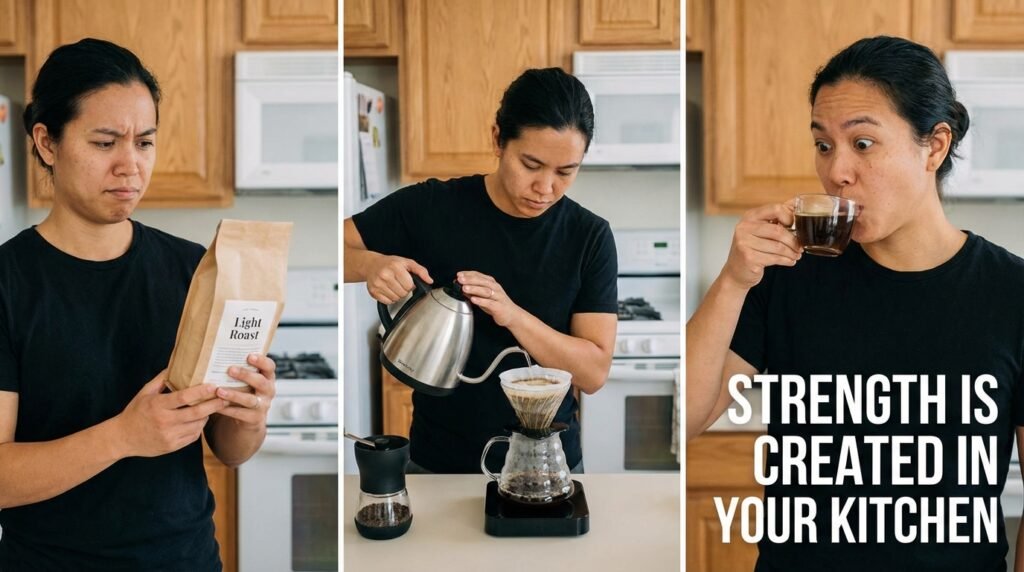
For years, I assumed that “Light Roast” meant the coffee would naturally taste weak and watery. I thought “Dark Roast” was the only way to get a strong, heavy cup of coffee.
This is a complete illusion.
The roast level does not dictate the strength of the coffee; it only dictates the flavor profile.
A light roast bean is actually denser and contains more of its original organic acids and natural caffeine than a dark roast bean. If you extract it properly using a fine grind and boiling water, a light roast coffee will hit your palate with an explosive, loud, overwhelming intensity of fruit and floral flavors.
A dark roast bean has had most of its complex acids burned away in the roasting machine. It will taste like chocolate, ash, and roasted nuts.
You can brew a weak, watery cup of dark roast if your ratio is wrong. And you can brew a terrifyingly strong, overwhelming cup of light roast if your technique is perfect. Strength is created in your kitchen, not in the roasting machine.
The Ritual of Correction
Fixing my weak coffee didn’t just improve the taste of my morning beverage; it completely changed my relationship with the entire brewing process.
Before, making coffee was a frustrating gamble. I was flying blind, crossing my fingers and hoping the coffee wouldn’t taste like dirty water.
Now, making coffee is a controlled, empowering ritual.
If I pull out a new bag of coffee and the first cup tastes a little bit hollow or sour, I don’t panic. I don’t blame the beans. I look at my variables. I tighten my grinder by one click to slow the water down. I check the temperature of my kettle. I make sure my pouring technique is slow and even.
I know exactly which lever to pull to increase the opacity and bring the flavor back to life.
Do Not Accept Bad Coffee
If you are currently staring into a glass mug of pale, translucent, sour coffee, I need you to know that you do not have to accept it. You do not have to force it down your throat just for the caffeine.
You have the power to fix it today.
Stop using a spoon to measure your beans. Buy a cheap digital scale and lock in your coffee-to-water ratio. If the coffee still tastes weak and sour, make your grind size finer. If it still lacks depth, turn up the heat on your water.
Coffee is a brilliant, heavy, complex, and deeply satisfying beverage when it is treated with respect. Turn the opacity slider all the way up to one hundred percent. Master your variables, take control of your kitchen, and finally give yourself the rich, powerful morning cup you actually deserve.

My name is Daniel Carter, I am 35 years old, and I live in the United States. I have been passionate about aquariums for many years, and what started as a simple hobby quickly became a lifelong interest in aquatic life, fish behavior, and responsible tank care.
Through TheBrightLance, I share real experiences, practical knowledge, and honest lessons learned from maintaining different types of aquariums. I enjoy testing equipment, studying fish behavior, improving maintenance routines, and helping beginners avoid common mistakes.
My goal is to make aquarism easier, more ethical, and more enjoyable for everyone — whether you are setting up your very first tank or looking to refine your techniques.