
If you have ever purchased a bookshelf or a television stand from a massive flat-pack furniture store, you are intimately familiar with a very specific type of human arrogance.
You carry the heavy cardboard box into your living room, slice it open, and dump hundreds of wooden planks, wooden dowels, and tiny metal screws onto your carpet. A small, illustrated instruction manual falls out of the box.
If you are like most people, you look at the manual, scoff, and toss it onto the couch.
You think to yourself, How hard can this possibly be? It’s just a bookshelf. I can figure this out. So, you start aggressively screwing pieces of wood together based entirely on intuition and guesswork.
Two hours later, you are sweating, frustrated, and staring at a complete disaster. The shelves are crooked, the drawers will not close, and for some terrifying reason, you have twelve leftover screws sitting in the palm of your hand. You are forced to swallow your pride, take the entire wobbly structure apart, and actually read the instructions step by step.
For the first year of my specialty coffee journey, I was the guy throwing away the instruction manual.
I bought a beautiful glass pour-over cone. I bought an expensive bag of single-origin coffee beans. I proudly walked into my kitchen, completely ignored the basic rules of extraction chemistry, and just started throwing things together.
The result was a wobbly, bitter, sour, and chaotic disaster every single morning.
Here is the honest, slightly embarrassing story of the beginner mistakes I made with coffee, the arrogant assumptions I had to unlearn, and the fundamental instructions I finally started following to save my morning routine.
Mistake One: The “More is Better” Fallacy
The very first, and easily the most destructive, beginner mistake I made was completely misunderstanding how coffee strength actually works.
I was used to drinking incredibly harsh, dark-roasted commercial coffee. When I bought my first bag of high-quality, lightly roasted Ethiopian coffee, I brewed a cup, and it tasted very delicate. It tasted like tea.
My arrogant, beginner brain immediately decided that I just needed to “make it stronger.”
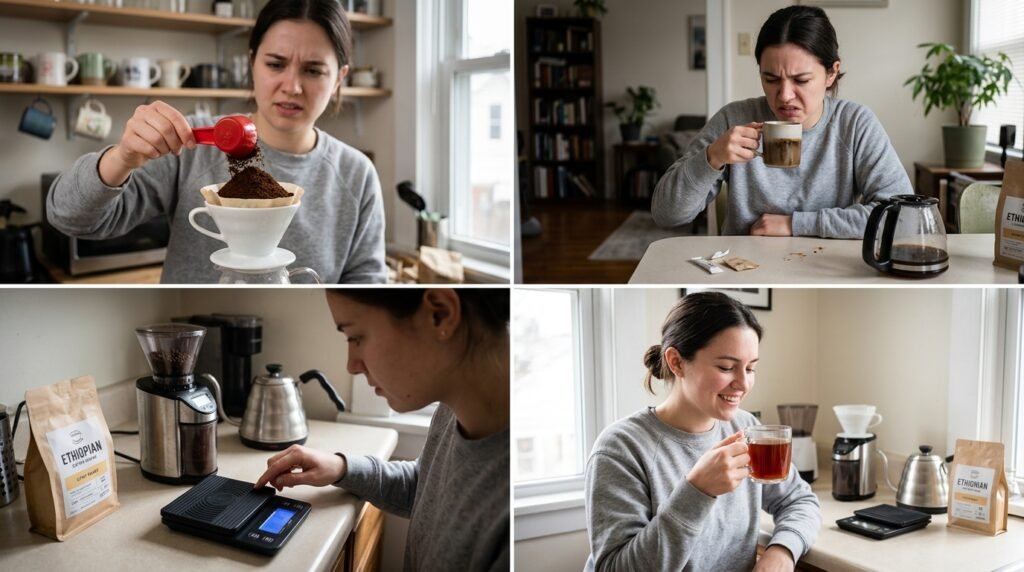
The next morning, I took my plastic scoop and dumped three massive, heaping mounds of ground coffee into the paper filter, while using the exact same amount of water I always used. I assumed that more coffee automatically equaled a bolder, better beverage.
I was completely ignoring the physics of extraction.
When you drastically increase the amount of coffee grounds but keep the water volume the same, you create a massive traffic jam inside the filter. The hot water cannot properly penetrate that massive, dry mountain of coffee. It struggles to pass through.
Instead of extracting the sweet, complex sugars hidden deep inside the beans, the water only manages to wash away the harsh, sour, and highly acidic surface compounds.
By adding more coffee, I didn’t make the cup stronger. I made it violently sour, incredibly muddy, and undrinkable.
I had to put my ego aside and buy a digital kitchen scale. I had to learn that coffee is a mathematical equation, not a guessing game. Accepting this strict chemistry and weighing my water was the defining moment of (The Day I Finally Got My Coffee Ratio Right). I learned that a perfect 1:16 ratio of coffee to water will always yield a better cup than blindly dumping extra scoops into the brewer.
Mistake Two: The Pre-Ground Convenience Trap
My second major beginner mistake was born purely out of laziness.
I wanted to drink premium, high-end specialty coffee, but I did not want to spend the money on a quality burr grinder, and I certainly did not want to perform physical labor at seven in the morning.
So, I would go to my local independent roastery, buy a twenty-dollar bag of freshly roasted single-origin beans, and ask the barista to grind the entire bag for me on their massive industrial machine. I thought I was hacking the system. I was getting perfectly ground coffee without having to do any of the work.
I had absolutely no idea that I was murdering the product.
Roasted coffee beans are basically tiny vaults protecting highly volatile aromatic oils. As long as the bean remains whole, those oils are relatively safe. But the exact second a grinder shatters that bean into hundreds of tiny pieces, those delicate oils are violently exposed to the oxygen in the air.
Within just a few hours of being ground, the oxygen completely strips the coffee of its complex flavors.
By day three, my expensive, pre-ground coffee tasted exactly like the cheap supermarket dust I was trying to escape. Realizing that I was paying a premium to destroy my own food was the main reason (Why I Gave Up Pre-Ground Coffee).
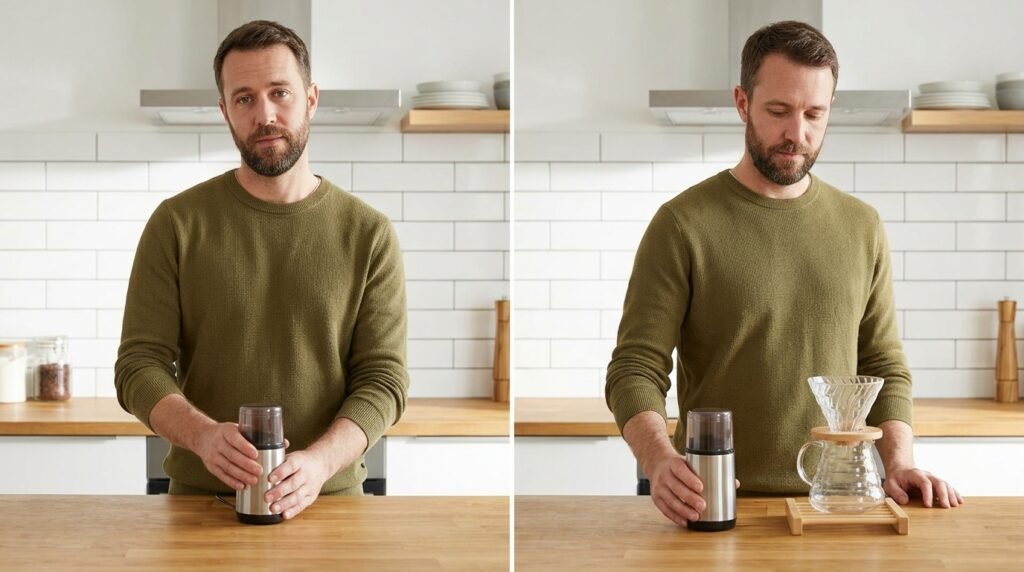
I finally swallowed my pride, bought a manual hand grinder, and learned that fresh coffee absolutely demands to be ground literally seconds before the hot water touches it.
Mistake Three: The Volcano Pour
Even after I bought a scale and a grinder, I still possessed a terrible habit that ruined the delicate flavor notes of my coffee every single morning.
I had no respect for the water temperature.
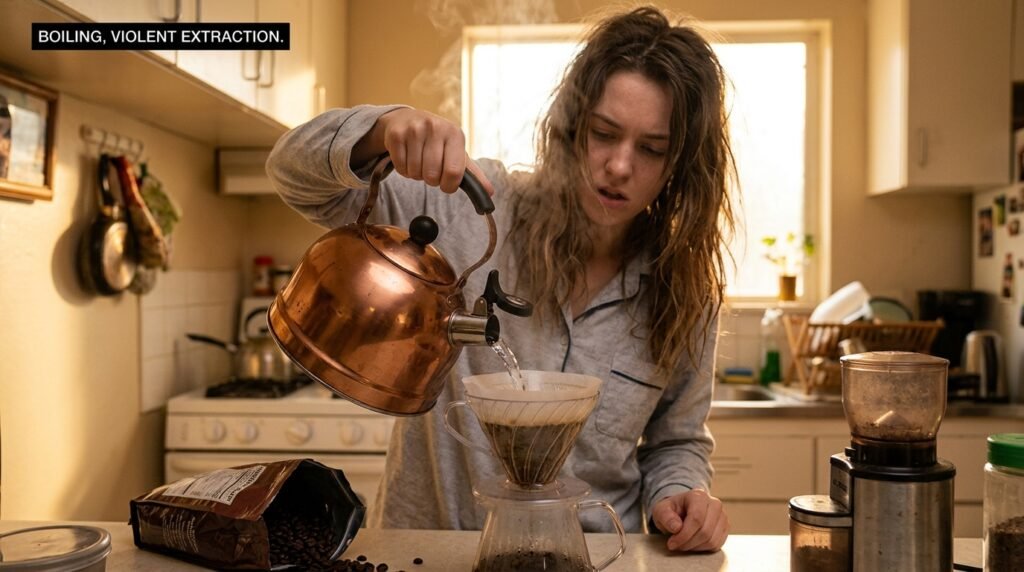
I would place my stovetop kettle on the burner, crank the heat to the maximum setting, and wait for the kettle to scream. The moment it started whistling, I would grab it and immediately dump the boiling, rolling, violently bubbling water straight onto my coffee grounds.
I assumed that hotter water meant better extraction.
I didn’t realize that light-roast specialty coffee is an incredibly delicate agricultural product. It is full of sensitive floral notes, bright citrus acidity, and sweet caramel sugars.
When you blast those delicate compounds with 212-degree Fahrenheit (100-degree Celsius) water, you commit culinary arson. You instantly scorch the oils. You literally burn the sweetness away before it ever has a chance to drip into your mug, leaving behind a harsh, carbonized, bitter aftertaste.
I had to learn to step back and take a breath. Now, when my kettle boils, I take it off the heat and I let it sit on the kitchen counter for one full minute. I let the water calm down to a gentle 200 degrees. That single minute of patience completely eliminated the burnt bitterness from my routine.
Mistake Four: The Impatient Flood
Another massive mistake I made was treating the actual brewing process like a race against the clock.
I would stand over my glass V60 cone, tip my kettle forward, and pour all of my hot water into the filter as fast as physically possible. I would fill the cone to the absolute brim and just stare at it impatiently, waiting for the liquid to drain.
I was completely ignoring the “bloom.”
When coffee is roasted, carbon dioxide gas becomes trapped inside the cellular structure of the seed. When hot water hits fresh coffee grounds, that gas aggressively rushes out. The coffee bed bubbles, heaves, and expands.
If you dump all your water in at once, that escaping gas physically repels the water. The water cannot enter the coffee grounds to extract flavor. Instead, it finds the path of least resistance, channeling rapidly down the sides of the paper filter and straight into your mug.
You end up with a watery, weak, and highly acidic beverage.
I had to learn how to respect the chemistry. Accepting that great coffee requires a little bit of waiting was one of (The Small Changes That Made My Coffee Much Better).
Now, I pour just enough water to wet the grounds, and I wait for forty-five seconds. I watch the gas escape. I let the coffee breathe. Only after the defensive gas is gone do I begin my slow, steady, deliberate pour.
Mistake Five: The Dirty Machine
The final beginner mistake I made is perhaps the most common, yet the least talked about, flaw in home coffee brewing.
I was absolutely terrible at cleaning my equipment.
I assumed that because I was only brewing coffee, my equipment didn’t need to be scrubbed. I would just rinse my glass pour-over cone with hot water and place it on the drying rack. I would tap my burr grinder on the counter to knock the loose dust out, but I never actually took it apart.
I didn’t realize that coffee oils are incredibly sticky.
Every time I ground beans or brewed a cup, a microscopic layer of oil coated the steel burrs of my grinder and the glass walls of my brewer. Over the course of a few weeks, those leftover oils began to oxidize and turn rancid.
I was taking incredibly fresh, expensive, high-quality coffee beans and forcing them through a layer of rotting, rancid oil every single morning. My coffee always possessed a subtle, stale, dirty-diner aftertaste, and I could never figure out why.
One Saturday morning, I finally took my grinder apart and scrubbed the steel burrs with a stiff brush. I washed my glass brewer with hot water and unscented dish soap until it squeaked.
The next cup I brewed was a revelation. It was so impossibly clean and vibrant that I actually felt embarrassed. I realized how much incredible coffee I had ruined simply by being too lazy to wash my dishes.
Read the Manual
When we discover a new hobby, our enthusiasm often blinds us to our own ignorance. We want to skip the boring fundamentals and jump straight into being experts.
But coffee, much like a complex piece of flat-pack furniture, does not care about your enthusiasm. It only cares about the physical laws of chemistry, extraction, and temperature. If you try to build the bookshelf without looking at the instructions, it is going to fall apart.
If your morning coffee is currently tasting bitter, sour, unpredictable, or just generally disappointing, take a step back and audit your routine.
Are you blindly scooping coffee instead of weighing it? Are you buying pre-ground beans? Are you scorching your coffee with boiling water, rushing the bloom, or brewing through dirty equipment?
Do not let your ego ruin your breakfast. Acknowledge the beginner mistakes. Buy a scale, buy a manual grinder, let your water cool down, and wash your gear. When you finally humble yourself and start following the basic instructions, your morning routine will instantly transform from a frustrating disaster into an absolute, flawless masterpiece.

My name is Daniel Carter, I am 35 years old, and I live in the United States. I have been passionate about aquariums for many years, and what started as a simple hobby quickly became a lifelong interest in aquatic life, fish behavior, and responsible tank care.
Through TheBrightLance, I share real experiences, practical knowledge, and honest lessons learned from maintaining different types of aquariums. I enjoy testing equipment, studying fish behavior, improving maintenance routines, and helping beginners avoid common mistakes.
My goal is to make aquarism easier, more ethical, and more enjoyable for everyone — whether you are setting up your very first tank or looking to refine your techniques.