
I was cleaning out the very top shelf of my kitchen pantry last week when my hand brushed against something cold and cylindrical hidden all the way in the back.
I pulled it out and wiped the dust off the label. It was a half-empty glass jar of instant coffee. The expiration date printed on the bottom said it had expired over four years ago.
I shook the jar. The little freeze-dried pebbles rattled against the glass, sounding exactly like a handful of cheap gravel. I opened the plastic lid and took a cautious sniff. It smelled like burnt toast, stale ash, and a faint hint of metallic chemicals.
I stood there in my kitchen, staring at that jar, and a massive wave of nostalgia hit me.
That jar represented a completely different era of my life. It represented the “Dark Ages” of my culinary journey. There was a time when I genuinely thought those little brown pebbles were what coffee was supposed to taste like. I drank it every single morning, forcing it down my throat purely for the caffeine, masking the horrible taste with a mountain of sugar and milk.
Looking at that jar made me realize just how incredibly far my palate has traveled.
My transition from drinking cheap, freeze-dried gravel to manually pressing high-end, single-origin specialty beans wasn’t an overnight switch. It was a messy, intimidating, and ultimately beautiful journey. And the catalyst for that entire transformation was a weird, plastic, syringe-looking device.
Here is the honest story of my journey from instant coffee to the AeroPress, how a thirty-dollar plastic tube completely rewired my brain, and why it is the absolute best gateway into the specialty coffee world.
The Appeal of the Dark Ages
To understand why the AeroPress was such a revelation for me, you have to understand why I was trapped in the instant coffee cycle for so long.
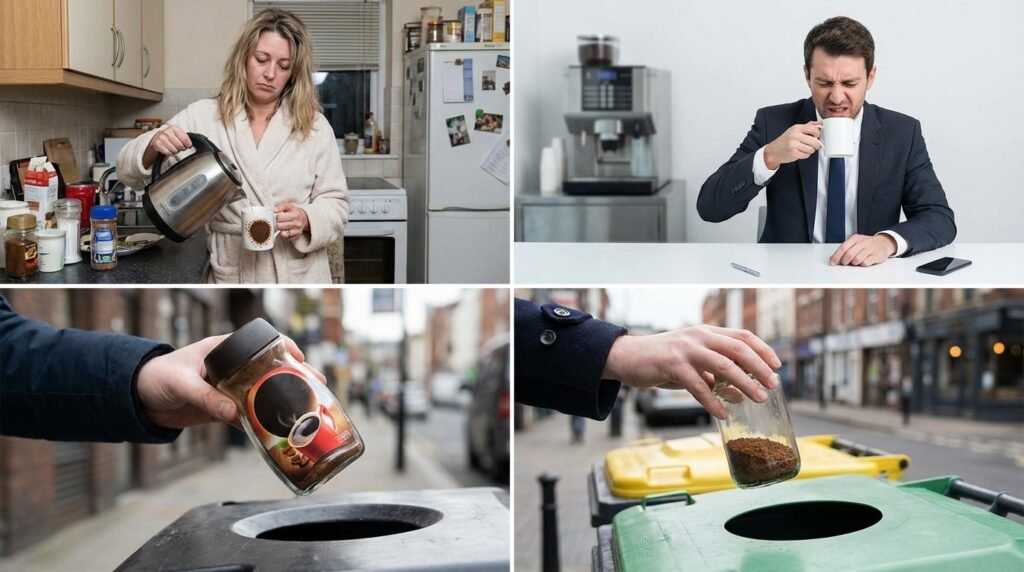
Instant coffee is a masterclass in convenience. You boil water in a kettle, you scoop a teaspoon of brown powder into a mug, you pour the water, and you are done. There is no brewing time. There is no filter to rinse. There are no grounds to clean up.
It takes exactly ten seconds.
For a stressed, chronically exhausted person who just needs to wake up for work, that ten-second convenience is a highly addictive trap.
But the trade-off for that convenience is the absolute destruction of flavor. Instant coffee is usually made from the lowest-grade Robusta beans on the planet. To make it “instant,” massive commercial factories brew giant vats of this cheap coffee, then either freeze-dry it or spray-dry it at aggressively high temperatures until all the liquid evaporates, leaving behind a hard crust of crystallized coffee extract.
The extreme heat of this factory process completely destroys any delicate, natural sugars or fruit acids the bean might have had. All that survives the fire is bitter, harsh, burnt carbon.
Taking the painful step of throwing that jar in the trash was exactly (Why I Stopped Buying Cheap Coffee and Never Looked Back), because I finally admitted to myself that convenience was not worth drinking a beverage I actively hated.
The Intimidation of the Upgrade
When I finally decided I wanted to drink “real” coffee, I was immediately overwhelmed by the specialty coffee scene.
I walked into a high-end café and saw baristas operating massive, ten-thousand-dollar chrome espresso machines with dozens of dials and steam wands. I saw them using delicate glass pour-over cones, pouring water from elegant gooseneck kettles while staring intensely at digital scales.
It looked like a chemistry lab. It looked incredibly expensive, deeply complicated, and entirely unapproachable for a beginner.
I just wanted a good cup of coffee. I didn’t want to become a scientist, and I definitely didn’t want to spend five hundred dollars on equipment.
I explained my frustration to a barista. I told him I wanted something that tasted amazing but was almost as easy to clean up as my old jar of instant coffee.
He smiled, walked over to a retail shelf, and handed me a hexagonal cardboard box. Inside the box was a dark gray plastic cylinder, a plunger with a rubber seal, and a stack of tiny circular paper filters.
“It’s called an AeroPress,” he said. “It looks like a giant medical syringe, and it was invented by the guy who created the Aerobie flying ring toy. It will change your life.”
I bought it for about thirty dollars, highly skeptical that a plastic toy could replace my instant coffee routine.
Unboxing the Plastic Syringe
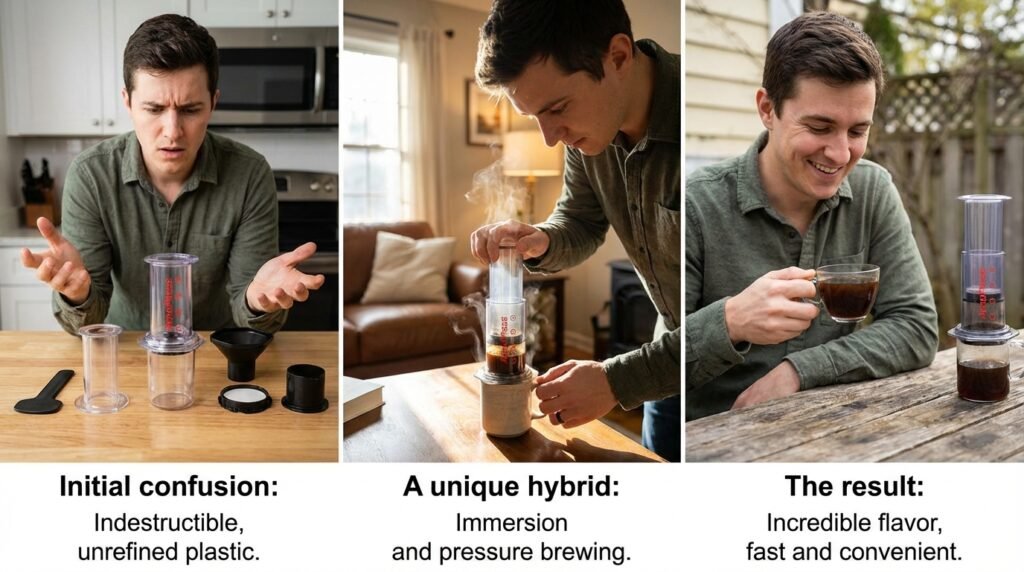
When I got home and unpacked the AeroPress, I was even more confused. It felt indestructible, made of high-grade, heat-resistant plastic, but it possessed absolutely zero aesthetic elegance. It wasn’t beautiful glass or polished stainless steel.
It came with a strange plastic stirring paddle and a funnel. The instructions seemed almost too simple to be true.
The genius of the AeroPress is its completely unique approach to brewing physics.
It isn’t just a pour-over where water drips through the grounds. And it isn’t just a French Press where the grounds steep in a glass beaker. The AeroPress is a hybrid. It uses Immersion (letting the grounds steep in the water) combined with Pressure (using the rubber plunger to force the water through the grounds).
This combination of steeping and pressure allows you to extract an incredible amount of heavy, sweet flavor in a fraction of the time it takes to brew other methods.
Finding this weird, plastic tube was undoubtedly (The Brewing Method That Changed Everything for Me), because it bridged the massive gap between the ten-second convenience of instant coffee and the high-end flavor of a specialty café.
The First Plunge
The next morning, I officially retired my jar of instant coffee. I was nervous. I weighed out 15 grams of a medium-roast Colombian coffee and ground it fresh.
I placed the tiny paper filter inside the plastic cap, twisted it onto the bottom of the main chamber, and sat the whole device directly on top of my favorite ceramic mug.
I poured the coffee grounds into the tube. I poured the hot water in, gave it a quick stir with the plastic paddle, and waited a very short sixty seconds.
Then came the fun part.
I inserted the rubber plunger into the top of the tube. I placed both hands on the plunger and gently pressed down. I could feel the trapped air compressing. The rubber seal created a perfect, airtight vacuum.
Pressing the plunger down is a deeply satisfying physical action. You feel a dense, firm resistance as you physically force the hot water through the bed of coffee grounds and through the paper filter.
At the very end of the plunge, the device lets out a loud, distinct hissing sound as the last bit of air escapes through the coffee puck.
The Revelation in the Cup
I removed the AeroPress from my mug and looked at the liquid inside.
Unlike the muddy, cloudy mess I used to get when I tried to use a French Press, this coffee was pristinely clean. Because the AeroPress uses a paper filter, all of the harsh, microscopic dust was trapped in the tube, leaving a beautiful, translucent liquid in my cup.
But unlike a delicate V60 pour-over, the coffee still had an incredible amount of weight and body, thanks to the physical pressure of the plunge.
I took a sip.
My eyes widened. It was the smoothest, sweetest cup of coffee I had ever made in my own kitchen. The bitter, ashy, metallic nightmare of my instant coffee days vanished entirely from my memory. The Colombian beans tasted vividly like rich caramel and sweet red apples.
Experiencing that flawless extraction on my very first try was a culinary milestone. That morning is exactly (My First Time Using an AeroPress (Honest Experience)), because it proved that you don’t need to be an expert barista with a gooseneck kettle to brew a masterpiece.
The Ultimate Forgiveness Tool
As I used the AeroPress over the next few weeks, I discovered its greatest superpower: Absolute forgiveness.
If you use a V60 pour-over and your grind size is slightly wrong, or your water is slightly too cold, the coffee is ruined. It is a highly sensitive, unforgiving instrument.
The AeroPress does not care if you make mistakes.
Because it is an immersion brewer, the water and the coffee just sit together. If you grind the coffee a little too coarse, you just wait an extra thirty seconds before plunging. If your water isn’t perfectly boiling, the pressure of the plunge still manages to force the flavor out of the beans.
You cannot mess it up. It is the ultimate safety net for someone who is just starting to learn about specialty coffee ratios, grind sizes, and water temperatures. It is a tool that holds your hand and guarantees a great cup, even when your technique is sloppy.
The Joy of Cleanup: The “Puck Pop”
The main reason I clung to instant coffee for so long was that I hated cleaning up wet coffee grounds. Scraping sludge out of a French Press glass beaker is a miserable, messy chore that I actively avoided.
The inventor of the AeroPress clearly understood this human laziness.
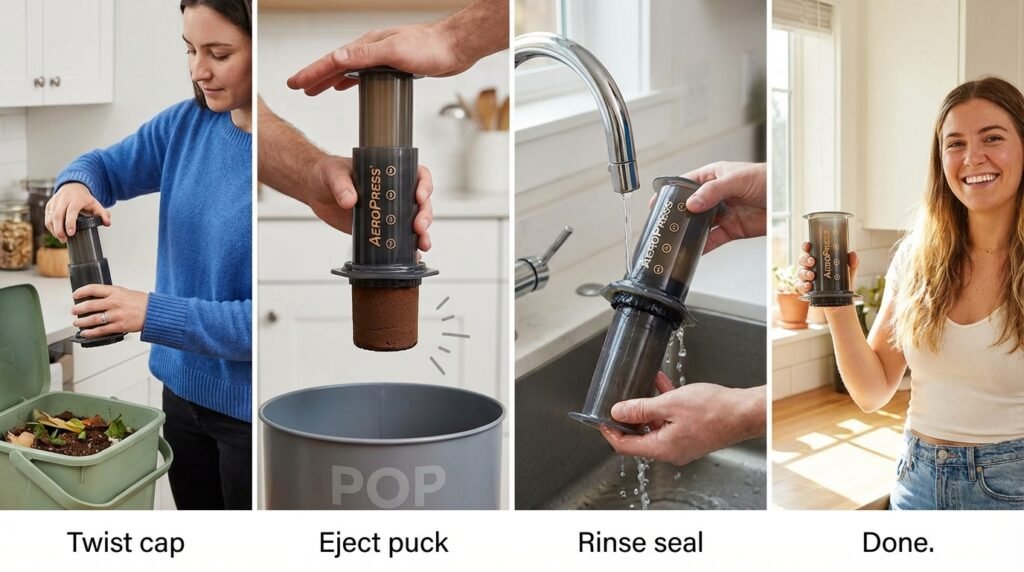
Cleaning the AeroPress is arguably the best part of the entire brewing experience. When you finish your plunge, all of the used coffee grounds are compacted into a dense, solid, dry little disk at the bottom of the tube.
You simply take the device to your trash can, twist the plastic filter cap off, and give the plunger one final, firm push.
With a deeply satisfying POP, the solid puck of coffee grounds and the paper filter shoot cleanly out of the tube and directly into the trash. There is no scraping. There is no sludge.
You just rinse the rubber seal under the sink for three seconds, and you are completely done. It is practically as fast as cleaning up a teaspoon of instant coffee powder.
The Rabbit Hole of Recipes
Once I mastered the basic, standard instructions that came in the box, I started looking online. I quickly realized that the AeroPress is not just a beginner’s tool; it is a cult phenomenon.
There is actually an annual “World AeroPress Championship” where professional baristas from around the globe fly to a single location to compete over who can brew the best cup using this thirty-dollar plastic tube.
I discovered a vibrant community of coffee nerds who had invented thousands of different recipes.
I learned about the “Inverted Method,” where you flip the entire device upside down, balancing it precariously on the plunger, to allow the coffee to steep even longer without dripping through the filter. It feels dangerous, slightly rebellious, and produces a massive, heavy-bodied cup.
I learned how to use a very fine grind, a tiny amount of water, and extreme pressure to create a concentrated, heavy shot of coffee that closely mimics the texture of true espresso. I could pour this concentrated shot over ice and milk to make a brilliant iced latte in two minutes.
I learned how to use a coarse grind and a long steep time to create a delicate, tea-like brew that perfectly highlighted the floral notes of my favorite Ethiopian beans.
The AeroPress is a chameleon. It is the only coffee brewer in the world that can effectively mimic a French Press, a pour-over, and an espresso machine, all depending entirely on how you choose to use it.
The Ultimate Travel Companion
My transition away from instant coffee was finally complete when I started traveling.
Whenever I used to go camping or stay in a cheap hotel, I would always pack a jar of instant coffee because it was the only thing that survived a suitcase.
But the AeroPress is practically indestructible. It is made of thick plastic. You can throw it into a backpack, drop it on a rock, and it will be perfectly fine. It weighs almost nothing.
Now, when I go camping, I pack my AeroPress, a small manual hand grinder, and a bag of high-end specialty beans. Sitting in the woods at sunrise, boiling water over a campfire, and pressing a world-class cup of coffee into my tin mug is one of the greatest simple joys of my life.
Say Goodbye to the Glass Jar
I stood in my kitchen, holding that expired, four-year-old jar of instant coffee.
I didn’t feel any desire to keep it “just in case.” I walked over to the trash can and threw it away.
If you are currently trapped in the exact same cycle I was—if you are drinking bitter, harsh, freeze-dried powder purely for the caffeine because you are too intimidated or too busy to learn how to brew manually—I am begging you to break the cycle.
You do not need to buy a thousand-dollar espresso machine. You do not need a gooseneck kettle. You do not need to become a snob.
You just need to spend thirty dollars on a weird, plastic syringe.
Buy an AeroPress. Buy a bag of freshly roasted, single-origin coffee. When you hear that final, satisfying hiss of air, and you taste the incredibly sweet, smooth, completely bitter-free liquid in your mug, you will never look at a jar of instant coffee ever again. The journey is short, but the reward is permanent.

My name is Daniel Carter, I am 35 years old, and I live in the United States. I have been passionate about aquariums for many years, and what started as a simple hobby quickly became a lifelong interest in aquatic life, fish behavior, and responsible tank care.
Through TheBrightLance, I share real experiences, practical knowledge, and honest lessons learned from maintaining different types of aquariums. I enjoy testing equipment, studying fish behavior, improving maintenance routines, and helping beginners avoid common mistakes.
My goal is to make aquarism easier, more ethical, and more enjoyable for everyone — whether you are setting up your very first tank or looking to refine your techniques.