
If you have ever purchased a high-end, premium set of audio speakers, you know that the ultimate goal is clarity. You want to sit in your living room, close your eyes, and hear every single instrument. You want to hear the precise vibration of the bass guitar, the crisp snap of the snare drum, and the subtle breath of the vocalist.
But there is a very simple way to completely ruin that expensive equipment.
If you walk over to the amplifier and crank the volume knob completely to the maximum setting, past its physical limits, the music stops being music. The sound violently distorts. The bass becomes a muddy rumble, the high notes screech painfully in your ears, and the entire song turns into a harsh, aggressive wall of noise.
You are no longer hearing the beautiful arrangement of the instruments. You are only hearing the physical distortion of the speakers breaking down under too much pressure.
For the vast majority of my adult life, my morning coffee was the culinary equivalent of a blown-out speaker.
Every single time I took a sip from my mug, my face would instinctively scrunch up. The liquid was harsh, aggressive, and overwhelmingly bitter. It felt like an assault on my palate. I honestly thought that this was just how coffee was supposed to taste. I thought the bitterness was the “music.”
I had absolutely no idea that I was just drinking distortion.
When I finally realized that coffee is actually a sweet, complex fruit, and that the bitterness was entirely my own fault, my entire worldview shifted. Here is the honest, highly detailed story of how I made my coffee taste less bitter, the specific kitchen habits I had to unlearn, and how I finally turned the distortion down so I could hear the actual music of the bean.
The Great Misunderstanding of Bitterness
The very first hurdle I had to overcome was purely psychological. I had to fundamentally redefine my relationship with bitter flavors.
From an evolutionary standpoint, human beings are biologically programmed to reject bitterness. In the natural world, a bitter taste is almost always a warning sign for poison, toxicity, or spoiled food. When we taste something incredibly bitter, our brain instantly tells us to spit it out.
Yet, for some reason, modern society has collectively convinced itself that choking down intensely bitter, black coffee is a badge of honor. We view it as a sign of adulthood and toughness.
We learn to mask the painful flavor with massive amounts of refined sugar, artificial vanilla syrups, and heavy cream. We do whatever it takes to hide the distortion.
The turning point for me was discovering that while coffee does contain caffeine—which is naturally a mildly bitter alkaloid—the overwhelming, harsh, woody bitterness that ruins your morning is not natural. It is an extraction flaw. It is a sign that the coffee was either physically destroyed during the roasting process or violently abused in your kitchen.
Escaping the Charcoal Trap
The fastest, most immediate step I took to eliminate bitterness had nothing to do with my brewing equipment. It had to do with the beans I was buying.
For years, I bought the darkest roasts I could find at the commercial supermarket. I bought bags labeled “French Roast,” “Italian Espresso,” and “Midnight Blend.” The beans inside the bags were pitch black, covered in grease, and smelled like an old campfire.
I thought this meant the coffee was “strong.”
I didn’t realize that the roasting machine was actually the source of the distortion. When commercial companies buy cheap, low-grade coffee that is full of agricultural defects, mold, and dirt, they cannot roast it lightly. If they did, you would taste the defects. Instead, they leave the beans in the 400-degree roasting drum until they are completely carbonized.
They burn the beans to a crisp.
When you brew a dark roast, you are not tasting the natural flavor of the coffee cherry. You are tasting the ash, the carbon, and the smoke of the oven. Carbon is inherently, unavoidably bitter.
I completely stopped buying dark roasts. I began seeking out high-quality, specialty beans. I started buying bright, floral Ethiopian coffees, deeply balanced Colombian beans, and complex, chocolatey Guatemalan roasts. By simply switching to light and medium roasts, I instantly removed the baseline taste of charcoal from my life.
The Chronology of Extraction
Once I had beautiful, unburnt coffee beans in my kitchen, I still had to figure out how to brew them without creating bitterness. To do this, I had to understand the strict chronology of coffee extraction.
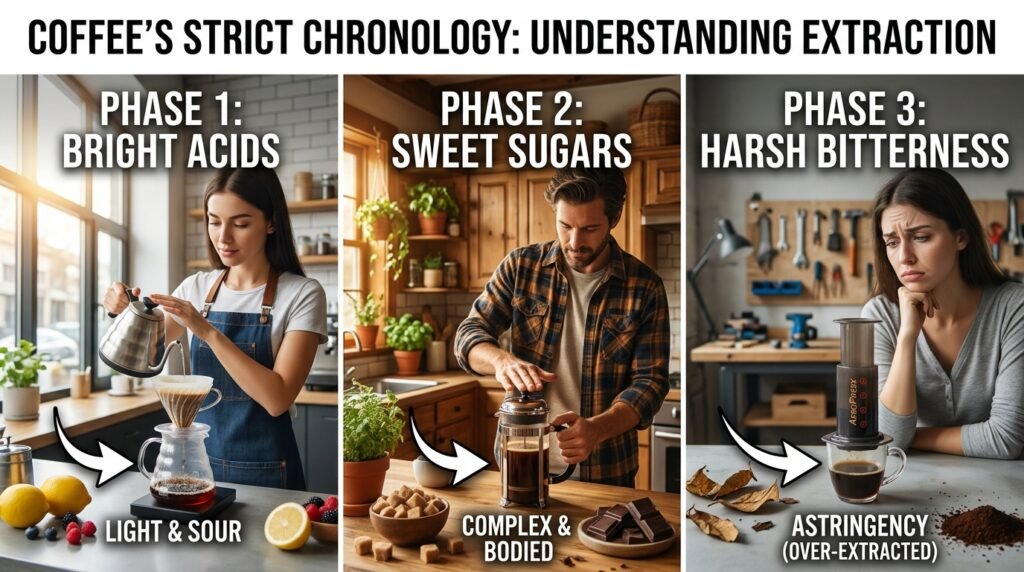
When hot water touches ground coffee, it does not extract all the flavors at the exact same time. It extracts them in a very specific, predictable sequence.
In the first phase of brewing, the water rapidly extracts the bright, fruity, and sour acids. In the second phase, the water extracts the complex, heavy, and sweet sugars. In the final phase, if the water stays in contact with the coffee for too long, it begins to extract the harsh, dry, astringent tannins and the intense bitterness.
This means that a bitter cup of coffee is an over-extracted cup of coffee. You have pushed the brewing process too far, entering the third phase and pulling out the defensive compounds of the plant.
Understanding this sequence was the exact foundation of (Why My Coffee Tasted Bitter (And How I Fixed It)). I realized I had to strategically stop the extraction process before the water reached those bitter tannins.
Turning the Dial: The Grind Size Epiphany
The most effective way to control how fast the water extracts flavor is by adjusting the physical size of the coffee grounds.
For a long time, I was using a cheap electric blade grinder that pulverized my coffee beans into a fine, microscopic powder. When I put that fine powder into my glass V60 pour-over cone and poured hot water over it, a disaster occurred.
Fine powder creates an incredibly dense coffee bed. It acts like wet clay.
The hot water could not flow through the filter. It would get trapped at the top, pooling up and sitting in direct contact with the coffee grounds for four, five, or even six minutes. Because the water was stuck, it blew right past the sweet sugars and aggressively extracted the bitter tannins.
The solution was a mechanical upgrade. I bought a high-quality manual burr grinder and started grinding my beans significantly coarser.
I aimed for a texture resembling coarse sea salt. Learning how this specific mechanical adjustment completely alters the flow of water was the core lesson of (How Grind Size Affected My Coffee More Than I Expected).
When the grounds are coarser, the water flows through the coffee bed smoothly and quickly. The extraction is completed in exactly three minutes, completely bypassing the bitter compounds at the end of the extraction cycle.
Lowering the Heat: The Thermal Shock
Even after I fixed my grind size, I occasionally encountered a harsh, aggressive bite at the back of my throat when drinking my coffee. It wasn’t the deep, ashy bitterness of a dark roast, but rather a sharp, metallic bitterness.
The culprit was the water in my stovetop kettle.
I was bringing my water to a violent, aggressive, rolling boil, and immediately dumping it straight onto the delicate grounds.
Heat is the physical engine of extraction. The hotter the water, the faster and more aggressively it pulls flavor compounds out of the cellulose structure of the bean. When you hit lightly roasted, complex coffee with 212-degree Fahrenheit (100-degree Celsius) water, you are essentially driving a sports car at maximum speed into a brick wall.
You scorch the delicate fruit oils. You obliterate the sweet sugars. You violently force the bitter tannins out of the bean in seconds.
Recognizing this destructive thermal energy perfectly illustrates (How Water Temperature Changed My Coffee Completely).
I introduced a mandatory sixty-second pause into my morning routine. When the kettle whistles, I take it off the heat. I let it sit on the counter for one minute, allowing the water to gently drop to roughly 200 degrees Fahrenheit. That tiny drop in temperature completely eliminated the metallic, scorched bitterness from my cup.
The Illusion of Dilution
There is a very common, very dangerous myth that beginners fall for when they are trying to make their coffee less bitter.
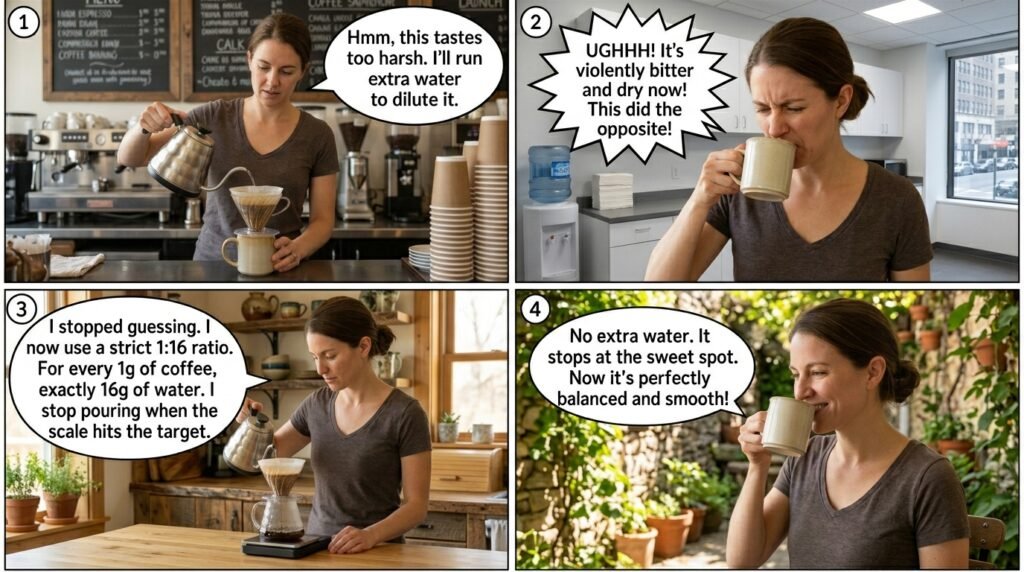
When the coffee tastes too strong or too harsh, the natural instinct is to run more water through the coffee machine to “dilute” it. I used to do this all the time. I would keep pouring hot water over the grounds, filling my mug to the absolute brim, hoping the extra water would weaken the bitter taste.
This is the exact opposite of how coffee extraction works.
Remember the chronological phases of brewing? When you run more water through the same bed of coffee grounds, you are not diluting the coffee. You are continuing the extraction process. You are actively washing more and more bitter tannins out of the exhausted coffee grounds and directly into your mug.
Running extra water through the filter guarantees a violently bitter, dry, astringent cup of coffee.
I completely stopped guessing. I bought a digital scale, and I now follow a strict 1:16 ratio. For every one gram of coffee, I use exactly sixteen grams of water. When the scale hits the target weight, I stop pouring. I do not add a single drop of extra water, ensuring the extraction stops exactly at the sweet spot.

The Invisible Oil Slick
The final step I took to eradicate bitterness from my life required no brewing skills whatsoever. It just required soap.
For the first few years, I was incredibly lazy about cleaning my equipment. I would just rinse my glass pour-over cone with hot water. I never washed the inside of my insulated metal travel mug. I just assumed that coffee couldn’t leave behind anything dangerous.
I was ignoring the physical reality of coffee oils.
When you brew coffee, a microscopic layer of oil coats every single surface it touches. If you do not wash those surfaces with soap, those oils begin to oxidize. Within two days, they turn rancid.
I was taking incredibly expensive, sweet, freshly ground Guatemalan and Ethiopian coffees, and I was brewing them directly through a layer of rotting, rancid oil every single morning. The old oil added a distinctly bitter, dirty, stale background flavor to every single cup I made.
The moment I started aggressively scrubbing my brewing equipment and my mugs with hot water and unscented dish soap, that phantom bitterness completely vanished. The coffee became impossibly clean and vibrant.
Listen to the Music
Bitterness is not a requirement. It is not an unavoidable reality of drinking coffee. It is simply an alarm bell.
When your coffee tastes bitter, the beans are trying to tell you that something in the kitchen has gone wrong. The volume knob is turned up too high, and the music is distorting.
If you are currently forcing yourself to drink bitter coffee, or hiding the flavor beneath an avalanche of sugar, I challenge you to turn the distortion down.
Stop buying burnt, black beans. Dial your grinder to a slightly coarser setting. Let your boiling water rest for sixty seconds before you pour. Stop adding extra water to the filter, and actually wash your coffee mug with soap.
When you finally eliminate the careless mistakes that cause over-extraction, the bitterness will fade away. And what you are left with is the pure, sweet, incredibly complex music of the coffee cherry—a masterpiece that you will never want to hide with milk and sugar ever again.

My name is Daniel Carter, I am 35 years old, and I live in the United States. I have been passionate about aquariums for many years, and what started as a simple hobby quickly became a lifelong interest in aquatic life, fish behavior, and responsible tank care.
Through TheBrightLance, I share real experiences, practical knowledge, and honest lessons learned from maintaining different types of aquariums. I enjoy testing equipment, studying fish behavior, improving maintenance routines, and helping beginners avoid common mistakes.
My goal is to make aquarism easier, more ethical, and more enjoyable for everyone — whether you are setting up your very first tank or looking to refine your techniques.