
In the world of visual composition, whether you are generating complex digital images or meticulously editing a photograph, it is incredibly easy to develop a severe case of tunnel vision.
I will often spend hours hyper-focused on the primary subject of an image. I will carefully adjust the lighting on a specific model’s face, ensuring the shadows under the cheekbones are mathematically perfect and the eyes are razor-sharp. I will obsess over the central figure until it is flawless.
But any experienced visual artist will tell you that the subject itself is only half of the equation.
The true emotion of a visual masterpiece is actually dictated by the “negative space.” Negative space is the empty, unoccupied area surrounding the subject. It is the blank wall, the out-of-focus background, the quiet, empty sky.
If you crop the image too tightly and crowd the subject, the photograph feels claustrophobic, intense, and anxious. But if you pull the camera back and provide breathable negative space, the image instantly feels calm, inviting, and human. The empty space is what actually allows the viewer to connect with the art.
For the first decade of my adult life, my social interactions lacked negative space.
They were intense, pressured, and tightly cropped. But as I slowly traded my cheap, utilitarian caffeine habit for the deliberate ritual of specialty coffee, I discovered a profound social loophole.
Coffee is the ultimate negative space for human connection. Here is the honest, deeply psychological story of why coffee brings people together, how a simple roasted seed completely dismantles our modern social anxieties, and why a warm ceramic mug is the greatest social tool ever invented.
The Pressure of the Modern Invitation
To understand why coffee is so effective at bringing people together, we first have to look at the architecture of modern adult friendships.
We live in a deeply lonely, hyper-connected era. We communicate constantly through text messages and emails, but these digital formats have absolutely no negative space. They are immediate, demanding, and sterile. We desperately crave real, analog human connection, but the actual logistics of achieving it are terrifying.
Asking another adult to “hang out” feels incredibly heavy.
If you invite a new acquaintance to dinner, the stakes are massively high. It implies a significant financial investment. It requires you to sit across a table from someone for two or three hours, maintaining a high-level conversation while staring directly into their eyes. It feels like an interview.
If you invite someone to a bar, the environment is usually so loud that you have to scream to be heard, and the entire social dynamic relies on the consumption of alcohol to numb the awkwardness.
But coffee operates on a completely different psychological wavelength.
Discovering this low-pressure alternative was the precise foundation of (How Coffee Became a Social Habit in My Life). I realized that “getting coffee” is the most brilliant, low-stakes invitation in modern society.

The Ultimate Social Loophole
When you ask someone to grab a cup of coffee, you are offering an invitation with a built-in safety net.
The interaction has a natural, globally understood expiration date. A standard cup of coffee takes exactly thirty to forty-five minutes to consume. If you meet someone and the conversation is awkward, forced, or simply boring, you do not have to invent a complex excuse to leave.
You simply wait for the liquid to disappear, politely announce that you have to get back to your computer, and walk away. No feelings are hurt. The social contract was fulfilled.
But if the connection is genuine, coffee is infinitely scalable. You can sit at that tiny wooden table for three hours, order a second cup, and talk until the sun goes down.
It is completely neutral territory. It provides the perfect amount of breathable negative space. You are not trapped, which ironically makes you want to stay longer.
The Psychological Prop
One of the most powerful, invisible reasons coffee brings people together is the physical object itself.
Human beings are naturally anxious creatures. When we are placed in a room with someone we do not know very well, our bodies tense up. We don’t know what to do with our hands. We cross our arms, adopting a defensive, closed-off posture.
A heavy, warm ceramic mug completely dismantles this physical anxiety.
When you hand someone a hot cup of coffee, you give their hands a job. They wrap their fingers around the warm ceramic. They blow gently on the steam. They take a slow, careful sip.
This simple physical act lowers their defensive posture. It allows them to break eye contact naturally without seeming rude. When a conversation hits a quiet lull, instead of panicking to fill the silence with awkward small talk, you simply take a sip of your drink.
The coffee absorbs the silence. It transforms an awkward pause into a thoughtful, comfortable moment of reflection.

The Confessional at the Kitchen Counter
The connective power of coffee becomes even more staggering when you bring the ritual into your own home.
When I used to offer friends a can of soda or a glass of water, the interaction was completely transactional. I handed them a drink, and we sat on the couch.
But when I started brewing specialty coffee manually, the entire dynamic of my apartment changed.
When a friend comes over now, I initiate the ritual. I pull out my digital scale, my manual burr grinder, and my glass V60 pour-over cone. I weigh the beans. I hand-grind the coffee, letting the intense, sweet aromatics fill the room.
Because the pour-over method requires exactly four minutes of continuous, slow pouring, I cannot walk away. I am anchored to the kitchen counter.
My guest naturally walks over and leans against the counter to watch.
The mechanical crunch of the grinder and the hiss of the steam create a mesmerizing, unhurried atmosphere. Without fail, the conversation in those four minutes immediately bypasses superficial topics.
We talk about life, stress, and real emotions. Recognizing this deeply intimate shift was the defining moment of (How Coffee Connects People in Ways I Didn’t Expect). The deliberate slowness of the preparation gives people permission to drop their guard. The kitchen counter becomes a confessional booth.
The Chemical Icebreaker
We also have to acknowledge the biological reality of the beverage. Coffee brings people together because it literally alters our brain chemistry in a highly specific, pro-social way.
Unlike alcohol, which is a central nervous system depressant that numbs our reactions and blurs our focus, caffeine is a mild stimulant.
When you drink a cup of high-quality coffee, it triggers the release of dopamine in your brain. It gently elevates your mood. But more importantly, it sharpens your cognitive focus.
When you are sitting across from someone in a café, the caffeine makes you more alert. It makes you a better listener. You are more engaged in the conversation, more receptive to their ideas, and more articulate in your responses.
It is the perfect chemical icebreaker. It provides the exact amount of energy needed to bridge the gap between two isolated human beings.
The Ambient Community
But you do not even need to be talking to someone to feel the connective power of coffee.
As a digital worker, I spend countless hours alone in my apartment. The isolation can become deafening. When the silence gets too heavy, I pack my laptop and walk to a local, independent roastery.
I do not go there to talk to anyone. I go there for the ambient community.
The coffee shop is one of the last remaining “Third Places” in modern society—a public space that is neither your home nor your strict workplace. It is an equalizer.
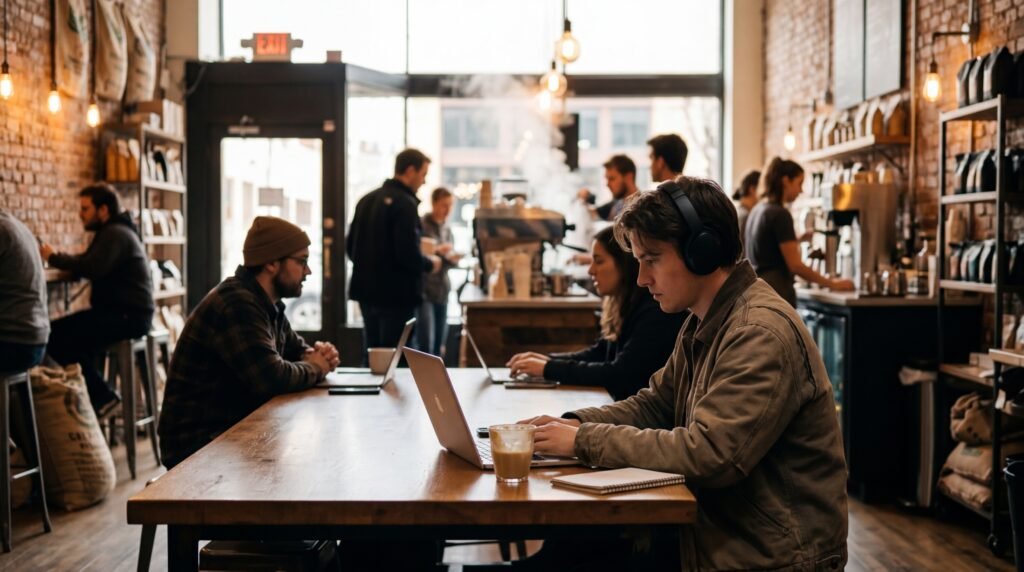
When you sit at a communal wooden table in a bustling café, you are surrounded by humanity. You hear the high-pitched squeal of the espresso machine’s steam wand. You hear the low, decipherable murmur of a dozen different conversations. You smell the heavy, caramelized sugars in the air.
Immersing myself in this shared, public sanctuary was the core lesson of (What I Learned From Visiting Different Coffee Shops). I realized that simply occupying the same physical space as other people, united by the exact same beverage, provides a profound sense of psychological relief.
You are alone, but you are part of a vibrant, living ecosystem.
The Universal Translator
Finally, coffee brings people together because it completely ignores demographic boundaries.
I work in a highly technical, digital field. If I try to explain artificial intelligence rendering algorithms to my older relatives, the conversation hits an immediate brick wall. We live in completely different technological realities.
But coffee requires no software updates.
When I go to visit my family, I bring my brewing equipment. When I hand my grandfather a steaming cup of freshly roasted Guatemalan coffee, we do not need to speak the same digital language.
We speak the language of warmth, flavor, and tradition. We talk about the sweet, chocolatey notes of the bean. We talk about the craftsmanship. The simple agricultural seed acts as a universal translator, effortlessly bridging a massive generational divide.
Give the Canvas Room to Breathe
If you are currently feeling the heavy weight of modern isolation, I urge you to look at how you are composing the picture of your life.
If you are only communicating through frantic text messages and stressful, high-stakes dinner invitations, your image is cropped too tightly. You are suffocating the subject. You need to introduce some negative space.
You need to step back.
Do not plan a massive social event. Just buy a bag of premium, single-origin coffee from a local roaster. Text a friend you haven’t seen in months and ask if they have thirty minutes to grab a cup. Or invite them to lean against your kitchen counter while you pour hot water over a glass cone.
When you stop treating coffee as a private, utilitarian drug and start treating it as a tool for connection, your entire lifestyle will shift.
You will quickly realize that the caffeine spike is just a secondary byproduct. The true magic of the coffee bean is its incredible, ancient ability to give us a quiet, safe, empty space to simply be human together.

My name is Daniel Carter, I am 35 years old, and I live in the United States. I have been passionate about aquariums for many years, and what started as a simple hobby quickly became a lifelong interest in aquatic life, fish behavior, and responsible tank care.
Through TheBrightLance, I share real experiences, practical knowledge, and honest lessons learned from maintaining different types of aquariums. I enjoy testing equipment, studying fish behavior, improving maintenance routines, and helping beginners avoid common mistakes.
My goal is to make aquarism easier, more ethical, and more enjoyable for everyone — whether you are setting up your very first tank or looking to refine your techniques.