
When you study the deep, rich history of traditional Japanese tattoos, you quickly realize that the art form is never just about putting ink into the skin.
It is fundamentally about lineage.
A master artist doesn’t simply wake up one day and invent a design. When they draw a massive, coiling snake winding its way through dark waves and heavy peonies, they are inheriting a centuries-old tradition. Every scale on the snake, every curve of the wind bars, and every shade of black ink carries the weight of the masters who came before them.
You aren’t just wearing an image. You are wearing a piece of living, breathing history. You are wearing a story of dedication, survival, and preservation.
For the first decade of my adult life, I treated my morning coffee with the exact opposite mindset.
I viewed coffee as a cheap, disposable, modern commodity. I thought it was just brown powder that magically appeared on supermarket shelves in plastic tubs, manufactured by some faceless corporation to help me wake up for work.
I had absolutely no idea that the liquid in my mug had one of the most violent, romantic, and statistically improbable histories of any agricultural product on the face of the earth.
When I finally took the time to read about how the coffee bean actually conquered the globe, it completely shattered my worldview. Here is the breathtaking, cinematic story behind coffee that made me appreciate it more, the epic journey of smuggling and survival, and how knowing the history forever changed the way I brew my morning cup.
The Legend of the Dancing Goats
Like all great historical epics, the story of coffee begins with a myth.
While historians debate the exact dates, the legend places the discovery of the coffee bean in the ancient, high-altitude coffee forests of the Ethiopian plateau, sometime around the 9th century.
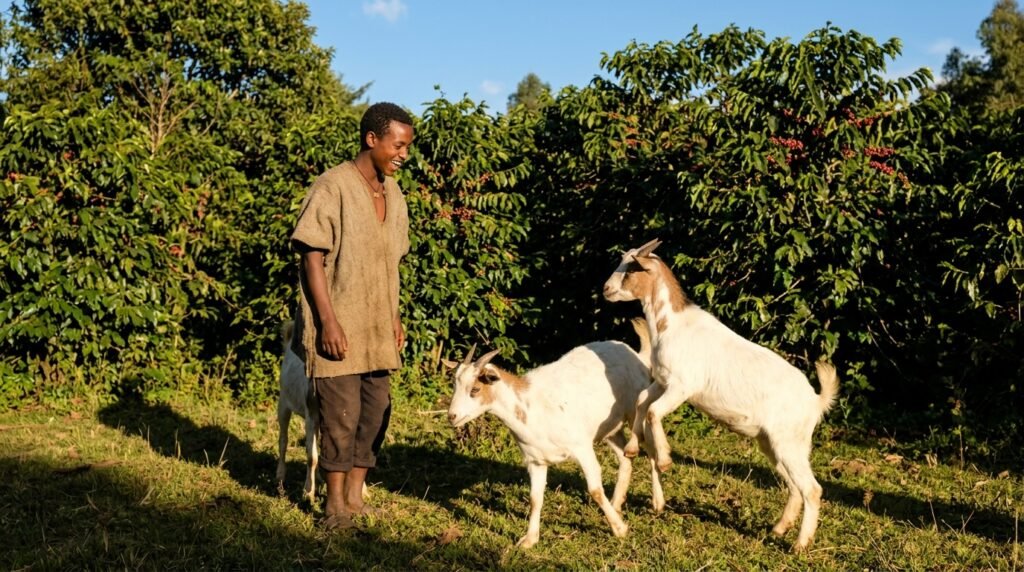
The story goes that a young goat herder named Kaldi was out watching his flock. He noticed that his goats were acting incredibly strange. They were full of boundless energy, dancing, running, and refusing to sleep at night.
Kaldi investigated and found that the goats had been eating the bright red berries from a specific, unfamiliar tree.
Curious, Kaldi ate a few of the red berries himself. Soon, he was experiencing the exact same rush of intense, euphoric energy. He gathered a handful of the fruit and brought them to the abbot of a local monastery.
The abbot, thinking the mysterious berries were the work of the devil, threw them into a roaring fire. But as the seeds inside the berries began to roast in the flames, they released an incredibly intoxicating, heavy aroma.
The monks quickly raked the roasted beans out of the fire, crushed them, and dissolved them in hot water to preserve them.
They drank the dark liquid and realized it kept them awake and alert during the long hours of evening prayer. The first cup of coffee had been brewed.
The Arabian Monopoly and the Port of Mocha
Word of this miraculous, energy-giving beverage quickly spread from the Ethiopian plateau across the Red Sea and into the Arabian Peninsula.
By the 15th century, coffee was being heavily cultivated in the Yemeni district of Arabia. It became an integral part of the culture, leading to the creation of the world’s very first public coffee houses, known as qahveh khaneh.
These coffee houses became the epicenters of social life, music, and political debate.
The rulers of Yemen quickly realized that they were sitting on a global goldmine. The demand for coffee from European travelers and merchants was exploding, and Yemen had absolute, uncompromised control over the global supply.
They established a ruthless monopoly.
To ensure that no other country could plant their own coffee trees, the Yemeni authorities strictly forbade the export of any fertile coffee beans. Before a coffee bean was allowed to leave the famous Port of Mocha, it was plunged into boiling water or heavily roasted to completely sterilize the seed.
They were protecting their lineage. If you wanted coffee, you had to buy it from them.
The Ultimate Heist: Baba Budan
For decades, the Yemeni monopoly was unbreakable. But the allure of the coffee bean was simply too strong for the rest of the world to accept defeat.
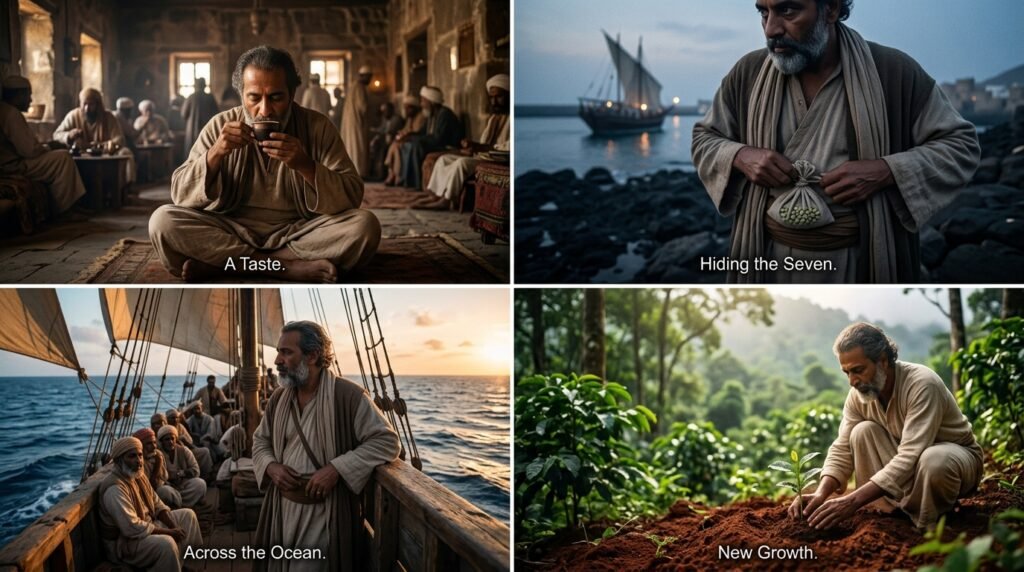
In the 17th century, a Sufi saint from India named Baba Budan went on a pilgrimage to Mecca. During his travels, he tasted the dark, intoxicating beverage and became absolutely obsessed with it. He knew he had to bring it back to his homeland.
Baba Budan accomplished what no merchant, army, or spy had been able to do.
He managed to acquire seven raw, unroasted, fertile coffee seeds. Knowing that he would be searched by the strict port guards before leaving Arabia, he strapped the seven tiny seeds directly to his stomach and taped them to his chest, hiding them deep within his robes.
He smuggled the seeds onto a ship and successfully carried them all the way back to the mountains of Mysore in southern India.
He planted the seven seeds, and they grew.
The unbreakable monopoly was finally shattered. Those seven smuggled seeds became the genetic foundation for the entire expansion of the global coffee trade. Realizing the sheer fragility of this agricultural spread is exactly (What I Discovered About Coffee Farming Around the World), because one man’s bravery literally planted an industry.
The Royal Gift and the Glass Greenhouse
Once the monopoly was broken, the European colonial powers began a frantic race to cultivate coffee in their own tropical territories.
The Dutch were the first to succeed commercially, securing coffee seedlings and bringing them to the island of Java in Indonesia. The industry exploded.
In 1714, the Mayor of Amsterdam wanted to curry political favor with the most powerful man in Europe: King Louis XIV of France. As a diplomatic gift, the Mayor presented the King with one single, healthy, beautiful coffee plant.
King Louis XIV was fascinated by the exotic plant. He ordered his royal botanists to build a massive, heated glass greenhouse in the Royal Botanical Garden in Paris just to protect this one single tree.
This tree became known as the “Noble Tree.” It was pampered, protected, and guarded by the French military.
Gabriel de Clieu’s Desperate Voyage
While the King was enjoying his private coffee tree in Paris, a young French naval officer named Gabriel de Clieu was stationed in the Caribbean territory of Martinique.
De Clieu had a vision. He realized that the tropical climate of the Caribbean was perfect for coffee cultivation. If he could get his hands on a coffee plant, he could turn Martinique into an agricultural powerhouse.
He traveled back to Paris and formally requested a clipping from the King’s Noble Tree. He was immediately denied.
Undeterred, De Clieu decided to take matters into his own hands. In 1720, he famously led a daring midnight raid on the Royal Botanical Garden. He scaled the walls, broke into the glass greenhouse, and successfully stole a small, fragile clipping from the Noble Tree.
He placed the tiny plant inside a custom-made glass box to protect it from the salt water and boarded a ship back to the Caribbean.
What followed was one of the most harrowing naval voyages in history.
De Clieu’s ship was attacked by Tunisian pirates and narrowly escaped. They survived a massive, violent hurricane that nearly sank the vessel. And finally, the ship became stranded in the doldrums—a windless part of the ocean—for over a month.
Drinking water had to be severely rationed. The crew was dying of thirst.
Gabriel de Clieu, knowing the historical importance of the tiny plant sitting in its glass box, made a sacrificial choice. He shared his meager, daily water ration with the coffee plant to keep it alive, while he suffered from severe dehydration.
The Father of a Continent
Against all odds, De Clieu and the tiny, battered coffee clipping survived the voyage.
He planted the tree in the rich, volcanic soil of Martinique. He surrounded it with a wall of thorn bushes and placed armed guards around it to protect it from jealous neighbors.
The tree flourished. It produced seeds. Those seeds were planted, and they produced more trees.
Within fifty years of De Clieu bringing that single, fragile clipping to the Caribbean, there were roughly 18 million coffee trees growing on the island of Martinique.
But the story doesn’t end there. The seeds from De Clieu’s tree were eventually transported to Haiti, Mexico, and ultimately, South America.
It is estimated that nearly every single Coffea arabica plant growing in Central and South America today—including the massive, world-dominating coffee empire of Brazil—is a direct genetic descendant of that one single tree that King Louis XIV kept locked in a greenhouse in Paris.
Understanding how the soil and climate of these new lands completely altered the flavor profile of those descendant seeds was the exact moment of (The First Time I Understood Coffee Terroir), where I finally tasted the history and the earth in my mug.
The Respect for the Ritual
When I finished reading the story of Gabriel de Clieu sharing his drinking water with a dying plant on a pirate-infested ship, I walked into my kitchen and looked at my coffee grinder.
I felt a profound sense of guilt.
For years, I had been treating this beverage like cheap, disposable trash. I had been buying stale, burnt powder and running it through a sputtering plastic machine without a second thought.
I realized that every single time I hold a handful of specialty coffee beans, I am holding a miracle of human history. I am holding the direct result of Kaldi’s dancing goats, the Yemeni monopoly, Baba Budan’s smuggling run, and a French naval officer’s desperate sacrifice.
This realization completely changed the way I interact with my morning routine. Grasping this epic journey is exactly (How Exploring Coffee Origins Made Me Enjoy Coffee More), because it adds a massive layer of reverence to a previously thoughtless chore.
I stopped rushing the process.

Honoring the Lineage
Today, when I make a cup of coffee, I treat it with the exact same respect that a tattoo artist treats their ink.
I weigh the beans precisely on my digital scale, knowing how much effort it took to grow them. I use a manual burr grinder, listening to the satisfying crunch as the beans break apart and release those ancient, sweet aromatics into the air.
I heat my filtered water to exactly 200°F. I gently pour the water over the grounds in my V60 paper filter, and I watch the coffee bloom.
I stand in my kitchen in total silence for three and a half minutes. I don’t look at my phone. I don’t check my emails. I just watch the water slowly drip into the glass carafe, respecting the unbroken chain of history that brought this liquid into my home.
You Are Drinking History
We live in a world of instant gratification, where the origins of our food and drink are completely hidden behind bright marketing and plastic packaging.
It is easy to forget that the things we consume every single day have deep, profound roots.
If you are currently treating your morning coffee like a cheap adrenaline shot—if you are drinking bitter, stale liquid just to keep your eyes open—I challenge you to remember the story.
Remember the monks throwing the berries into the fire. Remember the smuggler with seven seeds taped to his chest.
Go to a local specialty coffee roaster. Buy a bag of beautiful, light-roast whole beans from Ethiopia, Colombia, or Brazil. Buy a cheap manual pour-over cone and take ten minutes to brew it properly.
When you take a sip of that impossibly sweet, vibrant, complex liquid, you won’t just be tasting blueberries or chocolate. You will be tasting a thousand-year-old lineage. You will finally appreciate the masterpiece in your mug, and you will never view a simple cup of coffee the same way again.

My name is Daniel Carter, I am 35 years old, and I live in the United States. I have been passionate about aquariums for many years, and what started as a simple hobby quickly became a lifelong interest in aquatic life, fish behavior, and responsible tank care.
Through TheBrightLance, I share real experiences, practical knowledge, and honest lessons learned from maintaining different types of aquariums. I enjoy testing equipment, studying fish behavior, improving maintenance routines, and helping beginners avoid common mistakes.
My goal is to make aquarism easier, more ethical, and more enjoyable for everyone — whether you are setting up your very first tank or looking to refine your techniques.