
Whenever I am working on synthesizing a complex digital image, specifically when I am trying to perfectly preserve the facial identity of a specific model from a reference file, there is always a moment of intense, underlying anxiety.
I spend hours adjusting the parameters. I meticulously write the prompt, tweak the lighting weights, adjust the sampling steps, and set the rendering engine. But no matter how perfectly I set up the variables, there is always a leap of faith.
When I finally click the “Generate” button, I have to sit back and watch the progress bar load. Until that bar hits one hundred percent and the final image renders on my screen, I have absolutely no idea if I am going to get a photorealistic masterpiece, or a terrifying, distorted, unusable mess.
That exact feeling of nervous anticipation—that tense transition from theory to reality—is precisely how I felt standing in my kitchen a few years ago.
I was staring down at a dark gray, heavy-duty plastic cylinder sitting on top of my favorite ceramic mug. I had my hands resting on the plunger, ready to push. It was my very first time using the legendary, highly debated AeroPress coffee maker.
Here is the honest, unfiltered story of my first time using an AeroPress, the confusing instructions that almost derailed me, the incredibly satisfying physical mechanics of the plunge, and how the resulting liquid completely shattered my expectations of what home-brewed coffee could be.
The Unromantic Unboxing
My journey with this device started out of pure curiosity, fueled by relentless internet hype.
If you spend more than five minutes on any specialty coffee forum, someone will aggressively tell you to buy an AeroPress. They talk about it with an almost religious fervor. I finally caved and bought one.
When the hexagonal cardboard box arrived at my apartment, I was immediately underwhelmed by the aesthetics.
I was used to the specialty coffee world being defined by elegance. I was used to looking at beautiful, fragile glass hourglasses, polished stainless steel gooseneck kettles, and minimalist ceramic cones.
The AeroPress possessed absolutely none of that elegance.
It looked like a giant, dark plastic medical syringe. It came with a weird, oversized plastic stirring paddle that looked like a miniature golf putter, a bulky plastic funnel, and a stack of tiny, flimsy circular paper filters. It looked like a camping toy.
I learned that it was actually invented by Alan Adler, an engineer and physicist who also invented the Aerobie flying ring—the toy that holds the Guinness World Record for the farthest thrown object.
It made sense. It didn’t look like a coffee brewer; it looked like an aerodynamic engineering project.

The Conflicting Blueprints
The anxiety really started when I unfolded the paper instructions included in the box.
Alan Adler’s official instructions were completely counter-intuitive to everything I had ever learned about coffee brewing.
The manual told me to use a very fine grind size, almost like espresso powder. It told me to use water that was surprisingly cool, around 175°F (80°C). And most shockingly, it told me to stir the coffee for a mere ten seconds before immediately plunging.
This short, ten-second contact time broke every rule in my brain. I was used to letting my French Press steep for four full minutes.
To make matters worse, I had watched dozens of videos online of professional baristas completely ignoring these official instructions. The internet had invented the “Inverted Method,” where you balance the entire syringe upside down, steep the coffee for three minutes, and use boiling water.
I was paralyzed by the paradox of choice. Transitioning to manual brewing is always a bit overwhelming, which is the exact premise of (Why Pour-Over Coffee Felt Complicated at First). I was staring at this plastic tube, terrified I was going to ruin my expensive beans.
I took a deep breath. For my very first run, I decided to trust the engineer who invented the device. I followed the official instructions in the box.
The Setup and the Variables
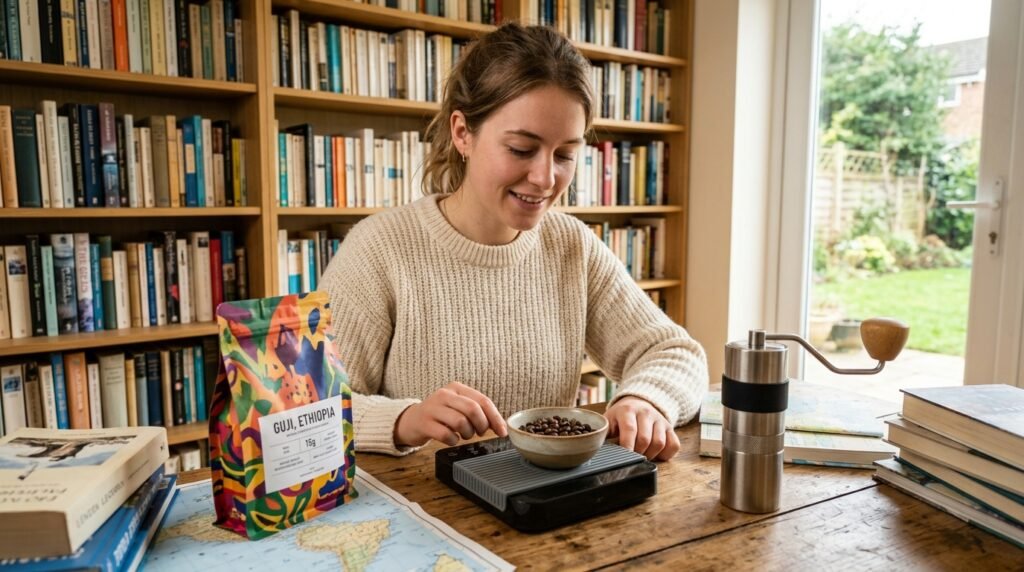
I pulled out a fresh bag of lightly roasted, naturally processed coffee from the Guji region of Ethiopia. This specific coffee was known for having intense, wild flavors of ripe blueberries and milk chocolate.
I grabbed my manual burr grinder and adjusted the dial to a fine setting, much finer than I would ever use for a standard drip machine. I weighed out exactly 15 grams of the beans and ground them down into a soft, sandy powder.
I boiled my kettle, but I followed the manual’s advice. I took it off the heat and let it sit for a few minutes until the water cooled down to roughly 180°F.
I took one of the tiny circular paper filters and placed it inside the plastic, perforated cap. I twisted the cap securely onto the bottom of the main chamber and placed the entire cylinder directly on top of my sturdy ceramic mug.
I dumped the 15 grams of ground Ethiopian coffee into the chamber. It sat at the very bottom, waiting.
The Ten-Second Race
This is where the process became incredibly fast and tactical.
I grabbed my kettle and poured the hot water into the plastic chamber. I didn’t use a scale for the water this time; I just filled it up to the number “2” printed on the side of the plastic, exactly as the instructions dictated.
The moment the water hit the coffee, I grabbed the weird plastic stirring paddle.
I vigorously stirred the slurry. The wet coffee grounds bubbled and foamed, releasing a massive, overwhelming wave of blueberry aromatics into my kitchen. It smelled incredible.
I counted to ten in my head. One, two, three…
The speed of the process was jarring. I felt like I was defusing a bomb. There was no slow, meditative pouring. There was no quiet observation. It was pure, kinetic action.
When I hit ten seconds, I immediately dropped the paddle and grabbed the plunger.
The Plunge and the Pressure
I inserted the rubber seal of the plunger into the top of the brewing chamber.
The moment the rubber made contact with the plastic walls, it created a perfect, airtight vacuum seal. I placed both of my hands flat on top of the plunger, leaned my body weight forward, and began to press down.
This physical sensation was the absolute highlight of the experience.
It didn’t feel like pushing a French Press, where the metal mesh simply glides through the liquid. The AeroPress fought back. The dense bed of finely ground coffee, combined with the tiny pores of the paper filter, created a massive wall of physical resistance.
I had to use steady, firm, consistent muscle power to force the trapped air down, which in turn forced the hot water straight through the coffee grounds.
It felt incredibly satisfying. I could feel the pneumatic pressure building under my palms. I was physically extracting the flavor myself.
The plunger slowly descended. As it reached the very bottom of the chamber, squeezing the last few drops of liquid through the compressed coffee grounds, the device let out a loud, distinct, and incredibly satisfying Hissing sound.
The air had broken through the puck. The extraction was complete.
The Liquid Result
I lifted the AeroPress off my mug and set it in the sink.
I looked down into my cup. The liquid inside was not a full mug of coffee. It was a tiny, concentrated, dark shot of liquid, roughly two or three ounces in total. It looked very similar to a double shot of espresso.
Following Adler’s instructions, I was supposed to drink this as a concentrated shot, or dilute it with hot water to create a standard Americano-style cup.
I wanted to taste the raw output first. I picked up the mug, let it cool for a few seconds, and took a tiny sip of the concentrate.
My eyes widened in absolute shock.
It was unlike anything I had ever brewed in my kitchen. Because I used a paper filter, the liquid was completely devoid of the muddy, gritty sludge that usually ruins immersion brewing. It was pristinely clean on my palate.
But because I used intense physical pressure to force the water through the grounds, the body of the coffee was incredibly heavy, syrupy, and thick.
The flavor was explosive. The ten-second brew time completely prevented any harsh, bitter tannins from extracting. All that ended up in the cup was the vibrant, sweet, juicy blueberry notes of the Ethiopian bean, wrapped in a heavy chocolate finish.
It was profoundly sweet. It was so perfectly balanced that it almost tasted like a dessert. Escaping the harsh bitterness of my old routines was a massive relief, which perfectly mirrors (From Instant Coffee to AeroPress: My Journey).
I poured some extra hot water into the mug to dilute it into a full cup of coffee. Even diluted, it retained its heavy, velvet body and pristine flavor clarity. It was a masterpiece.

The “Puck Pop” (The Greatest Cleanup on Earth)
As thrilled as I was with the taste, the AeroPress had one final trick up its sleeve that officially won my heart forever.
I walked over to the kitchen trash can holding the plastic cylinder. The wet, used coffee grounds were packed tightly at the bottom.
Normally, cleaning a coffee maker is a miserable chore. You have to scrape wet, muddy sludge out of a glass beaker or violently shake a plastic cone to dislodge a wet paper filter.
With the AeroPress, I simply twisted the perforated plastic cap off the bottom.
I pointed the open end of the cylinder into the trash can, and I gave the plunger one final, firm push.
With a loud, incredibly satisfying POP, a perfectly solid, dry, compact hockey puck of used coffee grounds shot out of the plastic tube, carrying the paper filter with it, and landed cleanly in the trash.
The inside of the plastic cylinder was almost completely clean. The rubber plunger had squeegeed the walls perfectly. I just ran it under warm tap water for three seconds, and the entire device was spotless and ready to be stored away.
The cleanup took less than five seconds. It was a revelation of engineering.
The Gateway to Experimentation
That first morning with the AeroPress completely changed my perspective on coffee brewing rules.
It proved to me that you don’t necessarily need a three-minute steep time, and you don’t always need boiling water. The addition of physical pressure completely alters the chemistry of the extraction.
Realizing that pressure could bypass the traditional rules of brewing time was exactly (The Brewing Method That Changed Everything for Me), because it opened my mind to entirely new ways of manipulating flavor.
Since that first honest experience, I have gone down the rabbit hole. I have tried the Inverted Method. I have tried brewing over ice. I have tried making concentrated milk drinks. The AeroPress can do it all. It is practically indestructible, incredibly cheap, and endlessly versatile.
Don’t Let the Plastic Fool You
If you have been avoiding the AeroPress because it looks like a cheap camping toy or a weird medical device, you are making a massive mistake.
Do not let the unromantic plastic aesthetic fool you.
Underneath that ugly exterior is one of the most brilliant, forgiving, and capable brewing tools ever invented. It bridges the gap between the heavy, comforting body of a French Press and the pristine, clean clarity of a paper-filtered pour-over.
Buy the weird plastic syringe. Follow the instructions in the box for your first run.
When you feel that pneumatic pressure building under your hands, hear that satisfying final hiss, and pop that solid puck of coffee into the trash can, you will finally understand the hype. And when you taste the incredibly sweet, rich liquid it produces, you will probably never want to use anything else ever again.

My name is Daniel Carter, I am 35 years old, and I live in the United States. I have been passionate about aquariums for many years, and what started as a simple hobby quickly became a lifelong interest in aquatic life, fish behavior, and responsible tank care.
Through TheBrightLance, I share real experiences, practical knowledge, and honest lessons learned from maintaining different types of aquariums. I enjoy testing equipment, studying fish behavior, improving maintenance routines, and helping beginners avoid common mistakes.
My goal is to make aquarism easier, more ethical, and more enjoyable for everyone — whether you are setting up your very first tank or looking to refine your techniques.