
In my digital image generation workflow, I am constantly tempted by the newest, shiniest tools.
Every single week, there is a new experimental model, a complex new upscaling script, or a wild text-to-image workflow that promises to revolutionize everything. I will spend hours downloading these new tools, tweaking the sampling steps, and trying to generate the perfect image. It is an incredibly fun distraction.
But eventually, the novelty always wears off.
When I have a highly specific vision in my head—when I need absolute, predictable control over the lighting, the composition, and the specific facial structure of the subject—I immediately abandon all the experimental toys. I always revert back to my primary, trusted base model.
I know exactly how my base model behaves. I know how it reacts to every single word in my prompt. It gives me uncompromised, naked control.
My kitchen cabinet looks exactly like my computer’s hard drive. It is a graveyard of abandoned, shiny toys.
Over the years, I have purchased massive glass French presses, intricate siphon brewers, complicated home espresso machines, and hybrid immersion tools. I have chased every single coffee brewing trend on the internet. I have spent hundreds of dollars trying to find a magic shortcut to the perfect cup.
But after the honeymoon phase of a new gadget fades, I always find myself reaching for the exact same object. It is a simple, cone-shaped piece of plastic that costs roughly ten dollars.
It is the Hario V60.
Here is the honest, highly technical story of the brewing method I keep coming back to, the brilliant simplicity of its geometric design, and why taking away all the mechanical training wheels is the ultimate secret to a perfect morning routine.
The Seduction of the Coffee Gadget
The specialty coffee industry is brilliant at marketing. They are constantly inventing new brewers that promise to fix all of your extraction problems automatically.
There are flat-bottom brewers that promise to prevent channeling. There are immersion brewers with massive rubber stoppers that promise to eliminate the need for a gooseneck kettle. There are complex, automated drip machines that promise to replicate a professional barista.
I have bought almost all of them.
And the truth is, most of them make a very good cup of coffee. But they all achieve that “good” cup by taking control away from the user. They impose physical limits to prevent you from making mistakes. They restrict the water flow. They flatten the coffee bed for you.
They are the equivalent of a point-and-shoot camera. They are safe, but they are incredibly limiting.
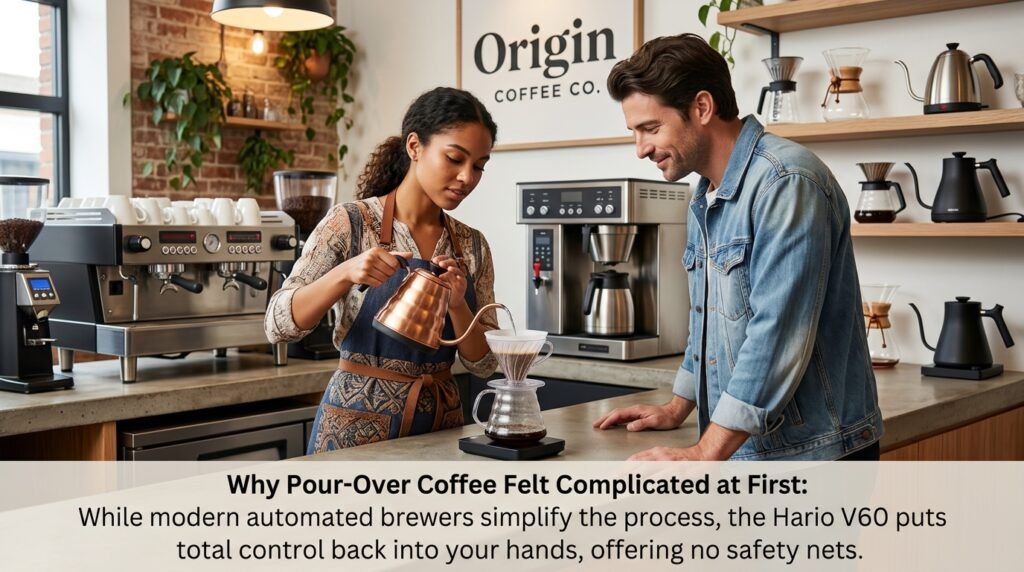
The Hario V60 is the exact opposite. It offers zero safety nets. Overcoming the sheer intimidation of this tool is exactly (Why Pour-Over Coffee Felt Complicated at First), because you quickly realize that the plastic cone isn’t brewing the coffee; you are brewing the coffee.
The Genius of Naked Geometry
At first glance, the V60 looks like an incredibly basic funnel. But its internal geometry is a masterpiece of fluid dynamics.
It gets its name from the precise 60-degree angle of its slopes. This angle forces the water to flow toward the center of the coffee bed, extending the amount of time the water is in contact with the coffee grounds.
Inside the cone, there are distinctive, swirling, spiral ribs that run from the top all the way down to the bottom hole.
These ribs are not there for decoration. When you place a wet paper filter inside the cone, the filter wants to stick to the plastic walls. If it sticks completely, a vacuum forms, and the water stops flowing entirely.
The spiral ribs hold the paper filter slightly away from the plastic wall, creating tiny air channels. This allows the hot air and trapped carbon dioxide to escape from the sides of the brewer, enabling the water to flow smoothly and continuously.
And finally, there is the massive, gaping hole at the very bottom.
This large hole is what separates the V60 from almost every other pour-over cone on the market. It provides absolutely no restriction to the water flow.
The Unforgiving Mirror
Because the V60 has that massive hole at the bottom, the flow of the water is dictated entirely by two things: the size of your coffee grounds, and the speed at which you pour the water from your kettle.
If you make a mistake, the V60 will violently punish you.
If your grind size is too coarse, or if you pour your water too fast, the liquid will rush straight through the massive hole in sixty seconds. Your coffee will taste like hot, sour lemon water.
If your grind size is too fine, the microscopic dust will clog the paper filter. The spiral ribs won’t be able to save you. The water will stall, taking five minutes to drain, and your coffee will taste like dry, burnt ash.
The V60 is an unforgiving mirror. It reflects your technique with brutal honesty.
Understanding how severely this brewer exposes bad habits is the core lesson of (The Simple Brewing Mistakes I Used to Make Every Day). I used to blame the V60 when my coffee tasted bad. I eventually realized that the plastic cone was just the messenger; my technique was the actual problem.
The Reward of Absolute Control
So, why do I keep coming back to a brewer that is so demanding and punishing?
Because when you finally master your variables—when you get your grind size perfect, when your water temperature is spot-on, and when you execute a flawless, gentle, concentric pour—the V60 produces a cup of coffee that no other brewer on earth can match.
The paper filter strips away all the heavy, muddy, bitter coffee oils. It leaves behind a liquid that is breathtakingly clear, ruby-red, and incredibly vibrant.
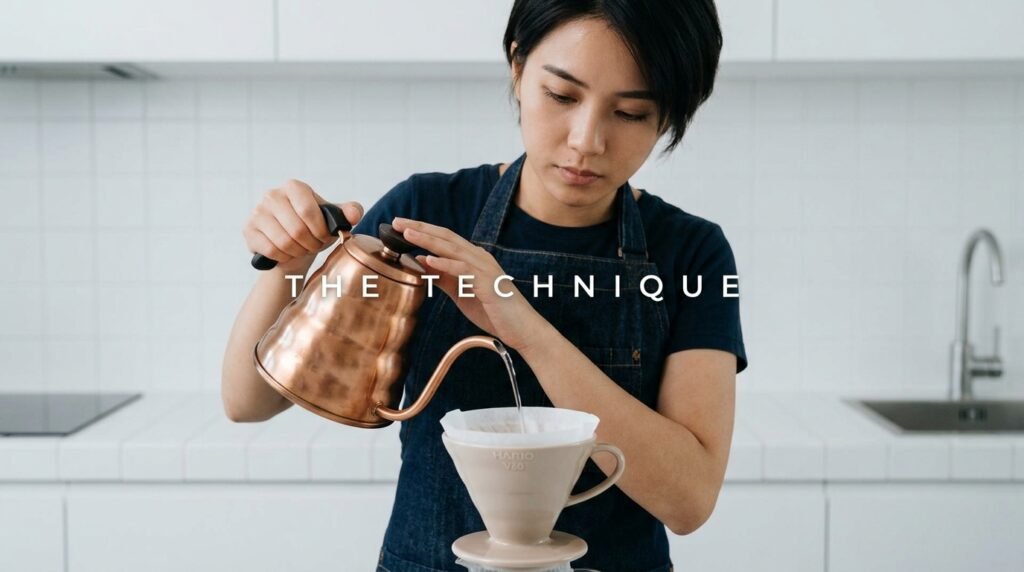
Because you are controlling the flow rate manually, you can manipulate the extraction in real-time.
If I notice the water is draining a little too fast, I can slow down my pouring hand. If I want to extract more heavy sugars, I can break my pour into three separate, smaller pulses to increase the contact time. If I want to highlight the bright fruit acids, I can pour the water in one continuous, heavy stream.
The V60 gives me the manual focus ring. I have absolute authority over the final image.
The Perfect African Canvas
This level of uncompromised clarity makes the V60 the ultimate translator for high-end, light-roast specialty coffee.
If you buy a dark roast from South America, you want a heavy, comforting, thick body. For that, you might use a French Press or an AeroPress.
But if you are buying incredibly complex, bright, floral coffees, you need a delicate canvas. The V60 was practically designed for this flavor profile.
When I brew a washed Ethiopian Heirloom coffee in my V60, the results are staggering. Because the brewer removes all the heavy, distracting “noise” from the cup, the delicate aromatics are thrust into the spotlight.
I can vividly taste the crisp snap of a sweet peach. I can smell the delicate perfume of jasmine blossoms. I can feel the vibrant, tea-like weight of the liquid on my palate.
This flawless translation of complex fruit notes is the exact reason (Why I Keep Going Back to African Coffees). Those expensive beans require a brewer that respects their fragility, and the V60 is the ultimate stage for them to perform on.
The Meditative Anchor
Beyond the geometry, the physics, and the unparalleled flavor clarity, the real reason I keep coming back to the V60 is psychological.
The V60 demands your absolute presence. You cannot multi-task when you are using it.
You cannot press a button and walk away to check your morning emails. You cannot scroll through social media. You have to stand at the kitchen counter with a gooseneck kettle in your hand. You have to watch the digital scale. You have to monitor the timer.
You have to watch the coffee bed physically expand and bubble during the bloom phase. You have to smell the intensely sweet aromatics filling your kitchen. You have to watch the physical flow of the water and adjust the angle of your wrist accordingly.
It takes exactly three and a half minutes.
Those three and a half minutes are my daily, non-negotiable anchor. In a world that constantly demands my attention, pulls me in a dozen different directions, and expects immediate, automated results, the V60 forces me to slow down.
It forces me to do one single thing, with absolute focus and intentionality, before the chaos of the workday begins.

The Forever Tool
I will never stop buying new coffee gadgets. The temptation is simply too strong.
I will always be curious about the newest flat-bottom dripper or the latest hybrid immersion tool. I will happily spend a Saturday afternoon testing a new piece of equipment just to see what it does to the flavor profile of my beans.
But my kitchen counter has limited space. The shiny new toys eventually get cleaned, dried, and placed into the dark cabinet above the fridge.
The Hario V60 never leaves the counter.
It is the base model. It is the trusted foundation of my entire culinary routine.
If you are currently relying on automated machines, or if you are using brewers that restrict the water flow for you, I highly encourage you to take the training wheels off. Buy a plastic V60. Buy a digital scale. Buy a gooseneck kettle.
It will be incredibly frustrating at first. You will make mistakes. You will pour too fast, and you will grind too coarse.
But when you finally sync your movements with the physics of the water, and you taste that impossibly clean, intensely sweet, vibrant cup of coffee that your own two hands completely engineered, you will understand. You will realize that true perfection cannot be automated. It must be crafted. And once you experience that level of naked control, you will keep coming back to it every single morning for the rest of your life.
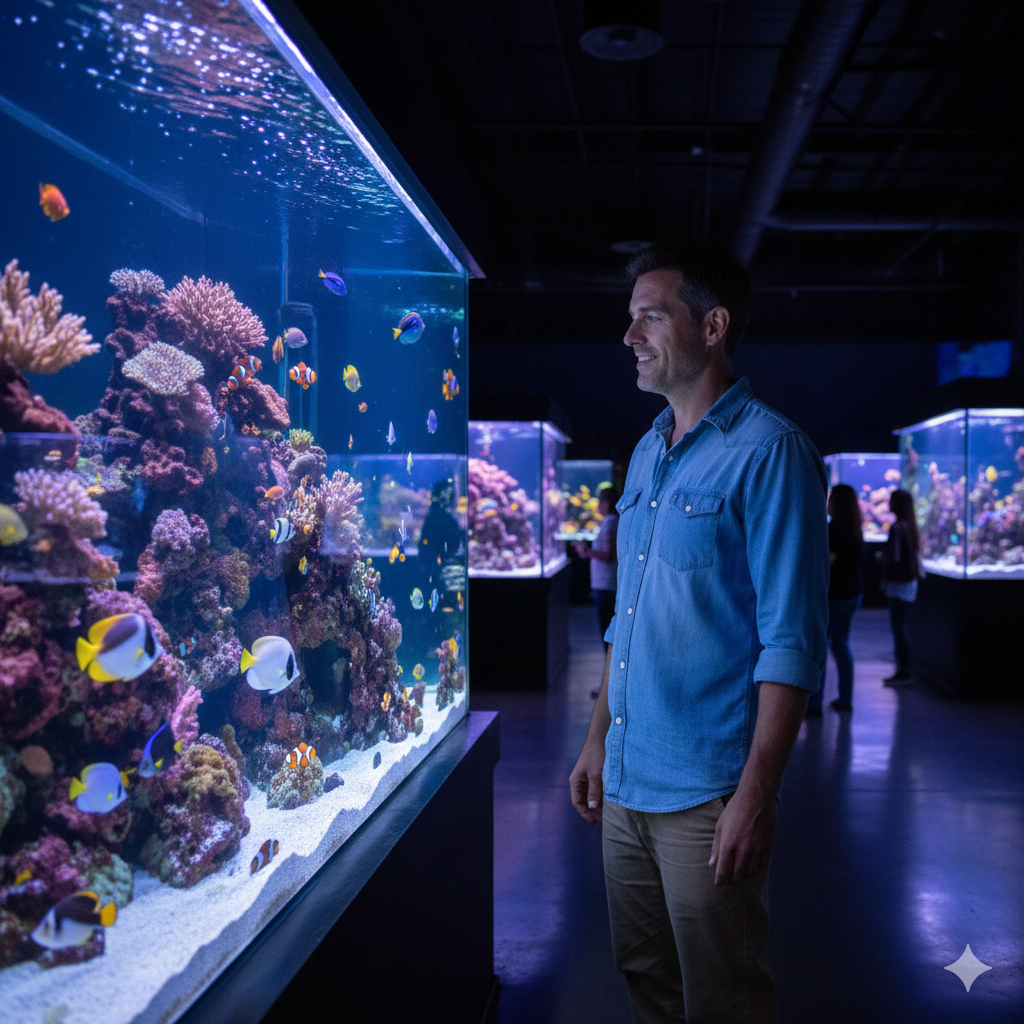
My name is Daniel Carter, I am 35 years old, and I live in the United States. I have been passionate about aquariums for many years, and what started as a simple hobby quickly became a lifelong interest in aquatic life, fish behavior, and responsible tank care.
Through TheBrightLance, I share real experiences, practical knowledge, and honest lessons learned from maintaining different types of aquariums. I enjoy testing equipment, studying fish behavior, improving maintenance routines, and helping beginners avoid common mistakes.
My goal is to make aquarism easier, more ethical, and more enjoyable for everyone — whether you are setting up your very first tank or looking to refine your techniques.