
Whenever I am sitting at my computer, deeply focused on editing a complex photograph, I always face the same frustrating dilemma.
If I need to remove an ugly, intrusive watermark from the background, or if I am trying to seamlessly replace the texture of a piece of clothing to make the portrait look perfect, my editing software always offers me an easy way out. There is always an automated, one-click “content-aware” button that promises to do the job for me in three seconds.
But I almost never use it.
I know from years of experience that automation sacrifices precision for speed. The automated tool always leaves a blurry smudge. It misses the fine details. It creates visual artifacts that ruin the illusion of the image.
If I want the final photograph to be a flawless masterpiece, I have to zoom in to five hundred percent, grab the manual clone stamp tool, and painstakingly rebuild the pixels myself. It takes ten times longer, requires my absolute focus, and forces me to understand the structure of the image. But the result is always breathtaking.
A few years ago, as I was staring at a cheap, plastic automatic drip coffee maker sputtering on my kitchen counter, I realized I was applying two completely different standards to my life.
I demanded absolute, manual perfection in my creative work, but I was entirely willing to let a cheap, automated robot ruin my expensive specialty coffee beans every single morning.
I took the machine, unplugged it, and threw it in the trash.
Here is the honest, highly technical, and deeply psychological story of why I prefer manual brewing over machines, the devastating mechanical flaws hiding inside your automatic drip maker, and how reclaiming control over my mornings changed my life.
The Illusion of the “Smart” Appliance
We live in an era where convenience is marketed to us as the ultimate luxury.
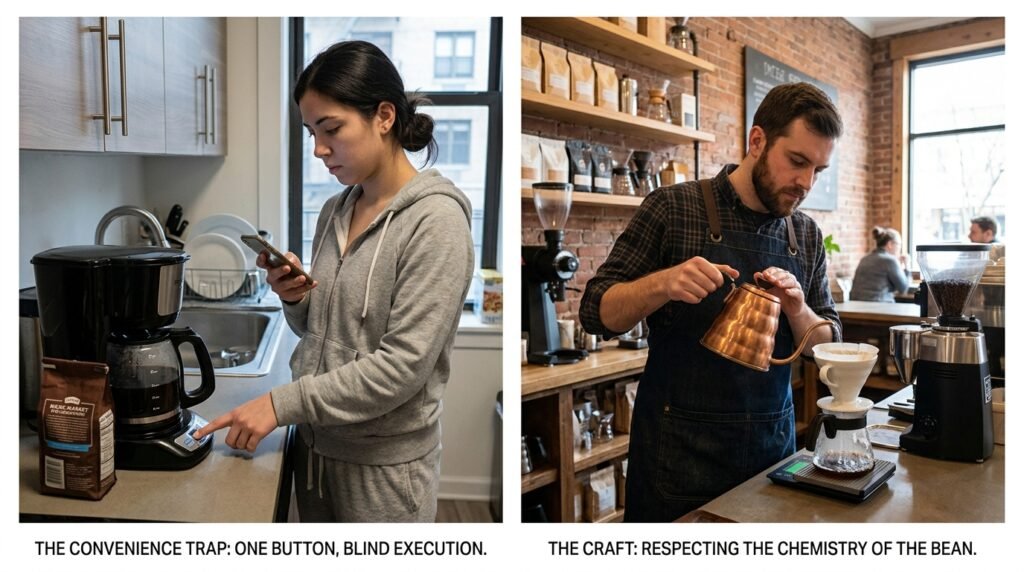
We are told that a machine that allows us to press a single blinking button and walk away is a technological marvel. The automatic drip coffee maker is the ultimate symbol of this modern convenience trap.
You fill the plastic reservoir with tap water. You dump a random scoop of pre-ground beans into a flimsy paper basket. You press “Brew,” and you walk away to stare at your phone. Five minutes later, the machine beeps, and a pot of hot, dark liquid is waiting for you.
It feels like magic. But if you look closely at the mechanics of what that machine is actually doing, the illusion completely shatters.
The machine is not smart. It is entirely blind.
It does not know if you put a dense, high-altitude light roast from Ethiopia into the basket, or if you used a puffy, oily, dark roast from Brazil. It does not know if your beans were roasted yesterday or six months ago.
It treats every single coffee the exact same way. It executes a rigid, unchangeable, automated program that completely ignores the delicate chemistry required to extract a great cup of coffee.
The Failure of the Showerhead
The first massive mechanical failure of the automatic drip machine happens right above the coffee bed.
In a manual pour-over, the barista uses a specialized gooseneck kettle to deliver a gentle, precise, and highly controlled stream of water. They pour in slow, concentric circles, ensuring that every single particle of coffee is evenly saturated at the exact same time.
The automatic machine tries to replicate this using a plastic “showerhead.”
But the showerheads on ninety percent of home machines are completely defective by design. They do not distribute the water evenly. Instead, they usually have one or two large holes in the very center that violently spit water directly into the middle of the coffee grounds.
This creates a disaster known as “Channeling.”
The aggressive water drills a massive crater straight down the center of your coffee bed. The water rushes through this single hole, severely over-extracting the grounds in the middle and making the coffee taste like harsh, bitter ash.
Meanwhile, the coffee grounds sitting on the outer edges of the filter remain completely dry for the first half of the brew. They aren’t being extracted at all.
Trusting a plastic showerhead to evenly distribute water was a painful lesson, and realizing the magnitude of this error is exactly ( The Biggest Brewing Mistake I Didn’t Notice). I was throwing away twenty-dollar bags of specialty coffee because the machine was only actually brewing half of the basket.
The Thermal Rollercoaster
The second reason I completely abandoned automatic machines is their terrifying inability to manage heat.
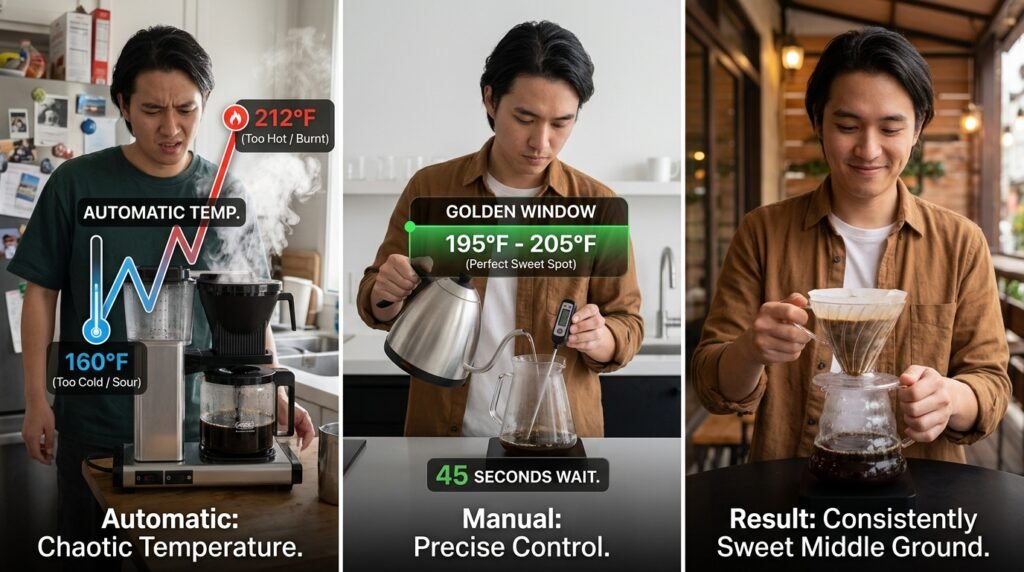
Coffee brewing is a delicate chemical reaction that requires a highly specific temperature range. To properly melt the heavy, sweet sugars trapped inside a roasted coffee bean without burning the delicate floral oils, your water needs to be consistently held between 195°F and 205°F (90°C to 96°C).
If the water is too cold, the coffee is sour and weak. If the water is too hot, the coffee is burnt and bitter.
Manual brewing allows you to use a simple thermometer. You boil the kettle, wait forty-five seconds, and pour exactly when the water hits the golden window.
An automatic drip machine uses a cheap aluminum heating block hidden inside the plastic casing. It operates on a massive thermal rollercoaster.
When you first press the button, the machine struggles to heat up. The first wave of water that hits your coffee is usually lukewarm, hovering around 160°F. This weak, cold water creates a highly sour, under-extracted puddle at the bottom of your carafe.
As the brew continues, the aluminum block violently overheats. By the end of the cycle, the machine is spitting aggressively boiling, 212°F water, violently burning the remaining coffee grounds and extracting harsh, astringent tannins.
The machine forces your coffee to endure both extreme sourness and extreme bitterness in the exact same cycle. Taking away the machine’s control over the heating element is the primary reason (How Water Temperature Changed My Coffee Completely), because manual brewing finally allowed me to extract the sweet middle ground without the burnt edges.
The Missing “Bloom”
Perhaps the most unforgivable sin of the automatic drip machine is its complete lack of patience.
When you pour hot water over freshly roasted, high-quality coffee grounds, a violent chemical reaction occurs. The coffee rapidly releases trapped carbon dioxide gas. The grounds bubble, expand, and physically rise up. This is called the “Bloom.”
If you try to pour your entire kettle of water over the coffee while it is actively releasing gas, the carbon dioxide acts as a physical shield. It repels the water, preventing it from actually touching the coffee particles.
In manual brewing, we account for this. We pour a tiny amount of water to wet the grounds, and then we put the kettle down. We wait for forty-five seconds. We let the coffee exhale, and only then do we resume the pour.
The automatic machine does not care about the bloom.
It does not pause. It just relentlessly dumps water onto the actively degassing coffee. Because the water is being repelled by the carbon dioxide, it simply slides past the coffee grounds and drops into the carafe below, completely empty of flavor.
This is why machine-brewed specialty coffee almost always tastes incredibly weak, watery, and lifeless compared to a manual pour-over.
The Beauty of Infinite Variables
When I threw my machine away and bought a simple glass V60 pour-over cone, a digital scale, and a gooseneck kettle, the training wheels finally came off.
Manual brewing handed me the keys to the entire culinary process.
I was no longer trapped by the rigid programming of a plastic robot. I was finally able to treat my coffee beans like a dynamic, living ingredient.
If I bought a highly acidic, bright African coffee that tasted a little too sharp on Tuesday, I didn’t have to suffer through it for the rest of the week. Because I was brewing manually, I could simply adjust my variables on Wednesday. I could pour the water slightly slower, or grind the beans one click finer, to extract more heavy sugars and balance out the acidity.
This ability to dynamically adapt to the beans in real-time is the ultimate superpower. Executing this level of micro-management is precisely (The Simple Change That Improved My Coffee Instantly), because a machine can never taste the coffee and correct its own mistakes. Only a human palate can do that.
The Danger of the Hot Plate
I also have to address the final insult that the automatic machine delivers to your coffee: the dreaded glass carafe sitting on a searing hot plate.
In an attempt to keep your coffee warm for hours, these machines use a scorching electric heating element underneath the glass pot.
Coffee is a highly volatile, delicate liquid. Once it is brewed, the chemical structure begins to break down immediately. When you force that liquid to sit on a 200-degree hot plate for an hour, you are literally cooking the coffee a second time.
The heat rapidly evaporates the water, condensing the heavy, bitter tannins. The beautiful, complex acids break down into harsh, metallic flavors. Within thirty minutes, that pot of coffee turns into a thick, black, stomach-churning sludge.
Manual brewing eliminates this entirely.
When you use a V60, an AeroPress, or a Chemex, you are brewing single, perfect cups of coffee on demand. You brew exactly what you are going to drink right now. The coffee never sits on a burner. It goes straight from the brewer into a pre-warmed ceramic mug, ensuring that the last sip is just as pristine and sweet as the first.

Reclaiming the Morning Ritual
But beyond the physics, the chemistry, and the absolute superiority of the flavor, my preference for manual brewing is deeply rooted in psychology.
The automatic coffee maker is designed to facilitate a rushed, frantic, mindless morning. It encourages you to stumble into the kitchen, hit a button, and immediately start stressing about your emails or your commute. It turns the act of making coffee into an invisible chore.
Manual brewing forces you to stop.
You cannot check your phone when you are holding a gooseneck kettle and trying to maintain a precise flow rate over a bed of coffee grounds. You have to watch the digital scale. You have to monitor the timer.
It demands your absolute, undivided attention for five minutes.
It is a quiet, analog, highly tactile process. I listen to the mechanical crunch of the burr grinder. I smell the intense, complex aromatics as the coffee blooms and releases its trapped gases. I watch the beautiful, ruby-red liquid slowly drip into the glass carafe.
In a world that is completely dominated by glowing screens, automated alerts, and relentless speed, those five minutes of manual brewing are my daily anchor. It is a mandatory, quiet meditation that grounds me before the chaos of the day begins.
Burn the Content-Aware Button
There is absolutely a time and a place for convenience. I am not suggesting that we should abandon all modern technology.
But when it comes to the things we consume every single day, and the rituals that set the tone for our entire lives, we shouldn’t settle for the blurry, smudged results of a cheap, automated shortcut.
Your morning coffee deserves better than a blind, sputtering plastic box with a defective showerhead.
I challenge you to unplug the machine. Buy a cheap digital scale, a manual pour-over cone, and a bag of incredible, freshly roasted single-origin beans.
Take the camera off auto mode. Grab the manual clone stamp tool.
When you finally take control of the variables, and you taste the impossibly clean, intensely sweet, perfectly balanced liquid that your own two hands engineered, you will realize exactly why the effort is worth it. You will never look at an automatic coffee machine the same way again, and your mornings will never be the same.
My name is Daniel Carter, I am 35 years old, and I live in the United States. I have been passionate about aquariums for many years, and what started as a simple hobby quickly became a lifelong interest in aquatic life, fish behavior, and responsible tank care.
Through TheBrightLance, I share real experiences, practical knowledge, and honest lessons learned from maintaining different types of aquariums. I enjoy testing equipment, studying fish behavior, improving maintenance routines, and helping beginners avoid common mistakes.
My goal is to make aquarism easier, more ethical, and more enjoyable for everyone — whether you are setting up your very first tank or looking to refine your techniques.