
I used to have one of those giant, scratch-off maps of the world hanging on my bedroom wall.
The goal was to slowly reveal the bright colors underneath the gold foil as I traveled to different countries over the course of my life. But looking back at it now, I realize that I have traveled to far more countries through my kitchen mug than I ever have on an airplane.
For the longest time, I thought coffee was just a generic, factory-produced powder. I thought that if you planted a coffee tree in Brazil, it would produce the exact same brown, bitter liquid as a coffee tree planted in Kenya, Indonesia, or Colombia. I assumed the only difference was the logo printed on the bag.
I was entirely wrong.
The first time I tasted a high-altitude African coffee that naturally exploded with the flavor of ripe peaches and jasmine flowers, my brain completely short-circuited. I had to know how a plant could taste like a flower garden on one continent, and taste like a heavy, dark chocolate bar on another.
What I discovered is that coffee is one of the most complex, environmentally sensitive agricultural products on the planet. It is a sponge that absorbs the story of its surroundings.
Here is the honest, fascinating truth about what makes coffee taste different around the world, and how the dirt, the air, and the altitude completely rewrite the genetic code of your morning cup.
The Foundation: The Dirt Under the Tree
If you want to understand flavor, you have to look down at the ground.
In the wine industry, they use a French term called terroir. It roughly translates to “the taste of a place.” It encompasses the soil, the climate, the topography, and every single environmental factor that touches the plant.
Coffee is essentially a liquid representation of terroir.
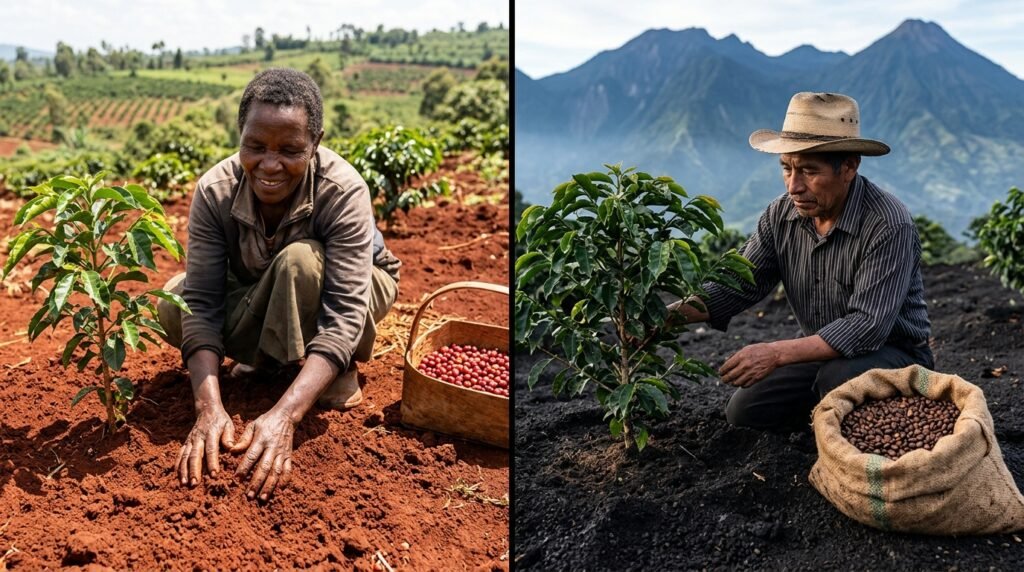
Imagine a coffee tree planted in the rich, deep red, iron-heavy soil of Kenya. The plant absorbs those specific minerals through its roots for years. That unique soil composition directly translates into the sharp, vibrant, mouth-watering acidity that Kenyan coffees are world-famous for. It tastes like dark berries and savory tomatoes because the dirt is feeding the plant those specific chemical building blocks.
Now, take that exact same species of coffee tree and plant it in the dark, volcanic ash of Guatemala.
The soil is completely different. It is packed with sulfur and different trace minerals. The resulting coffee won’t taste like sharp berries; it will taste like deep cocoa, warm spices, and smoky caramel.
Realizing that the physical earth changes the flavor of the seed was a massive paradigm shift for me. Fully grasping this concept was exactly (The First Time I Understood Coffee Terroir), because it forced me to respect coffee as a living, breathing reflection of global geography.
The Struggle: Why Altitude Matters
When I first started buying specialty coffee, I kept seeing the acronym “MASL” printed on the bags, followed by a number like 1,800 or 2,100.
I learned that it stands for Meters Above Sea Level. And I quickly learned that this number is the ultimate cheat code for finding delicious coffee.
Coffee plants are inherently lazy. If you plant a coffee tree at sea level in a hot, tropical jungle, it will grow incredibly fast. The warm temperatures allow the cherries to ripen rapidly. Because they ripen so fast, the seeds inside (the coffee beans) don’t have time to develop dense, complex cellular structures.
Low-altitude coffee often tastes bland, earthy, and sometimes a bit muddy. It lacks any exciting spark.
But when you force a coffee plant to grow high up in the mountains, everything changes.
At 2,000 meters above sea level, the air is thin. The days are warm, but the nights are freezing cold. The coffee plant is stressed. It is struggling to survive. Because of the cold nights, the coffee cherries mature at an agonizingly slow pace.
This slow maturation is the secret to world-class flavor.
Because the cherry takes so long to ripen, the plant has time to pack massive amounts of complex sugars, organic acids, and dense nutrients directly into the seed. This biological reaction to the cold mountain air is precisely (Why Some Coffee Origins Taste Sweeter Than Others).
When I brew a cup of my absolute favorite coffee—a washed Heirloom from the Guji region of Ethiopia grown at extreme altitudes—the intense, natural sweetness of peaches and honey is a direct result of the plant shivering in the cold African night.
The Genetics: Family Trees of Flavor
Geography is crucial, but it is only half of the equation. The other half is the specific genetic DNA of the plant itself.
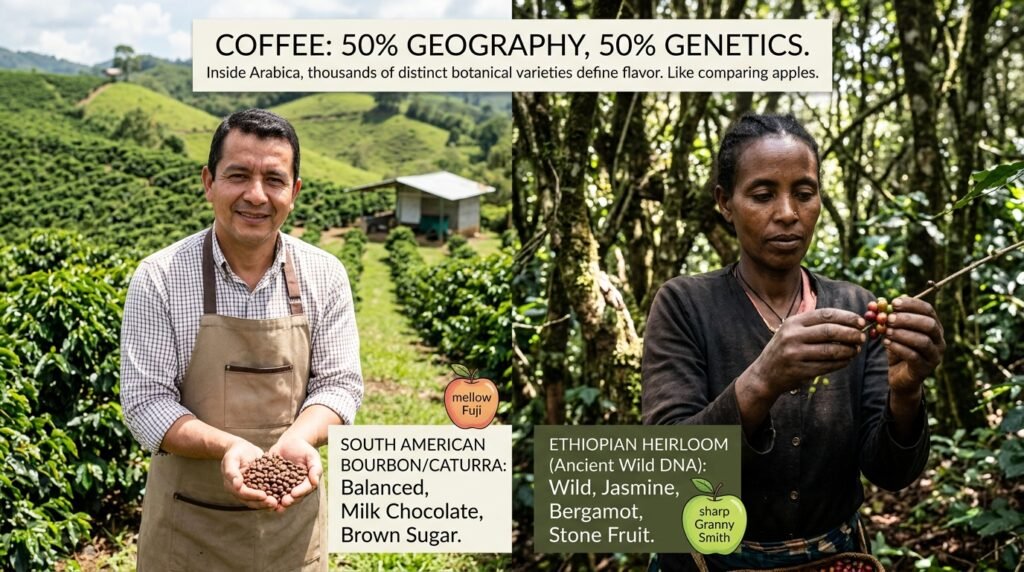
For years, I thought “100% Arabica” meant I was buying the best coffee in the world. I didn’t realize that Arabica is just a massive, umbrella species. Underneath that umbrella are thousands of different botanical sub-varieties, and each one has a completely different flavor profile.
It is exactly like apples. A Granny Smith apple tastes incredibly tart and sharp, while a Fuji apple tastes mellow and intensely sweet. They are both apples, but their genetics dictate their flavor.
Different countries specialize in different genetic varieties.
In South America, you will often find varieties like Bourbon, Caturra, or Typica. These genetics naturally lean toward comforting, balanced, and classic coffee flavors—think milk chocolate, toasted nuts, and brown sugar.
But in East Africa, particularly in Ethiopia, the genetics are completely wild.
Because Ethiopia is the birthplace of coffee, the forests are filled with ancient, uncatalogued genetics collectively called Heirloom varieties. These plants haven’t been cross-bred in a laboratory for high yields. They have grown wild for centuries.
Their ancient DNA naturally produces the mind-blowing, delicate flavors of jasmine flowers, bergamot, and juicy stone fruit. You cannot take an Ethiopian Heirloom seed, plant it in Brazil, and expect it to taste the same. The genetics and the terroir must work in perfect harmony.
The Weather: Forcing the Farmer’s Hand
The final factor that drastically alters how coffee tastes around the world happens after the cherry is picked from the branch.
Once a farmer harvests the fruit, they have to remove the sticky cherry pulp from the seed so it can be dried and exported. How they do this is heavily dictated by the local weather, and it completely changes the final flavor in your mug.
In regions with plenty of fresh water and predictable, dry sunny days (like many parts of Central America and East Africa), farmers use the Washed Process. They strip the fruit off immediately and wash the seed clean. This results in a very crisp, clean, tea-like cup of coffee where you taste the pure genetics of the bean.
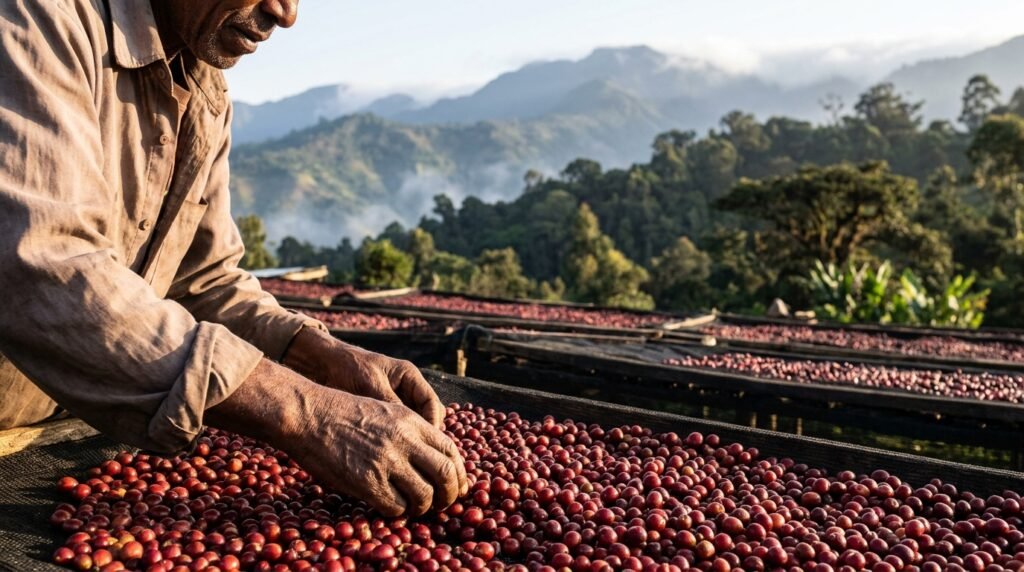
But in regions where water is scarce, or where the heat is intense, farmers often use the Natural Process. They leave the entire fruit intact and let it dry in the sun like a raisin.
As the fruit dries and rots slightly around the seed, all of those heavy, syrupy fruit sugars seep directly into the bean. This creates a wild, explosive, heavy coffee that often tastes like strawberry jam or blueberry pie.
The Indonesian Exception
Then, there are the extreme climates that force farmers to invent entirely new methods.
Take the islands of Indonesia, for example. The climate there is incredibly humid, and it rains constantly. If farmers tried to dry their coffee normally, the beans would rot and mold before they ever fully dried.
To survive the weather, Indonesian farmers developed a unique method called Wet-Hulling.
They remove the protective parchment layer of the seed while the bean is still wet and soft, exposing the naked, squishy bean to the humid jungle air to speed up the drying process.
This violent, unique processing method physically alters the cellular structure of the bean. It destroys the bright, fruity acidity and amplifies the deep, savory, earthy notes.
That is why a coffee from Sumatra tastes heavy, thick, and distinctly like cedar wood, dark spices, and pipe tobacco. It doesn’t taste like that just because of the dirt; it tastes like that because the unrelenting rain forced the farmers to adapt.
Building Your Sensory Map
When you put all of these pieces together—the soil, the altitude, the genetics, and the weather-dictated processing—you realize that coffee is an absolute miracle of global agriculture.
It is impossible for coffee to taste the same around the world because the world itself is so vastly different.
The realization of this immense diversity completely transformed my morning routine. Building a mental map of these flavors is exactly (What I Learned From Drinking Coffee From Different Regions), allowing me to curate my daily experience based on exactly what my palate is craving.
When I wake up on a gloomy, freezing winter morning, I know I want the deep, chocolatey, low-acidity comfort of a Brazilian or Colombian coffee. I want the comforting terroir of South America.
When I want a heavy, savory, intense cup to pair with a rich dessert, I look toward the humid jungles of Indonesia.
And when the sun is shining, and I want a bright, uplifting, naturally sweet cup of coffee that tastes like a blooming orchard, I travel straight to the high-altitude, ancient forests of Ethiopia.
A Challenge for Your Next Cup
If you are currently buying massive bags of commercial coffee blends, you are essentially drinking the agricultural equivalent of static noise.
Massive companies blend beans from five different countries together and roast them incredibly dark to create a uniform, boring flavor. They actively destroy the beautiful, unique characteristics that the soil and the altitude worked so hard to create.
I challenge you to break that cycle.
The next time you buy coffee, do not buy a blend. Buy a single-origin coffee from a specialty roaster. Look at the label. Read the name of the country. Read the altitude. Notice the processing method.
When you take a sip, close your eyes and think about where that seed came from. Think about the volcanic soil. Think about the cold mountain air. Think about the farmer who carefully processed it based on the weather of their homeland.
When you start tasting the geography, coffee stops being a generic morning chore. It becomes a daily ticket to explore the world, one brilliant, complex mug at a time.
My name is Daniel Carter, I am 35 years old, and I live in the United States. I have been passionate about aquariums for many years, and what started as a simple hobby quickly became a lifelong interest in aquatic life, fish behavior, and responsible tank care.
Through TheBrightLance, I share real experiences, practical knowledge, and honest lessons learned from maintaining different types of aquariums. I enjoy testing equipment, studying fish behavior, improving maintenance routines, and helping beginners avoid common mistakes.
My goal is to make aquarism easier, more ethical, and more enjoyable for everyone — whether you are setting up your very first tank or looking to refine your techniques.