
My eyes were blazing at my expensive coffee setup like it had personally insulted me. Sitting right in the middle of the mess was a beautiful, twenty-four-dollar bag of single-origin coffee. It was a washed Heirloom variety from the Guji region of Ethiopia, a type of coffee I had recently fallen deeply in love with.
I had bought this specific bag because the barista at the local roastery promised it was bursting with vibrant notes of fresh peaches, jasmine flowers, and raw honey.
But the liquid sitting in my mug did not taste like peaches or jasmine. It tasted like hot lemon juice mixed with battery acid. It was aggressively sour, incredibly thin, and completely undrinkable.
I was furious. I had done everything right. I had bought the premium beans. I had used filtered water. I had carefully poured the hot water from a fancy gooseneck kettle. Yet, somehow, I had managed to take a world-class agricultural product and turn it into garbage.
I almost threw the whole bag into the trash, convinced that I just wasn’t talented enough to brew specialty coffee at home.
But before I gave up, I sent a desperate text message to a friend who worked in the industry. I explained my setup, the type of coffee I was using, and the terrible results.
His reply came back less than a minute later. It was just one simple question.
“Are you using a plastic scoop to measure your beans?”
I looked down at the little black plastic spoon sitting next to my coffee grinder. I had been using it for five years. I texted him back: “Yes. Two scoops per mug. Why?”
His next message completely revolutionized my morning routine. He exposed a massive flaw in my logic, explained the physical differences between types of coffee, and introduced me to a fifteen-dollar tool that fixed my brewing instantly.
Here is the story of the simple change that improved my coffee overnight, and why relying on volume instead of mass is the fastest way to ruin a great bag of beans.
The Plastic Scoop Deception
For my entire adult life, coffee was measured by the scoop.
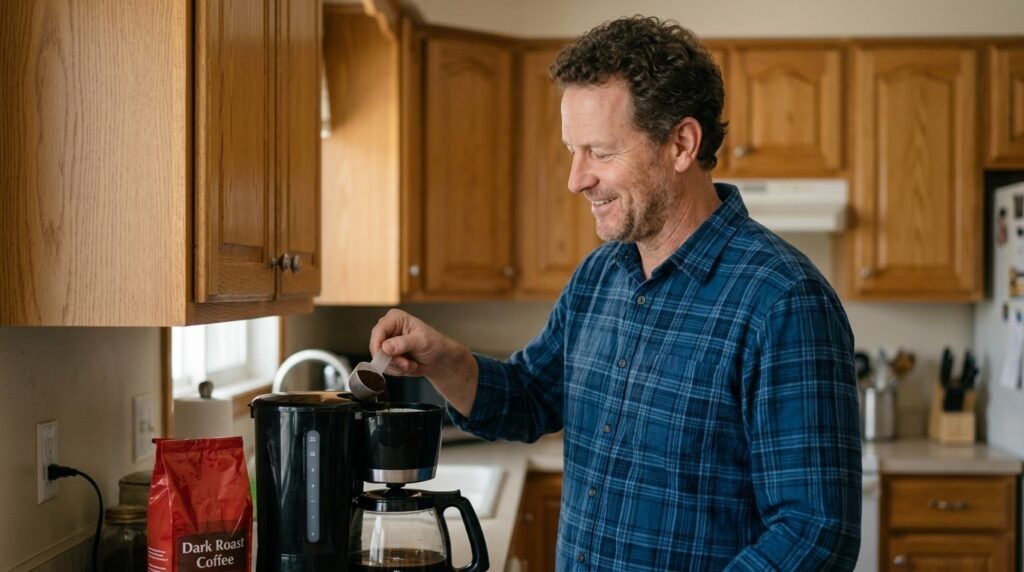
It didn’t matter what coffee maker I owned; they all came with a little plastic spoon in the box. The instructions were always identical and deceptively simple: put one scoop of grounds into the filter for every cup of water you want to drink.
It was a system built entirely on volume. You fill the physical space of the spoon, and you assume you are getting the exact same amount of coffee every single time.
If you are buying massive plastic tubs of generic, commercial dark roast from the supermarket, the scoop method actually works reasonably well. Commercial coffee is blended to be extremely consistent, and the dark roasting process makes the beans highly uniform.
But the moment you step into the world of specialty coffee, the plastic scoop becomes a weapon of mass destruction for your flavor profile.
My friend explained that I was treating all coffee as if it were identical in physical structure. I was assuming that a scoop of dark roast from South America was the exact same thing as a scoop of light roast from East Africa.
That assumption was the reason my Ethiopian Guji tasted like sour lemon water. I had completely ignored the physical density of the specific type of coffee I was trying to brew.
The Science of Coffee Density
To understand why my coffee tasted so bad, I had to understand what happens to a coffee seed when it is roasted.
Think of a raw coffee bean like a kernel of popcorn. When you apply heat to it, the moisture inside turns to steam, pressure builds up, and the cellular structure of the seed expands.
When massive commercial companies produce a “Dark Roast,” they cook the beans at very high temperatures for a long time. The beans expand dramatically. They become large, puffy, and very light in weight, much like fully popped popcorn. Their internal structure is brittle and porous.
Because they are so large and puffy, a dark roast bean takes up a lot of physical space. If you fill a plastic scoop with dark roast beans, you might only get about 5 or 6 grams of actual coffee weight inside that spoon. The rest of the space is just air between the large beans.
Now, let’s look at the type of coffee I was trying to brew: a light roast Ethiopian Heirloom.
Understanding the agricultural realities of this specific bean is exactly (What I Discovered About Coffee Farming Around the World), because the environment directly alters the physical bean. These Guji coffees are grown at extreme altitudes in cold mountain air. Because of the cold, the seeds mature incredibly slowly, resulting in a raw bean that is incredibly dense, hard, and small.
When a specialty roaster applies heat to these dense African beans, they do it very gently to preserve the delicate floral and peach flavors. They pull the beans out of the roaster before they have a chance to massively expand.
The resulting light-roast Ethiopian bean is tiny, hard as a rock, and incredibly heavy for its size.
When I took my plastic scoop and filled it with these dense Ethiopian beans, I wasn’t scooping 5 grams of coffee. Because the beans were so small and heavy, they packed tightly together. I was accidentally scooping almost 12 grams of coffee into that tiny spoon.
The Disaster in the Filter
Suddenly, the terrible taste of my morning cup made perfect mathematical sense.
When I used my old dark roast coffee, my “two scoops” equaled about 10 or 12 grams of coffee total. That was the perfect amount of coffee for the amount of water in my mug.
But when I switched to the dense, high-altitude Ethiopian Guji, my “two scoops” were actually holding almost 24 grams of coffee. I was accidentally using double the amount of coffee I needed, simply because the beans were smaller and heavier.
I was drowning my filter in an absurd amount of dense coffee grounds, but I wasn’t using enough water to properly extract the flavor from them.
In the coffee world, this is a classic recipe for disaster. When you have way too much coffee and not enough water, the water only has the energy to extract the very fastest-dissolving compounds. In coffee, the fastest compounds to dissolve are the bright, sour acids.
The water didn’t have a chance to extract the heavy, sweet sugars or the delicate jasmine notes. It just ripped the sour acidity off the surface of the massive pile of grounds and dripped into my mug, leaving me with a harsh, concentrated, mouth-puckering liquid.
I hadn’t bought bad coffee. I was simply a victim of the scoop.
The Simple Change: Embracing the Scale
My friend’s advice was blunt and non-negotiable.
“Throw the plastic scoop in the garbage,” he texted. “Go online right now and buy a cheap digital kitchen scale. You have to stop measuring by volume, and start measuring by weight.”
I drove to a local home goods store that very afternoon and spent fifteen dollars on a slim, black digital scale. It felt a little ridiculous. I felt like a scientist setting up a laboratory just to make my breakfast beverage.
But I was desperate to taste those peach notes the barista had promised me.
The next morning, I approached my coffee station with a completely new strategy. I threw the plastic spoon into the recycling bin. I placed my ceramic V60 pour-over cone onto the digital scale and zeroed it out.
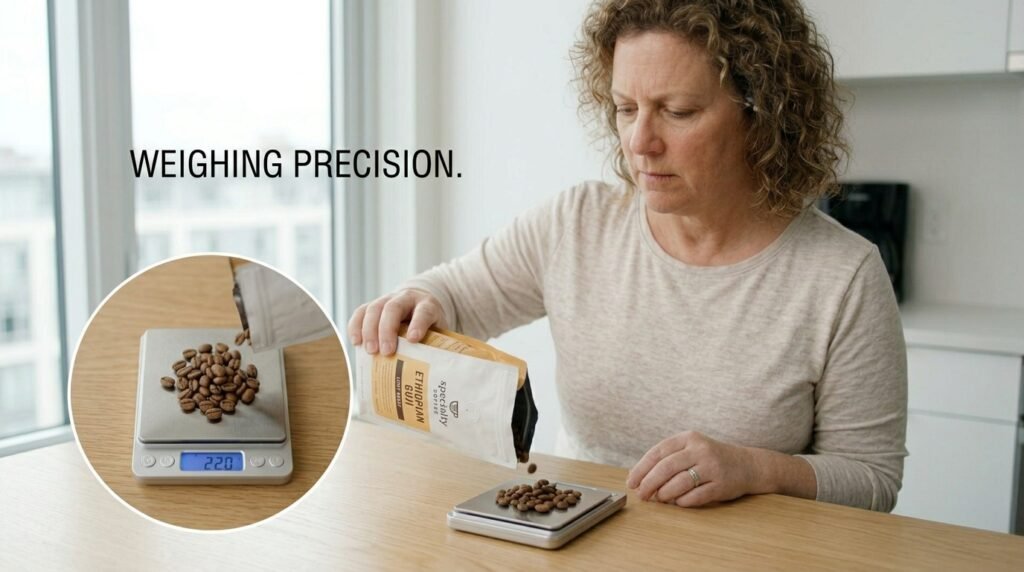
Instead of scooping blindly, I poured the Ethiopian whole beans directly into the grinder until the scale read exactly 15 grams.
When I looked at the 15 grams of dense Ethiopian beans sitting there, it looked like a terrifyingly small amount of coffee. My brain, which had been trained by years of using the plastic scoop, screamed at me that the coffee was going to be horribly weak and watery.
But I trusted the math. I ground the 15 grams of coffee, put them in the filter, and then I used the scale for the second half of the equation.
The Golden Ratio in Action
A digital scale doesn’t just measure your beans; it measures your water.
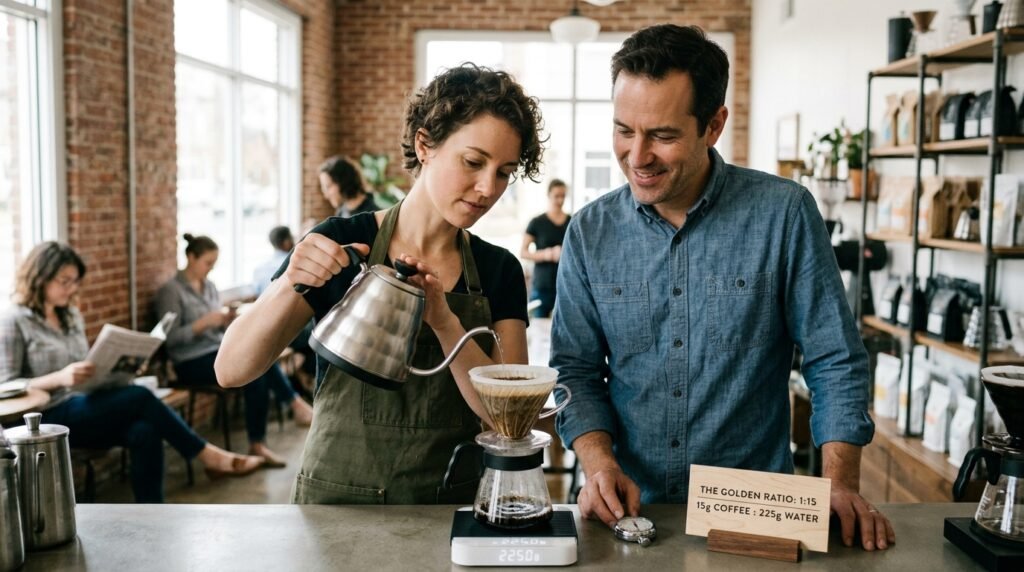
In the specialty coffee world, there is a concept called the “Golden Ratio.” It is the universally agreed-upon mathematical balance between coffee mass and water mass that ensures a perfect, sweet extraction.
Most professionals recommend a ratio of 1:15 or 1:16. That means for every 1 gram of coffee, you use 15 or 16 grams of water.
Because I had precisely weighed out 15 grams of the Ethiopian coffee, I knew exactly how much water I needed. 15 multiplied by 15 is 225. I needed exactly 225 grams of hot water.
Experiencing this exact mathematical harmony was a revelation. It was essentially (The Day I Finally Got My Coffee Ratio Right), because it removed all the emotional guesswork from my morning. I wasn’t hoping the coffee would taste good; I was mathematically ensuring it.
I started my timer and slowly poured the hot water over the fresh grounds. I watched the numbers on the digital scale climb. 50 grams… 100 grams… 175 grams.
When the scale hit exactly 225 grams, I stopped pouring. I stepped back and let gravity do the rest of the work.
The Taste of True Precision
The coffee finished dripping. I took the glass carafe off the scale and poured the ruby-red liquid into my favorite mug.
The aroma was immediately different. The harsh, grassy, acidic smell from yesterday was completely gone. The steam rising from the mug carried the undeniable, sweet perfume of jasmine flowers and brown sugar.
I sat down at my kitchen table, let the coffee cool for a full two minutes to avoid burning my palate, and took a slow sip.
I physically sighed in relief.
It was an absolute masterpiece. The aggressive, battery-acid sourness had vanished completely. Instead, the liquid was incredibly smooth, elegant, and light-bodied. As it washed over my tongue, the vibrant, juicy flavor of ripe peaches exploded in my mouth, followed by a delicate, honey-like sweetness that lingered long after I swallowed.
It was the exact flavor profile the barista had promised me. The coffee hadn’t changed. The water hadn’t changed. The only thing that changed was the precision of my measurements.
By using a digital scale to respect the physical density of that specific type of coffee, I had unlocked its true potential. I had given the water the exact environment it needed to extract the complex sugars, rather than just ripping out the sour acids.
The Freedom of Consistency
That fifteen-dollar digital scale completely transformed my relationship with coffee.
It eliminated the frustrating inconsistency that had plagued my mornings for years. Before the scale, my coffee was a lottery. Some days it tasted great, and some days it tasted terribly bitter or sour, and I never knew why.
With the scale, I was in absolute control.
If my coffee tasted perfectly sweet, I knew exactly how to replicate it the next morning. If I bought a new bag of dark-roast coffee from Colombia, I didn’t have to worry about the beans being huge and fluffy. The scale didn’t care about the size of the beans; 15 grams is always 15 grams, regardless of the volume.
This level of control also allowed me to troubleshoot other areas of my brewing. Once my ratio was locked in perfectly, I could finally understand (How Grind Size Affected My Coffee More Than I Expected). If the 1:15 ratio tasted just slightly too bitter, I knew I didn’t need to change my water or my beans; I just needed to make my grind size a tiny bit coarser.
The scale gave me a foundation of truth to build upon.
A Plea to Ditch the Scoop
Whenever friends come over to my house and watch me make coffee, they almost always make fun of my digital scale. They call me a mad scientist. They joke about how much effort it takes to make a simple beverage.
But then I hand them a mug of perfectly extracted, naturally sweet Ethiopian Guji, and they take a sip. The joking usually stops immediately. They always ask why their coffee at home never tastes this vibrant or clean.
My answer is always the same.
If you are currently buying expensive, high-quality specialty coffee, and you are still using a plastic scoop to measure it, you are actively sabotaging your own mornings. You are treating a delicate, diverse agricultural product with blunt, inaccurate force.
Different types of coffee have wildly different densities. A high-altitude African light roast will never take up the same physical space as a low-altitude South American dark roast.
Do yourself and your palate a massive favor. Throw the plastic scoop in the trash. Spend fifteen dollars on a basic digital kitchen scale. Start weighing your beans, and start weighing your water.
It might add exactly twenty seconds to your morning routine, but the resulting clarity, sweetness, and consistency in your cup will improve your coffee instantly, and you will never go back to guessing again.

My name is Daniel Carter, I am 35 years old, and I live in the United States. I have been passionate about aquariums for many years, and what started as a simple hobby quickly became a lifelong interest in aquatic life, fish behavior, and responsible tank care.
Through TheBrightLance, I share real experiences, practical knowledge, and honest lessons learned from maintaining different types of aquariums. I enjoy testing equipment, studying fish behavior, improving maintenance routines, and helping beginners avoid common mistakes.
My goal is to make aquarism easier, more ethical, and more enjoyable for everyone — whether you are setting up your very first tank or looking to refine your techniques.