
We are culturally conditioned to believe that fresher is always better.
If you go to a bakery, you want the bread that just came out of the oven, still warm to the touch. If you go to a farmer’s market, you want the tomatoes that were pulled from the vine that exact morning. We associate the absolute zero-point of time with the absolute peak of flavor.
When I first started diving into the world of specialty coffee, I carried this exact same logic into my kitchen.
I had recently abandoned the stale, vacuum-sealed bricks of supermarket coffee. I had learned to read labels. I had learned to seek out specific origins and roast dates. I thought I had cracked the ultimate code to the perfect morning cup.
My new rule was simple: buy the freshest coffee legally possible.
I would hunt for bags that had been roasted just a day or two prior. I thought that by minimizing the time between the roaster and my grinder, I was guaranteeing a flawless, explosive flavor profile.
But then, I had an experience that completely baffled me. I bought the freshest bag of my absolute favorite coffee, rushed home to brew it, and it tasted terrible. It was harsh, metallic, and completely flat.
I went to sleep frustrated, thinking I had lost my touch. But the next morning, I brewed the exact same beans, using the exact same water, and it was a masterpiece.
It was a culinary miracle. The flavor had completely transformed while I was sleeping. Here is the honest, scientific story of why my coffee started tasting better overnight, and the massive mistake I was making by being too impatient.
The Pursuit of Absolute Freshness
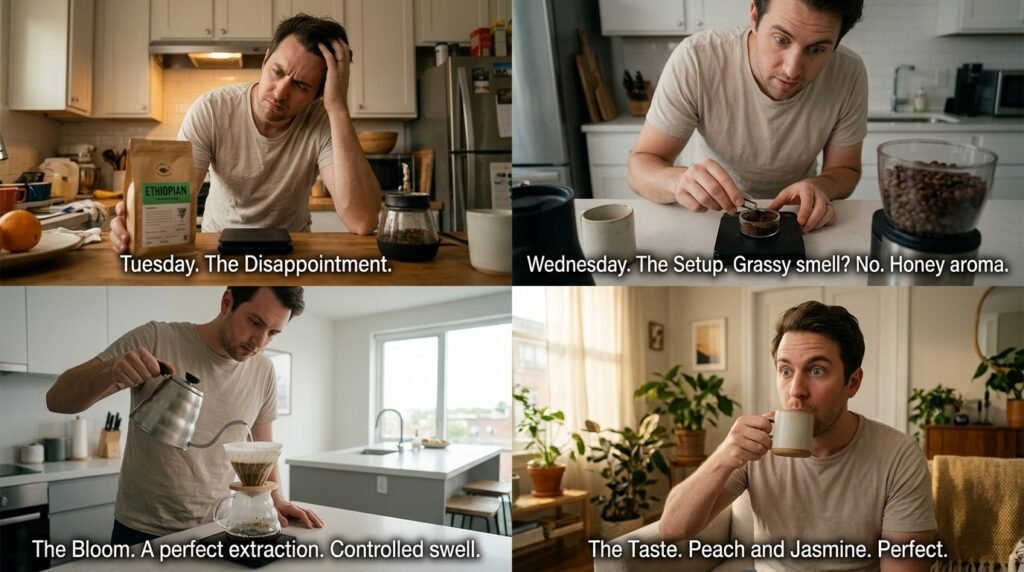
The incident happened on a rainy Tuesday. I had finally run out of my previous batch of coffee, so I drove to my favorite local specialty roaster right when they opened.
I walked in and looked at the retail shelf. I found a beautiful, washed Heirloom variety from the Guji region of Ethiopia. This was my holy grail. I knew exactly how this coffee was supposed to taste: vibrant, sweet, full of peach notes, and finishing with a delicate hint of jasmine flowers.
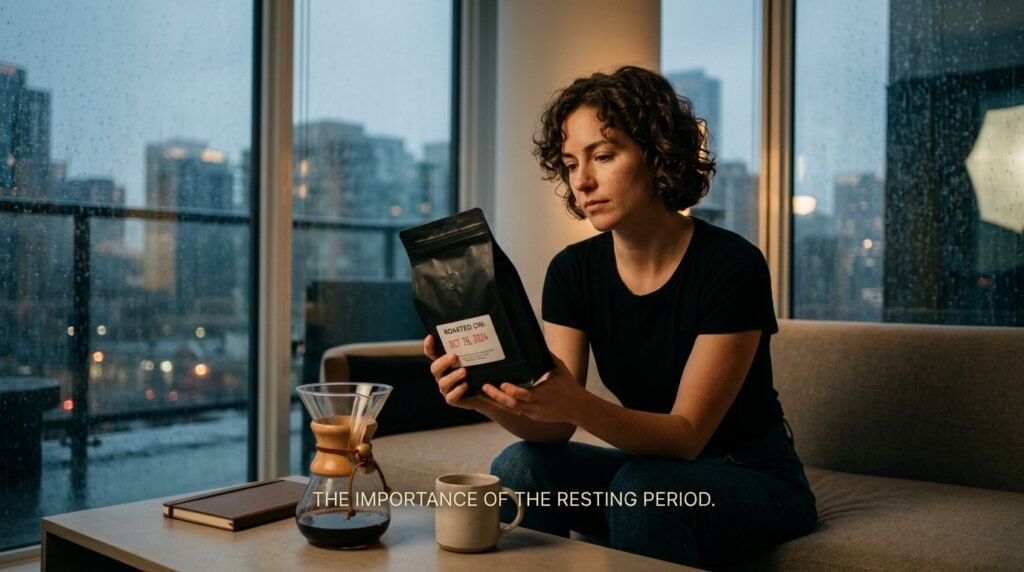
I picked up the bag and looked at the sticker on the back.
It said: Roasted On: Today.
I couldn’t believe my luck. The beans were literally hours old. The bag was still slightly warm from the roasting facility in the back of the building. I happily paid for it, convinced that I was about to experience the greatest cup of coffee of my entire life.
I drove home as fast as I could, practically running into my kitchen. I was so excited to experience this peak freshness. But looking back at my desperate rush, I now realize that understanding the timeline of a bean is exactly (Why I Check Coffee Dates Before Buying), not just to avoid stale coffee, but to actively avoid coffee that is too fresh.
The Disaster in the Carafe
I set up my brewing station with absolute precision.
I pulled out my digital scale and weighed out exactly 15 grams of the Ethiopian beans. I poured them into my manual burr grinder. As I turned the crank, the aroma was certainly intense, but it smelled a little different than usual. It smelled slightly green, almost like freshly cut grass mixed with toasted bread.
I boiled my water to 205 degrees Fahrenheit. I placed my V60 paper filter in the cone, rinsed it, and added the fresh grounds.
I started my timer and poured a tiny splash of water to initiate the bloom.
What happened next was violent.
Usually, fresh coffee will swell and bubble gently. But this coffee erupted. It heaved upward so aggressively that it almost spilled over the edges of the paper filter. Massive bubbles formed and popped, making the coffee bed look like a chaotic, boiling mud pit.
I struggled to pour the rest of the water. The coffee just kept pushing back. It refused to let the water settle.
When the dripping finally stopped, I poured the liquid into my mug. I let it cool for a moment, expecting a burst of peach and jasmine.
I took a sip, and my heart sank.
It was incredibly sour. But it wasn’t a pleasant, fruity sourness. It was a sharp, astringent, metallic sourness that coated the sides of my tongue and made me wince. There were no peach notes. There was no floral aroma. It tasted hollow, grassy, and entirely unbalanced.
I was devastated. I thought the roaster had ruined the batch. I thought my grinder was broken. I poured the rest of the cup down the sink and went to work feeling completely defeated.
The Overnight Miracle
The next morning, I woke up still feeling a little disappointed about my new bag of expensive Ethiopian coffee.
I considered going to a drive-thru café, but my stubbornness won. I decided to give the beans one more chance. Maybe I had messed up my pouring technique the day before.
I walked into the kitchen and repeated the exact same process.
I weighed 15 grams. I ground the beans. This time, the grassy smell was gone, replaced by a much sweeter, honey-like aroma.
I boiled the water and started my pour.
Immediately, I noticed a difference in the bloom. The violent, chaotic eruption from yesterday was gone. The coffee still swelled beautifully, but it was controlled. The bubbles were smaller. The water seemed to actually penetrate the coffee grounds rather than just bouncing off of them.
The pour felt smooth. The extraction looked perfect.
I poured the brewed coffee into my mug, sat down at the table, and braced myself for the metallic sourness.
I took a sip.
I froze. It was spectacular.
The harshness was completely gone. The liquid was incredibly smooth, sweet, and vibrant. The juicy peach notes I loved so much were singing loud and clear, followed by that beautiful, delicate jasmine finish.
It was perfect. It was the exact Ethiopian Guji experience I had paid for.
I sat there staring at my mug, completely bewildered. How could a bag of coffee taste like sour metal on Tuesday, and taste like a masterclass in culinary perfection on Wednesday?
The coffee hadn’t magically transformed. My brewing equipment hadn’t changed. The only variable that had shifted was time. The coffee had simply rested overnight on my kitchen counter.
The Invisible Shield: Carbon Dioxide
I needed to know the science behind this overnight miracle. I started researching the roasting process and quickly uncovered a massive blind spot in my coffee education.
It all comes down to chemistry, and specifically, to a gas called carbon dioxide (CO2).
When a green coffee seed is dropped into a roasting machine, it is subjected to intense heat. This heat causes complex chemical reactions inside the bean. Sugars caramelize, amino acids break down, and massive amounts of carbon dioxide are created as a byproduct.
Because the coffee bean is dense, a lot of this CO2 gets trapped deep inside the cellular structure of the roasted bean.
When you take a bean that was roasted just a few hours ago and grind it up, you are releasing a chaotic storm of trapped gas.
When you pour hot water over those ultra-fresh grounds, the water and the escaping CO2 collide. The gas aggressively pushes outward, creating a microscopic physical barrier around the coffee particles.
This barrier acts like an invisible shield. The water literally cannot touch the coffee grounds.
The Science of the Bad Cup
Understanding this invisible shield completely explained my disastrous cup of coffee from the day before.
Because the beans were only hours old, they were packed with an overwhelming amount of CO2. When I poured the hot water, the gas violently escaped (causing that massive, chaotic bloom).
Because the gas was pushing the water away, the water couldn’t properly extract the delicate sugars, oils, and flavor compounds hidden inside the bean.
Instead, the water only extracted the easiest, most acidic surface compounds before dripping quickly into my carafe. This is a classic case of under-extraction.
Realizing that my own impatience was causing this under-extraction was a huge lesson, and it completely redefined (The Simple Brewing Mistakes I Used to Make Every Day), proving that sometimes doing absolutely nothing is the best brewing technique you can apply.
The coffee didn’t taste bad because it was a bad batch. It tasted bad because the water physically couldn’t access the flavor.
The Art of Degassing
So, what happened overnight?
A process called “degassing.”
From the moment coffee leaves the roaster, it slowly, naturally releases its trapped carbon dioxide into the air.
Coffee bags from specialty roasters have a tiny, circular plastic valve on the front. I used to think this was a “smelling hole” so you could squeeze the bag and smell the coffee in the store.
I was wrong. That is a one-way degassing valve. It allows the massive amounts of CO2 to escape the bag without letting harmful oxygen inside.
By leaving the coffee on my counter overnight, I allowed the beans to naturally exhale a significant portion of that aggressive gas.
When I brewed it the next morning, the invisible shield was gone. The water was finally able to penetrate the cellular structure of the coffee grounds, beautifully dissolving the complex sugars and extracting the rich peach and jasmine flavors.
The coffee tasted better overnight simply because it had finally calmed down enough to be brewed.
Finding the “Sweet Spot”
This realization completely shattered my belief that fresher is always better.
Coffee is not like warm bread. It is more like a fine soup or a stew. It needs time to rest, settle, and allow its flavors to integrate.
I learned that every coffee has a “sweet spot”—a window of time where enough CO2 has escaped to allow for a perfect extraction, but not so much time has passed that the coffee becomes oxidized and stale.
This sweet spot varies wildly depending on how the coffee was roasted.
If you are buying a dark roast, the cellular structure of the bean has been heavily broken down by the heat. Dark roasts degas very quickly. They are usually ready to drink within 3 to 5 days after the roast date.
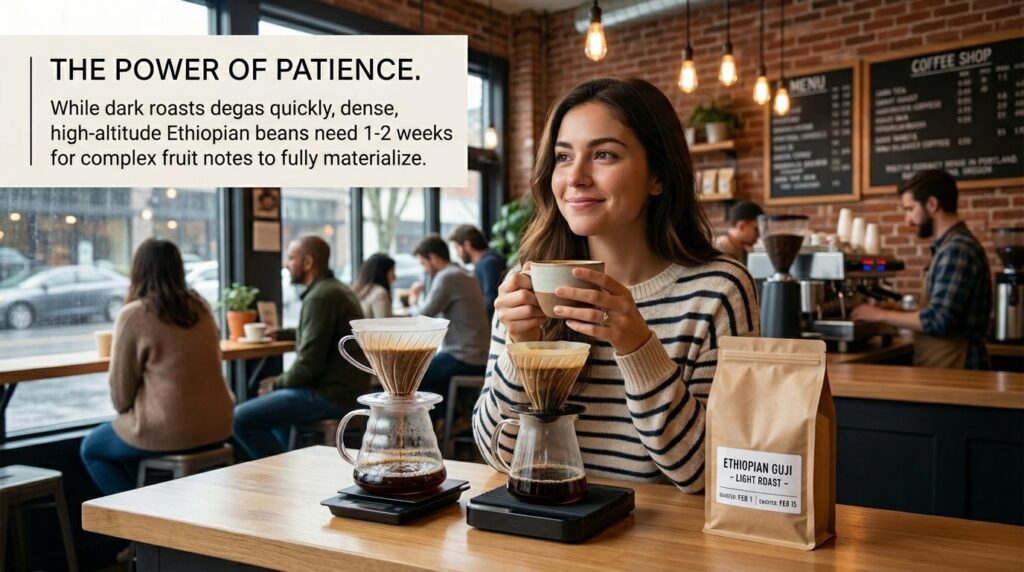
But I prefer very light roasts, especially dense, high-altitude African beans. Because they are roasted gently, their cellular structure remains tight and intact. They hold onto their carbon dioxide much longer.
For my favorite Ethiopian Guji, the sweet spot usually doesn’t even begin until at least 7 to 10 days after it was roasted. Sometimes, it peaks at day 14!
It requires an immense amount of patience. Experiencing this peak flavor is reminiscent of (The First Time I Tried Ethiopian Coffee (And Loved It)), because waiting that extra week is exactly what allows those mind-blowing fruit notes to fully materialize in the cup.
Changing the Buying Strategy
Learning about degassing changed how I manage my kitchen pantry.
I no longer run to the roaster on the exact day I run out of coffee. That leads to desperate, under-extracted mornings.
Instead, I plan ahead. I buy a bag of freshly roasted coffee while I still have about a week’s worth of my old coffee left.
I bring the new bag home, place it in a cool, dark cabinet, and I simply ignore it. I let it rest. I let it breathe. I let it release its aggressive gases in peace.
By the time I finally open that bag a week later, it is perfectly primed for extraction. The bloom is controlled, the water flows smoothly, and the flavor is spectacularly sweet and vibrant from the very first cup.
The Lesson in Patience
We live in a world that demands instant gratification. We want our food fast, we want our deliveries next-day, and we naturally assume that immediately consuming a product is the best way to enjoy it.
But coffee demands respect, and above all, it demands patience.
If you have ever bought a beautiful, expensive bag of specialty coffee, brewed it on day one, and felt disappointed by a sour, metallic, flat cup, please do not throw it away.
You didn’t do anything wrong. The roaster didn’t make a mistake. The coffee is just protecting itself.
Put the bag in a cupboard. Walk away. Let it rest overnight, or better yet, let it rest for a few days.
When you finally return to it, you will be shocked by the transformation. The harshness will fade, the natural sweetness will emerge, and you will understand exactly why your coffee suddenly started tasting infinitely better overnight.

My name is Daniel Carter, I am 35 years old, and I live in the United States. I have been passionate about aquariums for many years, and what started as a simple hobby quickly became a lifelong interest in aquatic life, fish behavior, and responsible tank care.
Through TheBrightLance, I share real experiences, practical knowledge, and honest lessons learned from maintaining different types of aquariums. I enjoy testing equipment, studying fish behavior, improving maintenance routines, and helping beginners avoid common mistakes.
My goal is to make aquarism easier, more ethical, and more enjoyable for everyone — whether you are setting up your very first tank or looking to refine your techniques.