
For a huge portion of my life, I lived in a state of blissful, highly caffeinated ignorance.
If you had asked me back then if I liked good coffee, I would have confidently said yes. I would have pointed to the giant plastic tub of dark roast sitting on my kitchen counter and defended it to the end. I thought I knew what I was doing.
I had a routine. Every morning, I would stumble into the kitchen, scoop an unmeasured amount of pre-ground coffee into a paper filter, press a plastic button, and wait for the machine to aggressively spit out a pot of hot, dark liquid.
I drank it out of necessity. It was fuel. It was the harsh, bitter reality of waking up early.
I never stopped to think about where it came from. I never stopped to think about the farmers, the altitude, or the roasting process. To me, coffee was just a commodity, like paper towels or gasoline. You buy it, you use it, and you move on with your day.
Looking back, I realize that I was completely blind to an entire universe of flavor.
It took one specific, unforgettable moment to shatter that illusion. It took one single cup of coffee to completely rewire my brain and make me realize that I had been doing it all wrong.
This is the story of the very first time I noticed that coffee quality actually matters, and why that realization changed my daily routine forever.
The Baseline of Mediocrity
To truly appreciate the revelation, you have to understand the baseline I was working from.
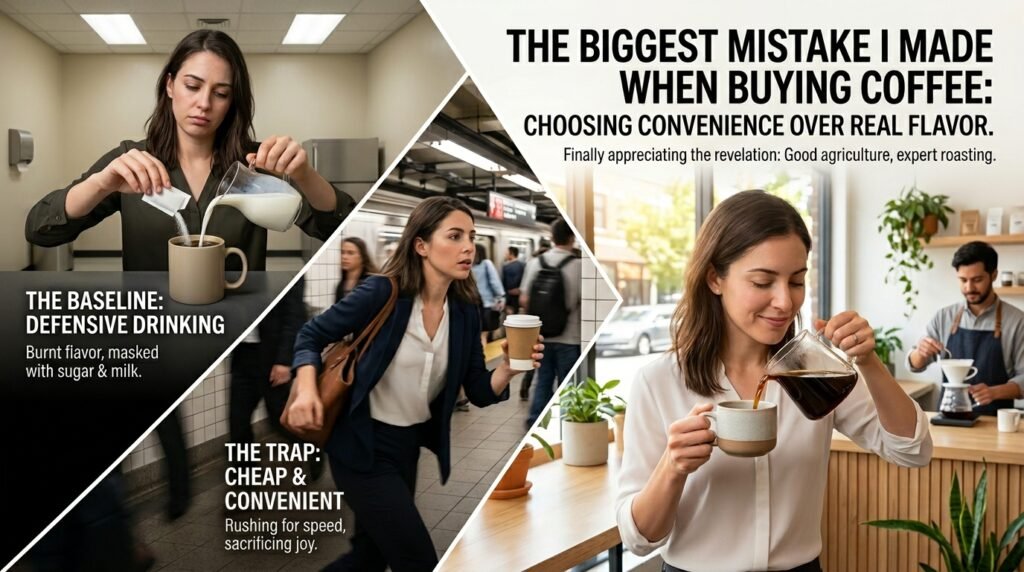
The coffee I grew up drinking, and the coffee I bought for myself throughout my twenties, was aggressively average. In fact, calling it average might be a compliment.
It was dark, oily, and smelled faintly of burnt rubber and stale chocolate.
Because it tasted so harsh and bitter, I developed a defensive drinking strategy. I would pour a heavy splash of cold milk into the mug and dump in at least two packets of sugar. I wasn’t trying to enhance the flavor of the coffee; I was actively trying to hide it.
I thought this was normal. I thought everyone secretly hated the taste of black coffee.
I didn’t realize that I was caught in a cycle of bad agriculture and bad roasting. I was buying beans that had been stripped of their natural flavors and roasted to a crisp just to hide their defects.
It was a terrible habit, but it was cheap and convenient. And for a long time, cheap and convenient were the only two metrics I cared about.
Honestly, looking back at my old habits, I can clearly see that falling for the illusion of convenience was (The Biggest Mistake I Made When Buying Coffee) because it kept me trapped in a world of terrible flavor for years. I was sacrificing joy for the sake of saving a few minutes and a couple of dollars.
The Unexpected Detour
The moment everything changed happened on a rainy Tuesday afternoon.
I was in a different part of the city for a meeting that had ended much earlier than expected. The rain was pouring down, traffic was a nightmare, and I had an hour to kill before I could reasonably head home.
I ducked into the first open door I saw to escape the downpour.
It wasn’t a corporate coffee chain. It was a small, independent specialty coffee roaster.
The moment I stepped inside, my senses were immediately confused. The air didn’t smell like the stale, burnt diner coffee I was used to. It smelled warm, sweet, and complex. It smelled like toasted almonds, caramelized sugar, and a faint hint of fresh berries.
I walked up to the counter, feeling completely out of my element.
There were no giant menus with colorful, sugary blended drinks. There were no massive syrup pumps. There was just a clean wooden counter, a beautiful espresso machine, and a row of glass pour-over carafes.
The barista greeted me warmly. He didn’t ask what size I wanted or if I wanted whipped cream. He asked, “What kind of flavor profile are you looking for today?”
I froze. I had never been asked that question before.
“I… I just want a regular coffee,” I stammered.
The barista smiled, completely understanding my deer-in-the-headlights expression. “Tell you what,” he said gently. “Let me brew you something special. It’s a light roast. Just trust me on this.”
The Cup That Broke the Matrix
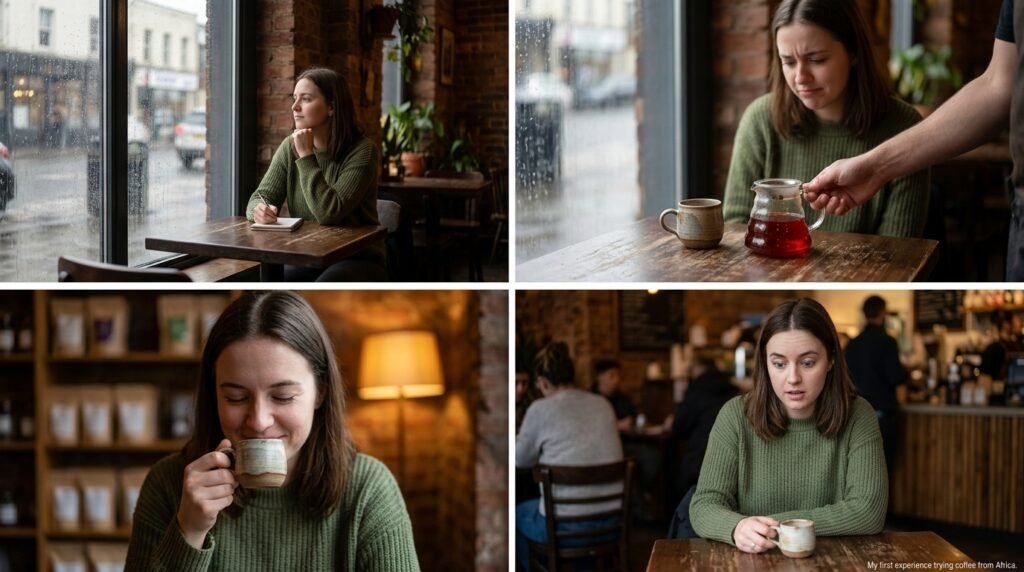
I sat down at a small table by the window, watching the rain hit the glass, and waited.
A few minutes later, the barista brought over a small ceramic mug and a glass server filled with a liquid that looked more like dark tea than coffee. It had a reddish, almost translucent hue.
He set it down and said, “This is a washed Heirloom variety from the Guji region in Ethiopia. Let it cool for just a minute before you taste it.”
I stared at the cup. I was skeptical. I had never seen coffee that looked like this.
I brought the mug to my face and inhaled. The aroma was startling. It didn’t smell heavy or smoky. It smelled vibrantly floral. It smelled exactly like a bouquet of jasmine flowers mixed with fresh peaches.
I took a slow, hesitant sip.
My brain completely short-circuited.
There was absolutely no bitterness. None. Zero. It didn’t burn the back of my throat, and it didn’t leave an ashy residue on my tongue.
Instead, it was incredibly smooth and naturally sweet. As the liquid washed over my palate, the flavors exploded. I could vividly taste the juicy acidity of ripe stone fruit, followed by a delicate, tea-like finish that lingered beautifully in my mouth.
I put the mug down and stared at it in sheer disbelief.
How was this coffee? How was this the same beverage that I had been choking down every morning from a plastic tub?
It felt like I had spent my entire life watching television on a tiny, blurry, black-and-white screen, and someone had suddenly dropped me into a high-definition IMAX theater.
The complexity, the sweetness, the clarity—it was completely overwhelming in the best way possible. That specific moment in the café was (My Experience Trying Coffee From Africa for the First Time), and it completely shattered every single preconceived notion I had about what coffee was supposed to be.
The Realization of Agriculture
I finished the entire cup without a single drop of milk or a single grain of sugar. It didn’t need it. Adding anything to that beautiful Ethiopian Guji would have been an absolute insult to the flavors in the cup.
Before I left the shop, I went back to the counter to talk to the barista.
I told him that the coffee he gave me was the best thing I had ever tasted, and I asked him why it was so different from what I made at home.
He gave me a brief, brilliant education that changed my perspective entirely.
He explained that coffee quality matters because coffee is an agricultural product. It is a fruit.
He told me about the high altitudes in Ethiopia, where the cool air slows down the maturation of the coffee cherry, allowing complex sugars to develop inside the seed. He explained how the farmers meticulously hand-pick only the perfectly ripe red cherries, leaving the unripe ones on the branch.
He told me how the beans were carefully washed and dried, and how the roaster applied just enough heat to highlight the natural floral notes of the Heirloom variety, rather than roasting them into oblivion.
Suddenly, the cheap plastic tub of coffee on my kitchen counter made sense.
The cheap stuff was mass-produced. It was harvested by machines that stripped the branches bare, mixing ripe cherries with unripe, green, and rotting ones. It was roasted dark to hide the terrible quality of the harvest.
I wasn’t just paying for a brand name when I bought specialty coffee. I was paying for care. I was paying for human effort, ethical farming practices, and incredible attention to detail.
Quality mattered because it was the difference between an industrial product and a piece of culinary art.
The Aftermath: Going Home
When I walked out of that café and back into the rain, I felt like a different person.
I couldn’t stop thinking about the flavors I had just experienced. The lingering taste of jasmine and peach stayed with me all the way home.
When I walked into my kitchen, the first thing I did was look at my coffee setup. The cheap drip machine, the plastic tub of dark roast, the bag of white sugar. It all looked incredibly depressing.
I decided right then and there that I could never go back. Once you taste the clarity and beauty of a high-quality, freshly roasted specialty bean, the cheap stuff becomes completely undrinkable.
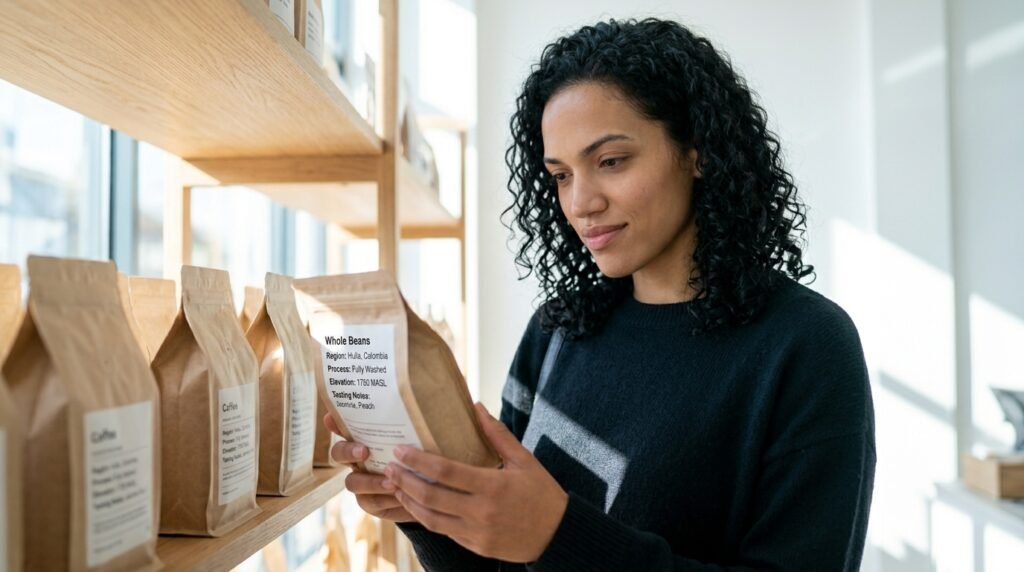
I grabbed my laptop and started researching. I wanted to understand everything. I started learning about roast dates, origins, and processing methods.
I realized that if I wanted to replicate that café experience at home, I needed to know what I was buying. I couldn’t just trust the marketing on the front of a bag anymore. This deep dive into the terminology is exactly (How I Learned to Read Coffee Labels Without Confusion), because understanding the label was the only way to ensure I was actually buying high-quality beans.
A Shift in Values
Switching to high-quality coffee wasn’t just a change in my diet; it was a fundamental shift in my values.
Yes, specialty coffee costs more. A bag of single-origin Ethiopian beans from a local roaster is undeniably more expensive than a bulk container of commodity coffee from the supermarket.
But I realized that I wasn’t just buying caffeine anymore.
I was investing in a moment of joy.
Instead of mindlessly chugging three mugs of bad coffee every morning just to wake up, I started taking the time to brew one single, perfect cup. I bought a manual burr grinder. I bought a simple pour-over cone.
I started waking up ten minutes earlier just so I could enjoy the ritual.
I would stand in my quiet kitchen, grind the fresh beans, and breathe in the incredible aromas. I would slowly pour the hot water, watch the coffee bloom, and focus on the present moment.
That morning ritual became the best part of my day. It became a time of meditation and peace before the chaos of work and life began.
And that is why coffee quality matters.
It matters because it turns a mundane, thoughtless routine into a daily celebration of flavor and craftsmanship. It forces you to slow down, to taste, and to appreciate the incredible journey that a tiny seed took to make it all the way from a mountain in Africa to a mug in your kitchen.
The Invitation to Taste
If you are reading this, and you are still drinking the same dark, bitter, pre-ground coffee out of habit, I completely understand. I was exactly where you are.
It is easy to believe that coffee is just a bitter liquid that needs to be masked with milk and sugar.
But I invite you to take a leap of faith.
Find a local specialty coffee shop in your town. Walk in, ignore the urge to order a massive vanilla latte, and ask the barista for their best light-roast pour-over.
Take it to a quiet table, let it cool for a minute, and take a sip with an open mind.
You might not taste jasmine or peach on your very first try. But you will taste something entirely different from the harsh bitterness you are used to. You will taste clarity. You will taste sweetness. You will taste the actual fruit of the coffee plant.
And I promise you, once you have that “aha” moment—once you finally notice that the quality of the bean actually matters—your mornings will never be the same again. You will start chasing that perfect cup, and you will never look back.

My name is Daniel Carter, I am 35 years old, and I live in the United States. I have been passionate about aquariums for many years, and what started as a simple hobby quickly became a lifelong interest in aquatic life, fish behavior, and responsible tank care.
Through TheBrightLance, I share real experiences, practical knowledge, and honest lessons learned from maintaining different types of aquariums. I enjoy testing equipment, studying fish behavior, improving maintenance routines, and helping beginners avoid common mistakes.
My goal is to make aquarism easier, more ethical, and more enjoyable for everyone — whether you are setting up your very first tank or looking to refine your techniques.