
If you have ever walked into a massive, commercial gym for the very first time, you are intimately familiar with the feeling of physical imposter syndrome.
You stand in the middle of the room, surrounded by heavy iron and complicated machines. You have absolutely no idea what you are doing. So, you use a survival tactic: you quietly watch the person next to you, and you try to mimic their exact movements.
You grab a heavy dumbbell, bend your knees, and lift the weight. But instead of feeling your muscles working, you just feel a sharp, agonizing pain in your lower back. You assume that the pain is just part of the process. You think, This is supposed to hurt, right? Then, a professional trainer walks over to you. They don’t tell you to drop the weight or use a different machine. They simply ask you to shift your grip by one single inch and pull your shoulders back.
You try the exact same lift again, and suddenly, the pain is completely gone. The weight feels lighter. The movement feels smooth, powerful, and effective. You didn’t need to change the equipment; you just needed someone to teach you the proper posture.
For the first several years of my specialty coffee journey, I was the guy lifting weights with terrible posture.
I was mimicking what I saw baristas doing in cafes. I was pouring water over brown grounds. But my coffee always tasted bitter, harsh, and painful. I thought that was just how coffee was supposed to taste.
I wasted years of my life drinking bad coffee because I didn’t know the insider secrets. Eventually, through trial, error, and talking to professionals, I learned the microscopic adjustments that completely changed the game.
Here is the honest, highly practical story of the coffee tips I wish someone had told me earlier, the invisible “posture” mistakes I had to fix, and how these simple secrets finally unlocked the sweet, flawless cup I had been chasing.
Tip One: The Magic of the “Swirl”
When I first bought a glass pour-over cone, I struggled heavily with the physical shape of the coffee bed after I finished pouring my water.
I would pour my hot water in circles, just like I saw in the YouTube tutorial videos. But when the water finally drained, the coffee grounds would be plastered all over the high walls of the paper filter. The center of the filter would be completely empty, like a massive crater.
In the coffee industry, this is known as “high and dry.”
When grounds get stuck to the upper walls of the filter, they are no longer submerged in the hot water. They stop extracting. Meanwhile, the few grounds left at the bottom of the crater are being over-extracted by all the remaining water. The result is a muddy, confused, and highly astringent cup of coffee.
I used to take a metal spoon and aggressively scrape the sides of the wet paper filter to push the grounds down, but this just clogged the bottom and stalled the brew.
Then, a barista told me about “The Swirl.”
It is the easiest, most elegant trick in the coffee world. Now, right after I finish pouring my final drop of hot water, I simply grab the glass brewing cone by the rim, lift it half an inch off the mug, and give the entire apparatus a gentle, circular swirl.
That gentle centrifugal force washes all of the stray grounds off the high walls of the filter and settles them perfectly at the bottom. The coffee bed becomes completely flat, ensuring a flawless, even extraction every single time.

Tip Two: A Scale is for the Lazy, Not the Obsessive
The second tip I wish someone had given me involves the psychology of kitchen equipment.
For years, I refused to buy a digital kitchen scale. I thought that weighing my coffee beans and my water was something only pretentious, obsessive coffee snobs did. I thought it would make my morning routine feel like a stressful high school chemistry exam.
I wanted my mornings to feel relaxed, so I just used a plastic scoop and guessed the volume of the water.
I wish someone had told me that a digital scale is actually the ultimate tool for lazy people.
When you guess your measurements, your mornings are highly stressful. You take a sip of your coffee, and if it tastes terrible, your brain immediately has to start working. Did I use too much coffee? Was it too much water? What did I do wrong? You spend your entire breakfast trying to solve a culinary mystery.
But when you use a digital scale, you are completely allowed to turn your brain off.
At 6:00 AM, I do not want to think. I just place my mug on the scale, weigh exactly 15 grams of coffee, and pour exactly 240 grams of water. Discovering this mental freedom was the core realization of (The Day I Finally Got My Coffee Ratio Right).
Because the math is locked in and guaranteed, I never have to stress about the outcome. The scale doesn’t make the routine complicated; it makes the routine completely foolproof.
Tip Three: The “Off-Boil” Secret
If I could travel back in time and scream one single piece of advice into my younger self’s ear, it would be about the temperature of my stovetop kettle.
I used to turn the stove on high, wait for the kettle to scream with a violent, aggressive boil, and immediately dump that bubbling water directly onto my delicate specialty coffee grounds. I thought I was being efficient.
I didn’t realize that I was physically destroying my own breakfast.
The aromatic oils that give specialty coffee its incredible flavors of blueberry, jasmine, and chocolate are highly volatile. When you hit them with water that is 212 degrees Fahrenheit (100 degrees Celsius), you scorch them instantly. You burn the sweetness out of the bean, replacing it with a harsh, bitter, ashy bite.
A local roaster finally noticed me complaining about bitter coffee and gave me the “Off-Boil” rule.
He told me that I didn’t need to buy a two-hundred-dollar digital smart kettle to fix the problem. I just needed to practice a tiny bit of patience. Learning this simple, zero-cost adjustment was exactly (What I Wish I Knew About Coffee Brewing Earlier).
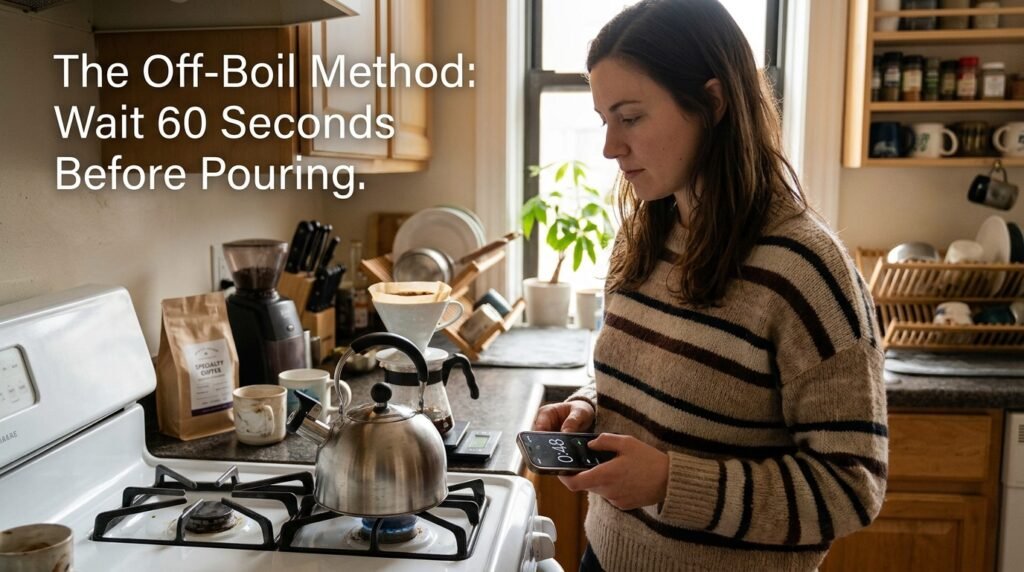
Now, when my cheap stovetop kettle reaches a boil, I simply pull it off the hot burner and let it sit on the counter for exactly sixty seconds. That single minute allows the water to naturally drop to a gentle, forgiving 200 degrees Fahrenheit. The scorching completely stopped, and the natural sweetness of the coffee finally survived the brew.
Tip Four: The Double Duty of the Rinse
When I finally started using paper filters for my pour-over, I committed a terrible, invisible error every single day.
I would put the dry paper filter into the glass cone, dump my coffee grounds in, and start brewing. My coffee always had a strange, dusty, cardboard-like aftertaste. Furthermore, my coffee was always lukewarm by the time I sat down to drink it.
I was completely ignoring the dual-purpose “Rinse and Heat” trick.
Paper filters are manufactured in massive factories. They are covered in microscopic paper dust. When you pour hot water over a dry filter, the very first thing that water extracts is the flavor of wet paper.
I wish someone had told me to rinse my filter. Now, before I add the coffee, I heavily saturate the empty paper filter with hot water from my kettle. It washes the paper taste completely down the drain.
But the real secret is where that rinse water goes.
I let that hot rinse water drain directly into my heavy ceramic mug. I let it sit there for thirty seconds while I grind my beans. This acts as a massive thermal pre-heater for the cold ceramic. Realizing how this protected the temperature of my beverage was a massive part of (The Small Changes That Made My Coffee Much Better).
When I finally dump the rinse water and brew my actual coffee, the liquid falls into a steaming hot mug. The ceramic doesn’t steal the heat, and my coffee stays hot for twenty minutes.
Tip Five: The Patience of the First Sip
The final tip I wish someone had given me is the absolute hardest one to practice, because it directly fights against our human desire for immediate gratification.
When you spend ten minutes meticulously grinding, weighing, and brewing a beautiful cup of coffee, the aroma fills your entire kitchen. Your brain is screaming at you to take a sip the exact second the last drop falls from the filter.
I used to drink my coffee immediately. And every single time, I felt disappointed. The coffee tasted like hot, bitter water. There was no complexity.
I wish someone had explained the biological limits of the human tongue to me earlier.
When a liquid is above 160 degrees Fahrenheit, the human palate goes into a defensive state of shock. The heat physically overwhelms your taste buds. Your brain cannot process sweet, fruity, or delicate floral notes when it is actively trying to prevent a burn. It only registers the heat and the bitter tannins.
If you want to taste the incredible flavors you paid for, you have to let the coffee cool down.
Now, when my coffee finishes brewing, I force myself to walk away. I leave the mug on the counter and I wait a mandatory five to eight minutes. I let the temperature drop to a comfortable 140 degrees.
As the coffee cools, it magically opens up. The aggressive bitterness fades away, and the sweet, complex sugars rush to the front of your palate. It is a completely different beverage.

Fix Your Posture
We spend so much time looking for the ultimate, expensive silver bullet to fix our morning coffee. We assume that the problem is our equipment, or our beans, or our lack of a professional culinary degree.
We keep lifting the heavy weights with terrible posture, wondering why our backs hurt.
But a perfect cup of coffee is not a luxury reserved for the elite. It is simply the result of avoiding a few highly common, highly destructive beginner mistakes.
I challenge you to implement these five tips tomorrow morning. Buy a cheap digital scale and turn your brain off. Give your brewer a gentle swirl to level the bed. Let your boiling water rest for sixty seconds before you pour. Rinse your paper filter, pre-heat your mug, and force yourself to wait five minutes before taking your first sip.
When you finally adjust your grip and fix your brewing posture, the pain of bitter, bad coffee will instantly vanish. The heavy weight of the morning routine will suddenly feel light, effortless, and flawlessly sweet.

My name is Daniel Carter, I am 35 years old, and I live in the United States. I have been passionate about aquariums for many years, and what started as a simple hobby quickly became a lifelong interest in aquatic life, fish behavior, and responsible tank care.
Through TheBrightLance, I share real experiences, practical knowledge, and honest lessons learned from maintaining different types of aquariums. I enjoy testing equipment, studying fish behavior, improving maintenance routines, and helping beginners avoid common mistakes.
My goal is to make aquarism easier, more ethical, and more enjoyable for everyone — whether you are setting up your very first tank or looking to refine your techniques.