
You cannot simply delete the text and leave a blank, white hole in the middle of the image. You have to act like a digital archaeologist. You have to carefully sample the surrounding pixels, study the lighting gradients, and painstakingly reconstruct the hidden background that the watermark was covering up.
You have to figure out the history of the image before the stamp was slapped over it.
For the vast majority of my adult life, my morning coffee was covered by a massive, impenetrable corporate watermark.
I bought my coffee in massive plastic tubs or vacuum-sealed foil bricks from the supermarket. The labels were covered in bright, flashy marketing buzzwords like “Premium Roast” and “Morning Blend.” I had absolutely no idea what was actually inside the container.
I treated coffee as a completely modern, faceless invention. I assumed it was just a dark brown powder engineered in a 20th-century factory to help office workers wake up for their morning commutes.
But when I finally decided to peel back that corporate label and look at the actual roots of the agricultural product I was drinking every single day, I was completely paralyzed by what I found.
Here is the honest, eye-opening story of why I started paying attention to coffee history, how uncovering the ancient, violent, and romantic past of this simple seed shattered my worldview, and how learning the history completely changed the physical taste of my morning mug.
The Erased Background
My ignorance regarding coffee history was not entirely my fault. The modern commercial coffee industry is specifically designed to erase the background of the bean.
When you walk into a fast-food drive-thru or a massive commercial grocery store, the marketing completely isolates the product from its agricultural reality. They do not want you to think about the dirt, the altitude, or the farmers. They just want you to associate their specific logo with a quick spike of caffeine.
I lived in this comfortable, ignorant bubble for years.
I drank bitter, stale coffee purely for the utility of it. I drowned it in artificial creamers and heavy spoonfuls of refined sugar. I never stopped to ask myself where the word “coffee” even came from, or how a tropical seed managed to find its way into my tiny apartment kitchen.
The first crack in this corporate illusion happened when I finally tasted a high-quality, lightly roasted specialty bean.
I took a sip of a single-origin Ethiopian coffee, and instead of harsh ash, I tasted vibrant blueberries and sweet jasmine flowers. The realization that a simple plant could produce such incredible, unadulterated flavor without any artificial additives was the exact premise of (What Nobody Told Me About Coffee Beans).
I realized I wasn’t drinking a factory product. I was drinking a botanical miracle. And I suddenly needed to know exactly how it got here.

The Sufi Monks and the Ancient Forests
As I began peeling back the layers of the watermark, my research immediately pulled me out of the modern world and dropped me directly into the ancient, high-altitude forests of the Ethiopian plateau.
I learned that coffee was not invented in a laboratory. It was discovered by accident.
While the legends of a goat herder named Kaldi are famous, the verifiable historical roots of coffee consumption lie with the Sufi monks of Yemen in the 15th century. These monks were deeply devoted to long, exhausting hours of nighttime prayer and spiritual chanting.
They needed a way to stay awake and maintain their focus through the dark hours of the night.
They discovered that by roasting and boiling the seeds of the Coffea arabica plant—which had been brought over from the wild forests of Ethiopia—they could create a dark, bitter tea that provided a profound sense of physical energy and mental clarity.
When I read this, I was sitting in my kitchen holding my ceramic mug. I looked down at the dark liquid.
I realized that the exact same chemical compound I was using to stay awake and edit digital photographs at two o’clock in the morning was the exact same compound ancient mystics used to communicate with the divine. The technological context had changed, but the human need for focus was exactly the same.
The Birth of the Public Square
As I continued to reconstruct the history of the bean, I learned that coffee did not stay quietly hidden in the monasteries for long.
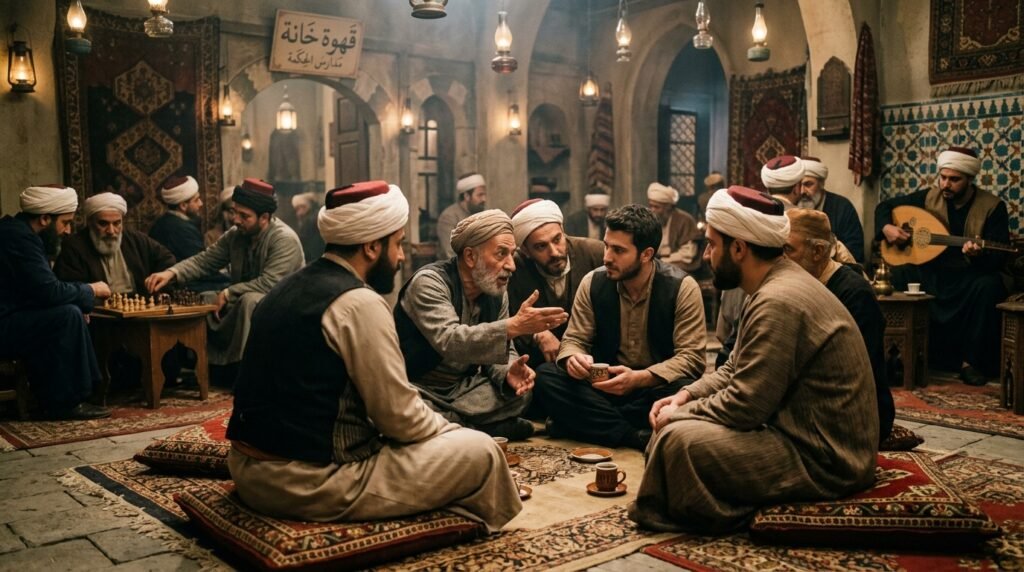
Because the drink was so physically stimulating, it quickly spilled out into the secular world. By the 16th century, the very first public coffeehouses—known as qahveh khaneh—began opening in the major cities of the Middle East, including Istanbul, Cairo, and Damascus.
These coffeehouses completely revolutionized human society.
Before coffee, the primary safe, pathogen-free beverage available to the public was weak beer or wine. People essentially spent their entire days in a mild state of intoxication.
When the coffeehouse was invented, it provided a public gathering space that promoted sharp, hyper-alert sobriety instead of dull drunkenness. These spaces became known as “Schools of the Wise.” Men would gather to listen to music, play chess, discuss philosophy, and most dangerously, debate politics.
They were so influential that rulers repeatedly tried to ban coffee entirely, fearing that the sharp, caffeinated conversations happening in these shops would spark political revolutions.
Immersing myself in the sheer social gravity of these ancient establishments is exactly (The First Time I Explored Coffee Culture Deeply), because it made me realize that the coffee shop has always been a theater for human connection.
The European Explosion and the Enlightenment
When the coffee bean finally made its way into Europe via Venetian trade routes in the 17th century, the historical narrative exploded.
The introduction of coffee to the European continent coincided perfectly with the Age of Enlightenment.
In cities like London and Paris, coffeehouses began popping up on every corner. They were famously dubbed “Penny Universities.” For the price of a single penny, a person could buy a cup of coffee and sit for hours, listening to the greatest writers, scientists, and philosophers of the era debate the nature of the universe.
Isaac Newton debated physics in coffeehouses. The French Revolution was plotted at the tables of Café de Procope in Paris. The London Stock Exchange literally began as a disorganized gathering of merchants shouting at each other inside Jonathan’s Coffee-House.
When I learned this, my perspective shifted entirely.
I realized that coffee was not just a passive background beverage. It was the active, liquid catalyst that sobered up the Western world, pulled it out of an alcoholic haze, and physically fueled the intellectual revolutions that shaped modern civilization.
The American Rebellion
As an American, the most fascinating piece of the historical puzzle was realizing how deeply coffee was tied to the foundational identity of my own country.
In the early colonial days of the Americas, tea was the undisputed beverage of choice, mirroring the deep cultural traditions of the British Empire. Coffee was present, but it was largely a secondary thought.
That all changed in 1773.
When the British government heavily taxed tea, the American colonists responded with the famous Boston Tea Party, throwing hundreds of chests of British tea into the harbor. Over the following months, drinking tea was suddenly viewed as an act of treason and unpatriotic loyalty to the Crown.
John Adams, who would later become the second President of the United States, famously wrote a letter to his wife Abigail declaring that he must break his tea-drinking habit, and that he would be drinking coffee instead.
Coffee became the official beverage of the American rebellion. It was the patriotic alternative.
It is staggering to think that a geopolitical tax dispute over three hundred years ago is the primary reason why there is a massive commercial coffee chain on nearly every single street corner in the United States today.
The Darker Shades of the Pixels
But as I reconstructed the full historical image, I also had to confront the darker, heavier shadows that the corporate watermark had been hiding.
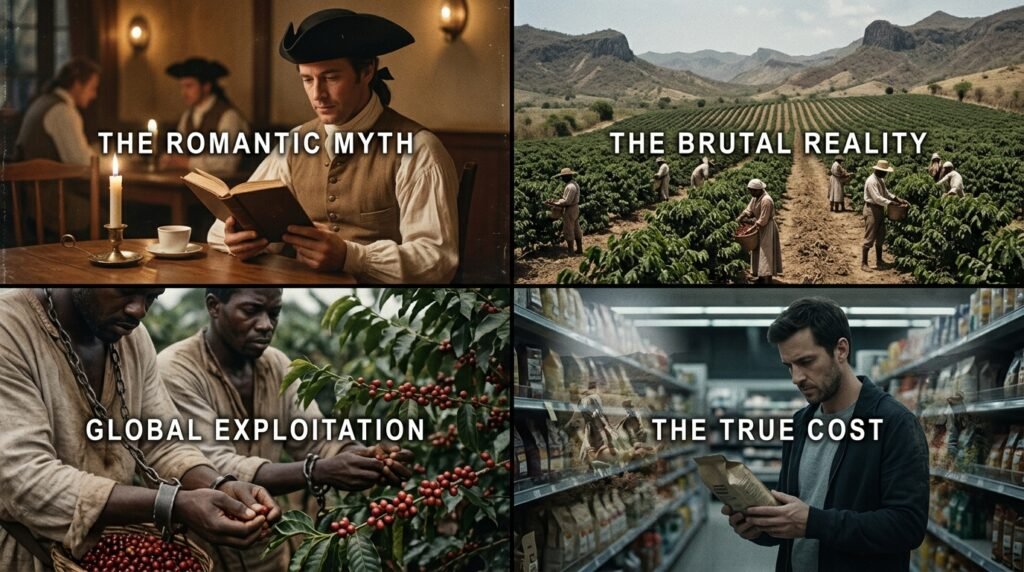
The story of coffee is not just a romantic tale of monks and philosophers. It is also a deeply violent story of colonial expansion and human exploitation.
When the European powers realized how massively profitable the coffee trade was, they aggressively ripped the plant from its origins and forced it to grow in their tropical colonies. The Dutch took it to Indonesia. The French took it to the Caribbean. The Portuguese took it to Brazil.
To fuel this massive global expansion and feed the caffeine addiction of the Western world, these colonial powers relied heavily on the brutal system of enslaved human labor.
Understanding this grim reality completely changed how I look at a cheap, two-dollar bag of supermarket coffee.
You cannot separate the modern luxury of the beverage from the immense human suffering that originally built the global supply chain. Acknowledging this heavy, complex legacy was the defining moment of (The Moment I Realized Coffee Is a Global Experience). I learned that to truly respect the bean, you must acknowledge the entirety of its history, both the light and the dark.
The Weight of the Morning Routine
When you finally take the time to learn the history of coffee, it becomes physically impossible to drink it thoughtlessly.
Before this realization, my morning routine was an irritating chore. I would angrily grind the beans and rush the pour, just wanting to get the caffeine into my bloodstream as quickly as possible.
But now, when I stand in my kitchen, I feel a profound sense of historical weight.
When I hold a handful of raw, whole beans, I am holding the direct descendants of the seeds that were smuggled out of Yemen strapped to the chest of a Sufi saint. I am holding the descendant of the single tree that King Louis XIV kept locked in a Parisian greenhouse.
I am participating in a ritual that spans centuries, oceans, and empires.
A Call to Remove the Watermark
We live in a hyper-convenient society that encourages us to consume products without ever asking where they came from. We want our coffee fast, hot, and cheap.
But that convenience comes at the cost of our connection to the physical world.
If your coffee currently feels like a boring, utilitarian routine, I challenge you to do some digital archaeology. Look past the bright corporate logo on the bag.
Buy a bag of specialty coffee from a local roaster. Look at the name of the country printed on the label. Take ten minutes to read about the history of coffee cultivation in that specific region. Read about the farmers, the altitude, and the centuries of tradition that exist in that dirt.
When you finally remove the corporate watermark and see the raw, unedited history of the agricultural product sitting in your kitchen, your entire perspective will shift.
You will no longer be drinking a factory product. You will be drinking a time machine. You will taste the revolutions, the poetry, the ancient forests, and the epic human journey that eventually ended right inside your favorite ceramic mug.
My name is Daniel Carter, I am 35 years old, and I live in the United States. I have been passionate about aquariums for many years, and what started as a simple hobby quickly became a lifelong interest in aquatic life, fish behavior, and responsible tank care.
Through TheBrightLance, I share real experiences, practical knowledge, and honest lessons learned from maintaining different types of aquariums. I enjoy testing equipment, studying fish behavior, improving maintenance routines, and helping beginners avoid common mistakes.
My goal is to make aquarism easier, more ethical, and more enjoyable for everyone — whether you are setting up your very first tank or looking to refine your techniques.