
When you look at raw, unedited LOG footage directly out of a high-end camera, it looks absolutely terrible. It is completely flat. It is grayish, washed out, and entirely devoid of contrast or color. It looks lifeless.
But the camera shoots it that way on purpose to preserve the maximum amount of digital data.
The real magic happens in the editing room during the “color grading” process. When you apply a specific color profile—a Look-Up Table, or LUT—to that flat, gray footage, the emotional context of the scene completely transforms.
If you push the shadows into a deep, cold blue and desaturate the highlights, the scene suddenly feels like a tense, modern thriller. If you push the mid-tones into a warm, heavy orange and crush the blacks, that exact same piece of raw footage suddenly feels like a nostalgic, romantic memory.
The raw data never changed. The only thing that changed was the cultural, emotional lens applied over it.
For the first decade of my coffee-drinking life, I did not understand that coffee operates on this exact same principle. The roasted coffee bean is the raw, flat LOG footage. It is a universal agricultural commodity.
But the way it is brewed, served, and consumed—the cultural “color grade” applied to it—completely changes its meaning, its purpose, and its soul.
Here is the honest, highly observant story of why coffee is so important in different cultures, how the exact same seed is used to communicate entirely different human emotions across the globe, and how applying these different lenses completely changed my own daily routine.
The Western Filter: The Cold, Blue Thriller
To understand the global tapestry of coffee, I first had to critically examine my own default cultural lens.
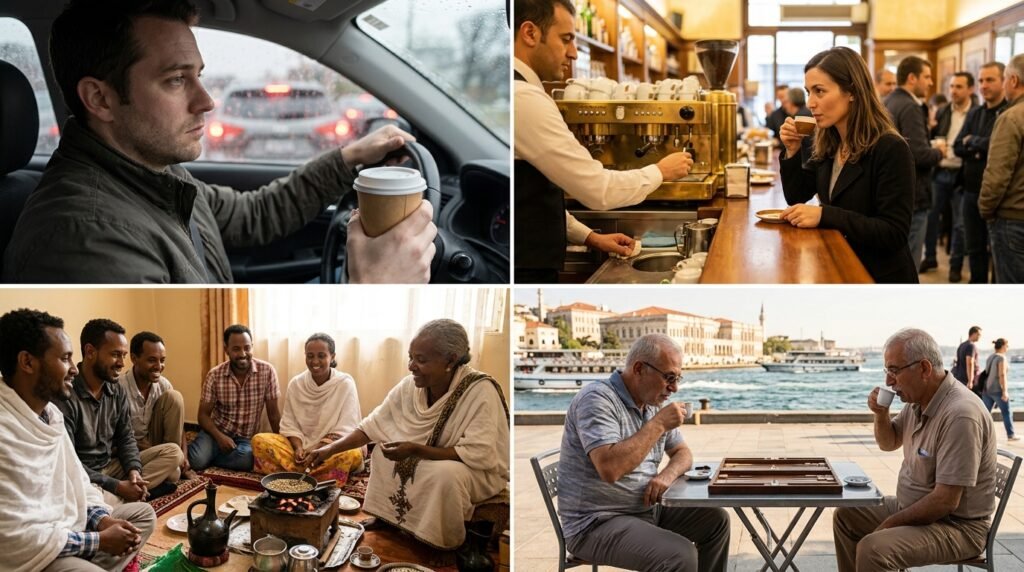
In the United States and much of the fast-paced Western world, coffee is color-graded like a high-tension action movie. It is cold, fast, and entirely utilitarian.
We treat coffee as a biological override. We brew it in massive, sputtering plastic drip machines. We pour it into disposable, insulated paper cups with plastic lids. We consume it in the drive-thru lane while gripping the steering wheel, or we drink it at our desks while staring at stressful spreadsheets.
In this specific culture, coffee is not a beverage to be enjoyed; it is an industrial tool. It is the fuel required to survive the relentless machine of modern capitalism.
I lived in this cold, blue filter for years. I drank bitter, stale coffee purely for the caffeine spike. But when I finally began exploring the history of the bean, I realized that my own utilitarian view was actually an anomaly.
Expanding my perspective beyond the American drive-thru was the exact catalyst for (What I Learned About Coffee Culture Around the World). I suddenly realized that the rest of the planet was treating this agricultural product with a level of reverence I could not comprehend.
The Italian Filter: The Democratic Spark
If you apply the Italian color grade to the exact same coffee bean, the scene changes from a solitary, stressful commute to a loud, vibrant, communal theater.
In Italy, the concept of a massive, 16-ounce cup of coffee to-go is practically non-existent. The Italian coffee culture is built entirely around the “Bar,” and it is defined by speed, accessibility, and intense socialization.
In cities like Rome, Florence, or Naples, coffee is considered a fundamental democratic right. It is not a luxury reserved for the wealthy.
You walk into a local bar multiple times a day. You do not bring a laptop, and you do not sit down. You stand shoulder-to-shoulder with strangers at a long, polished zinc or marble counter.
You order un caffè (a single shot of espresso). The barista pulls the dark, heavy, crema-topped liquid in twenty-five seconds. You add a packet of sugar, stir it once, and drink the entire thing in three quick sips.
The interaction is loud, chaotic, and beautiful. You exchange a quick joke with the barista, leave a one-euro coin on the counter, and walk back out into the sun.
In Italy, coffee is the great social equalizer. The CEO in a tailored suit and the construction worker in a dusty uniform stand at the exact same counter, drinking the exact same espresso. It is a shared, electric pulse that keeps the entire community moving to the same rhythm.
The Ethiopian Filter: The Golden Hour Epic
If you travel to the birthplace of the coffee plant, the high-altitude forests of Ethiopia, the color grade shifts into a warm, slow, sprawling epic.
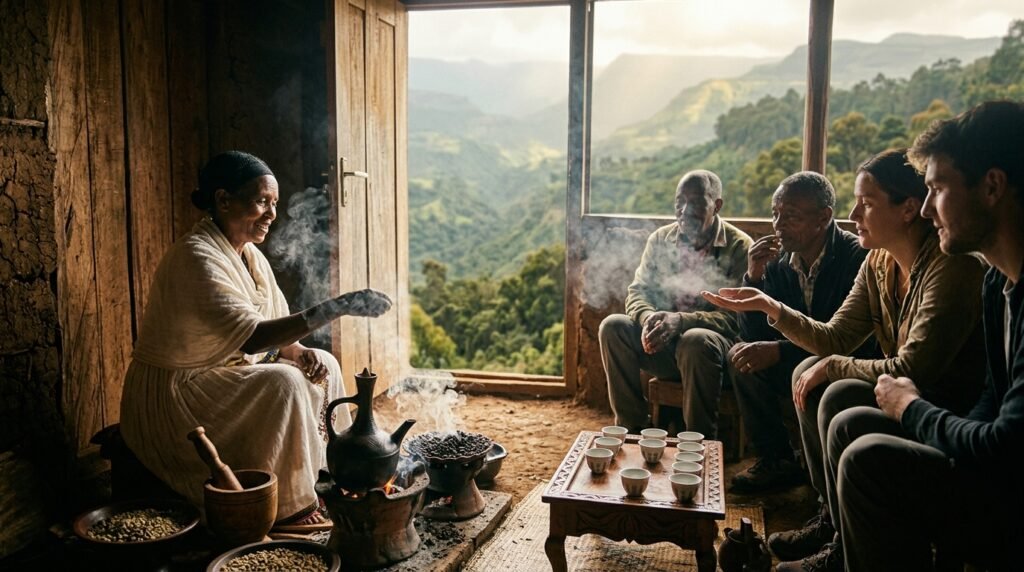
In Ethiopia, coffee is not a quick shot of energy. It is the absolute centerpiece of hospitality, family, and community life. The Ethiopian coffee ceremony is a daily ritual that can take up to three hours to complete, and it demands absolute patience.
It is a sensory masterpiece from start to finish.
The ritual begins with raw, green coffee seeds. The host washes the seeds and roasts them in a flat metal pan over a small, open charcoal fire directly in the living room. As the beans turn dark and oily, the host walks around the room, wafting the intense, heavy smoke toward the guests so they can appreciate the aroma.
The freshly roasted beans are then crushed by hand using a wooden mortar and pestle. The grounds are boiled in a traditional clay pot with a long, elegant neck, known as a jebena.
The coffee is poured from high above into tiny, handle-less cups. It is served in three distinct rounds. The first round is heavy and strong. The second is milder. The third round is considered a blessing.
You cannot rush this process. To leave before the third cup is poured is considered a deep insult to the host.
Experiencing the heavy, emotional weight of this ancient ceremony perfectly mirrors (The First Time I Explored Coffee Culture Deeply), because it forced me to confront my own impatience and learn how to actually sit still.
The Japanese Filter: The Meticulous Art Film
When I look at the incredibly complex, flawless shading of a traditional Japanese tattoo, or the pristine layout of a Kyoto rock garden, I see a culture deeply committed to absolute mastery.
That exact same philosophy of uncompromising precision is applied to their coffee culture, specifically in the traditional, old-school cafes known as Kissaten.
A Kissaten is the antithesis of a loud, bright American chain store. They are often dark, moody, and deeply quiet. They feature heavy wooden furniture, antique porcelain cups, and the soft, crackling sound of vintage jazz playing on vinyl records.
In a Kissaten, the coffee master does not use an automated machine with flashing lights. They rely entirely on slow, meticulous, manual brewing methods that look like 19th-century chemistry experiments.
They might use a complex glass vacuum siphon, where water boils and magically rises into an upper chamber. Or they might use the Nel Drip, a method that uses a thick, reusable cotton flannel cloth suspended on a wire hoop.
The master pours a thread-thin stream of hot water over heavily roasted coffee grounds. They stand perfectly still, executing a flawless flow rate for five or six agonizingly slow minutes.
The resulting liquid is thick, intense, and profoundly complex. In Japan, coffee is not just a drink; it is an artisan discipline. It is a medium for a master to express their lifelong dedication to their craft, and the patron consumes it in quiet, respectful reverence.
The Nordic Filter: The Mandatory Pause
If you travel to the freezing, dark winters of Scandinavia, specifically Sweden and Finland, you will find populations that consume more coffee per capita than anyone else on earth.
But the cultural filter applied here is deeply rooted in mental health and psychological survival.
In Sweden, they have a cultural institution known as Fika. It loosely translates to “having coffee and a sweet treat,” but it is a mandatory, non-negotiable part of the daily social contract.
In Swedish workplaces, productivity is entirely paused twice a day. At mid-morning and mid-afternoon, everyone steps away from their computer monitors. They leave their desks, gather in a communal break room, and pour a cup of hot, black filter coffee.
They eat a cinnamon bun. They talk to their colleagues about their lives, not about their spreadsheets.
Fika is an acknowledgment that human beings are not robots. The coffee provides the physical warmth needed to combat the freezing winter outside, but the ritual provides the emotional warmth needed to combat the isolation of the modern workday.
The Turkish Filter: Destiny and Mysticism
Finally, if you travel to the Middle East, into countries like Turkey or Lebanon, the color grade shifts into deep, mystical, heavy shadows.
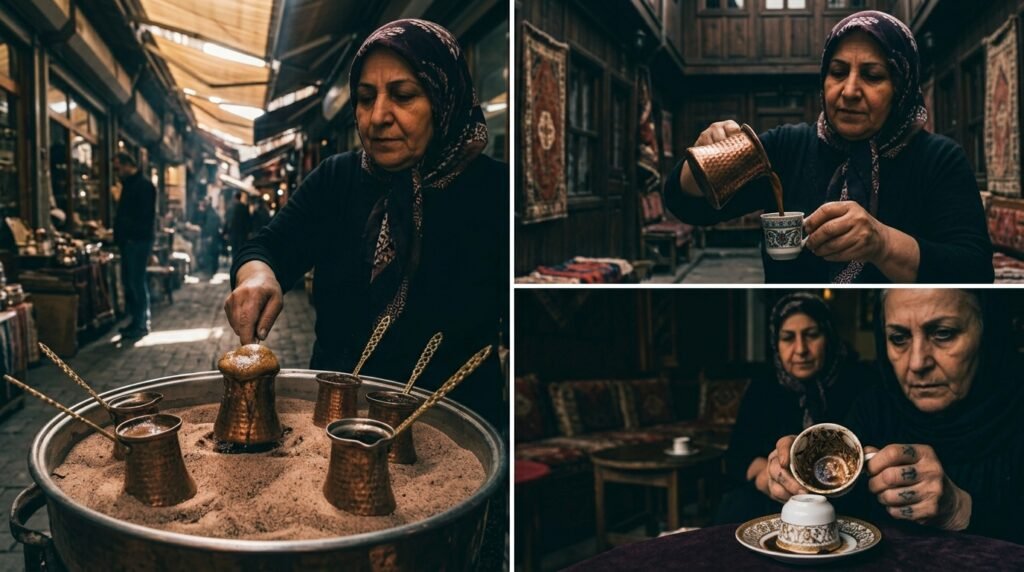
Here, coffee is intertwined with deep hospitality and ancient tradition. They do not filter their coffee. They grind the beans into a microscopic, flour-like powder.
They place the powder, along with water and sugar, into a small brass or copper pot called a cezve. The pot is buried in a bed of hot sand or placed directly over a flame. The coffee foams up violently, almost boiling over, before it is pulled away.
It is poured directly into a tiny, ornate cup. Because it is unfiltered, you must wait for the thick, muddy grounds to settle to the bottom before you take a careful sip. The liquid is incredibly thick, syrupy, and often heavily spiced with cardamom.
But the most incredible part of this culture happens when the cup is empty.
Because the thick mud is left at the bottom, a tradition of fortune-telling emerged. The drinker flips the cup upside down onto the saucer. Once it cools, a reader interprets the chaotic, abstract shapes left behind by the coffee grounds to divine the drinker’s future.
In this culture, the coffee bean literally dictates destiny. It is a bridge between the physical world and the spiritual one.
Editing Your Own Routine
When I finally understood this massive, diverse global tapestry, my own kitchen felt incredibly boring.
I realized that by treating coffee as a purely functional drug, I was leaving so much human experience on the table. I was shooting in flat LOG footage and refusing to color-grade the final image.
The realization that a simple agricultural seed can be used to forge such deep, emotional bonds perfectly illustrates (Why Coffee Brings People Together). It is a universal language with a thousand different dialects.
I decided to stop drinking coffee the same way every single day. I started applying different cultural filters to my own life.
If I am working on a complex digital edit and I feel the isolation creeping in, I channel the Nordic Fika. I close my laptop, walk into the kitchen, brew a French Press, and force myself to eat a pastry in silence for fifteen minutes.
If I buy an expensive, rare bag of single-origin beans, I channel the Japanese Kissaten. I pull out my glass V60, I use my digital scale, and I focus entirely on the physical perfection of the pour, treating the water like a precision instrument.
And if a friend comes over to visit, I channel the Ethiopian spirit. I do not rush the process. I let the smell of the freshly ground beans fill the apartment, using the brewing time as an excuse to stand together and talk.
The Masterpiece in the Mug
We live in a world that constantly tries to standardize everything. We are told to optimize our time, automate our routines, and consume our calories as efficiently as possible.
Coffee is one of the few things left on earth that actively resists that standardization.
The exact same roasted bean that fuels a frantic Wall Street trader is currently being boiled in a clay pot over a fire in an African village, and is simultaneously being poured through a glass siphon in a quiet cafe in Kyoto.
The next time you make a cup of coffee, I challenge you to think about the cultural filter you are applying to it. Are you rushing it? Are you drinking it out of a paper cup while staring at your phone?
Try changing the grade. Pre-heat a heavy ceramic mug. Slow down your kettle. Share the pot with someone else. When you finally allow the coffee to become an experience rather than a transaction, you will realize why this tiny seed managed to conquer the entire globe.
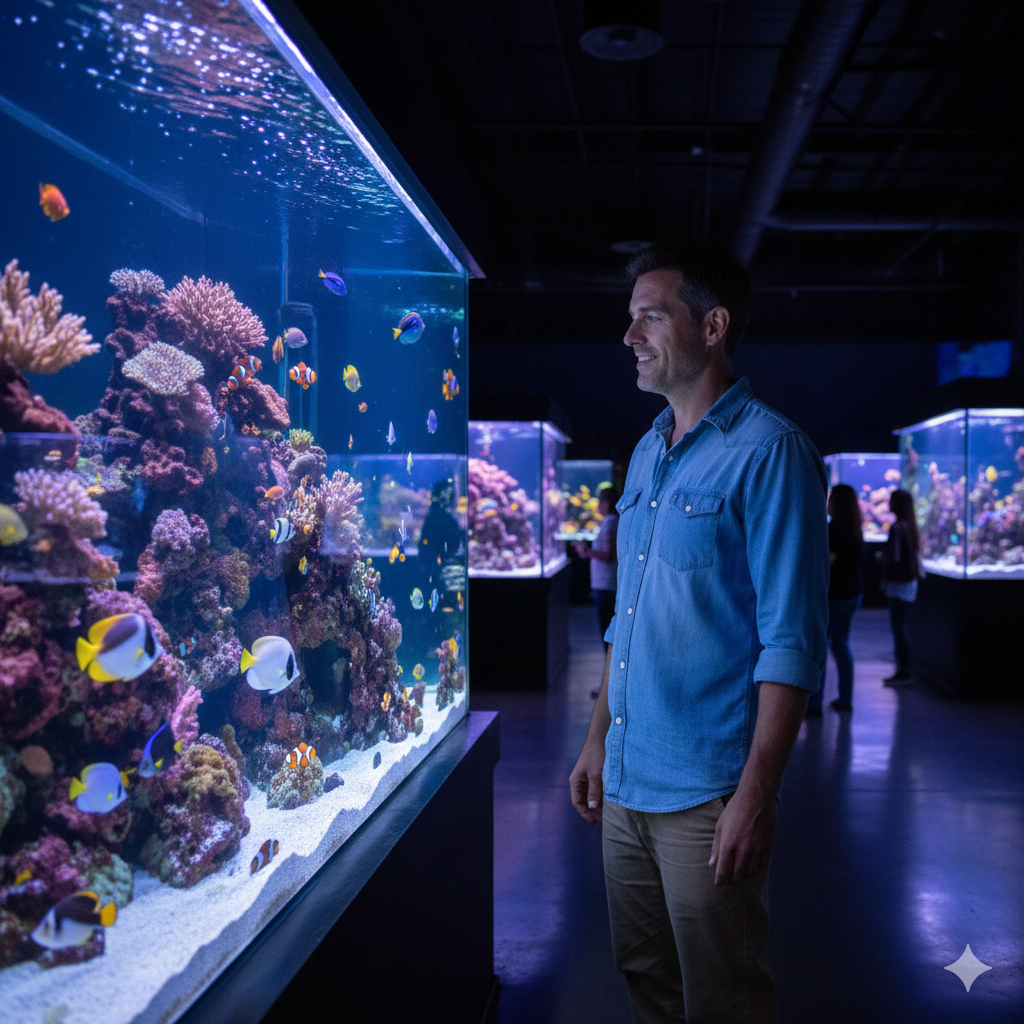
My name is Daniel Carter, I am 35 years old, and I live in the United States. I have been passionate about aquariums for many years, and what started as a simple hobby quickly became a lifelong interest in aquatic life, fish behavior, and responsible tank care.
Through TheBrightLance, I share real experiences, practical knowledge, and honest lessons learned from maintaining different types of aquariums. I enjoy testing equipment, studying fish behavior, improving maintenance routines, and helping beginners avoid common mistakes.
My goal is to make aquarism easier, more ethical, and more enjoyable for everyone — whether you are setting up your very first tank or looking to refine your techniques.